


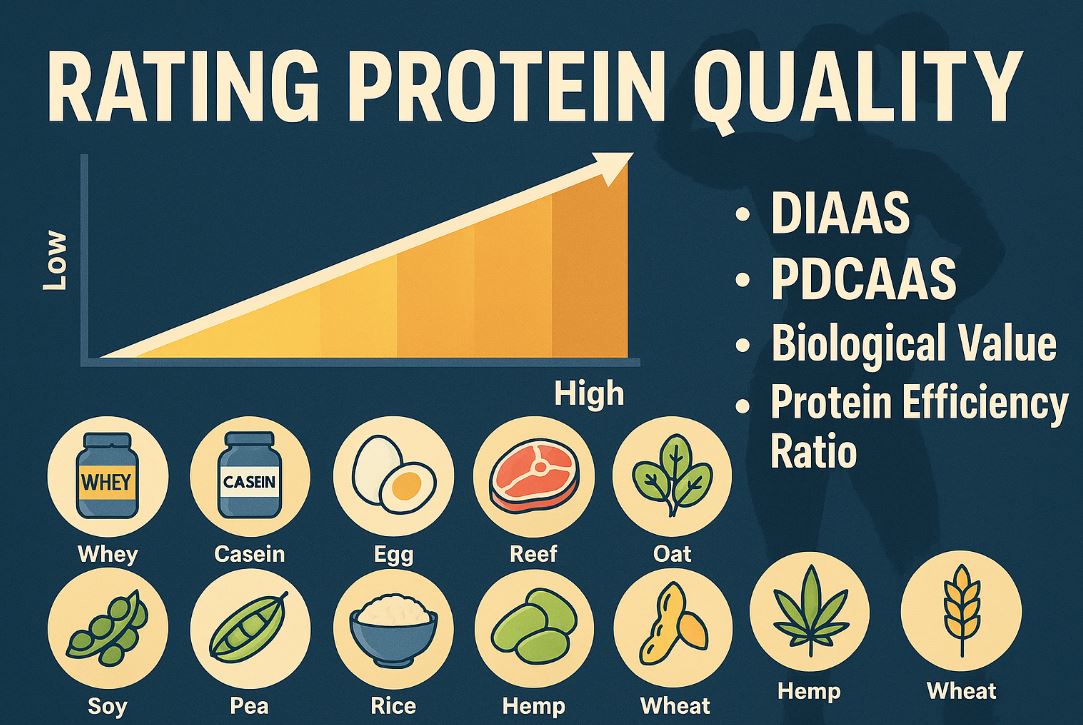
How to Evaluate Protein Quality: DIAAS, PDCAAS, and What They Mean for Your Gains
🏋️ Introduction
Not all proteins are created equal. For anyone serious about muscle growth, recovery, or optimizing nutrition, understanding protein quality rating is essential. Whether you’re choosing a post-workout shake or planning a high-protein meal, knowing how different proteins rank — and why — can make a real difference in your fitness results. In this guide, we’ll decode the most important methods used to measure protein quality and help you choose the best source for your goals.
📌 What Is Protein Quality and Why Does It Matter for Athletes
Protein quality refers to how effectively a protein provides the essential amino acids your body needs — and how efficiently your body can digest and utilize them.
For athletes and bodybuilders, high-quality protein means:
- More efficient muscle repair and growth
- Better nitrogen retention
- Faster recovery post-training
- Less waste and digestive stress
Your body doesn’t store protein the way it does fat or carbs. So, quality matters just as much as quantity.
📌 Protein Quality Measurement Methods (Explained)
Protein quality can be measured in many ways — from how digestible the protein is, to how well it supports muscle growth. Let’s explore the key metrics.
✅ 1. PDCAAS (Protein Digestibility-Corrected Amino Acid Score)
PDCAAS has been the industry standard for years. It combines the amino acid profile of a protein with its digestibility in the body. However, it caps scores at 1.0, meaning it doesn’t distinguish between proteins that are great and those that are outstanding.
Examples:
- Whey = 1.0
- Soy = 1.0
- Wheat = 0.42
Drawbacks:
- Doesn’t account for some types of fiber-bound amino acids
- Treats anything above 1.0 as “equal”
✅ 2. DIAAS (Digestible Indispensable Amino Acid Score)
This newer method, recommended by the FAO, offers a more accurate way to assess protein quality by measuring the true ileal digestibility of each essential amino acid individually. True ileal digestibility refers to the precise measurement of how much of each essential amino acid is absorbed in the small intestine, specifically before reaching the large intestine. This method ensures that only the amino acids actually available for muscle building and repair are counted, making it far more accurate than older fecal-based methods.
Examples:
- Whey: 1.25
- Egg: 1.18
- Soy: 0.91
- Rice: 0.66
- Wheat: 0.45
Advantages:
- Doesn’t cap the score
- More relevant to human digestion
- Highlights subtle differences between high-end protein sources
✅ 3. BV (Biological Value)
BV looks at how efficiently your body uses absorbed protein to build tissues. A higher BV means more of the protein ends up in muscle, rather than being excreted.
Examples:
- Whole egg: 100
- Whey: up to 159
- Casein: 77
- Soy: 74
Good to know:
While BV is helpful, it doesn’t account for digestibility limits or amino acid ratios.
✅ 4. PER (Protein Efficiency Ratio)
An older method, PER, measures how much weight gain an animal (usually a rat) experiences from a given amount of protein.
Examples:
- Casein: 2.5
- Whey: 3.2
Limitations:
- Based on animal models
- Not directly applicable to human metabolism
✅ 5. NPU (Net Protein Utilization)
NPU tells you what percentage of the ingested protein is actually retained in the body (as tissue, not waste). It reflects both digestibility and amino acid utilization.
Examples:
- Whole egg: 94%
- Milk: 85%
- Soy: 61%
This score is particularly helpful when comparing animal vs. plant proteins.
✅ 6. AAS (Amino Acid Score)
This simple method compares the essential amino acid content of a protein to human amino acid requirements.
If a protein lacks sufficient amounts of any one essential amino acid (called a “limiting amino acid”), its score drops significantly.
AAS is the basis for PDCAAS, but it doesn’t account for digestibility.
✅ 7. Protein Absorption Rate
This measures how fast your body digests and absorbs the protein, which can affect when you should consume it.
Absorption speeds (grams/hour):
- Whey: ~10 g/h
- Egg: ~3 g/h
- Casein: ~6 g/h
Fast-digesting proteins like whey are ideal post-workout, while slow proteins like casein are better before bed.
📊 Protein Quality Comparison Table
When it comes to choosing the right protein, numbers can speak louder than marketing claims. The table below compares the most common protein sources based on several key quality metrics — including DIAAS, PDCAAS, Biological Value, and more — to help you see how they truly stack up.
| Protein Source | DIAAS | PDCAAS | BV | NPU | PER | Absorption Rate |
|---|---|---|---|---|---|---|
| Whey | 1.25 | 1.00 | 104–159 | ~92% | 3.2 | Fast (~10 g/h) |
| Egg | 1.18 | 1.00 | 100 | 94% | 3.9 | Medium (~3 g/h) |
| Casein | 1.08 | 1.00 | 77 | 84% | 2.5 | Slow (~6 g/h) |
| Soy | 0.91 | 1.00 | 74 | 61% | 2.2 | Medium |
| Pea | 0.82 | 0.89 | ~65 | ~50% | 1.8 | Medium |
| Rice | 0.66 | 0.47 | ~59 | ~51% | 1.5 | Medium |
| Wheat | 0.45 | 0.42 | 54 | ~45% | 1.4 | Medium |
| Hemp | ~0.50 | ~0.46 | ~50 | ~40% | ~1.2 | Medium |
| Beef | 1.10 | 0.92 | 80 | ~78% | 2.9 | Medium-Slow |
| Oat | ~0.56 | ~0.57 | ~58 | ~52% | ~1.6 | Medium |
As the comparison shows, animal-based proteins like whey, egg, and casein consistently outperform plant-based options across most quality indicators. However, with smart combinations, plant proteins can still be highly effective, especially when digestibility and amino acid completeness are taken into account.
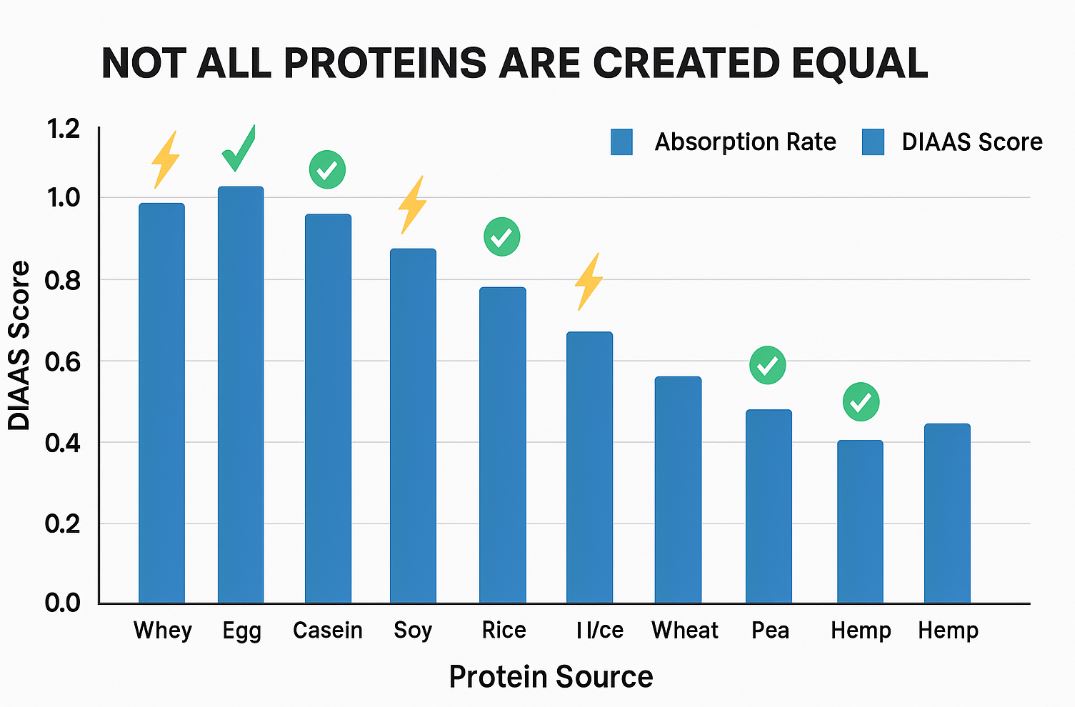
💪 Best Protein Sources According to DIAAS
If you’re serious about maximizing muscle gains and recovery, understanding the protein quality rating of your chosen sources is essential, and DIAAS provides the most reliable framework to evaluate it.
Here’s how the top contenders rank when it comes to both quality and practical application:
🥇 Whey Protein
- Outstanding DIAAS and BV values (often over 1.2)
- Rapid digestion makes it perfect for post-workout recovery
- Contains all essential amino acids in optimal ratios
- One of the most complete and efficient protein sources available
🥈 Egg Protein
- Long considered the gold standard in protein quality
- High in bioavailable amino acids and excellent BV (~100)
- Slower absorption than whey, but ideal for sustained release
- Suitable for any time of day, with minimal allergens
🥉 Casein Protein
- Slower-digesting protein with a high DIAAS and solid BV
- Ideal before bed or during long periods without food
- Provides a steady release of amino acids, supporting overnight recovery
🌱 Best Plant-Based Combinations
While individual plant proteins may score lower on the protein quality rating scale, strategic combinations can significantly enhance their effectiveness:
- Pea + Rice → Complements lysine and methionine deficiencies for a balanced EAA profile
- Soy + Oat → Improves amino acid completeness while offering better texture and digestibility
- Blended vegan proteins are specially formulated to boost DIAAS scores and provide muscle-supporting amino acids comparable to some animal-based sources
For athletes on plant-based diets, paying attention to amino acid balance and digestibility is crucial to overcoming limitations shown in traditional rating systems like PDCAAS or AAS.
Compare the best vegan protein powders for women before you buy — tested for taste, texture, and real recovery results. Your next favorite shake is just one click away.
Compare Top Vegan Proteins🎯 Using DIAAS to Pursue Excellence in Your Nutrition
The protein quality rating of your food and supplements can make a significant difference in how effectively your body builds and repairs muscle. While grams of protein are easy to count, quality often goes unnoticed, and that’s where DIAAS stands out.
Unlike outdated scoring systems, DIAAS provides a more accurate picture by evaluating how much of each essential amino acid is truly absorbed where it matters: in the small intestine. This allows you to choose protein sources that deliver real value to your body, not just numbers on a label.
For example, consuming 30 grams of whey protein with a high DIAAS (1.25) offers far greater anabolic potential than the same amount of wheat protein with a low DIAAS (0.45). By prioritizing proteins with superior protein quality ratings, you ensure that every gram you consume contributes meaningfully to your goals — whether that’s muscle gain, fat loss, or athletic recovery.
Ultimately, excellence in nutrition isn’t about eating more — it’s about eating smarter.
🧠 Coach’s Tip: Quality Over Quantity “When my clients hit a plateau, I don’t just ask how much protein they’re eating — I ask what kind. Switching from a low-scoring plant isolate to a high-DIAAS source like whey isolate or a smart plant blend can dramatically improve recovery and lean mass gains. Don’t waste your macros — upgrade them.”
✅ Practical Advice for Choosing the Right Protein
- 🏋️ Post-workout? Go with fast-absorbing, high-DIAAS sources like whey or egg.
- 🌙 Before bed? Use casein or egg for slow release.
- 🌱 Vegan? Mix complementary plant proteins (like rice + pea)
- 💰 On a budget? Focus on quality per gram, not just price per tub.
Remember: It’s not just about “more protein.” It’s about the right protein.
🧠 Conclusion — Choose Smart, Fuel Hard
Protein quality rating is more than just science — it’s a powerful tool to guide your nutrition. Whether you’re bulking, cutting, or just trying to stay fit, choosing proteins with high DIAAS, BV, and digestibility ensures your body gets what it needs, when it needs it.
Don’t just count protein grams. Rate them. Compare them. Upgrade them.
✅ Key Takeaways
- Protein quality rating is essential for understanding how effectively a protein supports muscle growth and recovery; not all proteins are equally useful to the body.
- DIAAS is the most accurate and modern method for evaluating protein quality, measuring true ileal digestibility of each essential amino acid.
- PDCAAS, while still commonly used, is outdated because it caps scores at 1.0 and doesn’t account for individual amino acid bioavailability.
- Biological Value (BV) and Net Protein Utilization (NPU) help assess how well the absorbed protein is actually used in tissue synthesis.
- Amino Acid Score (AAS) identifies limiting amino acids but does not reflect digestibility, making it incomplete on its own.
- Animal-based proteins like whey, egg, and casein consistently score highest across all protein quality rating methods.
- Plant-based proteins tend to score lower individually, but smart combinations (e.g., pea + rice) can raise their overall effectiveness.
- Protein absorption rate plays a key role in nutrient timing — fast proteins like whey are ideal post-workout, while slower ones like casein suit overnight recovery.
- Choosing protein based solely on grams or marketing labels can lead to suboptimal results — quality always trumps quantity.
- To get the most out of your nutrition, look beyond the label and use protein quality ratings (especially DIAAS) to guide your choices.
What is the best method to evaluate protein quality?
The most accurate method today is DIAAS (Digestible Indispensable Amino Acid Score). Unlike PDCAAS, it measures individual amino acid digestibility at the ileal level, offering a detailed protein quality rating that directly reflects muscle-building potential.
Why is DIAAS better than PDCAAS for athletes?
DIAAS doesn’t cap scores at 1.0 and evaluates amino acid absorption where it matters most — in the small intestine. This makes it more relevant for athletes who rely on precision nutrition to maximize performance, muscle repair, and hypertrophy.
Which protein has the highest DIAAS score?
Whey protein isolate often scores over 1.2 on the DIAAS scale, making it one of the highest-quality proteins available for muscle synthesis, recovery, and bioavailability.
Can you build muscle with plant proteins if they have low DIAAS scores?
Yes — but only with strategic combinations. For example, combining pea and rice protein balances limiting amino acids and raises the overall protein quality rating. Many vegan blends are designed specifically to improve DIAAS performance.
What is Biological Value (BV) and is it still relevant?
BV measures how efficiently absorbed protein is used for tissue synthesis. While it's less precise than DIAAS, it's still a helpful indicator — egg protein scores 100, making it a biological benchmark.
What’s the difference between DIAAS and AAS?
AAS (Amino Acid Score) evaluates amino acid content only, without considering digestibility. DIAAS, on the other hand, factors in both content and actual absorption, making it a superior measure for anyone seeking muscle growth and nutrient optimization.
Should I choose protein based on DIAAS for post-workout nutrition?
Absolutely. After training, your body demands rapidly absorbed, high-quality protein. Whey, with its fast absorption rate and top-tier DIAAS score, is ideal. Avoid low-DIAAS proteins during this window, as they’re less effective for recovery.
Is casein protein good even though it digests slowly?
Yes. Casein has a high DIAAS and excellent nitrogen retention. Its slow release of amino acids makes it perfect for overnight muscle repair and reducing muscle breakdown during fasting periods.
How does protein absorption rate affect performance?
Absorption rate influences timing. Fast proteins like whey spike amino acids in the bloodstream quickly, ideal post-workout. Slow proteins like casein deliver a sustained release, better for prolonged anabolic support. Pairing both strategically enhances results.
Do food labels show DIAAS scores?
No — most labels don’t list DIAAS. However, you can use scientific data or charts (like the one in this article) to guide your choices. Knowing the protein quality rating helps you look beyond labels and make performance-based decisions.
