



Introduction
Muscle recovery nutrition is one of those topics everyone thinks they understand—until progress stalls. Many people train consistently, push hard in the gym, and even drink a post-workout shake, yet still deal with soreness that lingers, declining performance, or a feeling that their body never fully “bounces back.”
The problem is not effort. It’s an incomplete understanding.
Most people reduce muscle recovery nutrition to a single moment: what they eat or drink right after exercise. In reality, recovery is not an event—it’s a process. What you eat before training, immediately after, and throughout the next 24 to 48 hours influences how well your muscles repair, adapt, and grow stronger.
This confusion is made worse by fitness marketing. One product promises to “speed up recovery,” another claims to “maximize the anabolic window,” and suddenly nutrition feels like a checklist of powders and timing rules instead of a practical system that supports training.
This article exists to simplify that system.
From a coaching perspective, muscle recovery nutrition is not about perfection, expensive supplements, or chasing tiny physiological advantages. It’s about consistently giving your body what it needs to repair tissue, restore energy, and prepare for the next training session—without turning nutrition into another source of stress.
In the sections that follow, you’ll learn precisely what muscle recovery nutrition is, when recovery actually happens, why it matters more than most people realize, and how to apply it in real life—whether your goal is strength, fat loss, endurance, or long-term fitness.
What Is Muscle Recovery Nutrition?
Muscle recovery nutrition refers to the planned intake of nutrients that support muscle repair, energy restoration, and overall recovery after training. Its purpose is not just to reduce soreness, but to ensure that training stress leads to adaptation instead of fatigue, stagnation, or injury.
Every workout places stress on the body. Resistance training creates mechanical tension and micro-damage to muscle fibers, cardio depletes glycogen and fluids, and intense sessions tax the nervous system. Muscle recovery nutrition provides the building blocks your body needs to respond to that stress effectively. Without it, even the best training program eventually stops working.
Importantly, recovery nutrition is not a single meal or shake, but a process that unfolds over time.
Muscle Recovery Starts Before You Leave the Gym
Muscle recovery begins the moment training ends—but it doesn’t finish there.
During exercise, your body experiences:
- Mechanical stress (muscle fiber tension and micro-tears),
- Metabolic stress (glycogen depletion, byproducts like lactate),
- Nervous system stress (especially during heavy or high-intensity work).
Recovery nutrition supports all three. Protein supplies amino acids for tissue repair, carbohydrates restore depleted energy stores, and fluids and electrolytes normalize physiological function. This process continues for hours—and often days—after the workout.
From a coaching perspective, this is where many people go wrong. They treat recovery as an afterthought, focusing only on training intensity while ignoring the nutritional support required to recover from it.
Is Muscle Recovery Nutrition Just Post-Workout Nutrition?
Post-workout nutrition is important—but it’s only part of the picture.
There’s a difference between:
- Post-workout feeding: the first intake of nutrients after training,
- The 24–48 hour recovery window: the period during which muscles continue repairing, glycogen is fully restored, and adaptation occurs.
Many people overestimate the so-called “anabolic window,” believing that if they don’t consume nutrients immediately after training, recovery is lost. In reality, the body is responsive to nutrients for many hours after exercise. Total intake, timing across the day, and consistency matter far more than rushing a shake within minutes.
Muscle recovery nutrition works best when post-workout intake fits into a well-structured daily diet, not when it’s treated as a magic moment.
In short, recovery nutrition is not about chasing perfect timing—it’s about supporting the entire recovery process, from the end of your workout through the next one.
🔵 What Is Muscle Recovery Nutrition?
Muscle recovery nutrition refers to the strategic intake of nutrients after training that allows the body to adapt, repair, and prepare for the next workout. It is not about eliminating soreness—it is about ensuring that training stress results in progress rather than fatigue or breakdown.
At its core, recovery nutrition focuses on three fundamental goals:
- Repairing muscle tissue damaged during training through adequate protein and amino acid intake
- Replenishing energy stores by restoring depleted muscle glycogen, primarily through carbohydrates
- Restoring hydration and electrolytes to normalize bodily function, support circulation, and regulate the nervous system
In simple terms, muscle recovery nutrition is the bridge between one workout and the next. It determines whether your body shows up to the next session stronger, recovered, and ready—or fatigued, flat, and underperforming.
How Important Is Recovery Nutrition After Exercise?
Recovery nutrition after exercise is not optional—it is the deciding factor between progress and stagnation. Training itself does not make you fitter or stronger. Training creates stress. Nutritional recovery determines how your body responds to stress.
When recovery nutrition is adequate, the body adapts by rebuilding muscle tissue, restoring energy levels, and improving future performance. When it’s insufficient or poorly timed, the same training load can lead to fatigue, stalled results, or even regression.
Why Recovery Nutrition Matters More Than Most People Think
Every workout—whether it’s strength training, cardio, or high-intensity intervals—creates a combination of:
- Muscle tissue damage
- Glycogen (energy) depletion
- Fluid and electrolyte loss
- Nervous system stress
Recovery nutrition addresses all four. Without it, the body stays stressed longer than it should. Over time, that stress accumulates.
In practical terms, poor recovery nutrition often shows up as:
- Declining performance despite consistent training
- Increased soreness that lingers for days
- Low energy in subsequent workouts
- Higher injury risk
- Mental burnout and loss of motivation
Many people blame their program, genetics, or age—when the real issue is that the body hasn’t been given the resources to recover.
Does Importance Depend on Training Type and Intensity?
Yes—very much so.
The harder, longer, or more frequent the training, the more critical recovery nutrition becomes.
- Strength training creates significant muscle damage and nervous system stress, making protein and total energy intake essential.
- Endurance and cardio training heavily deplete glycogen and fluids, increasing the importance of carbohydrates and hydration.
- High-intensity or hybrid training (HIIT, CrossFit, circuits) combines both, placing the highest demand on recovery nutrition overall.
Light activity or low-intensity sessions may not require aggressive recovery strategies, but even then, consistently skipping recovery nutrition adds up over time.
Recovery Nutrition and Long-Term Progress
What makes recovery nutrition so important is not just how you feel today—but how well you can train tomorrow, next week, and next month.
Fitness progress is built on the ability to:
- Train consistently
- Maintain training quality
- Recover fast enough to repeat the effort
Recovery nutrition directly influences all three.
Tendons, ligaments, cartilage, and joint structures adapt more slowly than muscle tissue and are highly sensitive to chronic under-recovery. Inadequate energy intake, low protein availability, and persistent dehydration increase the risk of overuse injuries and joint irritation.
From a coaching perspective, some of the biggest breakthroughs happen not when clients train harder—but when they finally start eating and hydrating in ways that support recovery. Performance improves, soreness decreases, and progress resumes without adding more volume or intensity.
In short, recovery nutrition is what turns training stress into adaptation. Without it, even the best-designed program eventually stops working.
⚠️ Coach’s Warning: What Happens When Recovery Nutrition Is Inadequate
When muscle recovery nutrition is neglected or poorly structured, the consequences go far beyond simple soreness. In real-world coaching, these are the most common outcomes I see when recovery is consistently underfueled:
- Stalled strength and performance gains despite consistent training effort
- Chronic muscle soreness that never fully resolves between sessions
- Reduced training volume tolerance and faster onset of fatigue
- Loss of muscle mass, especially during fat-loss phases
- Increased injury risk involving tendons, joints, and connective tissue
- Persistent low energy levels and declining workout quality
- Impaired glycogen replenishment, leading to weaker subsequent sessions
- Compromised immune function and higher susceptibility to illness
- Hormonal stress accumulation that negatively affects recovery and motivation
- Burnout and loss of consistency due to feeling constantly “run down”
From a coaching standpoint, most plateaus blamed on “bad genetics” or “poor programs” are actually recovery problems. Training creates stress. Recovery nutrition determines whether that stress turns into progress or breakdown.
When Does Muscle Recovery Actually Happen?
One of the biggest misconceptions about muscle recovery nutrition is that recovery happens in a short, isolated window right after training. In reality, muscle recovery is a continuous process that unfolds over hours—and often days—after a workout. Nutrition doesn’t just “switch recovery on”; it supports a cascade of repair, replenishment, and adaptation that determines how well you perform in your next session.
The Immediate Post-Workout Phase (0–2h)
This phase gets the most attention, often more than it deserves.
Right after training, the body is primed for nutrient uptake. Muscle protein synthesis is elevated, glycogen-depleted muscles are more receptive to carbohydrates, and fluids lost through sweating need to be replaced. This is where a protein shake can make sense—but it’s not mandatory.
Shakes are helpful when:
- A full meal isn’t practical
- Training volume or intensity was high
- The next meal will be delayed

They are far less critical when a balanced meal follows within a reasonable timeframe. A shake doesn’t magically accelerate recovery if total daily intake is already adequate. It’s a convenience tool, not a requirement.
The Extended Recovery Window (24–48h)
This is where most recovery actually happens—and where most people fall short.
Muscle tissue repair, connective tissue adaptation, glycogen replenishment, and nervous system recovery continue long after the workout ends. One post-workout meal cannot compensate for a poorly fueled day.
What matters most here is:
- Total daily protein intake
- Sufficient overall calories
- Consistent carbohydrate availability
- Hydration across the entire day
From a coaching perspective, many stalled athletes aren’t missing a post-workout shake—they’re missing enough food over the next 24–48 hours. Recovery nutrition is cumulative, not punctual.
Recovery Between Training Sessions
The quality of recovery nutrition directly determines the quality of the next workout.
When recovery is supported, athletes show up feeling:
- Stronger
- More coordinated
- Mentally fresher
- Able to handle higher volume or intensity
When it’s not, the signs are clear: flat workouts, nagging soreness, declining performance, and rising injury risk. Nutrition bridges one session to the next. If that bridge is weak, progress eventually collapses—no matter how good the training plan looks on paper.
In practice, muscle recovery happens between workouts, not during them—and nutrition is the deciding factor.
What to Eat for Muscle Recovery
Muscle recovery nutrition isn’t about chasing a single “perfect” post-workout meal. It’s about supplying the body with the right building blocks, in the right amounts, over the entire recovery window. Training creates mechanical damage, metabolic stress, and nervous system fatigue. Food determines whether that stress turns into adaptation—or stagnation.
Below are the core nutritional components that actually drive recovery, explained from a practical, coaching-based perspective.
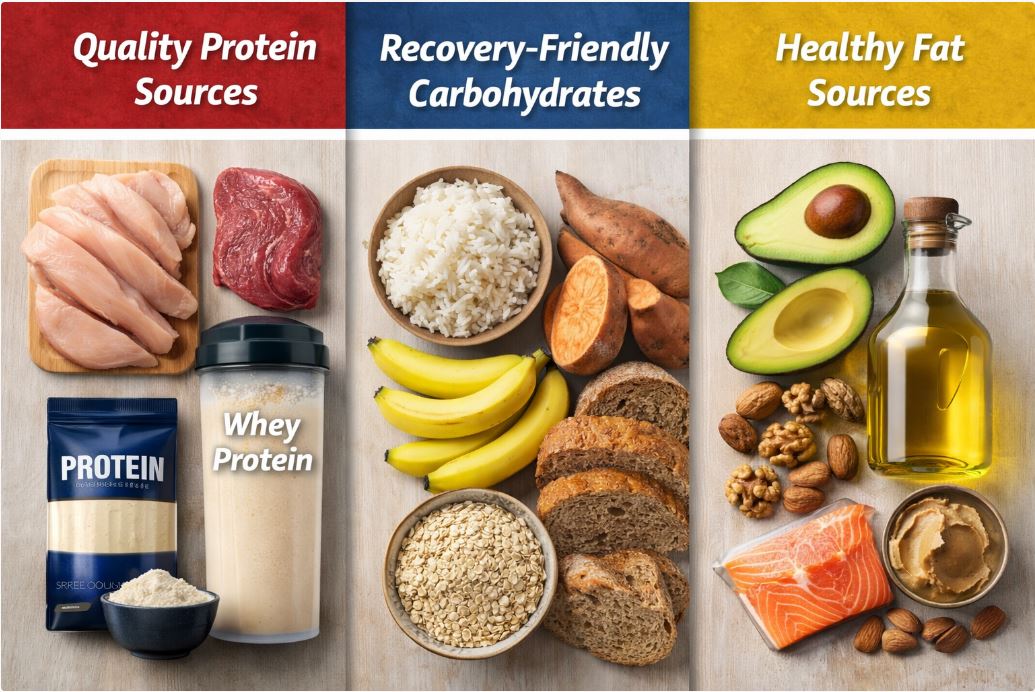
Protein — The Structural Priority
Protein is the foundation of muscle recovery. Without it, repair doesn’t happen.
After training, muscle protein synthesis is elevated, but it can only proceed if sufficient amino acids are available. This doesn’t mean more is always better—it means enough, consistently.
How much protein?
For most active individuals, effective recovery occurs around:
- 1.6–2.2 g of protein per kg of bodyweight per day
Going below this range often leads to poor recovery, muscle loss during dieting, and stalled progress. Going far above it rarely provides additional benefit if calories are adequate.
Distribution matters more than timing hype
One of the most overlooked aspects of recovery nutrition is protein distribution. Instead of loading all protein into dinner or a single shake, spreading intake across the day works better for recovery:
- 3–5 protein-rich meals
- roughly 25–40 g of protein per meal, depending on body size
This keeps muscle protein synthesis stimulated repeatedly rather than in one short spike.
Whey vs whole food
Whey protein is adequate, fast-digesting, and convenient—especially post-workout. But it is not superior to whole foods for recovery when total protein intake is matched.
Use whey when:
- Appetite is low after training
- Time is limited
- Digestion needs to be easy
Use whole foods when:
- Meals are accessible
- Long-term satiety matters
- Overall diet structure is solid
From a recovery standpoint, consistency beats protein source.
Carbohydrates — Recovery’s Missing Piece
Carbohydrates are the most underestimated component of muscle recovery nutrition—especially among strength-focused trainees.
Training depletes muscle glycogen. Even resistance training can significantly reduce glycogen stores, particularly with higher volume, supersets, circuits, or short rest periods. Recovery without carbs is slower, more stressful, and less complete.
Glycogen isn’t just for endurance athletes
Low glycogen affects:
- Training intensity
- Perceived effort
- Nervous system readiness
- Ability to maintain volume across sessions
This is why people on chronically low-carb diets often report feeling “flat,” weaker, or slower to recover—even if protein intake is high.
Why low-carb slows recovery
Without adequate carbohydrates:
- Cortisol remains elevated longer
- Muscle protein breakdown increases
- Nervous system fatigue accumulates
- Training quality declines over time
Carbohydrates help shift the body from a breakdown state into a recovery state. They don’t “block fat loss”—they enable training quality, which is what preserves muscle and drives long-term progress.
Practical recovery approach
Carbohydrates don’t need to be complicated. Potatoes, rice, oats, fruit, bread, pasta—all work. Timing carbs around training helps, but what matters most is daily intake matched to training load.
Fats — Support, Not Fuel
Dietary fats play an important—but often misunderstood—role in recovery.
Fats support:
- Hormone production
- Joint and connective tissue health
- Cell membrane integrity
- Absorption of fat-soluble vitamins
However, fats are not a primary fuel for recovery after exercise.
Where fats help
Adequate fat intake supports long-term recovery by maintaining hormonal balance and reducing excessive inflammation. Eliminating fats often leads to joint discomfort, low energy, and poor adherence.
Where people overdo it
The most common mistake is overusing “healthy fats.” Oils, nuts, seeds, avocado, and nut butters are calorie-dense and easy to overconsume. High fat intake can:
- Displace carbohydrates needed for glycogen
- Push calories too high without improving recovery
- Slow digestion around training windows
From a coaching standpoint, fats should be deliberate, not accidental—enough to support health—never so much that they compromise protein and carbohydrate intake.
Micronutrients That Support Recovery
Micronutrients don’t drive recovery on their own, but deficiencies can severely impair it.
Key electrolytes and minerals
- Sodium: critical for hydration, nerve function, and muscle contraction—especially after heavy sweating
- Potassium: supports muscle function and fluid balance
- Magnesium: involved in muscle relaxation, sleep quality, and nervous system recovery
Athletes who sweat heavily or train frequently often underconsume sodium and magnesium, leading to persistent fatigue, cramps, or poor sleep.
Antioxidants — helpful, but not excessive
Fruits and vegetables provide antioxidants that help manage oxidative stress. However, excessive antioxidant supplementation (high-dose vitamin C or E) may blunt training adaptations if overused.
Real food sources—berries, vegetables, herbs—provide a balanced antioxidant load without interfering with recovery signaling.
The coaching reality
Micronutrients optimize recovery only when macronutrients are already in place. No amount of magnesium or superfoods will fix inadequate calories, low protein, or insufficient carbohydrates.
A healthy muscle recovery meal doesn’t need to be complicated. Combining one protein source, one carbohydrate source, and a moderate amount of fats from the lists above covers the vast majority of recovery needs.
How Soon After Exercise Should You Eat and Drink?
Muscle recovery nutrition timing is far less dramatic than fitness marketing suggests. While eating after training does matter, the idea that recovery is won or lost in a tiny post-workout window is largely misunderstood. What matters most is total intake across the day and how well nutrition matches training demands.
The Truth About the “Anabolic Window”
The classic “30-minute anabolic window” is mostly a myth.
Yes, muscle tissue is more sensitive to nutrients after training—but that sensitivity lasts several hours, not minutes. Muscle protein synthesis remains elevated well beyond the gym session, especially if total daily protein and calories are sufficient.
In practice:
- Missing an immediate post-workout meal does not kill recovery
- Chronic under-eating does
Recovery nutrition is a process, not a race against the clock.
Immediate Intake vs Delayed Meals
There are situations where immediate intake makes sense—but it’s not mandatory for everyone.
A shake is smart when:
- You trained fasted or under-fueled
- You won’t eat a solid meal for several hours
- Appetite is low, but protein is needed
A typical meal is entirely sufficient when:
- You ate protein and carbs before training
- A proper meal follows within 1–2 hours
- Daily intake is already well structured
From a coaching standpoint, consistency beats urgency.
Training Type Matters
Not all training creates the same recovery demands.
Strength training
Protein is the priority. Carbs help, but timing is flexible as long as daily intake is adequate.
HIIT
Both protein and carbohydrates matter more because of greater glycogen depletion and nervous system stress.
Endurance training
Carbohydrates become critical. Faster refueling improves next-session performance, especially with frequent training.
Bottom line:
Eat and drink soon enough, not as fast as possible. Recovery nutrition works best when it fits your training type, schedule, and total daily intake—not when it follows rigid timing rules.
Best Fluids for Muscle Recovery
Fluid intake is a core—but often overlooked—part of muscle recovery nutrition. Training stresses not only muscles, but also fluid balance, electrolytes, and circulation. Even mild dehydration can slow recovery, reduce performance in the next session, and increase perceived fatigue. The goal of recovery fluids is simple: restore hydration, support normal muscle function, and prepare the body for the next workout.
Water — Still Underrated
Water remains the foundation of muscle recovery.
During training, you lose fluids through sweat and respiration. If those losses aren’t replaced, recovery processes slow down. Muscle protein synthesis, nutrient transport, joint lubrication, and nervous system function all depend on adequate hydration.
For most strength-training sessions lasting under 90 minutes, plain water is sufficient—especially if overall daily hydration is consistent. Many people search for “recovery drinks” when they simply aren’t drinking enough water throughout the day.
A practical rule: if urine color stays light and body weight doesn’t drop significantly post-training, hydration is likely adequate.
Electrolytes and Sodium
Electrolytes—especially sodium—play a role in muscle contraction, nerve signaling, and fluid balance. They matter most when sweat losses are high.
Electrolytes are beneficial when:
- Training is long, intense, or performed in heat
- You sweat heavily or train multiple times per day
- Cramping or persistent fatigue appears despite adequate calories
They are mostly marketing when:
- Sessions are short and low-sweat
- Daily food intake already includes sufficient sodium
In many cases, regular meals provide all the electrolytes needed for recovery.
Recovery Drinks — Useful or Overkill?
Sports drinks can be helpful after endurance or high-volume training due to their carbohydrate and sodium content—but they’re unnecessary for most gym sessions.
Chocolate milk deserves its reputation: it naturally provides carbohydrates, protein, fluids, and electrolytes. That said, it’s not magic—just convenient.
From a coaching perspective, the best recovery fluid is the one that fits the session, restores hydration, and supports total daily intake—nothing more complicated than that.
Supplements for Muscle Recovery — What Actually Helps
Supplements can support muscle recovery nutrition—but only after the fundamentals are in place. If calories, protein, carbohydrates, sleep, and hydration are inconsistent, supplements won’t fix the problem. Used correctly, however, a small number of evidence-based options can meaningfully support recovery and performance.
Creatine
Creatine is one of the most researched and reliable supplements in sports nutrition.
Its primary benefit is improved performance during high-intensity efforts, which, in turn, enhances recovery by allowing better training quality over time. Stronger sessions, higher training volume, and enhanced repeat performance all contribute to better long-term adaptation.
Creatine also supports cellular hydration and may reduce perceived fatigue between sessions. While it’s not a “recovery supplement” in the traditional sense, athletes who use creatine consistently often recover better simply because their training stimulus is more productive.
Daily dosing (3–5 g) is sufficient. Timing is far less important than consistency.
Protein Powder
Protein powder is not magic—it’s convenience.
Its role in muscle recovery nutrition is simple: helping you meet your daily protein targets when whole foods aren’t practical. Whey protein is fast-digesting and rich in leucine, making it a beneficial option post-workout or between meals. Plant-based blends can also work if total protein intake is adequate.
What protein powder does not do is override poor nutrition. If total protein is already sufficient, adding shakes won’t accelerate recovery further. Think of protein powder as a tool, not a strategy.
Omega-3s, Magnesium, Collagen
These supplements can make sense in specific contexts:
Omega-3 fatty acids may help modulate inflammation and support joint health, particularly in individuals with low fish intake or high training volume.
Magnesium supports muscle function, sleep quality, and nervous system recovery—especially for people who sweat heavily or experience frequent cramps.
Collagen may support connective tissue health when paired with vitamin C, but it’s not a substitute for adequate protein. It’s best viewed as a targeted joint/tendon support, not a muscle builder.
Used selectively, these supplements can support recovery—but none are essential for everyone.
What to Avoid
Most “recovery blends” are expensive combinations of underdosed ingredients with impressive marketing but limited real-world impact.
Also, be cautious with excessive antioxidant supplementation. High doses of vitamin C or E can blunt training adaptations by interfering with natural recovery signaling. Recovery is not about eliminating stress—it’s about adapting to it.
In practice, the best recovery supplement strategy is boring: use a few proven tools, skip the hype, and let nutrition and training do the heavy lifting.
Muscle Recovery Nutrition and Different Training Goals
Muscle recovery nutrition doesn’t look the same for every goal. Strength training, fat-loss phases, and endurance or hybrid programs place different demands on the body, so recovery strategies must adapt accordingly. When nutrition matches the training goal, recovery becomes more efficient—and progress more predictable.
Strength & Hypertrophy
For strength and muscle-building goals, recovery nutrition must support high training volume and repeated mechanical stress. Heavy lifting and hypertrophy work cause significant muscle damage, but adaptation occurs only when sufficient nutrients are available afterward.
Protein intake becomes the non-negotiable foundation. Consistent daily intake, spread across meals, supports ongoing muscle repair rather than relying on a single post-workout feeding. Carbohydrates are equally important, as they replenish glycogen and allow you to maintain training intensity across sessions. Without adequate carbs, volume drops and progression slows—even if protein intake is high.
In practice, lifters who recover best are those who eat enough overall, not just those who eat “clean.” Strength and hypertrophy thrive on predictable fueling, not nutritional minimalism.
Fat Loss Phases
Recovery during fat loss is more challenging because energy availability is intentionally limited. The goal shifts from maximizing recovery to preserving performance and muscle while managing fatigue.
Protein intake becomes even more critical in a calorie deficit to protect lean mass. Carbohydrates should be prioritized around training to maintain output, even if total intake is lower. Many recovery issues during fat loss stem not from the deficit itself, but from poorly distributed food intake—training hard while under-fueled.
Successful fat loss phases respect recovery by keeping deficits moderate, managing training volume, and avoiding aggressive restriction on rest days. When recovery nutrition is neglected, performance drops first, followed by adherence.
Endurance & Hybrid Training
Endurance and hybrid athletes place greater stress on glycogen stores, hydration status, and electrolyte balance. Recovery nutrition here focuses less on muscle damage and more on restoring energy systems and fluid balance.
Carbohydrates play a dominant role, as depleted glycogen directly impairs subsequent performance. Fluids and sodium become critical, especially with longer sessions or high sweat rates. Protein still matters, but it supports tissue maintenance rather than being the primary limiter of recovery.
In these programs, under-eating carbohydrates is one of the fastest ways to accumulate fatigue. Recovery nutrition must reflect the total workload, not just the presence of strength training.
Across all goals, the principle remains the same: recovery nutrition should match the demands of training. When it does, adaptation accelerates—and training stops feeling like a constant uphill battle.
Common Muscle Recovery Nutrition Mistakes
Even people who train consistently and “eat well” often sabotage their recovery with a few repeatable mistakes. These errors don’t look dramatic, which is why they persist—but over time, they quietly slow progress, increase fatigue, and raise injury risk.
Eating Too Little Because It’s “Lean”
One of the most common recovery mistakes is chronic under-eating disguised as discipline. Meals look lean, portions are small, and calories are kept low to stay shredded—but recovery suffers.
When total energy intake is too low, the body has limited resources to repair muscle tissue, replenish glycogen, and restore the nervous system. The result is lingering soreness, flat workouts, and a gradual drop in performance. Lean eating only supports recovery if it still meets energy demands. Otherwise, it creates a constant recovery debt.
Neglecting Carbohydrates
Carbohydrates are often the first thing people cut—and one of the fastest ways to impair recovery. Without sufficient carbs, glycogen stores remain partially depleted, making subsequent training sessions feel harder than they should.
This isn’t just an endurance issue. Strength training, HIIT, and hybrid workouts all rely on glycogen. When carbs are consistently too low, training volume drops, recovery slows, and fatigue accumulates—even if protein intake is adequate.
Letting Weekends Destroy Recovery
A widespread pattern is structured eating during the week, followed by nutritional chaos on weekends. Alcohol, irregular meals, poor hydration, and reduced protein intake disrupt recovery processes that should be ongoing.
Recovery doesn’t reset every Monday. Two days of poor fueling, low sleep quality, and dehydration can carry fatigue into the following training week, making progress feel inconsistent or unpredictable.
Relying Only on a Post-Workout Shake
Protein shakes are convenient—but they’re not a recovery strategy on their own. Many people assume that a shake immediately after training “covers” recovery, even if the rest of the day is underfueled.
Muscle recovery nutrition depends on total daily intake, not a single feeding. A shake can help bridge gaps, but it can’t compensate for low calories, insufficient carbs, or poor meal structure.
Ignoring Sleep as a Nutritional Factor
Finally, sleep is often overlooked as part of recovery nutrition. In reality, poor sleep alters hunger hormones, reduces glycogen storage efficiency, and impairs muscle repair—even with a perfect diet.
Recovery is a system. When sleep is neglected, nutrition can’t do its job as well. The best recovery plans respect both fuel and rest, not one without the other.
🧠 Coach’s Note: Why Recovery Nutrition Fails in Real Life
From a coaching perspective, muscle recovery nutrition rarely fails because people don’t know what to do. It fails because knowing the rules is not the same as applying them consistently.
With clients, I see the same pattern over and over: they train hard, understand the importance of protein and carbs, but then undereat, skip meals, or rely on a single shake to “cover” recovery. The intention is right — the execution is not.
Another issue is complexity. People overthink recovery nutrition, chase perfect timing, supplements, or “optimal” ratios, and miss the basics: enough total food, enough protein, enough carbohydrates, and enough sleep.
In real-world coaching, the athletes who recover best are not the ones with the most advanced strategies. They are the ones with simple, repeatable recovery meals they can execute even on busy days. Simple plans beat perfect plans — every time.
Conclusion
Muscle recovery nutrition is not a separate phase of training — it is part of the training process itself. What you eat, drink, and consistently provide your body between sessions determines whether workouts build strength and resilience or accumulate fatigue.
In practice, recovery nutrition doesn’t fail because people choose the “wrong” foods. It fails because intake is inconsistent, total energy intake is too low, carbohydrates are neglected, or recovery is treated as optional rather than essential. No supplement, shake, or timing trick can compensate for chronic underfueling and poor sleep.
The most effective recovery strategies are also the simplest: adequate protein spread throughout the day, enough carbohydrates to replenish energy stores, proper hydration, and meals that are easy to repeat in real-life conditions. When nutrition reliably supports recovery, performance improves, injury risk decreases, and training feels sustainable rather than draining.
From a coaching perspective, the goal is not to recover perfectly — it’s to recover well enough, consistently. When muscle recovery nutrition becomes boring, predictable, and sufficient, progress stops being a guessing game and starts becoming the natural outcome of your training.
If you can recover, you can train. If you can train consistently, results will follow.
✅ Key Takeaways: Muscle Recovery Nutrition
- Muscle recovery nutrition is a process, not a moment. Recovery continues for 24–48 hours after training, not just immediately post-workout.
- Protein is essential, but not enough on its own. Without adequate carbohydrates and total calories, recovery remains incomplete.
- The “anabolic window” is wider than most people think. Consistent daily intake matters more than rushing a shake.
- Carbohydrates play a critical role in recovery. Low-carb approaches often slow glycogen restoration and increase fatigue.
- Hydration and electrolytes directly affect recovery quality. Dehydration alone can impair performance in the next session.
- Supplements support recovery only after fundamentals are in place. Calories, protein, carbs, sleep, and hydration come first.
- Recovery nutrition must match the training goal. Strength, fat loss, and endurance each demand different recovery priorities.
- Most recovery failures are consistency problems. Simple, repeatable meals outperform complex “optimal” strategies.
✍️ Written by: Krunoslav O., PhD — Kinesiology, Certified Strength Coach
🔄 Updated on: January 2026
👥 Expert Contributors:
