



If you’ve spent any time in fitness or biohacking content, you’ve probably heard it: sauna use can boost growth hormone by 16 times. You see it in podcast clips, short-form videos, and gym conversations, usually presented as settled fact. And here’s the thing — it’s a real, published number, not an internet fabrication. But the study behind it looks nothing like a typical gym sauna session, and the researchers who ran it had their own doubts about what was actually causing the spike.
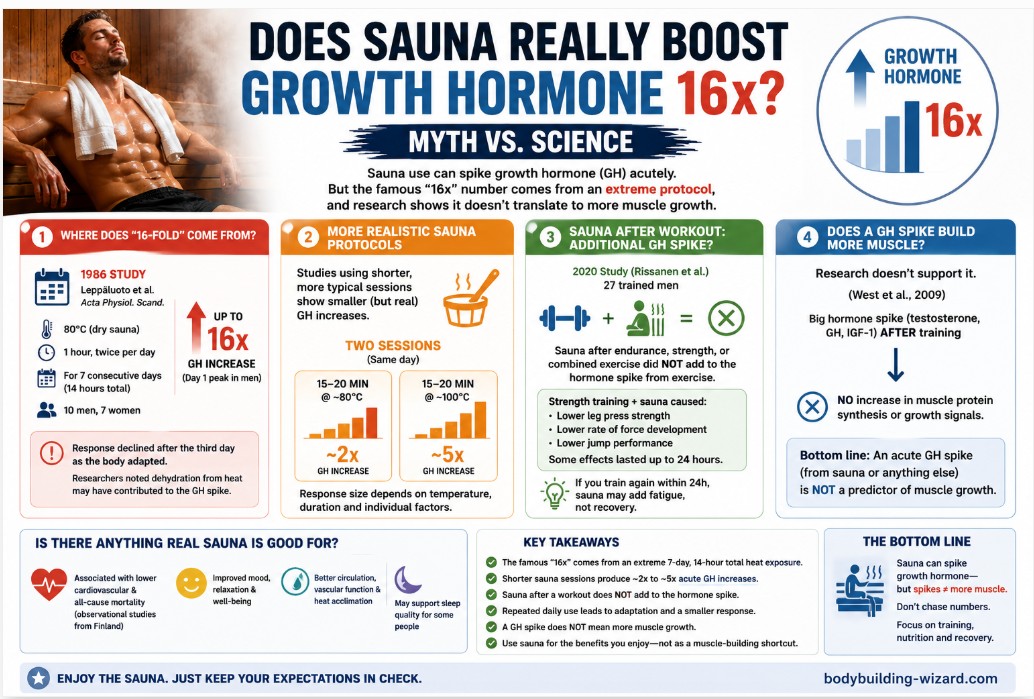
QUICK ANSWER: The “16-fold” claim is real, but it comes from an extreme 1986 protocol — two hours of sauna daily for seven straight days — not a typical gym session. More realistic protocols (two 15-20 minute sessions) produce a 2- to 5-fold increase. Either way, research directly testing elevated growth hormone found no benefit to muscle protein synthesis or hypertrophy — an acute GH spike, from sauna or anything else, isn’t a reliable predictor of muscle growth.
Where Does the “16-Fold” Claim Actually Come From?
The number traces to a 1986 study by Leppäluoto and colleagues, published in Acta Physiologica Scandinavica. Ten healthy men and seven healthy women were exposed to dry heat in an 80°C Finnish sauna for one hour, twice a day, for seven consecutive days — 14 hours of heat exposure in a single week. On day one, male participants showed a genuine, statistically significant 16-fold increase in growth hormone. Cortisol and ACTH actually decreased over the course of the experiment, and testosterone, thyroid hormones, and gonadotropins stayed largely unchanged — the GH and prolactin response was the standout finding.
Three details from that study rarely make it into the viral version. First, the protocol bears no resemblance to a normal 15-20 minute sauna session after a workout — this is 14 hours of cumulative heat exposure across a week, not a single session. Second, the GH response had already declined by the third day as the body adapted to repeated exposure, meaning the headline number describes a single, first-exposure peak, not a sustainable, repeatable effect. Third, and easy to miss: the researchers themselves raised the possibility that the spike was driven at least partly by heat-related dehydration rather than a genuine, isolated hormonal signal — a caveat that virtually never survives the trip from the original paper to a biohacking blog post. That’s a real, peer-reviewed, statistically significant finding — under conditions almost no one training in a gym ever replicates.
What Do More Realistic Sauna Protocols Actually Show?
A separate, frequently cited study by Kukkonen-Harjula and colleagues used a protocol much closer to how people actually use a sauna: two 15-20 minute sessions at varying temperatures. This found a 2- to 5-fold increase in growth hormone, with the response size tracking the intensity of heat exposure. That’s still a genuinely substantial acute hormonal response — just an order of magnitude more modest than the number that gets repeated in podcast clips and short-form videos.
Does Sauna Add to Your Post-Workout Hormone Spike?
A relevant question for anyone using sauna specifically after training. A 2020 study by Rissanen and colleagues, published in the Journal of Strength and Conditioning Research, had 27 experienced sauna users complete endurance, strength, or combined exercise sessions followed by a traditional sauna bath. The result: sauna did not produce an additional increase in growth hormone, testosterone, or cortisol beyond what the workout itself already caused. There’s a further, genuinely useful practical detail for lifters: sessions combining strength training with sauna showed reduced isometric leg press force and rate of force development for up to 24 hours afterward—worth knowing if you use post-workout sauna and wonder why the next day’s session feels a little flat.
Coach’s Note: I’ve had clients tack on 20 minutes of sauna after every single session because they heard it “spikes growth hormone.” Meanwhile their actual training volume was inconsistent and their sleep was a mess. If you enjoy sauna, use it — just not as a substitute for the boring stuff that actually builds muscle. And if you’re using it heavy after leg day specifically hoping for a recovery boost, keep an eye on how the next day’s session feels; the research suggests it might not be doing you any favors there.
Why Does Sauna Increase Growth Hormone at All?
Worth explaining briefly, since the articles hyping the 16-fold number rarely bother to. Heat exposure is a genuine physiological stressor—core temperature rises, and the body mounts a coordinated thermoregulatory and endocrine response. Part of that response involves the hypothalamus signaling the pituitary to release more growth hormone, alongside other stress-related hormones. The size of that response depends on several factors working together: how hot the sauna is, how long you stay in, how acclimated your body already is to heat exposure, and your hydration status going in — which lines up with why the same researchers who found the 16-fold spike also suspected dehydration was part of what drove it.
The fact that GH rises as part of a general physiological stress response is itself worth sitting with. It’s another reason not to automatically interpret every GH spike as an anabolic signal — the same hormone rises in response to fasting, hard exercise, sleep, and now heat stress, none of which share an obvious common thread with “building more muscle.” A hormone that responds to that many different kinds of stress is doing something broader than acting as a dedicated muscle-growth switch.
Does an Acute GH Spike From Sauna Actually Build Muscle?
This is the question that actually matters, and it connects directly to research already covered in our growth hormone and muscle growth guide. A now-classic study by West and colleagues, published in The Journal of Physiology, had young men train their arms under two different hormonal conditions: one designed to keep testosterone, GH, and IGF-1 at baseline, and another that added heavy leg exercise immediately afterward specifically to produce a large systemic hormone spike. The result: the elevated-hormone condition did not enhance muscle protein synthesis or the intracellular signaling pathways that drive hypertrophy, compared to the low-hormone condition—despite the acute hormone spike being real and measurable.
Put together with everything above: even in the extreme 1986 protocol that produced the headline-grabbing 16-fold number, there’s no evidence that spike did anything for muscle growth — because the broader research on acute GH elevation and hypertrophy consistently finds the same thing, independent of what actually caused the spike in the first place. A bigger hormone number on a blood test is not the same claim as more muscle, whether that number comes from a sauna, a hard leg day, or anything else designed to chase a transient spike.
Is There Anything Real Sauna Is Actually Good For?
Worth being fair here rather than dismissing sauna use entirely. Large observational studies out of Finland have found associations between regular sauna use and reduced cardiovascular mortality, and sauna sessions have documented effects on mood, relaxation, and post-exercise recovery that don’t depend on the growth hormone story. None of that requires the 16-fold claim to be true — sauna can be a genuinely worthwhile recovery and wellness habit without being a hormonal muscle-building shortcut. The two claims just don’t need each other, and conflating them is exactly how a legitimate wellness practice ends up wrapped in an oversold pitch.
Common Sauna Myths
❌ Myth: Sauna reliably increases growth hormone 16-fold.
✅ Reality: That figure comes from an extreme, week-long protocol (two hours of heat exposure daily) that bears no resemblance to a normal sauna session, and even in that study, the response had faded by day three.
❌ Myth: A typical post-workout sauna session meaningfully boosts your hormone response.
✅ Reality: Realistic protocols show a more modest 2- to 5-fold GH increase, and research specifically testing sauna after exercise found no additional hormone boost beyond training alone.
❌ Myth: Since sauna raises GH, using it after training will help you build more muscle.
✅ Reality: Research directly testing elevated post-exercise hormones, including GH, found no benefit to muscle protein synthesis or hypertrophy signaling — an acute hormone spike isn’t a reliable predictor of muscle growth.
❌ Myth: More sauna sessions always produce a bigger hormone response.
✅ Reality: The original 16-fold study found the opposite — the GH response declined with repeated daily exposure as the body adapted.
Bodybuilder’s Take
The 16-fold number is real, but it comes from a protocol no one actually uses, and even the researchers who found it weren’t fully convinced it reflected a clean hormonal signal rather than dehydration. A normal sauna session produces a real, more modest GH response — and there’s no good evidence that response translates into more muscle, whether it comes from sauna or from training itself. If you enjoy sauna for recovery, relaxation, or its own documented benefits, that’s a fine reason to keep using it. Just don’t expect it to substitute for progressive training or meaningfully change your physique on its own.
