



If T3 speeds up metabolism, wouldn’t more T3 make cutting easier? And if T3 falls during a hard diet, does that mean your metabolism is “broken”?
Both ideas contain a piece of truth — and miss most of the physiology. Thyroid hormones sit at an unusual intersection in bodybuilding content: they’re genuinely central to metabolism, which makes them an obvious target for both fear (“my metabolism is ruined”) and wishful thinking (“if I could just boost my thyroid, cutting would be easy”).
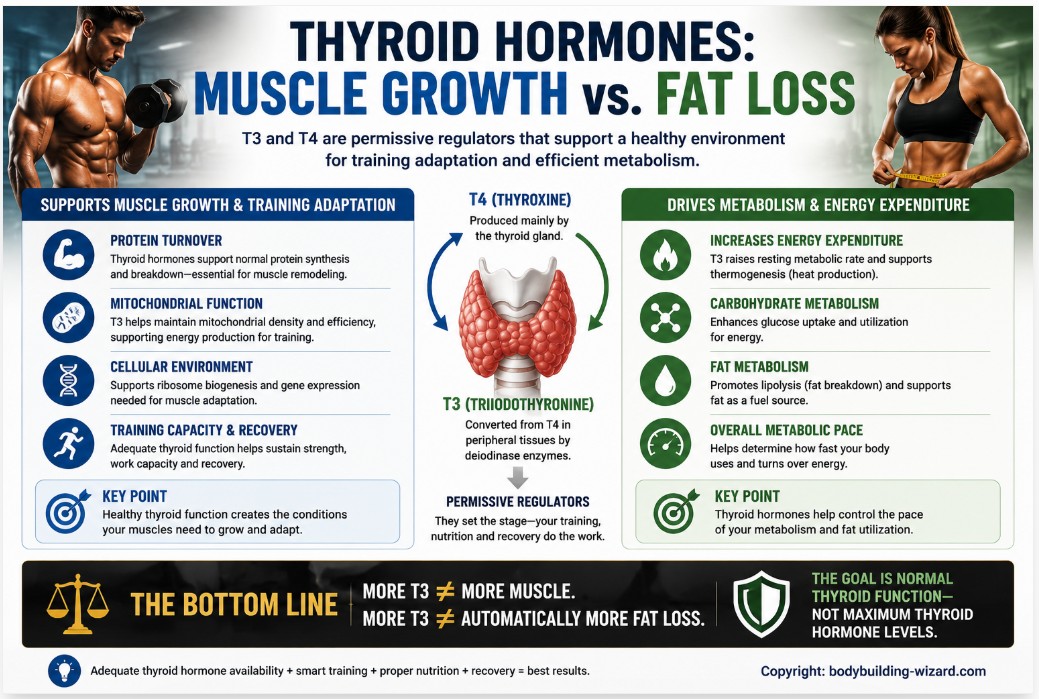
Here’s the thesis of this article: thyroid hormones are better understood as permissive regulators of metabolism and muscle adaptation than as a dial you want to push as high as possible. Adequate thyroid hormone availability supports the cellular environment needed for normal training adaptation and fat metabolism. Too little can genuinely compromise that environment — but too much isn’t better, since excess thyroid hormone activity accelerates protein breakdown right alongside everything else it speeds up.
QUICK ANSWER: Thyroid hormones (T3 and T4) regulate resting metabolic rate, thermogenesis, and protein turnover, and act as permissive regulators of muscle adaptation rather than direct anabolic hormones. During a hard cut, T3 can fall as part of a normal adaptive response to energy restriction — this usually isn’t evidence of “metabolic damage.” Trying to artificially boost thyroid hormone levels isn’t a safe or effective fat-loss or muscle-building strategy for lifters with normal thyroid function.

What Are Thyroid Hormones?
T4 (Thyroxine)
T4 is the main hormone secreted by the thyroid gland, and it functions largely as a circulating reservoir and precursor. Most of what T4 does happens after it’s converted into the more biologically active hormone described next.
T3 (Triiodothyronine)
T3 is the biologically more active thyroid hormone. Some T3 is secreted directly by the thyroid, but the majority is produced by peripheral tissues converting T4 into T3 as needed — a detail that matters later in this article when we discuss diet and energy availability.
What Is Reverse T3?
Worth a brief mention, mostly because it’s a magnet for online bro-science. Reverse T3 (rT3) is an inactive mirror-image form produced from T4 through an alternate conversion pathway. It gets discussed heavily in fitness and “metabolic damage” content online, often with more confidence than the underlying science actually supports for healthy, non-clinical populations. This article won’t be treating rT3 as a practical metric for lifters to track.
How the Hypothalamic-Pituitary-Thyroid (HPT) Axis Works
The regulatory chain follows a familiar pattern to the other hormones in this category: the hypothalamus releases thyrotropin-releasing hormone (TRH), which signals the pituitary gland to release thyroid-stimulating hormone (TSH), which then signals the thyroid gland to produce T4 and T3. From there, peripheral tissues convert T4 into the more active T3 via enzymes called deiodinases — meaning a meaningful part of your active thyroid hormone status is determined outside the thyroid gland itself, at the tissue level.
Like the other endocrine axes covered throughout this category, this system runs on negative feedback: rising T3 and T4 signal back to the hypothalamus and pituitary to dial down TRH and TSH release. This is also why a standard thyroid panel typically measures TSH first — because TSH tends to respond in the opposite direction of T3/T4, a low TSH combined with normal-to-high T3/T4 (or vice versa) is often more informative on its own than a T3 or T4 reading in isolation.
T3 vs. T4: What’s the Difference?
| T4 | T3 | |
|---|---|---|
| Produced mainly by | Thyroid gland | Thyroid + peripheral conversion |
| Circulating amount | Higher | Lower |
| Biological activity | Lower | Higher |
| Main role | Hormone reservoir / precursor | Active metabolic signaling |
| Relevance to lifters | Supports the thyroid hormone pool | Closely tied to metabolic regulation |

How Thyroid Hormones Regulate Metabolism
Thyroid hormones influence several interconnected processes: resting metabolic rate, thermogenesis, carbohydrate metabolism, fat metabolism, and protein turnover. A foundational review on thyroid hormone regulation of metabolism describes how the active form, T3, is generated locally in key metabolic tissues — including the hypothalamus, white fat, brown adipose tissue, and skeletal muscle — by a deiodinase enzyme required for adaptive thermogenesis specifically. This local tissue-level activation is also part of why thyroid signaling isn’t governed purely by TRH and TSH from the brain — nutritional signals like leptin provide additional, central modulation of the whole system.
It’s worth resisting the temptation to reduce all of this to “T3 is the calorie-burning hormone” — that’s true as far as it goes, but it skips the protein turnover and tissue-level effects that matter most for a lifter specifically, which is exactly where this article is headed next.
Thyroid Hormones and Muscle Growth
This is a section where recent, genuinely current research gives us a much better framework than older fitness content had access to. A 2026 review on thyroid hormones and skeletal muscle frames this precisely: rather than directly stimulating muscle protein synthesis, thyroid hormones create the intracellular environment required for effective adaptation to training — supporting mitochondrial integrity, ribosome biogenesis, and coordinated protein turnover that allows anabolic signaling to actually translate into structural muscle adaptation. Reduced translational efficiency during hypothyroidism can blunt the hypertrophic response, while hyperthyroidism accelerates proteolytic pathways and compromises net protein gain despite elevated overall turnover.
Thyroid hormones are better viewed as permissive regulators of muscle adaptation than as direct anabolic hormones. Adequate availability supports the cellular environment protein accretion and remodeling depend on. Too little can compromise that adaptation — but too much isn’t better, since hyperthyroid physiology increases protein breakdown right alongside everything else it accelerates.
Do Thyroid Hormones Increase Muscle Protein Synthesis?
Yes — but the honest answer isn’t a simple “yes” on its own. T3 can increase overall metabolic and protein turnover, but faster turnover is not the same thing as net muscle gain. This is a very similar lesson to what we covered in our growth hormone article: biochemical activity and hypertrophy outcome are related, but they aren’t the same measurement, and conflating them leads to exactly the kind of oversimplified “more hormone = more muscle” thinking this entire hormone category exists to correct.
Hypothyroidism vs. Hyperthyroidism: What Happens to Muscle?
| Low Thyroid Activity | Normal Thyroid Function | Excess Thyroid Activity | |
|---|---|---|---|
| Metabolic rate | Decreased | Normal | Increased |
| Energy | Often decreased | Normal | May feel elevated, then fatigued |
| Protein turnover | Altered / slower | Balanced | Accelerated |
| Muscle adaptation | May be impaired | Supported | Net muscle retention can suffer |
| Training | Performance may decline | Normal adaptation | Recovery and performance may suffer |
This table is descriptive context, not a diagnostic tool — if you suspect you fall meaningfully outside “normal thyroid function,” that’s a conversation for a doctor, covered later in this article.
Thyroid Hormones and Fat Loss
Does T3 Burn Body Fat?
T3 increases energy expenditure — that part is genuinely well-established. But “more T3” is not a safe or intelligent fat-loss strategy, for reasons that become clear once you get to the section on exogenous T3 use later in this article.
Does a Faster Metabolism Guarantee More Fat Loss?
No. Energy intake, behavioral and dietary adherence, activity levels, and overall body composition also determine the outcome — a faster metabolic rate is one input into a larger system, not a guarantee of anything on its own.
What Happens to Thyroid Hormones During a Cut?
This is arguably the most important bodybuilding-specific question in this entire article — and it’s exactly the kind of question a generic medical resource isn’t built to answer well.
During prolonged energy restriction, several hormones can shift together: T3 can fall, along with leptin, insulin, and testosterone, alongside reduced energy expenditure and other adaptive responses. Athlete literature clearly documents these thyroid-axis adaptations during energy deprivation — this isn’t a controversial claim.
But here’s where this article needs to be more nuanced than a lot of older bodybuilding content. A 2026 systematic review examining short-term, experimentally induced low energy availability in athletes (13 studies, 145 participants) found that leptin decreased consistently across the included studies, while IGF-1 and T3 remained stable in most studies — testosterone decreased in about half of the interventions. In other words: don’t write “start dieting → T3 drops” as a simple, universal rule. Duration, severity of the deficit, sex, starting energy reserves, and training load all shape how — and whether — T3 specifically responds in the short term. Leptin appears to be the more consistently responsive signal early in a deficit, with T3 changes showing up more reliably over longer, more severe restriction.

Does Lower T3 Mean Your Metabolism Is Damaged?
Usually, no. A drop in T3 during prolonged energy restriction can be part of adaptive thermogenesis and energy conservation — a normal, coordinated physiological response to reduced energy intake — rather than evidence of a permanently “damaged” metabolism. This distinction matters enormously for how a lifter should actually respond to a stalling cut: it’s a signal to reassess the deficit, training load, and diet duration, not evidence that something is irreversibly broken.
Adaptive Thermogenesis: Why Fat Loss Gets Harder
This connects directly to what we covered in our leptin article: as body mass falls during a cut, several things tend to move together — thyroid hormone activity, leptin, non-exercise activity thermogenesis (NEAT), and overall energy expenditure all tend to decrease, while hunger drive increases. Athlete weight-loss research describes this as a combined endocrine response to a deficit that favors reduced energy expenditure and increased drive to eat — not a single hormone acting in isolation. For the fuller mechanism behind this, see our guide to metabolic adaptation and “starvation mode”.
Low Energy Availability, RED-S and Thyroid Function
This doesn’t need to be a huge section, but it needs to be here. Aggressive cutting combined with high training expenditure and inadequate intake isn’t simply a matter of slower fat loss — it’s a real risk factor for low energy availability and Relative Energy Deficiency in Sport (RED-S). The HPT axis is one of several systems that can adapt to chronic energy deprivation, alongside the reproductive and other endocrine systems covered in our testosterone and cortisol articles.
Coach’s Note: In practice, one of the biggest mistakes I see during cutting phases is interpreting every slowdown in weight loss as a “damaged metabolism” or thyroid problem. As body mass falls and the diet becomes more demanding, lower energy expenditure, less spontaneous movement, greater hunger, and hormonal adaptation are expected. The solution is not to chase T3 — it is to manage the deficit, training load, recovery, and diet duration intelligently.
Can Refeed Days Restore T3?
This deserves a genuinely careful answer, because it’s exactly the kind of claim that gets oversold in bodybuilding content — including, in the past, on this site. Older mechanistic research in animals found that carbohydrate refeeding after fasting could measurably increase T3 and normalize T4-to-T3 conversion enzyme activity within roughly 72 hours — but that’s a rodent fasting-and-refeeding model, not a direct stand-in for a bodybuilder’s typical one- or two-day refeed after weeks of dieting.
Human data specific to bodybuilders is more limited and more modest in what it shows. A case report tracking a natural male bodybuilder through contest prep found that after just two days of modest energy repletion in peak week, free T3 increased by 18.5% — but it was still returning only to a sub-clinically low value, not a full normalization. This is a genuinely useful real-world data point: a short refeed can produce a measurable, partial bump in T3, but it isn’t accurately described as “resetting” thyroid function or reversing weeks of accumulated metabolic adaptation. Treat a one- or two-day high-carbohydrate refeed as a genuine, modest tool for managing a long cut — not a thyroid reset button.
Does Carbohydrate Intake Affect T3?
Yes — this is a much better-supported and more precisely worded claim than “carbs boost thyroid.” Overall energy status and carbohydrate availability can influence thyroid physiology, but the effect needs to be considered within the full context of total energy availability, not carbohydrate grams treated in isolation. If you’re structuring your intake around this, our carbohydrate intake calculator and guide to how carbohydrates affect hormones cover the broader picture.
Does Resistance Training Affect Thyroid Hormones?
Yes, but briefly: acute exercise can change circulating thyroid hormone levels, and training status may be associated with baseline differences. But the same philosophy applies here as it did in our testosterone and growth hormone articles: you should not choose a workout because it produces the biggest thyroid-hormone response. Training decisions belong to the same fundamentals — volume, progressive overload, recovery — regardless of which hormone panel happens to shift afterward.
Should Lifters Try to “Boost” Thyroid Hormones Naturally?
No — and this section exists specifically to push back on a whole category of “natural thyroid booster” content: kelp stacks, mega-dose iodine, selenium “hacks,” and various supplement blends marketed around this exact promise. The goal worth having is normal thyroid function, not maximum T3.
Iodine and Selenium: Important — but More Isn’t Better
Worth addressing directly because of how often these two show up in supplement marketing. Iodine is genuinely required for thyroid hormone synthesis, and selenium participates in deiodinase enzyme function and broader thyroid biology — both are real, essential nutrients for normal thyroid physiology. But correcting an actual deficiency is a completely different claim from supraphysiological thyroid enhancement. If you’re not deficient, more iodine or selenium isn’t doing anything productive for your thyroid function, and both can cause genuine harm in excess. For the broader micronutrient picture, see our complete guide to vitamins and minerals for bodybuilders.
What About T3 (Liothyronine) Use for Fat Loss in Bodybuilding?
This needs to be here, because anyone researching thyroid hormones and bodybuilding will eventually run into this topic — the same pattern we’ve followed for insulin, growth hormone, and IGF-1 in this category.
Exogenous T3 (liothyronine) can genuinely increase metabolic rate. But it also increases cardiovascular and metabolic risk, and excessive thyroid hormone exposure accelerates protein breakdown — a potentially damaging combination for someone specifically trying to preserve muscle during a cut, working directly against the goal it’s supposedly being used to achieve. This article isn’t the place for dosages, cycling, or tapering protocols related to T3 use, and we’re not providing any.
Thyroid Hormones During Bulking vs. Cutting
Bulking: adequate energy availability supports normal thyroid physiology. There’s no legitimate reason to try to “boost” T3 for a leaner bulk — the mechanism doesn’t support that goal in the first place.
Cutting: a moderate deficit typically produces a manageable degree of adaptation. An aggressive or prolonged deficit carries a greater risk of meaningful endocrine adaptation, including the T3 and broader HPT-axis effects covered throughout this article.
Contest prep: extreme leanness combined with prolonged restriction and high training volume is the context where thyroid-axis adaptation becomes most clinically relevant — exactly the population covered in the LEA research and case report referenced earlier in this article.
| Bulking | Cutting | Contest Prep | |
|---|---|---|---|
| Energy availability | Higher | Lower | Lowest, often for extended periods |
| Thyroid-axis risk | Minimal | Manageable if moderate | Highest — closest monitoring warranted |
| Should you chase higher T3? | No | No | No |
| Coaching priority | Adequate surplus + training | Sustainable deficit + recovery | Careful periodization + monitoring |
Supporting Healthy Thyroid Physiology — Without Chasing It
Pulling this article’s lessons into a practical checklist:
- Avoid unnecessarily aggressive or prolonged calorie deficits, especially stacked with very high training volume
- Get adequate iodine and selenium through a normal, varied diet — correct an actual deficiency if one exists, rather than supplementing blindly above adequate levels
- Use planned refeeds or diet breaks as a genuine tool for managing a long cut, not as a promised “thyroid reset”
- Treat a stalling cut as a signal to reassess your deficit, training load, and diet duration — not as evidence of a broken metabolism
- If you suspect a genuine thyroid problem, get proper lab testing rather than trying to self-diagnose from energy levels or a stalled scale
Bodybuilder’s Take
Your thyroid is not a fat-burning dial that should be turned as high as possible. Healthy thyroid function creates the metabolic environment in which you can train, recover, retain muscle, and regulate energy expenditure normally. When a cut starts feeling harder and the scale slows down, that’s usually your body doing exactly what it’s designed to do under sustained energy restriction — not a sign that something has broken.
Common Thyroid Myths in Bodybuilding
❌ Myth: More T3 always means better fat loss.
✅ Reality: T3 increases energy expenditure, but total energy balance, adherence, and activity level determine actual fat loss — and artificially elevated T3 comes with real cardiovascular and muscle-preservation trade-offs.
❌ Myth: Lower T3 during a cut means your metabolism is damaged.
✅ Reality: A drop in T3 during prolonged restriction is usually a normal adaptive response to reduced energy intake, not evidence of permanent metabolic damage.
❌ Myth: You can permanently “reset” your metabolism with a refeed.
✅ Reality: A short refeed can produce a modest, partial bump in T3, but human data doesn’t support it fully normalizing or “resetting” thyroid function after weeks of dieting.
❌ Myth: More iodine means more thyroid hormone.
✅ Reality: Iodine is essential for thyroid hormone synthesis, but correcting a genuine deficiency is a different claim from supraphysiological enhancement — excess iodine isn’t productive and can cause harm.
❌ Myth: Thyroid boosters accelerate fat loss in healthy lifters.
✅ Reality: Supplements marketed as natural thyroid boosters lack solid evidence for meaningfully accelerating fat loss in people without an actual deficiency.
❌ Myth: T3 only affects fat, not muscle.
✅ Reality: Thyroid hormones are permissive regulators of both fat and muscle metabolism — excess thyroid activity accelerates muscle protein breakdown right alongside fat metabolism.
❌ Myth: If fat loss stalls, your thyroid must be the problem.
✅ Reality: A stalling cut is far more often explained by adherence, an underestimated deficit, or normal adaptive responses across several hormones — not an isolated thyroid problem.
