


The Most Misunderstood Muscle-vs-Fat Question
You’ve probably heard it: “muscle weighs more than fat.” Technically — no. Five kilograms of muscle and five kilograms of fat have exactly the same mass. But the person saying it is usually trying to express something that is true: muscle tissue is denser, so the same mass takes up less space. And that single fact is exactly why the scale can be such a poor narrator of what’s actually happening to your physique.
QUICK ANSWER: No. A pound of muscle and a pound of fat weigh exactly the same — one pound. The important difference is density. Muscle tissue is denser than adipose tissue, so the same weight of muscle generally occupies less volume than the same weight of fat. This is why someone can lose fat, gain muscle, look noticeably leaner, and still weigh roughly the same.
Muscle vs. Fat: What’s Actually Different?
| Muscle | Body Fat | |
|---|---|---|
| Primary role | Movement, force production, metabolism | Energy storage, endocrine and other physiological roles |
| Density | Higher | Lower |
| Volume at equal mass | Smaller | Larger |
| Contribution to physique | Shape and muscularity | Soft-tissue volume and contours |
| Energy use at rest | Higher | Lower |
| Can change independently? | Yes | Yes |
Worth flagging immediately: muscle’s higher resting energy use is real, but as covered later in this guide, it’s not the metabolic superpower fitness content often makes it out to be.
Does Muscle Weigh More Than Fat?
One Pound of Muscle vs. One Pound of Fat
One pound is one pound. The same holds at any scale — five pounds, ten pounds, a kilogram, doesn’t matter. Weight is weight, regardless of what tissue it’s made of.
The better question was never “which weighs more?” It’s “which takes up more space at the same weight?” — and that’s where the real, useful answer lives.
Muscle vs. Fat Density: Why Muscle Takes Up Less Space
Density is simply mass divided by volume. Muscle tissue is composed largely of water and protein structures; adipose tissue is composed largely of lipid, which is less dense. A published correction in a peer-reviewed journal — issued after the authors’ original statement that “lean mass weighs far more than fat” was flagged as an overstatement — settled on the actual figures: skeletal muscle density is approximately 1.06 kg per liter, compared to approximately 0.92 kg per liter for adipose tissue. That’s roughly a 15% density difference, not a dramatic one, but a real and consistently measured one.
Worth being precise here rather than overstating it: real human tissue isn’t a laboratory block of pure material, and figures like “muscle takes up exactly 20% less space than fat” circulating online should be treated as rough approximations rather than precise universal constants. The principle — muscle is meaningfully denser than fat — is well-established. You shouldn’t treat the exact percentage difference in any given person’s body as a precise, guaranteed number.
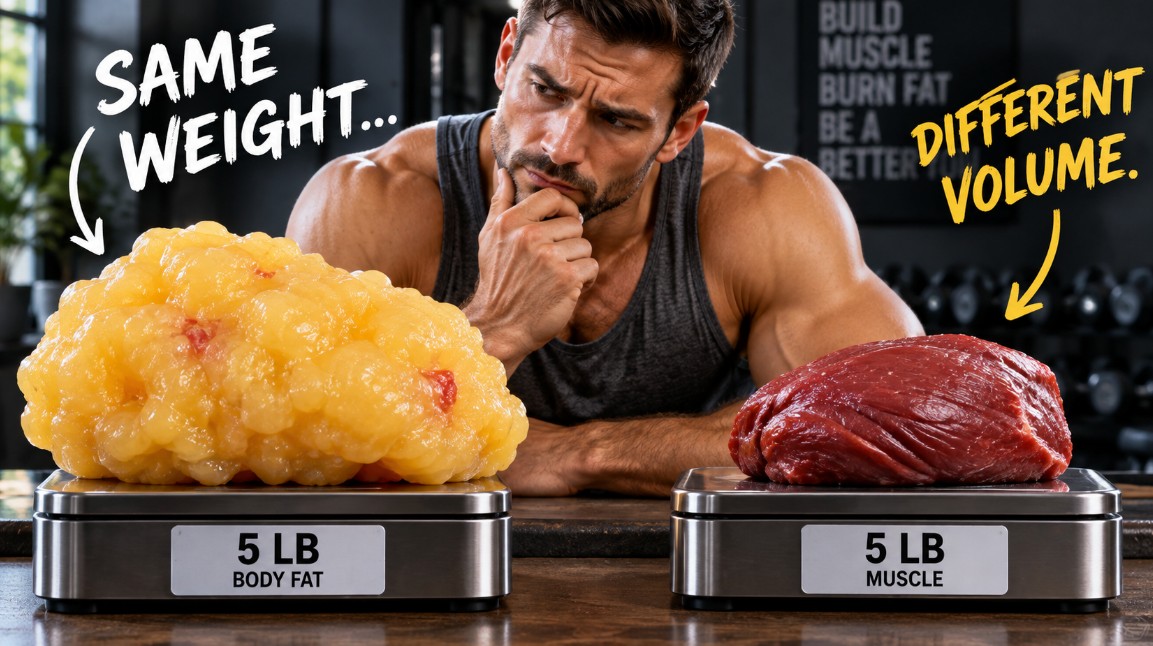
What Does 5 Pounds of Muscle vs. 5 Pounds of Fat Look Like?
Same weight, different volume. Five pounds of fat occupies a noticeably larger volume than five pounds of muscle, because of the density difference covered above.
The scale sees 5 lb. Your physique doesn’t.
Worth a direct caveat here: the “5 lb fat vs. muscle” photos and plastic models that circulate online represent an approximation of the volume difference — not a universal, exact depiction of how these tissues look inside every individual body. The general principle they illustrate is accurate; the specific visual should be read as illustrative, not literal.
Why You Can Look Leaner Without Losing Weight
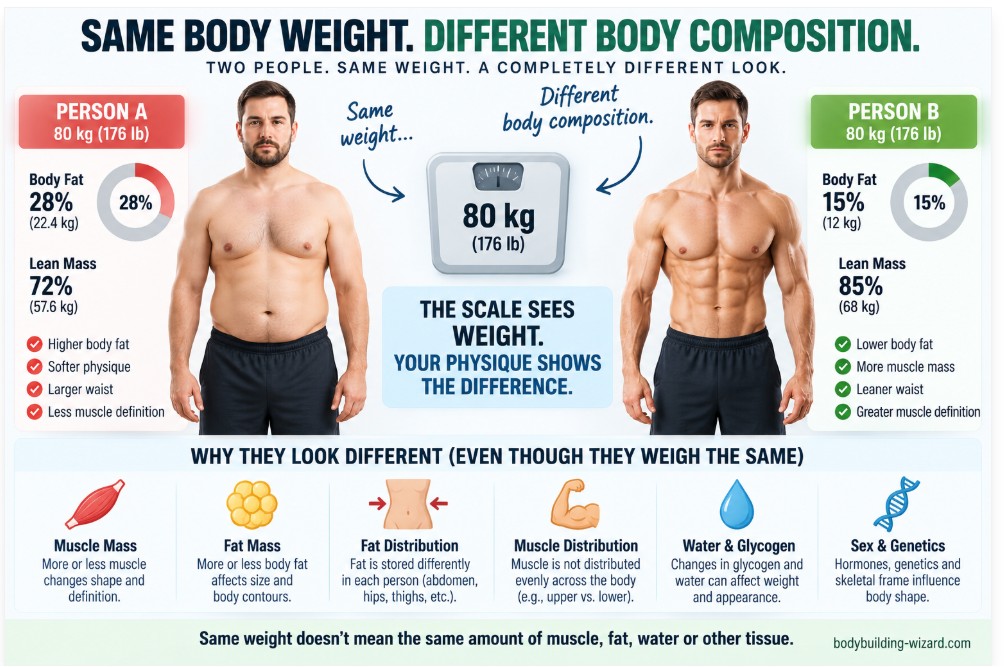
Here’s a simplified illustrative example — not a promise of exactly how any individual’s numbers will play out. Starting point: 80 kg body weight. After a period of training and dieting: −3 kg fat, +3 kg lean mass. Scale: still 80 kg. Physique: completely different.
To be clear, this is an illustrative example, not an expectation that anyone will neatly swap 3 kg of fat for 3 kg of muscle on a fixed schedule — real results vary considerably by individual and timeline. But the underlying principle is exactly right, and it’s the core mechanism behind body recomposition: building muscle and losing fat simultaneously, at a stable or even unchanged body weight.
Same Body Weight, Completely Different Body
Take this a step further: two people at an identical 82 kg can look entirely different because of muscle mass, fat mass, body fat percentage, fat distribution, muscle distribution, skeletal frame, water and glycogen levels, and sex. Full context on each of these variables: What Is Body Composition?, Healthy Body Fat Percentage, and Male vs. Female Fat Distribution.
Why the Scale Can Mislead You When You Start Lifting
This is where a lot of generic content stops short, and it’s worth going one layer deeper. When someone starts resistance training, scale weight isn’t simply reflecting “fat down, muscle up.” Several other things are happening simultaneously: muscle glycogen stores increase, the water bound to that glycogen increases along with it, training produces short-term fluid shifts, food and gut content vary, hydration status changes day to day, and sodium intake affects water retention.
This is exactly why someone can say “I’ve been training for three weeks, my clothes fit better, but the scale hasn’t moved” — and why that observation doesn’t actually prove they’ve built as much muscle as they’ve lost fat. It’s a very common, very understandable, but premature interpretation of very noisy early data.
Are You Gaining Muscle or Just Not Losing Fat?
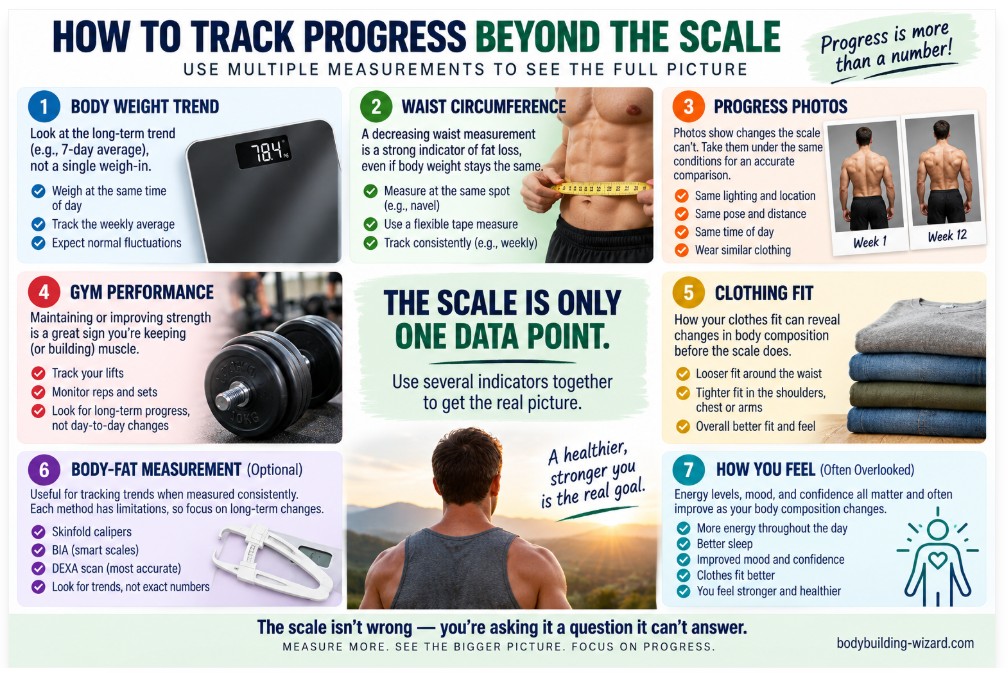
A stalled scale on its own isn’t proof of recomposition — it’s also consistent with simply not losing fat. Reading this correctly requires looking at several signals together: body weight trend, waist circumference, progress photos, gym performance, clothing fit, and a body composition measurement if you have access to a reasonably consistent one.
Coach’s Note: As a coach, I rarely judge a lifter’s progress from a single scale reading. I want to know what the weight trend is doing over several weeks, whether waist circumference is changing, how the physique looks under similar conditions, and whether strength and training performance are being maintained or improved. A scale tells me total mass. It does not tell me what changed inside that mass.
A simple checklist worth using: 7-day average body weight, waist circumference, progress photos under similar conditions, gym performance, clothing fit, and an optional body-fat measurement if you want one more data point.
How to Tell If You’re Losing Fat and Gaining Muscle
This deserves a proper section of its own, not just a checklist buried in a coaching aside.
Your body weight is stable or falling slowly. The scale trend alone isn’t enough — but a stable or gently declining trend, combined with the signals below, starts to paint a real picture.
Your waist circumference is decreasing. This is a genuinely interesting signal, specifically when it happens alongside a similar or stable average body weight — it suggests the composition underneath is shifting even if the total mass isn’t moving much.
Your progress photos are improving. Taken under consistent conditions — same lighting, distance, pose, and roughly the same time of day — so you’re comparing like with like rather than reading into lighting or pump differences.
Your gym performance is stable or improving. Particularly useful during a recomposition attempt, though it’s worth being precise: strength gain and muscle gain are related but not identical, so this is a supporting signal, not proof on its own.
Your clothes fit differently. Looser at the waist, different fit through the shoulders, chest, or thighs — a practical, low-effort data point most people already notice without trying.
No single one of these proves that you gained muscle and lost fat. The pattern across several measurements over time is far more informative than any one data point in isolation.
Why Your Weight Can Increase When You Start Strength Training
A short but important detour, since this trips up a lot of new lifters specifically.
Glycogen and water can increase relatively quickly. A new training stimulus, often paired with higher carbohydrate intake to support it, increases glycogen storage — and each gram of stored glycogen holds roughly 3 grams of water alongside it. That alone can move the scale before any new muscle tissue exists, a pattern covered in more depth in our lean body mass guide.
Exercise can temporarily increase fluid retention, especially after a new or noticeably harder training program than the body is used to.
Actual muscle gain occurs much more slowly. This is the piece that matters most. Someone gains 1.5 kg after two weeks in the gym, and the internet tells them, “don’t worry, muscle weighs more than fat!” That’s not accurate reassurance — 1.5 kg of new skeletal muscle in two weeks is essentially not physiologically realistic for the vast majority of lifters.
Don’t automatically label every increase on the scale after starting resistance training as muscle gain. Early changes often include glycogen, water, gut content, and normal day-to-day fluctuation, long before enough new muscle tissue has actually accumulated to explain the full change. For the fuller picture on how much of that overnight scale jump could ever realistically be fat (or muscle), see How Much Fat Can You Gain in a Day?
Does Muscle Make You Look Smaller or Bigger?
Both can be true, depending on what you’re actually comparing. If you replace a given amount of fat tissue with muscle, you can genuinely look smaller in circumference and leaner at the same body weight — the density difference covered earlier in this guide. But building a substantial amount of new muscle can just as legitimately increase circumference at the shoulders, chest, arms, and thighs. “Muscle takes up less space, therefore gaining muscle makes you smaller” is an oversimplification — it depends entirely on whether you’re comparing muscle replacing fat at a fixed total mass, or muscle simply being added on top of what was already there.
Does Muscle Burn More Calories Than Fat?
Yes — skeletal muscle is more metabolically active than adipose tissue at rest. But the effect of any single additional kilogram of muscle on total daily energy expenditure is genuinely modest, not the dramatic “every pound of muscle burns 50 extra calories a day” claim that circulates in fitness content. Skeletal muscle burns roughly 13 kcal per kilogram per day at rest, a real but far smaller number than the popular myth suggests — organs like the brain, liver, heart, and kidneys, which together make up only about 5% of body weight, account for roughly 60% of total resting energy expenditure on their own.
Can Muscle Turn Into Fat If You Stop Training?
No. Muscle cells do not become fat cells — they’re entirely different tissue types. What can genuinely happen is muscle loss occurring alongside fat gain, if training stimulus and activity decline while energy intake stays too high. That combination can create the visual and scale-weight impression that “muscle turned into fat,” but it’s actually two separate processes happening in the same direction at the same time, not one tissue converting into the other.
Can Fat Turn Into Muscle?
No, for the same reason — these are different tissues entirely. What you can do is lose fat while building muscle under the right conditions, which is a completely different (and completely real) process. Full guide: Body Recomposition: Can You Lose Fat and Build Muscle at the Same Time?
What Matters More: Body Weight or Body Composition?
Not “ignore body weight” — that overcorrects in the wrong direction. The better framing: use body weight as one measurement, not the entire definition of progress. For the complete picture on this distinction, see our body composition guide.
Muscle vs. Fat During a Cut
The goal was never simply “lose weight” — it’s lose predominantly fat while preserving as much muscle as practically possible. For the complete strategy on exactly how to do that, see How to Lose Fat Without Losing Muscle.
Muscle vs. Fat During a Bulk
Similarly, the goal isn’t “gain as much weight as possible” — it’s to build muscle while keeping unnecessary fat gain in check.
The “Muscle Weighs More Than Fat” Myth: What People Actually Mean
Muscle does not weigh more than fat when you compare equal weights. Muscle is denser than fat, which means an equal mass generally occupies less space. To put it as precisely as this topic deserves:
❌ Muscle weighs more than fat.
✅ Muscle is denser than fat.
✅ At the same volume, muscle weighs more.
❌ Gaining muscle always makes you look smaller.
✅ At the same weight, fat occupies more volume.
Coach’s Note: Stop Asking the Scale to Measure What It Can’t Measure
The scale is not inaccurate — it is simply answering a different question. It tells you how much you weigh, not how much muscle you gained, how much fat you lost, or whether your physique improved. The scale does its job perfectly. The problem is that people ask it a question it was never built to answer.
Bodybuilder’s Take
Same weight doesn’t mean same physique. Build muscle, manage body fat, and use the scale as data — not as your physique score.
Key Takeaways
- ✓A pound of muscle and a pound of fat weigh exactly the same — the real difference is density, not weight.
- ✓Muscle is roughly 15% denser than fat, so the same mass of muscle takes up meaningfully less space.
- ✓You can lose fat, gain muscle, and look completely different while the scale barely moves.
- ✓A stalled scale after starting resistance training isn’t automatic proof of recomposition — glycogen, water, and food content all add noise early on.
- ✓An early scale-weight increase after starting training is far more likely to be glycogen and water than new muscle tissue — real muscle gain takes much longer.
- ✓Muscle burns more calories than fat at rest, but the effect per kilogram is modest, not a metabolic superpower.
- ✓Muscle cannot turn into fat, and fat cannot turn into muscle — they’re separate tissue types.
- ✓The scale isn’t wrong — it’s just answering a different question than “how has my physique changed.”
Frequently Asked Questions About Muscle vs. Fat
Does muscle weigh more than fat?
No. A pound of muscle and a pound of fat weigh exactly the same. Muscle is denser, meaning the same weight of muscle takes up less space than the same weight of fat.
Which takes up more space, muscle or fat?
Fat takes up more space than muscle at the same weight, because muscle tissue is roughly 15% denser than adipose tissue.
What does 5 pounds of muscle vs. fat look like?
Both weigh exactly 5 pounds, but the fat occupies a noticeably larger volume due to its lower density — the classic comparison images represent this difference approximately, not as an exact universal depiction.
Is muscle denser than fat?
Yes. Skeletal muscle density is approximately 1.06 kg per liter, compared to approximately 0.92 kg per liter for adipose tissue.
Can you weigh the same but look thinner?
Yes — this happens when fat mass decreases and muscle mass increases by a similar amount, changing your body composition and appearance without changing your total body weight.
Why am I losing inches but not weight?
Losing inches while body weight stays similar can be consistent with improving body composition, particularly when waist circumference is decreasing and training performance is stable or improving. However, hydration, glycogen, bloating, and measurement technique can also affect circumference, so look for a consistent trend over time rather than reading too much into a single measurement.
Does muscle burn more calories than fat?
Yes, skeletal muscle is more metabolically active than fat at rest, burning roughly 13 kcal per kilogram per day — a real but modest effect, not the dramatic “50 calories per pound” figure often claimed.
Can muscle turn into fat?
No. Muscle and fat are different tissue types that cannot convert into one another. Losing muscle while gaining fat can happen simultaneously, which sometimes creates that impression.
Can fat turn into muscle?
No, for the same reason — they’re separate tissues. You can, however, lose fat while building muscle simultaneously through body recomposition.
Should I track body weight or body fat percentage?
Both, alongside other signals like waist circumference and photos — body weight alone can’t distinguish fat loss from muscle loss or gain, so tracking multiple measures together gives a far more complete picture.
- Correction on lean mass and fat density claims, citing Méndez, J. & Keys, A. (1960). Density and composition of mammalian muscle. Metabolism, 9, 184–188. pmc.ncbi.nlm.nih.gov/PMC3445233
- Anatomical and ontogenetic influences on muscle density, confirming Méndez & Keys (1960) muscle density values across 594 measured muscles. pmc.ncbi.nlm.nih.gov/PMC7822901
- Wang, Z., Ying, Z., Bosy-Westphal, A., et al. (2010). Specific metabolic rates of major organs and tissues across adulthood: evaluation by mechanistic model of resting energy expenditure. American Journal of Clinical Nutrition, 92(6), 1369–1377. pmc.ncbi.nlm.nih.gov/PMC2980962
