



Most lifters think they only have two options. Bulk, and gain muscle along with some fat. Or cut, and lose fat while risking some muscle along with it. Pick your poison.
There’s a third option most people don’t realize is on the table: gaining muscle while losing body fat at the same time. That’s body recomposition.
Body recomposition is physiologically real — but how achievable it is for you specifically depends heavily on your training experience, starting body fat level, diet, training quality, and energy availability. This isn’t a “yes, anyone can build muscle while getting shredded” article. It’s a “here’s exactly when this works, when it doesn’t, and how to run it properly” article.
QUICK ANSWER: Yes, you can lose fat and build muscle at the same time. This process is called body recomposition. It’s most achievable in beginners, detrained lifters, people with higher body-fat levels, and trainees whose previous training or nutrition was poorly optimized. Experienced, lean lifters can sometimes recomp too, but muscle gain becomes progressively slower and harder to achieve while simultaneously losing fat. Successful recomposition requires sufficient protein, progressive resistance training, appropriate energy intake, and enough time — it isn’t fast, and it isn’t automatic.
What Is Body Recomposition?
Body recomposition is the simultaneous reduction of fat mass and increase of skeletal muscle mass — a change in the ratio between the two components covered in our body composition guide, rather than a change in overall body weight.
Body Recomposition Is Not the Same as Weight Loss
Here’s the example that makes this click:
- Before: 80 kg = 16 kg fat + 64 kg fat-free mass
- After: 80 kg = 12 kg fat + 68 kg fat-free mass
On the scale: zero change. On the body: a dramatically different physique — 4 kg less fat, 4 kg more muscle, same total weight. This is exactly why body weight is such a poor tool for tracking recomposition specifically, even though it’s a perfectly fine tool for tracking a straightforward cut or bulk. For the science behind why identical weight can look so different, see Muscle vs. Fat: Which Weighs More and Takes Up More Space?
Recomposition vs. Cutting vs. Bulking
| Goal | Muscle | Fat | Body Weight | Energy Intake |
|---|---|---|---|---|
| Cut | Preserve | ↓ | ↓ | Deficit |
| Lean bulk | ↑ | Ideally minimal ↑ | ↑ | Surplus |
| Recomp | ↑ | ↓ | ↔︎ / small change | Context-dependent |

Can You Really Build Muscle and Lose Fat at the Same Time?
Yes — and understanding why requires looking at what each process actually demands from your body. Fat loss requires mobilizing stored energy from adipose tissue. Muscle hypertrophy requires a training stimulus, sufficient amino acids, and adequate available energy for the repair and building process. These aren’t automatically mutually exclusive requirements.
Fat Cells and Muscle Cells Are Separate Tissues
This is the key conceptual point people miss: your body doesn’t have to be in an identical “energy state” in every tissue at once. Adipose tissue can release stored energy for use elsewhere in the body while skeletal muscle simultaneously responds to a resistance-training stimulus and the amino acids from dietary protein. One tissue releasing energy and another tissue using that energy to rebuild and grow isn’t a contradiction — it’s two different tissues responding to two different signals at the same time.
To be precise about what’s actually happening: fat does not turn into muscle. They’re entirely different tissue types with entirely different biological roles — see Essential Fat vs Storage Fat for the full picture of what fat tissue actually is and does. Fat loss and muscle gain are two separate, parallel processes that can run concurrently under the right conditions — not one process converting into the other.
What Does the Research Say About Body Recomposition?
This isn’t a fringe internet theory — it’s a documented, if nuanced, area of exercise science research.
Beginners and Untrained Individuals
The strongest and most consistent evidence for simultaneous muscle gain and fat loss comes from people new to resistance training, who experience a uniquely large adaptive response to a training stimulus their body has never encountered before.
Resistance-Trained Individuals
This is the point worth stressing hardest, because it’s where most generic fitness content gets it wrong: recomposition isn’t exclusive to beginners. A comprehensive review examining body recomposition specifically in trained populations found a meaningful body of evidence for simultaneous fat loss and muscle gain in resistance-trained lifters — the magnitude is smaller, and the conditions matter more than they do for beginners, but it isn’t restricted to novices the way a lot of fitness content implies.
Recomposition During an Energy Deficit
In a controlled trial using a substantial energy deficit combined with intense resistance and interval training, a higher-protein group (2.4 g/kg/day) gained 1.2 kg of lean mass while losing 4.8 kg of fat mass over four weeks — genuine simultaneous muscle gain and fat loss inside a real, meaningful deficit. The lower-protein group in the same study saw a much smaller lean mass benefit, underscoring how much protein intake matters for this specific outcome.
High-Protein Diets and Recomposition
Protein intake shows up as a recurring variable across the recomposition literature, not just the general muscle-building literature — the studies that show the clearest simultaneous fat loss and muscle gain consistently use protein intakes toward the higher end of the effective range, not the population-average minimums.
Evidence Verdict: Body recomposition is real. It is not equally likely — or equally fast — for everyone.
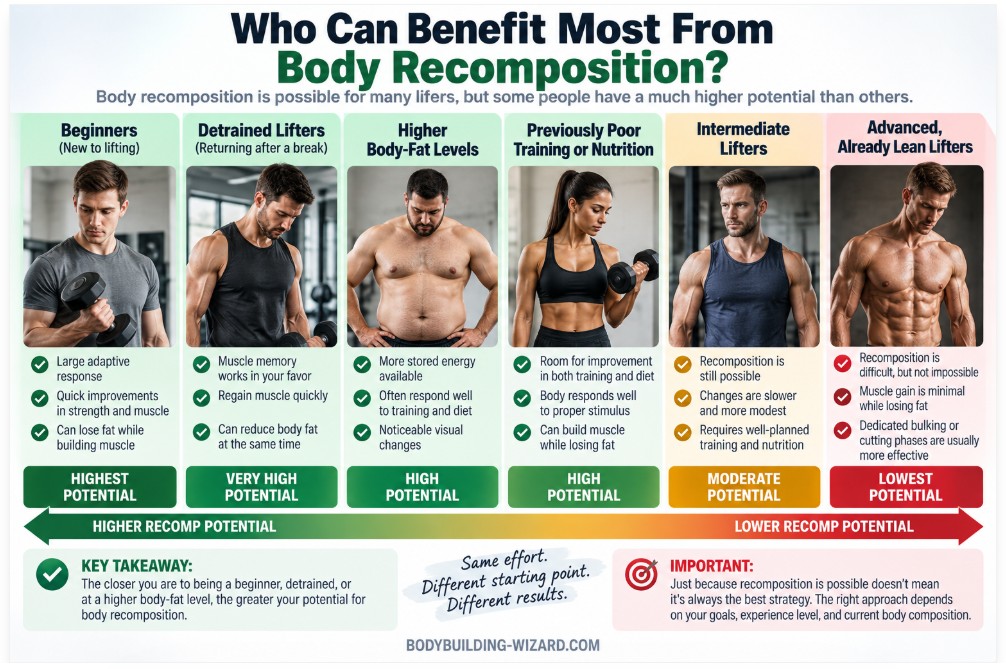
Who Can Build Muscle and Lose Fat at the Same Time?
This is arguably the single most useful section of this entire guide.
Beginners have the highest recomposition potential of any group — a novel training stimulus combined with a large adaptive reserve their body hasn’t yet used up.
Detrained lifters returning after a layoff often recomp surprisingly fast. Part of this may relate to “muscle memory” — early research identified myonuclei added during a previous period of training that weren’t lost during subsequent detraining, a proposed mechanism for why previously trained muscle can respond faster on retraining. It’s worth being precise here: more recent work on this exact mechanism has produced mixed results, with some studies confirming myonuclear permanence and others finding myonuclei can be lost during extended detraining. The practical, well-established observation—previously trained lifters generally regain size and strength faster than true beginners build it the first time—holds up regardless of which specific cellular mechanism turns out to be the full explanation.
People with higher body-fat levels have more stored energy available to draw on during a deficit, which supports the energy demands of muscle building alongside fat loss. To be precise about the mechanism: this doesn’t mean body fat “directly fuels” muscle protein synthesis — it means a larger energy reserve gives more room for a deficit that still leaves enough available energy for the muscle-building process to function.
Lifters with previously poor training or nutrition are an underrated recomp candidate — someone can have trained for years and still have real recomp potential left if their program never actually applied a proper hypertrophy stimulus or their diet never supported it.
Intermediate lifters can generally still recomp, just more slowly than beginners.
Advanced, lean lifters face the steepest climb — not an impossible one, but a progressively slower and less likely one the closer someone gets to their natural muscular ceiling.

Who Should NOT Make Recomposition Their Primary Goal?
Most articles on this topic only tell you who recomp works well for. Here’s who it doesn’t serve well as a primary strategy.
- Very lean, advanced lifters trying to maximize muscle gain are usually better served by a controlled surplus — trying to drop further body fat while building muscle slows the process this group needs most.
- Physique athletes preparing for competition have a primary goal of fat loss with muscle retention, not new hypertrophy — treating contest prep as a recomp phase sets the wrong expectation.
- Underweight lifters have no good reason to run any kind of deficit at all — this is also, notably, the opposite profile from someone with The Skinny Fat Body Type, who is often one of the best possible recomp candidates precisely because they combine low muscle mass with higher relative body fat.
- People who need fast, predictable results on a deadline should look elsewhere — recomposition is a genuinely slow process by nature.
The bigger message here: just because recomposition is possible doesn’t mean it’s always the best strategy for a given person at a given time.
Do You Need a Calorie Deficit for Body Recomposition?
Not necessarily — this depends heavily on who’s asking.
Recomp in a calorie deficit works best for beginners, detrained lifters, and people carrying more body fat, where there’s enough of an adaptive reserve or energy reserve to support both processes at once.
Recomp around maintenance calories is often the most practical option for intermediate lifters — neither a surplus nor a deficit, just consistent training and adequate protein at a stable energy intake.
Finally, recomp in a calorie surplus is technically possible in one specific sense: body fat percentage can decrease even while you run a small surplus, if muscle mass increases faster than fat mass. This nuance matters: a lower body-fat percentage isn’t the same as actual fat loss—if fat mass stays flat or rises slightly while muscle mass rises faster, the percentage improves because the denominator changes, not because you’re carrying less fat.
How Large Should Your Calorie Deficit Be?
There’s no single universal number here, and treating one figure as the answer for everyone (like “300 calories below maintenance”) oversimplifies a real trade-off: a larger deficit produces faster fat loss but creates a generally less favorable environment for muscle gain and retention, while a smaller deficit slows fat loss but better supports training performance and lean-tissue outcomes.
This trade-off isn’t just theoretical. In a study comparing weight-loss rates in elite athletes, a slower rate of loss (0.7% of body weight per week) produced a meaningful lean body mass increase, while a faster rate (1.4% per week) left lean mass essentially unchanged — despite both groups losing a similar amount of fat mass. The rate of loss, not just the total amount lost, materially changes what happens to muscle along the way.
Several factors shift where in that range you should sit:
- Starting body fat — higher starting body fat generally tolerates a larger deficit without sacrificing recomp potential
- Training experience — beginners can generally tolerate a larger deficit than advanced lifters and still recomp
- Rate of weight loss — slower, more conservative loss rates consistently favor better lean mass outcomes across the research on this topic, covered in full for lifters running a straightforward cut in How to Lose Fat Without Losing Muscle.
How Much Protein Do You Need for Body Recomposition?
Why Protein Requirements Can Rise During a Deficit
Protein needs during active fat loss run higher than general population recommendations, because adequate protein specifically helps protect existing muscle tissue while the body is in an energy-restricted state — the exact condition under which muscle loss risk is elevated.
Protein Intake for Resistance-Trained Lifters
According to the International Society of Sports Nutrition’s position stand on protein, daily intakes of 1.4–2.0 g/kg are generally sufficient for most exercising individuals, with evidence that higher intakes can further support outcomes during fat-loss phases. For recomposition specifically, aiming toward the higher end of the effective range (roughly 1.8–2.4 g/kg) is a reasonable, evidence-consistent target.
Does More Protein Always Mean Better Recomposition?
No. Protein intake has a point of diminishing returns — pushing well past the upper end of the effective range doesn’t produce proportionally better results, and simply crowds out calories that could otherwise support training performance or overall diet adherence.
Protein Distribution Across the Day
Spreading protein intake across 3–5 meals, each containing a meaningful dose, is a practical and sensible approach — without needing to obsess over a precise “anabolic window” immediately after training.
How Should You Train for Body Recomposition?
This section matters more than almost anything else in this guide, because it’s where recomp attempts most commonly go wrong. Recomp training is not light weights and high reps in an attempt to “burn fat” — that approach undermines the exact muscle-building stimulus recomposition depends on.
- Progressive resistance training is the foundation — the single most important variable in the entire equation
- Training volume should stay at a level that continues to challenge the muscle, not get slashed just because you’re in a deficit
- Training intensity/load needs to remain high enough to drive a real hypertrophy stimulus
- Proximity to failure on working sets matters for maintaining the stimulus, especially as energy availability tightens
- Progressive overload — some form of continued progression (load, reps, or volume) needs to keep happening, even if more slowly than in a surplus
- Exercise selection should stay consistent enough to track real progress on key lifts
- Training frequency per muscle group should be maintained, not cut back
- Maintaining strength during fat loss is one of the best available proxies that muscle is actually being preserved or built, not just lost more slowly than fat
The key coaching takeaway: don’t turn your hypertrophy program into a calorie-burning circuit just because you’re trying to lose fat. That’s one of the most common ways a promising recomp attempt quietly turns into simple, unremarkable fat loss with no muscle gain to show for it.
Do You Need Cardio for Body Recomposition?
No — but it can help, within limits.
Cardio contributes to overall energy expenditure, supports cardiorespiratory health, builds work capacity, and can support the fat-loss side of the equation. But it needs to support resistance training, not compete with it — a systematic review comparing resistance, aerobic, and concurrent training found aerobic training produced somewhat greater fat mass reduction but less fat-free mass retention compared to resistance training alone, with concurrent (combined) training landing in between — a reasonable practical middle ground as long as the volume doesn’t compromise resistance training quality or recovery.
Steps and NEAT (non-exercise activity thermogenesis) matter more than people expect — daily activity outside of structured training sessions contributes meaningfully to total energy expenditure and is generally easier to sustain consistently than adding more formal cardio sessions.
How Important Are Sleep and Recovery?
This isn’t a generic “sleep 8 hours because recovery matters” note — there’s a specific, documented mechanism worth understanding. In a controlled trial, dieters restricted to 5.5 hours of sleep lost the same total weight as a well-rested group on the identical diet, but far less of that weight came from fat, and far more came from fat-free mass. For a goal focused on which tissue changes, not just total weight change, this makes sleep a direct, mechanistic lever on recomposition outcomes — not just a general wellness recommendation.
Stress and recovery matter too, though not through the oversimplified “cortisol makes you fat” framing that circulates in fitness content — chronic under-recovery affects training quality, appetite regulation, and consistency, all of which affect recomposition more directly than any single hormone acting alone. Full context on this hormonal picture: Hormonal Regulation of Fat Storage.
How Long Does Body Recomposition Take?
Longer than most people expect — and understanding why prevents a lot of unnecessary frustration.
Why the Scale May Barely Move
Because fat loss and muscle gain are happening simultaneously and partially offsetting each other on the scale, weekly weigh-ins during a genuine recomp often look almost flat, or move in small, inconsistent directions — a very similar pattern to what shows up in Body Fat Set Point, which is exactly why body weight is the wrong primary metric for this specific goal. It’s also worth understanding just how little of a single day’s weight swing could ever be real fat in the first place — see How Much Fat Can You Gain in a Day?
What Changes Should You Expect First?
In roughly this order: strength trends improving, waist measurement trending down, progress photos showing visible change, other body measurements shifting — with body weight typically the last and least informative signal to move.
Beginners vs. Advanced Lifters
Beginners can see meaningful recomposition within a few months. Advanced lifters should expect a much slower timeline, measured in many months rather than weeks — there’s no honest version of “you’ll recomp in 8 weeks” as a universal promise, and any content making that claim is overselling the timeline.
How Do You Know If Body Recomposition Is Working?
Don’t rely on the scale alone — track multiple signals together.
| Signal | Fat Loss | Muscle Gain | Good Recomp Sign |
|---|---|---|---|
| Waist ↓ | ✓ | ✓ | |
| Strength ↑ | ✓ | ✓ | |
| Weight stable | Potentially ✓ | ||
| Photos leaner/more muscular | ✓ | ✓ | ✓ |
Track weekly average body weight (not single daily readings), waist circumference, progress photos, gym performance, body composition measurements if you use them, and how your clothes fit — the combination tells a far more reliable story than any single metric in isolation.
Why Isn’t My Body Recomposition Working?
A practical troubleshooting checklist, roughly in order of how often each one turns out to be the actual culprit:
- Your deficit is too aggressive — undermining the muscle-building half of the equation
- You’re not actually in the energy intake range you think you are — tracking accuracy problems are extremely common
- You’re not eating enough protein — especially relative to the higher end recomp requires
- Your training has no progressive stimulus — going through the motions without actually overloading the muscle
- You’re doing too much cardio — competing with, rather than supporting, the resistance training stimulus
- You’re changing programs too often — never staying with one approach long enough to see if it’s working
- You’re not recovering — inadequate sleep, chronic stress, or insufficient rest between sessions
- You’re already very lean and advanced — the group for whom this is genuinely hardest, not a sign anything is being done wrong
- You’re expecting results too quickly — the single most common reason people incorrectly conclude recomp “isn’t working” when it actually is, just slowly
Body Recomposition for Beginners
Calories: at or slightly below maintenance is usually appropriate — beginners rarely need an aggressive deficit to see real recomp progress. Protein: 1.6–2.2 g/kg, on the higher end if body fat is elevated. Training: a structured, progressive resistance program covering all major muscle groups, 3–4 times per week. Cardio/activity: light to moderate, mainly for general health and daily activity rather than as a primary fat-loss driver. Expected progress: meaningful visible and measurable change within 8–16 weeks, faster than any other group covered in this guide.
Body Recomposition for Intermediate and Advanced Lifters
Why Recomp Becomes Less Efficient
As training age increases and body fat drops, the adaptive reserve that makes recomposition easy for beginners is largely already used up. Both processes—fat loss and muscle gain—become individually harder, making them even harder to run simultaneously.
Maintenance Phases, Mini-Cuts, and Lean Bulks
For this population, cycling deliberate, focused phases — a maintenance period, a short mini-cut, a dedicated lean bulk — often produces better long-term results than an extended attempt to recomp indefinitely.
When Dedicated Phases Become More Efficient
Once someone trains with real intent and sits at a moderate-to-lean body fat level, dedicated bulking and cutting phases generally outperform a prolonged recomp attempt, simply because each phase can fully commit to the energy balance that specific goal needs.
Body Recomposition for Men vs. Women
The core principles don’t change by sex — protein, progressive resistance training, and appropriate energy intake matter identically for both. What differs are some underlying variables:
- Baseline body fat — women carry meaningfully higher essential fat, covered in full in Gender Differences in Fat Distribution
- Sex hormones — different hormonal environments influence fat distribution and, to some degree, muscle-building rate
- Fat distribution patterns — differ by sex independent of total body fat percentage
- Menstrual cycle and fluid fluctuations — can add noise to short-term weight and measurement tracking that isn’t present for men
- Energy availability considerations — particularly relevant for women training at high volume with insufficient intake
None of this means women need a “completely different” recomp approach — it means a few contextual factors are worth accounting for when interpreting week-to-week data.
Recomp vs. Bulk and Cut: Which Strategy Is Better?
Neither — this decision depends on individual context, not a single universal winner.
| Your Situation | Best Starting Strategy |
|---|---|
| Beginner + higher body fat | Recomp |
| Beginner + lean | Recomp or slight surplus |
| Detrained lifter | Recomp |
| Intermediate + moderate body fat | Recomp or cut, depending on goal |
| Advanced + lean | Lean bulk |
| Advanced + higher body fat | Cut |
| Contest prep | Cut |
A simple decision path: New to lifting, or returning after time off? Recomp is usually the right call. Carrying more fat than you’d like, regardless of training age? Recomp or a cut both work, with recomp often the more sustainable psychological choice. Already lean and experienced, chasing new muscle? A dedicated lean bulk will get you there faster than a recomp attempt will. Already lean and experienced, needing to drop the last bit of fat for a specific goal or event? A focused cut, not a recomp, is the right tool.

A Practical Body Recomposition Framework
- Establish your starting point — record body weight, waist measurement, progress photos, and current training performance before changing anything
- Set energy intake — deficit, maintenance, or small surplus, based on your candidate profile from the sections above
- Set protein — toward the higher end of the effective range, roughly 1.8–2.4 g/kg
- Follow a progressive resistance program — one that maintains volume, intensity, and frequency rather than shrinking under deficit pressure
- Keep daily activity consistent — steps and general NEAT, not just formal training sessions
- Recover — prioritize sleep and manage overall stress load, given the direct evidence linking sleep to which tissue actually changes
- Assess progress after several weeks — not after a few days; recomposition needs real time to show up in the data
- Adjust only one variable at a time — so you actually know what caused any change you see
Coach’s Note: Recomposition is psychologically harder than a straightforward cut or bulk, and it’s not because the training or nutrition is more complicated — it’s because the scale doesn’t reward you the way it does with the other two. During a cut, you see 80, 79, 78 and get a hit of feedback every week. During a bulk, you see 80, 81, 82, and it’s the same story in reverse. During a real recomp, you see 80, 80, 79.8, 80.2 — and it looks like nothing is happening. I’ve had clients convinced their program had failed after six weeks of exactly that pattern, right before their waist measurement and their squat both told a completely different story. The body was absolutely changing. The scale was just the wrong instrument to see it with.
Bodybuilder’s Take
Recomposition is not a shortcut around bulking and cutting. It’s a specific strategy that works extremely well for the right lifter at the right time — and a genuinely inefficient one for the wrong lifter at the wrong time. Beginner? Great opportunity. Returning after time off? Great opportunity. Carrying more body fat than you’d like? Often a very useful approach. Advanced and already lean, chasing maximum new muscle? Dedicated phases are usually the more efficient tool. Knowing which category you’re actually in matters more than picking whichever strategy sounds the most appealing.
Common Body Recomposition Myths
❌ Myth: You must be in a calorie surplus to build any muscle.
✅ Reality: Muscle can be built at maintenance and even in a moderate deficit, particularly for beginners, detrained lifters, and those carrying more body fat — a surplus helps but isn’t an absolute prerequisite for every population.
❌ Myth: Fat turns into muscle during recomp.
✅ Reality: Fat and muscle are entirely separate tissue types. Fat loss and muscle gain are two parallel processes happening at the same time, not one converting into the other.
❌ Myth: Only beginners can recomp.
✅ Reality: Resistance-trained individuals show documented recomposition too — the conditions matter more and the magnitude is smaller, but it isn’t beginner-exclusive.
❌ Myth: You need to eat at exact maintenance calories for recomp to work.
✅ Reality: Recomposition has been demonstrated across a deficit, at maintenance, and in some cases at a small surplus — the “exact maintenance” framing is far more rigid than the actual evidence supports.
❌ Myth: More cardio means faster recomposition.
✅ Reality: Excess cardio can compete with the resistance training stimulus recomposition depends on — more isn’t automatically better past a reasonable, supportive amount.
❌ Myth: The scale must go down for recomp to work.
✅ Reality: A stable or even slightly fluctuating scale weight is a normal, expected feature of genuine recomposition, not evidence it’s failing.
❌ Myth: Recomp is always better than bulking and cutting.
✅ Reality: For advanced, already-lean lifters chasing maximum hypertrophy, a prolonged recomp attempt is often just a slower way to accomplish very little — dedicated phases are frequently the more efficient tool for that specific group.
❌ Myth: You can recomp indefinitely.
✅ Reality: Recomposition potential is a finite, adaptive reserve that shrinks as training age increases and body fat drops — it isn’t a permanent state you stay in forever.
Key Takeaways
- ✓Body recomposition is possible, but its rate and likelihood depend heavily on training status, starting body fat, energy intake, protein intake, and training quality.
- ✓A stable scale weight does not mean your body isn’t changing — it’s an expected feature of real recomposition, not a failure signal.
- ✓Fat does not turn into muscle — they’re separate tissues undergoing two parallel processes at once.
- ✓Beginners, detrained lifters, and people with higher body fat have the greatest recomposition potential.
- ✓Resistance-trained individuals can recomp too — it’s not exclusive to beginners, just slower and more condition-dependent.
- ✓Higher protein intake (roughly 1.8–2.4 g/kg) is one of the most consistently supported levers for successful recomposition.
- ✓Progressive resistance training — not high-rep “fat-burning” circuits — is the foundation of a successful recomp.
- ✓Advanced, already-lean lifters chasing maximum hypertrophy are usually better served by dedicated bulk and cut phases than a prolonged recomp attempt.
- ✓Sleep restriction specifically shifts weight loss away from fat and toward fat-free mass — recovery is a direct lever on recomposition outcomes, not just a wellness add-on.
- ✓Recomposition is a tool for the right lifter at the right time — not a universally superior alternative to bulking and cutting.
Frequently Asked Questions About Body Recomposition
Can you really lose fat and gain muscle at the same time?
Yes. This is called body recomposition, and it’s documented in beginners, detrained lifters, and even resistance-trained individuals under the right conditions of protein intake, training, and energy balance.
How many calories should I eat for body recomposition?
It depends on your profile — beginners and those with higher body fat often do well at maintenance or a moderate deficit, while intermediate lifters frequently see the best results right around maintenance calories.
Should I be in a calorie deficit for body recomposition?
Not necessarily. A deficit works well for beginners and people with more body fat to lose, but many lifters — especially intermediates — recomp successfully at maintenance calories instead.
How much protein do I need for body recomposition?
Roughly 1.8–2.4 g per kg of body weight is a reasonable, evidence-consistent target — toward the higher end of what’s generally recommended for resistance-trained individuals.
How long does body recomposition take?
Beginners can see meaningful change within 8–16 weeks. Advanced lifters should expect a much longer timeline, often many months, since both fat loss and muscle gain individually slow down with training age.
Can experienced lifters recomp?
Yes, though it’s slower and more condition-dependent than for beginners. Research specifically on resistance-trained individuals shows it’s achievable, just not as fast or as automatic as it is for newer trainees.
Should I do cardio during body recomposition?
Cardio isn’t required, but a moderate amount can support fat loss and cardiorespiratory health without necessarily hurting muscle gain, as long as it doesn’t come at the expense of resistance training volume or recovery.
How do I know whether I should recomp, bulk, or cut?
It comes down to training experience and current body fat: beginners and detrained lifters generally do best with recomp, advanced lean lifters chasing muscle do better with a dedicated lean bulk, and advanced lifters carrying more fat are usually better served by a focused cut.
References
- Barakat, C., Pearson, J., Escalante, G., Campbell, B., & De Souza, E. O. (2020). Body Recomposition: Can Trained Individuals Build Muscle and Lose Fat at the Same Time? Strength and Conditioning Journal, 42(5), 7–21. journals.lww.com
- Longland, T. M., Oikawa, S. Y., Mitchell, C. J., Devries, M. C., & Phillips, S. M. (2016). Higher compared with lower dietary protein during an energy deficit combined with intense exercise promotes greater lean mass gain and fat mass loss. American Journal of Clinical Nutrition, 103(3), 738–746. pubmed.ncbi.nlm.nih.gov/26817506
- Garthe, I., Raastad, T., Refsnes, P. E., Koivisto, A., & Sundgot-Borgen, J. (2011). Effect of two different weight-loss rates on body composition and strength and power-related performance in elite athletes. International Journal of Sport Nutrition and Exercise Metabolism, 21(2), 97–104. pubmed.ncbi.nlm.nih.gov/21558571
- Bruusgaard, J. C., Johansen, I. B., Egner, I. M., Rana, Z. A., & Gundersen, K. (2010). Myonuclei acquired by overload exercise precede hypertrophy and are not lost on detraining. PNAS, 107(34), 15111–15116. pnas.org
- Jäger, R., Kerksick, C. M., Campbell, B. I., et al. (2017). International Society of Sports Nutrition Position Stand: protein and exercise. Journal of the International Society of Sports Nutrition, 14, 20. pmc.ncbi.nlm.nih.gov/PMC5477153
- Nedeltcheva, A. V., Kilkus, J. M., Imperial, J., Schoeller, D. A., & Penev, P. D. (2010). Insufficient sleep undermines dietary efforts to reduce adiposity. Annals of Internal Medicine, 153(7), 435–441. news.uchicago.edu
- Systematic review and meta-analysis. Comparison of concurrent, resistance, or aerobic training on body fat loss. ncbi.nlm.nih.gov/PMC12107660
