


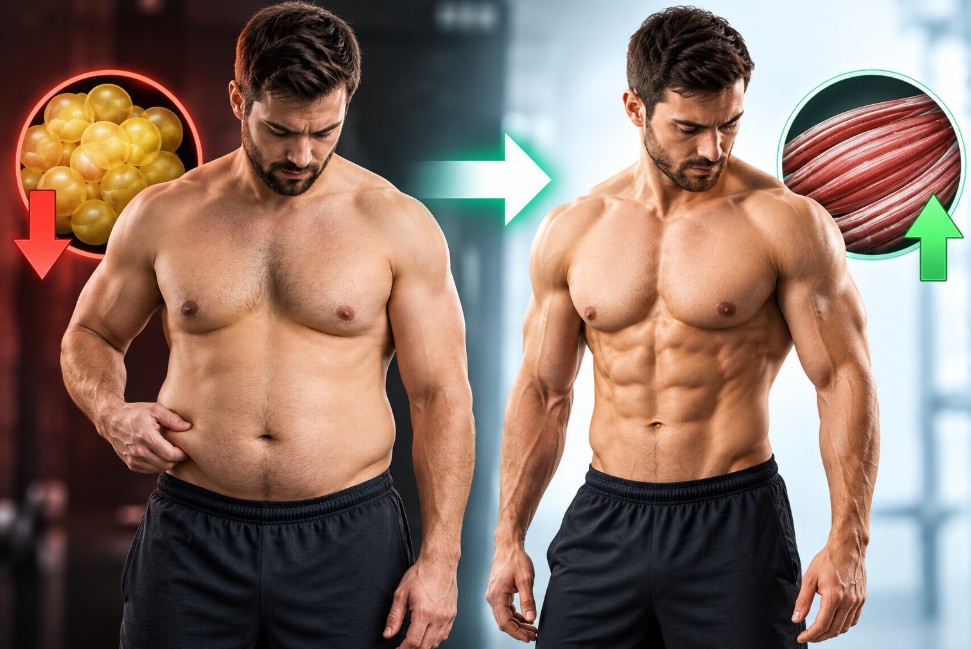
Losing Weight Is Easy. Losing the Right Weight Is Harder.
The scale can drop 5 kg during a diet, but it doesn’t tell you what that 5 kg actually was — body fat, muscle tissue, glycogen, water, or gut contents. Weight loss is not the same thing as fat loss, and that single distinction is the reason this guide exists.
The goal of a successful cut is not simply to lose weight. It is to maximize fat loss while preserving as much muscle, strength, and training performance as reasonably possible. The real question this entire guide answers is: what determines whether the weight you lose during a calorie deficit comes predominantly from fat rather than lean tissue?
For the underlying concepts behind why the scale can’t distinguish these tissues, see our guides on Muscle vs. Fat and What Is Body Composition?
QUICK ANSWER: To lose fat while minimizing muscle loss, use a moderate calorie deficit, eat enough protein, continue progressive resistance training, avoid unnecessarily rapid weight loss, manage cardio and overall training fatigue, and prioritize recovery. The leaner and more highly trained you are, the more conservative your approach generally needs to be. No strategy can guarantee that every kilogram lost comes exclusively from fat, so the goal is to maximize fat loss while preserving as much lean tissue and performance as possible.
First, Understand What You’re Actually Trying to Preserve
Weight Loss vs. Fat Loss
Weight loss is a change in total body mass. Fat loss is a change in one specific component of that mass. They overlap, but they’re not the same measurement, and conflating them is where most confusion about cutting starts.
Lean Body Mass vs. Muscle Mass
This distinction matters enormously here specifically. A drop in lean body mass on a DEXA or BIA scan is not automatically equal to skeletal muscle loss — lean mass includes water, glycogen, organs, and connective tissue alongside muscle. Full breakdown: Lean Body Mass Explained.
Why You Often Look “Smaller” Early in a Cut
Glycogen and its associated water drop early in a deficit, which can make muscles look visibly flatter within the first week or two. This does not automatically mean muscle tissue has been lost — it’s a real, common, and misleading early signal that catches a lot of people off guard. The same water-and-glycogen logic works in reverse after overeating — see How Much Fat Can You Gain in a Day? for the full picture on why the scale swings so much more than actual fat mass does.
Why Can You Lose Muscle During a Calorie Deficit?
Energy restriction changes the internal environment your body uses to maintain and build muscle. A few of the key mechanisms, without a full molecular biology lecture: the balance between muscle protein synthesis and breakdown shifts somewhat unfavorably during restriction, insufficient training stimulus fails to signal that muscle needs to be kept, inadequate protein removes the raw material needed for repair, low energy availability compounds all of the above, and increasing fatigue makes maintaining training quality harder. The risk generally grows with more aggressive or more prolonged dieting.
Who Is Most at Risk of Losing Muscle During a Cut?
Risk increases with: leanness, training experience/advancement, an aggressive calorie deficit, rapid weight loss, low protein intake, a poor resistance-training stimulus, excessive training or cardio load, poor recovery, and very prolonged dieting.
By contrast, a beginner or detrained individual carrying more body fat often has meaningfully better odds of losing fat and building muscle simultaneously — which is exactly the scenario covered in our Body Recomposition guide.

The Muscle-Retention Hierarchy
Not ten scattered hacks — a hierarchy, in order of how much each lever actually matters:
- Create an appropriate calorie deficit
- Eat enough protein
- Keep resistance training
- Control the rate of weight loss
- Manage training volume, cardio, and fatigue
- Support recovery and sleep
- Use supplements only as a minor addition
If you manage the first five poorly, no supplement will rescue your muscle mass.
1. Use a Calorie Deficit — But Don’t Make It More Aggressive Than Necessary
How Large Should Your Calorie Deficit Be?
No single magic number applies to everyone. The trade-off: a larger deficit produces faster scale loss, but potentially at a greater cost to recovery, performance, and muscle retention. A smaller deficit produces slower loss, but generally makes training and recovery easier and better protects lean tissue.
Does a Bigger Calorie Deficit Cause More Muscle Loss?
The risk generally increases as restriction becomes more aggressive, though starting body fat, protein intake, training quality, and diet duration all shape the actual outcome — this isn’t a fixed, linear relationship that applies identically to everyone.

2. How Fast Should You Lose Weight to Preserve Muscle?
This is one of the most important sections in this entire guide, and it deserves practical ranges rather than one rigid rule for everyone.
| Situation | Practical Starting Range |
|---|---|
| Higher body fat | ~0.75–1.0% BW/week may be reasonable |
| Moderate body fat | ~0.5–0.75% BW/week |
| Lean, trained lifter | ~0.5% BW/week or slower |
| Very lean / contest prep | Individualize; often toward the conservative end |
Table 1: Practical starting ranges for rate of weight loss by starting point
These are practical starting ranges, not physiological cutoffs. The appropriate rate depends on training status, starting body fat, diet duration, performance, recovery, and individual response to the deficit. For context on what “lean” or “very lean” actually means in practice, see our Healthy Body Fat Percentage guide.
The most detailed evidence-based review specifically covering resistance-trained, lean athletes recommends setting caloric intake to produce roughly 0.5–1% of body weight lost per week to maximize muscle retention during contest-style preparation — a genuinely useful anchor point, particularly for leaner, more advanced lifters. In elite athletes, Garthe et al. compared a slower (~0.7% body weight/week) with a faster (~1.4%/week) weight-loss approach. The slower-loss group increased lean body mass on average, whereas lean mass remained approximately unchanged in the faster-loss group — supporting a more conservative approach when preserving lean tissue and performance is a priority. One study doesn’t establish a universal ideal rate, but it’s a meaningful data point supporting the general direction recommended throughout this section.
The leaner and more advanced you are, the less reason you generally have to chase rapid weight loss.
3. Eat Enough Protein During Your Cut
Why Protein Becomes Especially Important During Fat Loss
Adequate protein supports amino acid availability for muscle repair, contributes to satiety during a period of restricted intake, directly supports muscle retention, and interacts favorably with the resistance training stimulus covered next.
How Much Protein Do You Need to Preserve Muscle?
Requirements depend on body size and composition, current leanness, the size of your deficit, training status, whether you’re resistance training, and total energy intake — which is exactly why blanket recommendations vary so much between sources.
The same review on lean, resistance-trained athletes suggests 2.3–3.1 g/kg of fat-free mass per day, scaling upward within that range as leanness increases and deficit severity grows. Other athlete-focused reviews recommend roughly 2.2–3.0 g/kg of total body weight per day instead. These aren’t necessarily contradictory recommendations — they reflect different populations, different underlying assumptions, and different ways of scaling protein intake, not a genuine disagreement about what actually works. For a broader, non-competitive population, the International Society of Sports Nutrition’s position stand suggests 1.4–2.0 g/kg body weight is generally sufficient, with higher intakes specifically supporting outcomes during active fat loss.
Should Protein Be Based on Body Weight or Lean Body Mass?
A genuinely important question for this specific audience. For someone carrying substantially more body fat, blindly multiplying a high protein target by total body weight can produce an unnecessarily large and impractical intake. In those cases, lean body mass, a goal body weight, or an appropriately adjusted body-weight target may provide a more practical basis — though this isn’t a claim that lean-mass-based scaling is universally superior for everyone; it’s a practical adjustment that matters most at higher body fat levels specifically.
Does Protein Timing Matter During a Cut?
Total daily protein intake matters far more than precise timing. Spreading protein across three to six meals, with a reasonable dose around training, is a sensible practical approach — without needing to treat timing itself as a decisive variable.
4. Keep Resistance Training While Losing Fat
Diet creates the conditions for weight loss. Resistance training gives your body a reason to retain muscle.
Should You Lift Heavy While Cutting?
Yes, generally — the popular idea of switching to light weights and high reps “for definition” doesn’t hold up. Muscle doesn’t know you’re cutting; it responds to the training stimulus in front of it, and that stimulus generally needs to stay meaningful to justify retaining the tissue. This doesn’t mean forcing every personal record regardless of accumulated fatigue — it means the underlying intensity and effort still need to be real.
Should You Reduce Training Volume During a Cut?
There’s no single evidence-based rule that everyone should slash training volume during a cut — the evidence here is genuinely less clear than for the deficit size and protein sections above. The goal is to maintain a sufficiently strong resistance-training stimulus while keeping total workload recoverable. If recovery deteriorates as the deficit progresses, some lifters may benefit from reducing volume rather than allowing training quality to collapse across the board — but this is a coaching judgment call, not a hard rule with strong evidence behind a specific volume reduction.
What If Your Strength Drops During a Cut?
Strength loss is not automatically muscle loss. Performance can decline because of lower glycogen, accumulated fatigue, shifting leverage with lower body weight, motivation, and reduced recovery capacity. That said, a persistent, substantial decline across multiple lifts over several weeks is a signal worth paying attention to, not something to automatically dismiss.
5. Don’t Turn Cardio Into a Muscle-Loss Machine
Does Cardio Cause Muscle Loss?
Not inherently. Problems tend to arise from excessive endurance volume, poor recovery management, a very aggressive deficit stacked on top of heavy cardio, inadequate protein, and poorly managed training interference and fatigue — not from cardio itself as a category. The relevant question is not whether cardio is “catabolic,” but whether the total combination of resistance training, cardio, calorie restriction, and recovery exceeds what the athlete can actually recover from. Current evidence generally supports that resistance exercise performed during caloric restriction helps preserve lean mass compared to restriction alone.
How Much Cardio Should You Do While Cutting?
Not “as much as possible.” Use it as a tool for additional energy expenditure and cardiovascular fitness, not as a penalty for eating.
Cardio vs. Steps: Which Is Better for Preserving Muscle?
Daily steps and general NEAT can often add meaningful energy expenditure with a smaller recovery cost than structured cardio sessions — genuinely useful, though not a universally superior replacement for all forms of cardio in every situation.
6. Don’t Ignore Carbohydrates
Protein is the priority macronutrient during a cut, but carbohydrate availability genuinely supports training performance and glycogen status.
Do You Need Carbs to Preserve Muscle?
Not in an absolute sense — muscle retention doesn’t strictly require a specific carbohydrate intake. But for a lifter who wants to train at a meaningful quality throughout a deficit, adequate carbohydrate intake is genuinely useful, not a luxury.
Should You Eat Carbs Around Your Workout?
A practical, sensible approach doesn’t require treating nutrient timing as something magical — placing some carbohydrate intake around training sessions can support performance without requiring precision to the minute.
7. Dietary Fat Still Matters
Cutting dietary fat to the absolute minimum because it’s calorically dense (9 kcal/g) isn’t the right instinct either. Adequate dietary fat supports essential fatty acid intake, food quality and satisfaction, general hormonal and physiological function, and — practically — dietary adherence over time. It’s also worth avoiding the opposite overstatement: dietary fat intake doesn’t function as a simple, direct “protects testosterone, therefore prevents muscle loss” mechanism — the relationship is real but more complex than that shorthand suggests.
8. Sleep and Recovery Matter More as the Diet Gets Harder
Poor sleep affects training recovery, appetite regulation, fatigue, performance, and overall dietary adherence — all of which compound as a diet becomes more difficult.
Can Poor Sleep Increase Muscle Loss During a Diet?
Yes, with real human data behind it. In a controlled short-term crossover study, 10 overweight adults following an identical moderate calorie deficit lost the same total weight whether sleeping 5.5 or 8.5 hours per night — but sleep restriction shifted a greater proportion of that weight loss toward fat-free mass and away from fat. This is a direct, measured body-composition effect from a small, short-duration study — worth taking seriously, without treating it as an unqualified universal law given the limited sample size and duration.
9. What About Refeeds and Diet Breaks?
Do Refeed Days Prevent Muscle Loss?
Refeed days shouldn’t be presented as a hormonal reset — that framing overstates what a single day of higher intake actually does.
Do Diet Breaks “Reset” Your Metabolism?
Not in the dramatic sense the phrase implies. The MATADOR trial, conducted in men with obesity (average BMI around 34), found that alternating two-week blocks of energy restriction with two-week periods at energy balance produced greater weight and fat loss than continuous restriction, with similar fat-free-mass loss between groups and a smaller adaptive reduction in resting energy expenditure after adjustment for body-composition changes.
However, these findings should not be directly extrapolated to lean, resistance-trained lifters, or interpreted as evidence that diet breaks “reset” metabolism. This wasn’t a study on lifters, and it didn’t measure training performance, psychological sustainability, or dietary adherence in the way those factors matter for a physique-focused audience.
For lifters specifically, diet breaks may still be useful as a practical tool for managing diet fatigue, food flexibility, and training quality — but whether they improve muscle retention beyond what can be achieved with a well-designed continuous deficit remains genuinely less certain.
10. Which Supplements Help Preserve Muscle During a Cut?
Deliberately placed near the end of this hierarchy, because that’s genuinely where it belongs.
- Protein powder — convenience for hitting a protein target, not a unique muscle-preservation mechanism on its own
- Creatine — one of the better-supported supplements available for resistance-trained individuals broadly
- Caffeine — relevant to training performance and appetite management, not a muscle-preservation supplement specifically
- BCAAs — add very little on top of an already-adequate total protein intake
- “Fat burners” — don’t protect muscle and aren’t a foundation of a successful cut
Can You Lose Fat and Gain Muscle at the Same Time?
Yes, under the right circumstances — most commonly beginners, detrained lifters, people carrying more body fat, and those whose previous training or nutrition was poorly optimized. Lean, advanced lifters find this considerably harder and slower. Full guide, without duplicating it here: Body Recomposition: Can You Lose Fat and Build Muscle at the Same Time?

How Do You Know If You’re Losing Muscle?
Signs That Deserve Attention
Not diagnostic proof, but genuine signals worth watching: unusually rapid weight loss, a persistent decline in training performance, declining circumferences in muscular regions alongside other concerning signals, prolonged poor recovery, and visible physique changes beyond normal fluctuation.
Why Looking Flat Doesn’t Necessarily Mean Muscle Loss
As covered earlier, glycogen and water changes commonly explain this, especially early in a cut.
Why One Bad Workout Doesn’t Mean Muscle Loss
Fatigue and normal day-to-day variation are far more common explanations than actual tissue loss from a single poor session.
Can DEXA or a Smart Scale Tell You?
Both carry real measurement error and hydration sensitivity, covered in full in our guide to measuring body fat percentage — useful tools, but not infallible verdicts from a single reading.
How I Evaluate Whether a Cut Is Going Well
Coach’s Note: As a coach, I don’t judge a cut by how quickly the scale falls. I look at the rate of weight loss, waist measurements, progress photos taken under comparable conditions, training performance, recovery, and how the lifter is responding over several weeks — not any single week in isolation.
What concerns me: weight falling very rapidly, waist measurement barely changing despite that rapid loss, training performance collapsing, and poor recovery — that combination suggests the deficit or overall approach needs adjusting.
What a good pattern looks like: gradual weight decline, waist measurement declining alongside it, the physique visibly improving over time, and key lifts holding reasonably stable given the context of a deficit.
Common Mistakes That Cost You Muscle During a Cut
- Cutting calories too aggressively
- Losing weight too quickly
- Eating too little protein
- Replacing resistance training with cardio
- Suddenly switching to very light “fat-burning” workouts
- Adding too much cardio at once
- Ignoring recovery
- Assuming every strength drop means muscle loss
- Chasing supplements instead of fundamentals
- Staying in an aggressive deficit longer than necessary
A Practical Muscle-Preserving Cut Checklist
Before and during the cut:
- ☐ Set a realistic rate of loss
- ☐ Create an appropriate deficit
- ☐ Set a protein target
- ☐ Keep resistance training
- ☐ Track body-weight trend
- ☐ Measure waist
- ☐ Monitor key lifts
- ☐ Add cardio and activity strategically
- ☐ Monitor recovery
- ☐ Adjust based on several weeks of data, not single readings
Coach’s Note
A successful cut is not the one that produces the fastest drop on the scale. It is the one that gets you meaningfully leaner while preserving the physique and performance you worked hard to build.
Bodybuilder’s Take
Don’t diet just to become lighter. Diet to reveal the muscle you’ve built.
Key Takeaways
- ✓The goal isn’t to lose as much weight as possible — it’s to lose the right weight.
- ✓A moderate rate of loss (roughly 0.5–1% of body weight per week for leaner, trained lifters) generally protects muscle better than aggressive, rapid loss.
- ✓Protein needs during a cut are higher than general population recommendations, particularly for leaner, more advanced lifters.
- ✓Continued resistance training, not lighter “definition” workouts, is what gives your body a reason to retain muscle during a deficit.
- ✓Cardio doesn’t inherently cause muscle loss — excessive volume combined with poor recovery and an aggressive deficit does.
- ✓In a controlled short-term study, sleep restriction shifted a greater proportion of weight loss toward fat-free mass and away from fat, reinforcing the importance of adequate recovery during a diet.
- ✓Structured diet breaks can be a useful dieting tool, but they should not be presented as a metabolic reset or as a proven requirement for preserving muscle in lifters specifically.
- ✓Don’t diet just to become lighter — diet to reveal the muscle you’ve built.
Frequently Asked Questions About Losing Fat Without Losing Muscle
Can you lose fat without losing muscle?
You can meaningfully minimize muscle loss with a moderate deficit, adequate protein, continued resistance training, and reasonable rate of loss — but no strategy guarantees that literally every gram lost is fat.
How fast should I lose weight to preserve muscle?
For leaner, resistance-trained lifters, research suggests roughly 0.5–1% of body weight per week; those with higher starting body fat can often tolerate a somewhat faster rate.
How much protein should I eat while cutting?
Lean, resistance-trained individuals often benefit from roughly 2.3-3.1 g/kg of lean body mass per day, while a more moderate 1.4-2.0 g/kg of total body weight is generally sufficient for a broader population.
Will I lose muscle in a calorie deficit?
Not necessarily, if the deficit is reasonable, protein is adequate, and resistance training continues — risk rises specifically with aggressive deficits, low protein, and inadequate training stimulus.
Should I lift heavy while cutting?
Generally, yes — switching to light weights and high reps for “definition” doesn’t preserve muscle better, since the training stimulus needs to remain meaningful to justify retaining the tissue.
Does cardio cause muscle loss?
Not inherently — problems typically come from excessive volume combined with poor recovery, an overly aggressive deficit, and inadequate protein, rather than cardio itself.
How can I tell if I’m losing fat or muscle?
Track multiple signals together — body weight trend, waist circumference, progress photos, and training performance — rather than relying on any single measurement or a flat or bad-looking day in the gym.
Can you gain muscle while losing fat?
Yes, particularly for beginners, detrained lifters, and those carrying more body fat — see our full guide on body recomposition for the complete picture.
Does losing strength mean I’m losing muscle?
Not necessarily — strength can dip due to lower glycogen, fatigue, or reduced body weight changing leverages. A persistent, substantial decline across multiple lifts over several weeks is worth paying attention to.
What supplements help preserve muscle during a cut?
Protein powder and creatine have the best support, primarily by helping you hit nutritional and performance targets — no supplement substitutes for an appropriate deficit, adequate protein, and continued resistance training.
References
- Helms, E. R., Aragon, A. A., & Fitschen, P. J. (2014). Evidence-based recommendations for natural bodybuilding contest preparation: nutrition and supplementation. Journal of the International Society of Sports Nutrition, 11, 20. pmc.ncbi.nlm.nih.gov/PMC4033492
- Garthe, I., Raastad, T., Refsnes, P. E., Koivisto, A., & Sundgot-Borgen, J. (2011). Effect of two different weight-loss rates on body composition and strength and power-related performance in elite athletes. International Journal of Sport Nutrition and Exercise Metabolism, 21(2), 97–104. pubmed.ncbi.nlm.nih.gov/21558571
- Longland, T. M., Oikawa, S. Y., Mitchell, C. J., Devries, M. C., & Phillips, S. M. (2016). Higher compared with lower dietary protein during an energy deficit combined with intense exercise promotes greater lean mass gain and fat mass loss. American Journal of Clinical Nutrition, 103(3), 738–746. pubmed.ncbi.nlm.nih.gov/26817506
- Jäger, R., Kerksick, C. M., Campbell, B. I., et al. (2017). International Society of Sports Nutrition Position Stand: protein and exercise. Journal of the International Society of Sports Nutrition, 14, 20. pmc.ncbi.nlm.nih.gov/PMC5477153
- Nedeltcheva, A. V., Kilkus, J. M., Imperial, J., Schoeller, D. A., & Penev, P. D. (2010). Insufficient sleep undermines dietary efforts to reduce adiposity. Annals of Internal Medicine, 153(7), 435–441. pmc.ncbi.nlm.nih.gov/PMC2951287
- Byrne, N. M., Sainsbury, A., King, N. A., Hills, A. P., & Wood, R. E. (2018). Intermittent energy restriction improves weight loss efficiency in obese men: the MATADOR study. International Journal of Obesity, 42(2), 129–138. pubmed.ncbi.nlm.nih.gov/28925405
