


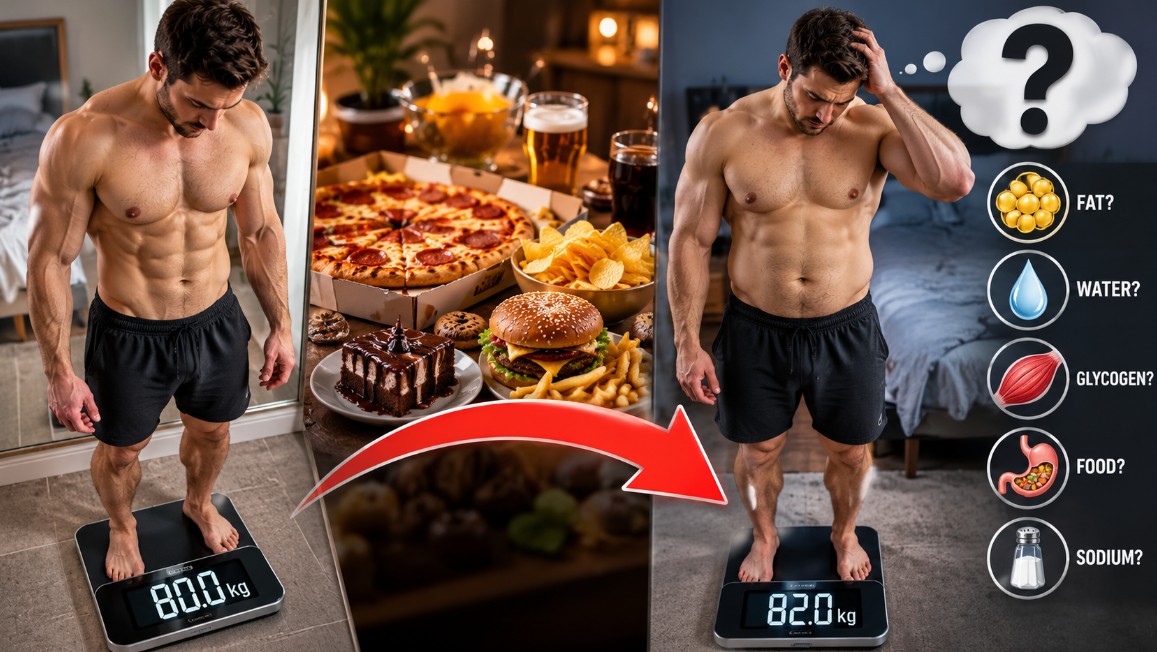
You Woke Up 2 kg Heavier — Did You Really Gain 2 kg of Fat?
Friday: 80.0 kg. A big dinner — pizza, dessert, more carbohydrates and sodium than usual. Saturday morning: 82.0 kg.
The natural reaction: did I just gain 2 kg of fat overnight?
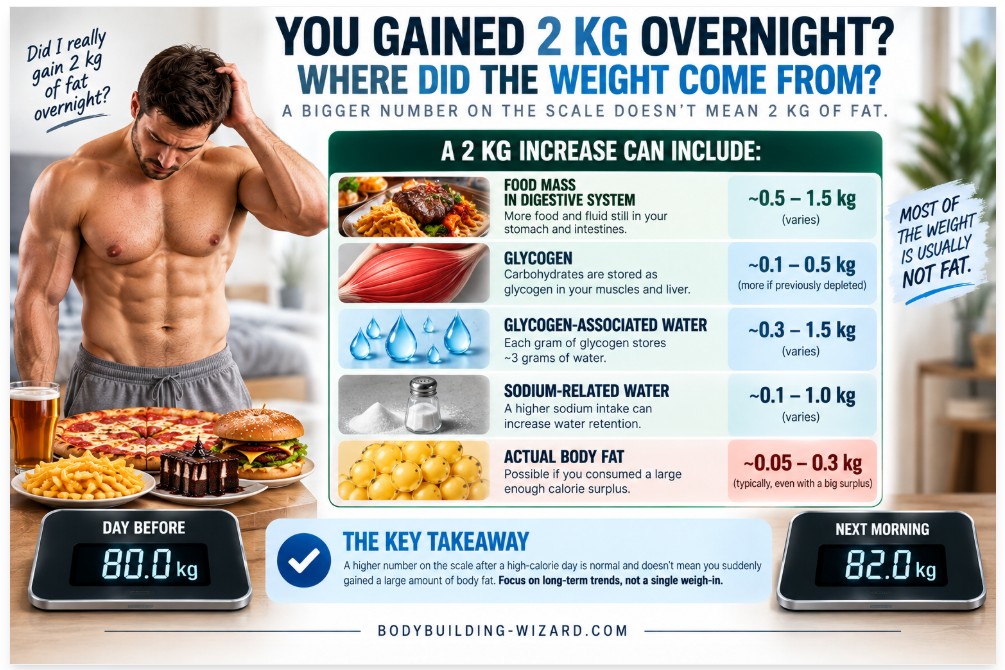
Almost certainly not. That +2 kg most likely includes some combination of more food and fluid still sitting in your digestive system, glycogen, glycogen-associated water, sodium-related fluid shifts, normal hydration changes — and possibly some genuine fat storage, if the day involved a large enough energy surplus. That combination is exactly what this guide unpacks.
QUICK ANSWER: There is no single maximum amount of body fat that everyone can gain in 24 hours. Actual fat gain depends primarily on the size of the energy surplus and how that excess energy is handled and stored. However, a large overnight increase in scale weight is usually much greater than the amount of new body fat gained, because food mass, water, glycogen, sodium, and normal fluid shifts can rapidly increase body weight. A very large single-day surplus could theoretically translate to a fraction of a kilogram of actual fat-energy equivalent — nowhere near what the scale often shows the next morning.
First: Scale Weight Is Not Body Fat
| What can increase overnight? | Is it body fat? | How quickly can it change? |
|---|---|---|
| Body fat | Yes | Requires a surplus and storage over time |
| Glycogen | No | Relatively quickly |
| Glycogen-associated water | No | Relatively quickly |
| Gut contents | No | Immediately |
| Body water | No | Hours to days |
| Food/fluid mass | No | Immediately |
The scale measures total body mass. It cannot tell you which compartment changed. For the fuller picture on why this matters for physique tracking generally, see our guides on Muscle vs. Fat and What Is Body Composition?
Where Does the “3,500 Calories = One Pound of Fat” Rule Come From?
This is almost certainly how most people will try to calculate their own fat gain, so it deserves direct treatment. The commonly cited figures: roughly 3,500 kcal per pound of fat, or roughly 7,700 kcal per kilogram — based on the approximate energy density of adipose tissue.
Why This Isn’t a Perfect One-Day Fat-Gain Calculator
Body fat isn’t pure, uniform lipid tissue with a perfectly fixed energy value, and the body isn’t a simple calorimeter where every calorie above maintenance automatically becomes adipose tissue. A formal critique published in the International Journal of Obesity showed that this rule assumes a static relationship between energy balance and weight change, when the real relationship is dynamic—energy expenditure and substrate handling shift as intake changes, which the simple rule doesn’t account for. The same critique applies to the static version of this rule: it overestimates weight change dramatically over longer time periods because it ignores these physiological adaptations.
The 3,500-calorie rule can be useful for rough illustration, but it should not be treated as an exact equation for predicting how much body fat you will gain from one day of overeating.
What Actually Happens When You Overeat for One Day?
Some energy is used immediately — resting metabolism, physical activity, and the thermic effect of digesting the food itself all consume a portion of what you just ate.
Glycogen stores can increase, particularly if they weren’t already full going into the high-calorie day.
Glycogen brings water with it — highly relevant for anyone coming off a diet or a low-carb stretch, where glycogen stores were likely depleted beforehand.
Dietary fat can be stored efficiently. Worth being precise here rather than repeating the oversimplified “carbs can’t turn into fat” claim — macronutrients aren’t handled identically by the body, and dietary fat has a comparatively direct route to storage once energy intake exceeds what’s needed.
De novo lipogenesis — the process of converting excess carbohydrate into fatty acids — does occur, but it has real physiological limits worth understanding precisely. A classic metabolic balance study found that glycogen storage capacity in humans is roughly 15 g per kilogram of body weight, capable of accommodating a gain of about 500 g of glycogen before net lipid synthesis meaningfully contributes to increased body fat mass. Once glycogen stores were saturated, the study found the body disposed of massive carbohydrate intakes primarily through sharply increased carbohydrate oxidation, with de novo lipogenesis contributing a real but comparatively modest share. In other words: your body has a substantial glycogen “buffer” to fill before excess carbohydrate specifically becomes a major fat-storage pathway.
Does It Matter Whether You Overeat Fat, Carbs, or Protein?
Worth a direct answer, without turning this into a nutrition textbook chapter.
Dietary fat has a relatively efficient, direct storage pathway — it requires comparatively little metabolic processing to be stored as body fat once intake exceeds what’s needed.
Carbohydrate behaves differently, as the section above covered: the body responds to excess carbohydrate primarily by increasing carbohydrate oxidation and topping off glycogen stores first, with de novo lipogenesis becoming a meaningful contributor only once intake is genuinely massive and glycogen stores are already saturated.
Protein is handled differently again — it has a notably higher thermic effect than fat or carbohydrate, meaning more of its energy is spent on digestion and processing rather than being directly available for storage, and its metabolic fate under overfeeding conditions differs from the other two macronutrients as well.
The practical point: it isn’t accurate to treat all three macronutrients as identical “calories waiting to become fat.” Macronutrient composition affects how the body handles an energy surplus, but it does not make sustained overconsumption irrelevant. A sufficiently large and repeated energy surplus can increase body fat regardless of whether the diet is labeled high-carb or high-fat.
Why Did the Scale Go Up So Much After One Day of Overeating?
1. More food is physically inside you. Simple, but easy to forget — if you ate and drank several kilograms’ worth of food and fluid, some of that mass is still inside you when you step on the scale.
2. More carbohydrate means more glycogen — and water. A larger-than-usual carbohydrate intake replenishes glycogen and its associated water, without needing precise numbers to understand the effect.
3. Sodium can increase water retention. Restaurant meals, pizza, and processed foods generally contain much more sodium than home-cooked meals, and higher sodium intake is a well-established driver of short-term water retention.
4. Alcohol can complicate fluid balance when relevant to the specific overeating episode.
5. Inflammation and training can affect water. A hard leg session before a weigh-in can shift fluid levels on its own, adding another variable.
6. Different bowel contents — not glamorous, but genuinely part of the picture.
A 2-kg increase on the scale after a high-calorie day does not mean that 2 kg of adipose tissue appeared overnight.
Let’s Do the Math: How Much Fat Could You Theoretically Gain?
This is illustrative energy accounting, not a claim about actual measured fat gain in any individual. Assume a maintenance intake of roughly 2,500 kcal.
| Daily Intake | Maintenance | Estimated Surplus | Rough Fat-Energy Equivalent |
|---|---|---|---|
| 3,000 kcal | 2,500 | +500 | ~0.07 kg |
| 4,500 kcal | 2,500 | +2,000 | ~0.26 kg |
| 7,500 kcal | 2,500 | +5,000 | ~0.65 kg |
Important: These calculations describe an approximate energy equivalent, not a direct measurement or guarantee of actual adipose-tissue gain. Real-world fat storage is influenced by glycogen status, macronutrient composition, individual metabolic response, and more — this table illustrates scale, not a precise personal outcome.
Can You Really Gain a Pound of Fat in One Day?
Mathematically, this would require roughly a 3,500-kcal surplus above maintenance according to the classic model — not simply “eating 3,500 calories.” This distinction matters enormously. If maintenance is 2,500 kcal, reaching a 3,500-kcal surplus would require eating around 6,000 kcal total in a single day in this illustrative example. That’s a genuinely large amount of food for most people to physically consume in one sitting or one day — and even then, this remains an energy-equivalent estimate, not a guarantee that exactly one pound of new adipose tissue will result.
Can One Cheat Day Make You Fat?
One high-calorie day can contribute to fat gain, but it does not suddenly transform your body composition. The real problem tends to be pattern-based: one cheat meal becomes a cheat day, becomes a cheat weekend, becomes a repeated weekly surplus — and it’s the accumulation of many smaller episodic surpluses that actually matters over time.
One day matters far less than the pattern it becomes part of.
What About a Cheat Weekend?
This is a more realistic version of the same problem. A Friday night, Saturday, and Sunday of higher intake can create a considerably larger cumulative surplus than a single meal. Consider a lifter running a modest Monday-through-Friday deficit — two genuinely high-calorie weekend days can offset a meaningful share of that entire week’s deficit, simply because the weekend surplus, added up across two full days, can rival or exceed five days’ worth of smaller planned deficit.
Why You May Look Fatter the Next Day Without Gaining Much Fat
A genuinely useful bodybuilding-specific section. You look in the mirror the next day and feel visibly softer. Why? Abdominal distension, gut contents, water retention, sodium, extracellular fluid shifts, glycogen and its associated water redistribution, and even simple differences in lighting or time of day can all contribute. The result can be looking puffier, smoother, or less defined — without a proportional increase in actual adipose tissue.
Why You Can Also Look Better After Eating More
A useful nuance most competing content misses entirely. After a period of dieting or glycogen depletion, more carbohydrate intake replenishes glycogen, and fuller muscles can genuinely make a physique look better, not worse. The same person, after a high-carbohydrate day, can show a larger scale weight, fuller-looking muscles, and improved overall appearance at the same time— a clear demonstration that scale weight and physique quality are not the same thing.
How Long Does “Overnight Weight Gain” Usually Last?
No fixed timeline like “48 hours and it’s gone.” Food mass, water, glycogen, and sodium-related changes typically begin declining over the following days once normal eating and routine resume, but the exact duration varies considerably based on meal size, carbohydrate content, sodium intake, hydration, glycogen status, bowel contents, activity level, and individual physiology.
What Should You Do the Day After Overeating?
This section exists specifically to head off counterproductive compensation strategies.
- Don’t starve yourself the next day
- Don’t punish yourself with hours of cardio
- Return to your normal diet
- Hydrate normally
- Resume your normal training and activity
- Give the scale time to normalize
The best response to one unusually high-calorie day is usually a return to your normal plan — not an extreme attempt to undo it in 24 hours.
When Should You Actually Worry About Fat Gain?
Not after one morning weigh-in. Look instead at your 7-day average body weight, the trend across several weeks, waist circumference, progress photos, and a body-composition trend if you track one. For the full toolkit on tracking this properly, see How to Measure Body Fat Percentage and Muscle vs. Fat.
Coach’s Note: Don’t Let One Weigh-In Rewrite the Story. As a coach, I would never conclude that someone suddenly gained a large amount of body fat from one high weigh-in after an unusually large meal or weekend. I want to know what happened to the body-weight trend once normal eating, hydration, activity, and digestion resumed. One measurement is data; the trend gives it context.
Bodybuilder’s Take
You can gain some fat in a day. You cannot read that amount directly from tomorrow morning’s scale.
Key Takeaways
- ✓One day of overeating can result in some real body-fat gain if it creates a genuine energy surplus.
- ✓Overnight scale gain is not the same as overnight fat gain.
- ✓Food mass, water, glycogen, and sodium can move scale weight rapidly and substantially.
- ✓The ~3,500 kcal/lb figure is an approximate energy-equivalent concept, not an exact one-day fat-gain equation.
- ✓Calories eaten are not the same thing as calories above maintenance — the surplus is what matters for fat gain math.
- ✓One high-calorie day matters far less than the repeated pattern it becomes part of.
- ✓Don’t respond to one overeating episode with starvation or punitive exercise — return to your normal plan instead.
- ✓Judge body-composition progress from trends over weeks, not from a single weigh-in.
Frequently Asked Questions About Gaining Fat in a Day
How much fat can you gain in one day?
There’s no fixed universal maximum — it depends on the size of your energy surplus. Even an extreme overeating day typically translates to well under a kilogram of actual fat-energy equivalent, far less than the scale often suggests the next morning.
Can you gain 1 kg of fat in one day?
This would require an extremely large energy surplus, roughly 7,700 kcal above maintenance in the classic model — physically difficult for most people to achieve in a single day through food alone.
Can you gain a pound of fat overnight?
It would require roughly a 3,500-kcal surplus above maintenance, not just eating 3,500 calories total — for most people this means consuming a genuinely enormous amount of food in one day.
Why did I gain 2 kg overnight?
Almost certainly a combination of food and fluid still in your digestive system, increased glycogen and its associated water, and sodium-related fluid retention — not 2 kg of new body fat.
How many calories does it take to gain one pound of fat?
Roughly 3,500 kcal above maintenance is the commonly cited approximate figure, though this is a rough energy-equivalent estimate rather than a precise, universally applicable equation.
Can one cheat day make you gain fat?
It can contribute a small amount of real fat gain if it creates a large surplus, but it won’t meaningfully change your body composition on its own — the bigger risk is a cheat day turning into a repeated pattern.
Can one binge ruin a week of dieting?
A single high-calorie day can offset some of a week’s deficit, but it rarely erases it entirely — the overall weekly and monthly pattern matters far more than any one day.
Why do I look fatter after eating a lot?
Abdominal distension, water retention, sodium, and glycogen-related water shifts can all make you look temporarily softer or puffier, without a proportional increase in actual body fat.
How long does weight gain after overeating last?
It varies, but food mass, water, and sodium-related weight typically begin declining within a few days of returning to your normal eating pattern.
Should I eat less the day after overeating?
No — the best response is generally to return to your normal eating plan rather than compensating with extreme restriction or excessive cardio, which tends to backfire and disrupt otherwise good habits.
References
- Hall, K. D., & Chow, C. C. (2013). Why is the 3500 kcal per pound weight loss rule wrong? International Journal of Obesity, 37, 1614. nature.com/articles/ijo2013112
- Acheson, K. J., Schutz, Y., Bessard, T., Anantharaman, K., Flatt, J. P., & Jéquier, E. (1988). Glycogen storage capacity and de novo lipogenesis during massive carbohydrate overfeeding in man. American Journal of Clinical Nutrition, 48(2), 240–247. pubmed.ncbi.nlm.nih.gov/3165600
- Bouchard, C., Tremblay, A., Després, J. P., et al. (1990). The response to long-term overfeeding in identical twins. New England Journal of Medicine, 322(21), 1477–1482. pubmed.ncbi.nlm.nih.gov/2336074
