



Same Weight. Completely Different Body.
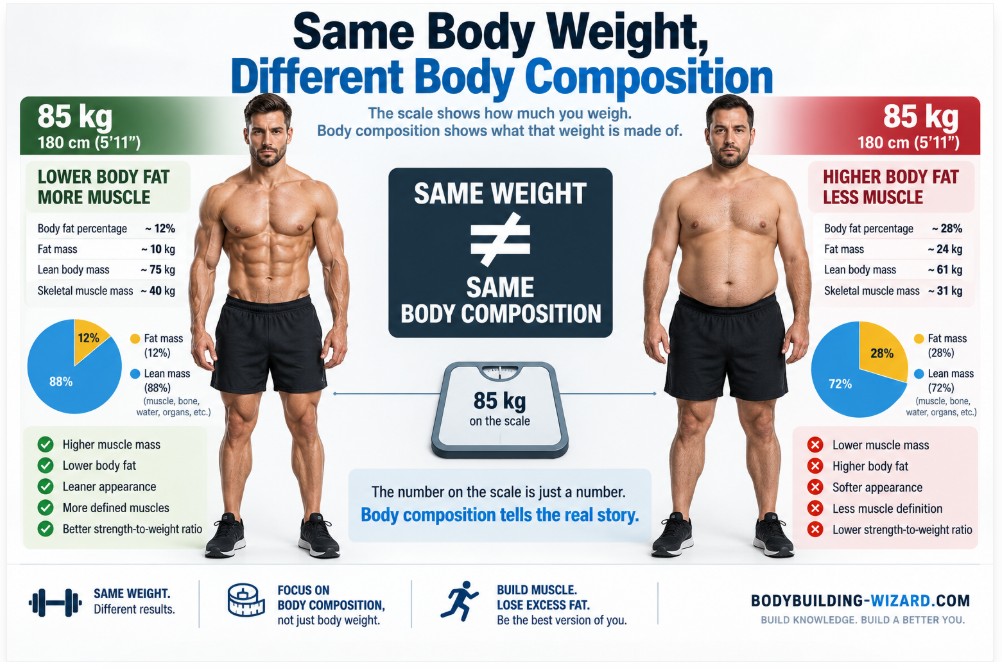
Picture two men, both 180 cm, both 85 kg. One’s trained for eight years — developed shoulders, thick back, legs that fill out his jeans, visible abdominal separation. The other doesn’t train, carries noticeably more fat around his midsection, and has a fraction of the muscle. Same height. Same scale weight. Even nearly the same BMI.
Their bodies tell completely different stories.
That difference is body composition — and for a lifter, it tells you far more than body weight alone ever can.
QUICK ANSWER: Body composition is the breakdown of total body weight into fat mass and fat-free mass (muscle, bone, organs, water). Two people at identical height and weight can have dramatically different body compositions. For lifters, it matters more than scale weight because bulking, cutting, and recomposition are really about changing the ratio between these tissues — not the number on the scale. It’s measured through methods ranging from tape measurements and skinfolds to DEXA scans, and it’s shaped by genetics, sex, age, training, nutrition, hormones, and sleep — most of which you can influence directly.
1. What Is Body Composition?
Body composition is the proportion of fat mass to fat-free mass that makes up your total body weight. It answers a question body weight physically cannot: not “how much do you weigh,” but “what is that weight actually made of.”
The Two-Component Model: Fat Mass and Fat-Free Mass
The simplest useful way to think about body composition is what researchers call the two-component model:
Total Body Mass = Fat Mass + Fat-Free Mass
Fat mass is exactly what it sounds like — all the adipose tissue on your body. Fat-free mass is everything else: muscle, bone, organs, connective tissue, and body water.
Most gym-accessible tools (calipers, BIA scales, tape-based formulas) estimate this two-component model. More sophisticated models — three-compartment (adding bone mineral) and four-compartment (adding total body water as its own measured variable) — exist and are more accurate, which is why DEXA and lab-grade methods use them. We’ll cover how they differ in Section 9.
Body Weight vs. Body Composition
Take a lifter who cuts for 8 weeks and loses 4 kg. Body weight tells you: 4 kg lighter. Body composition tells you whether that was 4 kg of fat (excellent), 2 kg of fat and 2 kg of muscle (a mediocre cut), or mostly water and glycogen (barely any real progress at all). Same scale outcome, three completely different results.
Why Body Composition Matters More Than Scale Weight for Lifters
This is where the concept stops being an academic definition and becomes the framework you should train and diet around. Bulking isn’t “gain weight”—it’s gaining muscle while limiting fat gain. Cutting isn’t “lose weight” — it’s losing fat while preserving muscle. Recomposition isn’t a weight-loss strategy at all — it’s changing the ratio at a stable scale weight. Every one of these goals is a body composition goal wearing a body-weight costume.

2. What Is Your Body Actually Made Of?
Fat Mass
Fat mass is all the adipose tissue in your body. Not all of it is interchangeable — some is essential fat your body needs for hormone production and organ protection, and some is storage fat, the reserve you’re actually targeting when you diet. We cover this distinction properly in Section 6.
Fat-Free Mass
Fat-free mass (FFM) is everything that isn’t fat: skeletal muscle, smooth and cardiac muscle, bone, organs, connective tissue, and body water. It’s the largest single component of body weight for most people, fat included.
Lean Body Mass
Here’s a terminology issue worth clearing up directly, because it trips people up constantly: lean body mass (LBM) and fat-free mass (FFM) are often used interchangeably, but they’re not technically identical. FFM, by definition, contains zero fat. LBM technically includes the small amount of essential fat embedded in organs, bone marrow, and cell membranes. In practice, the difference is small enough (a few percent of body weight) that most devices, apps, and even research papers use the terms loosely and interchangeably. Just know that if two sources give you slightly different LBM numbers from the same measurement, this is often why. We cover the full calculation and why it matters for tracking progress in our dedicated lean body mass guide.
Skeletal Muscle Mass
This is the one that actually matters most for a lifter, and it’s worth stating plainly: lean mass is not the same thing as muscle mass. Fat-free mass/lean body mass includes bone, organs, and water alongside skeletal muscle — meaning a “lean mass gain” on a scan could theoretically include added bone density or body water, not exclusively new muscle tissue. Skeletal muscle mass specifically is the tissue you’re training to grow, and some advanced methods (DEXA with appendicular lean mass, MRI) isolate it more precisely than a basic FFM number can.
Bone
Bone mineral content and skeletal mass are a smaller but non-trivial part of fat-free mass — typically somewhere around 3–5% of total body weight. Resistance training also measurably increases bone mineral density over time, which is one more reason lifting matters well beyond the mirror.
Body Water
Roughly 60% of a lean adult’s total body weight is water, split between intracellular and extracellular compartments. This is why body composition tracking gets noisy day to day: a high-sodium meal, a hard training session, your menstrual cycle, or simple dehydration can shift scale weight and BIA readings by a kilogram or more without any real change in fat or muscle.
Organs and Other Tissues
Organs, connective tissue, and the nervous system round out fat-free mass. They’re a relatively stable, non-trainable portion of your composition — useful to know mainly so you don’t misattribute normal organ-mass stability (or the rare medical change in it) to your training program.
3. Fat Mass vs. Lean Mass vs. Muscle Mass: What’s the Difference?
This distinction has real search value and, more importantly, real practical value — confusing these terms is probably the single most common body-composition mistake lifters make when reading their own scan results.
| Measure | What It Includes | What It Doesn’t Tell You | Why Lifters Should Care |
|---|---|---|---|
| Body weight | Everything (fat + lean + water + bone) | Composition | Useful as a rough trend only |
| Fat mass | Total fat tissue | Where that fat is distributed | Central to cutting and long-term health |
| Body-fat % | Fat relative to total body mass | Absolute muscle amount | The standard leanness metric |
| Fat-free mass | Everything except fat | Muscle amount specifically | Broad indicator of overall tissue change |
| Lean body mass | Similar to FFM, depending on the model used | Muscle amount specifically | Often misread as “muscle gained” |
| Skeletal muscle mass | Skeletal muscle tissue only | Other lean tissue changes | The actual target of hypertrophy training |
4. Why Body Composition Matters for Bodybuilders and Athletes
Body Composition During a Bulk
The goal of a bulk was never “gain body weight” — it’s to maximize the muscle-gain-to-fat-gain ratio. Two lifters can both gain 6 kg in a bulk; one gains 5 kg of muscle and 1 kg of fat, while the other gains 2 kg of muscle and 4 kg of fat. Identical scale outcome, wildly different bulk quality.
Body Composition During a Cut
Same logic in reverse. The goal isn’t “lose body weight” — it’s to lose fat while preserving as much muscle as possible. A cut that drops 6 kg with 5 kg of that being fat is a good cut. A cut that drops the same 6 kg with 3 kg coming from muscle has cost you hard-earned tissue for very little actual leanness gained.
Body Composition During Recomposition
Recomposition clearly illustrates why body composition and body weight can diverge: the scale barely moves, or doesn’t move at all, while the underlying muscle-to-fat ratio shifts substantially. We cover exactly who this works best for in Section 14.
Body Composition and Strength
The relationship here isn’t as simple as “more muscle equals more strength.” Greater muscle cross-sectional area generally supports greater force production, but strength is also driven by neural efficiency, leverages, technique, and fiber-type distribution — which is exactly why two lifters with near-identical muscle mass can have meaningfully different one-rep maxes.
Body Composition and Athletic Performance
Optimal body composition is sport-specific, not universal. A marathoner benefits from minimizing non-functional mass to reduce the energy cost of carrying it over 42 km. A powerlifter or strongman competitor benefits from more total mass — including a higher fat mass than a physique athlete would ever accept — because absolute mass contributes to force production in ways leanness doesn’t.
Coach’s Note: I’ve coached recreational lifters who wanted to bulk “like a powerlifter” and then got frustrated when their waist expanded faster than their squat total. The mismatch usually wasn’t effort — it was that they’d borrowed a body-composition target from a sport with completely different demands than the one they were actually training for. Define what you’re training toward before you decide what body composition change actually serves that goal.
5. Why BMI and Body Weight Can Mislead Lifters
BMI (body mass index) gets an unfair amount of hate in fitness content, and an unfair amount of blind trust in medical settings — the truth sits between those two extremes. As an epidemiological screening tool across large populations, BMI is genuinely useful and cheap to calculate, which is exactly why public health researchers still use it.
The problem is specific and well documented: BMI cannot distinguish between fat mass and lean mass because it’s calculated purely from height and weight. A cross-sectional study of 622 male athletes found that standard BMI cutoffs classified more than a quarter as overweight or obese—but when body fat was measured directly, fewer than 4% actually were. The mismatch wasn’t a data error; it was a structural limitation of a formula never designed to account for muscle.
So the honest position isn’t “BMI is useless” — it’s “BMI is a reasonable population-level screening tool that becomes unreliable at the individual level for anyone with above-average muscle mass,” which describes a large share of the audience reading this article.
6. Understanding Body Fat as Part of Body Composition
Body fat isn’t a single, uniform tissue, and where you look inside “body fat” changes what the number actually means for you.
Essential Fat vs. Storage Fat
Your body needs a baseline of essential fat for hormone production, organ cushioning, and temperature regulation — dropping below it is genuinely dangerous, not just aesthetically extreme. Everything above that baseline is storage fat, which is what a cutting phase actually targets. Full breakdown: Essential Fat vs Storage Fat.
Subcutaneous vs. Visceral Fat
Fat under the skin (subcutaneous) and fat wrapped around internal organs (visceral) carry very different health implications, even at the same total body fat percentage. Full breakdown: Belly Fat Defined: Subcutaneous vs Visceral Fat.
White vs. Brown Adipose Tissue
Not all fat is metabolically passive storage — brown fat actively burns energy for heat. Full breakdown: Brown Fat vs White Fat.
Why Fat Distribution Matters
Sex and genetics shape where you store fat, not just your total body fat percentage. Full breakdown: Gender Differences in Fat Distribution.
7. What Determines Your Body Composition?
This is the section most “body composition” guides skip entirely, and it’s arguably the most useful one for actually setting realistic expectations.
| Factor | Mainly Affects Fat | Mainly Affects Muscle | Modifiable? |
|---|---|---|---|
| Genetics | ✅ | ✅ | ❌ Fixed, but not deterministic |
| Biological sex | ✅ | ✅ | ❌ Fixed |
| Age | ✅ | ✅ | ⚠️ Trajectory is modifiable |
| Energy intake | ✅ | — | ✅ Fully |
| Protein intake | — | ✅ | ✅ Fully |
| Resistance training | ⚠️ Indirect | ✅ Primary driver | ✅ Fully |
| Physical activity / NEAT | ✅ | — | ✅ Mostly |
| Hormones | ✅ | ✅ | ⚠️ Partially, mostly via lifestyle |
| Sleep and recovery | ✅ | ✅ | ✅ Mostly |
| Training history | — | ✅ | ✅ Cumulative, not instant |
The genetics point deserves real weight, not a dismissive footnote. In a classic study, researchers overfed 12 pairs of identical twins an identical 1,000-calorie daily surplus for 84 days. Weight gain ranged from 4.3 kg to 13.3 kg across pairs — but within each twin pair, the response was remarkably similar, with about three times more variance between pairs than within them. That’s genuine evidence that genetics meaningfully shapes how a given surplus or deficit gets partitioned between fat and lean tissue. It doesn’t mean training and nutrition don’t matter—it means two people following the same program can legitimately see different results, and that’s not a compliance problem.
8. How Is Body Composition Measured?
| Method | What It Estimates | Best Use Case | Practical for Lifters? |
|---|---|---|---|
| DEXA scan | Fat, lean mass, bone mineral (3-compartment) | Periodic gold-standard baseline | Occasional use — cost/access limited |
| Hydrostatic (underwater) weighing | Body density → fat/lean split | Research, one-off validation | Low — requires specialized facility |
| Bod Pod (air displacement) | Body density via air volume | Similar role to hydrostatic weighing | Low–moderate — limited availability |
| MRI / CT scan | Precise regional tissue composition | Research, clinical, rarely fitness use | Very low — cost and access prohibitive |
| Skinfold calipers | Subcutaneous fat thickness at sites | Regular self- or coach-tracking | High — cheap, but technician-dependent |
| BIA (scales, handheld devices) | Fat/lean estimate via electrical resistance | Rough trend tracking | High — accessible, hydration-sensitive |
| Circumference measurements | Body shape change (waist, hips, etc.) | Simple, consistent progress tracking | Very high — free, reliable trend data |
| Progress photos / visual assessment | Overall visual change | Long-term motivation and sanity check | Very high — free, people actually do it |
DEXA, hydrostatic weighing, Bod Pod, and MRI/CT are genuinely valuable — but mostly in research settings or as an occasional baseline check, not as a routine tool for a gym-goer tracking week-to-week progress. That’s an important, often-missed distinction: a method being “more accurate” doesn’t automatically make it “more useful” for your actual situation.

9. Which Body Composition Method Is Most Accurate?
The honest answer isn’t simply “DEXA” — it’s more nuanced than that, and worth understanding properly.
| Method | What It Measures/Estimates | Strength | Limitation | Practical for Lifters? |
|---|---|---|---|---|
| DEXA | Fat, lean mass, bone (3-compartment) | Closest to a reference standard; regional data | Inter-machine and inter-manufacturer variation; not infallible | Yes, periodically |
| 4-compartment lab models | Fat, lean, bone, total body water separately | The actual research reference standard | Requires multiple devices/tests combined; essentially unavailable outside research | No |
| Hydrostatic weighing | Body density | Well-validated historically | Requires full submersion, trained technician | No |
| BIA | Fat/lean via resistance | Fast, cheap, accessible | Highly sensitive to hydration status | Yes, for trend only |
| Skinfolds | Subcutaneous fat at specific sites | Cheap, portable, decent trend tool | Technician skill dramatically affects accuracy | Yes |
DEXA is widely treated as a criterion/reference method — validated against total-body and regional bone-mineral and soft-tissue measurements — and current body composition research validates most other tools against it. But even DEXA has documented limitations: results can differ meaningfully between manufacturers’ machines, and it’s still an indirect estimate built on assumptions about tissue density—not a literal, error-free count of every fat and muscle cell. The real answer to “which method is most accurate” is: the true four-compartment model used in research settings, which almost no one outside a lab will ever access — meaning that for practical purposes, DEXA repeated consistently on the same machine is the best realistic option, not a flawless one.
Why Your Body-Fat Reading Can Change Without Gaining or Losing Fat
This deserves its own callout because it’s one of the most common sources of false alarms for lifters tracking body composition:
- Hydration status — BIA readings shift measurably based on how hydrated you are at the time of testing
- Glycogen and its bound water — each gram of stored glycogen holds roughly 3 g of water, so a carb refeed can add real scale weight and shift BIA readings without adding fat
- Recent food intake — a heavy meal before a scan or weigh-in adds temporary mass unrelated to composition
- Recent exercise — sweat loss and post-exercise fluid shifts affect same-day readings
- Time of day — morning vs. evening measurements are not directly comparable
- Device or technician — different BIA devices and different technicians performing skinfolds produce different numbers even on the same person, same day
None of this means the methods are useless — it means single readings are noisy, and only trends across multiple standardized measurements are meaningful.
10. How Should Lifters Track Body Composition?
This is the section a generic health encyclopedia won’t have, because it’s built around what actually keeps lifters consistent, not what’s theoretically most precise.
A practical tracking strategy:
- Scale weight trend — averaged over a week or two, not a single daily number
- Waist circumference — measured at the same spot, same time of day, same conditions
- Standardized progress photos — same lighting, pose, and time of day, taken monthly
- Gym performance — strength trends are a useful indirect signal of whether you’re actually preserving muscle
- A consistent body-fat method, if you use one — same device, same technician, same conditions every time, so you’re comparing apples to apples
Don’t Chase a “Perfect” Body-Fat Number
The single biggest mistake in this category is treating any one reading as gospel. A BIA scale telling you 15.4% one week and 16.1% the next isn’t necessarily “backsliding” — it’s very possibly just water and glycogen noise. What matters is the trend across weeks and months, under reasonably standardized conditions, cross-checked against the mirror and the tape measure.
Coach’s Note: The lifters I see get frustrated fastest are almost always the ones staring at a single BIA reading instead of the trend across all their tracking methods together. I’ve had clients text me in a mild panic because their smart scale jumped two points overnight — nine times out of ten, it’s sodium and water, not fat. I’d genuinely rather a client skip the smart scale entirely and just track waist measurement plus monthly photos than obsess daily over a number that bounces around for reasons that have nothing to do with fat loss.
11. What Is a Healthy Body Fat Percentage?
This question has real search demand, so it deserves a direct answer—just not a falsely universal one.
The American Council on Exercise (ACE) provides commonly referenced category ranges:
| Category | Women | Men |
|---|---|---|
| Essential fat | 10–13% | 2–5% |
| Athletes | 14–20% | 6–13% |
| Fitness | 21–24% | 14–17% |
| Acceptable | 25–31% | 18–24% |
| Obesity | 32%+ | 25%+ |
These are population guidelines, not individual prescriptions. What counts as “healthy” for a given individual also depends on:
- Sex — women require meaningfully higher essential fat for reproductive and hormonal function
- Age — healthy ranges shift upward somewhat with age as part of normal physiology
- Health status — some medical conditions change what’s actually appropriate
- Performance goals — a powerlifter’s ideal body fat differs from a marathoner’s or a physique competitor’s
- Sustainability — a body fat percentage you can only maintain for a few weeks a year isn’t a “healthy” year-round target, regardless of what the chart says
- Measurement uncertainty — every method above carries some margin of error, so treat any single number as an estimate, not a precise fact
Athletic Does Not Automatically Mean Healthier
Very low body fat isn’t automatically a health achievement — dropping near or below essential fat levels carries real hormonal, immune, and reproductive risks regardless of how it looks.
Stage-Lean Is Not Year-Round Lean
This one matters specifically for a bodybuilding audience: the 5–6% body fat a competitor hits on stage is a short-term, deliberately unsustainable state, not a year-round target. Presenting it as an everyday goal to a general audience is genuinely irresponsible, and it’s part of why we built a dedicated, realistic goal-setting guide: Setting Realistic Body Fat Goals.
12. Can Two People With the Same Body-Fat Percentage Look Different?
Yes — and this is one of the more satisfying “aha” answers in the whole topic of body composition, because the intuitive assumption (same body fat % = same look) is simply wrong.
Two people at an identical body fat percentage can look completely different due to:
- Absolute muscle mass — 15% body fat on someone with substantially more total muscle looks entirely different than 15% on someone with less
- Muscle distribution — genetics determine which muscle groups respond most readily to training, shaping the overall silhouette independent of fat percentage
- Fat distribution pattern — the same total fat mass concentrated around the midsection looks different from the same amount spread more evenly
- Skeletal structure — bone width and joint structure change how the same soft-tissue composition is displayed
- Sex — hormonal differences in fat storage patterns between men and women persist at matched body fat percentages
- Glycogen and water content — someone carb-loaded and well-hydrated looks visibly fuller than someone depleted, at an identical underlying body fat percentage
- Skin thickness and quality — genuinely affects how visible muscle definition appears at a given leanness level
- Measurement error — the “same” percentage from two different methods or technicians may not represent truly identical underlying fat mass
The practical takeaway: “get to 15% body fat” is a reasonable target, but it doesn’t promise a specific look. Two lifters chasing the same number can end up with genuinely different physiques, and that’s not a sign either of them did anything wrong.
13. How Does Resistance Training Change Body Composition?
If a body composition guide doesn’t earn its place with a substantial section here, it’s not really a bodybuilding resource — it’s a repackaged health article with a gym photo on top.
Resistance Training and Muscle Mass
Progressive resistance training is the primary, non-negotiable driver of skeletal muscle hypertrophy. No other single intervention — diet, cardio, supplements — comes close to its effect on this specific tissue.
Resistance Training During Fat Loss
Resistance training during a calorie deficit does something cardio alone cannot: it preserves the muscle mass that would otherwise be lost alongside fat. This is precisely why “just eat less” without a training program produces a much worse body composition outcome than the same deficit combined with lifting.
Resistance Training and Fat Mass
Strength training’s direct effect on fat mass is smaller than its effect on muscle, but it contributes indirectly — more muscle mass modestly raises resting energy expenditure, and the training sessions themselves burn calories.
Resistance Training and Bone
Load-bearing resistance training measurably increases bone mineral density over time, which matters increasingly with age as a genuine protective factor against fractures, independent of anything visible in the mirror.
Long-Term Body Composition Adaptations
Sustained resistance training over years, not weeks, produces the body composition changes people associate with “genetics” or “good bone structure” — trained muscle bellies, improved posture from balanced development, and a fundamentally different fat distribution pattern than the same person would have shown untrained at the same body weight.
14. Can You Build Muscle and Lose Fat at the Same Time?
Yes — body recomposition is real, backed by controlled research, not just social media before-and-afters. In a proof-of-principle trial, young men following a substantial 40% energy deficit combined with intense resistance and interval training for four weeks were split into a higher-protein group (2.4 g/kg/day) and a lower-protein group (1.2 g/kg/day). The higher-protein group gained 1.2 kg of lean mass while losing 4.8 kg of fat mass — genuine simultaneous muscle gain and fat loss, in a real deficit, over just four weeks.
Who Has the Greatest Recomposition Potential?
- Beginners — new to resistance training, with the most “newbie gains” headroom available
- Detrained lifters — returning after a layoff, who tend to regain muscle faster than true beginners build it
- People carrying more fat — a larger fat reserve provides more energy to draw on to support muscle-building processes during a deficit
- Anyone whose training or nutrition wasn’t previously optimized — there’s more room to improve both variables simultaneously
Why Recomposition Gets Harder for Advanced Lifters
For an already-lean, experienced lifter close to their genetic muscular ceiling, simultaneously building new muscle and losing fat becomes far more difficult — the body has less “easy” muscle-building potential left, and a deficit large enough to meaningfully reduce fat starts working directly against the surplus-like conditions muscle growth typically favors. This is exactly why advanced competitors cycle deliberate bulking and cutting phases rather than trying to recomp indefinitely.
15. How to Improve Your Body Composition

| Goal | Calories | Protein | Training Priority | Main Metric |
|---|---|---|---|---|
| Lose fat, preserve muscle | Moderate deficit (~15–25% below maintenance) | 1.6–2.2 g/kg | Maintain training volume/intensity | Waist + strength trend |
| Gain muscle, limit fat gain | Small surplus (~5–15% above maintenance) | 1.6–2.2 g/kg | Progressive overload, adequate volume | Rate of weight gain + waist |
| Recomposition | Maintenance or very small deficit | 1.8–2.4 g/kg (higher end) | Progressive overload, consistency | Photos + strength + tape, not scale |
Goal: Lose Fat While Preserving Muscle
- A moderate, not extreme, calorie deficit — large deficits accelerate muscle loss right alongside fat loss
- Adequate protein intake, generally 1.6–2.2 g/kg body weight
- Continued resistance training at maintained volume and intensity, even in a deficit
- A realistic rate of loss rather than an aggressive one
- Sufficient sleep and recovery — in a controlled trial, dieters who cut their sleep to 5.5 hours a night lost the same total weight as a well-rested group, but far less of it was fat and far more came from fat-free mass — a direct demonstration that skimping on sleep during a cut actively works against the “preserve muscle” half of the goal
Goal: Gain Muscle While Limiting Fat Gain
- Progressive resistance training with a clear overload strategy
- Adequate protein, same 1.6–2.2 g/kg range
- A modest surplus rather than an aggressive “dirty bulk”
- Monitoring rate of weight gain and waist measurement together, not weight alone
- Patience — meaningful muscle gain happens over months and years, not weeks
Your Goal: Recomposition
- Calories at maintenance or a very small deficit, individualized to the person
- Protein at the higher end of the effective range
- Consistent progressive resistance training
- Patience specifically — recomp is real but genuinely slower to show on the scale than a straightforward bulk or cut, which is exactly why it frustrates people who are only watching body weight
According to the International Society of Sports Nutrition’s position stand on protein, daily intakes of 1.4–2.0 g/kg are sufficient for most exercising individuals to build and maintain muscle, with some evidence that higher intakes (above 3.0 g/kg in resistance-trained individuals) may further support fat loss specifically — useful context for why protein targets in body composition guides tend to run higher than general population recommendations.
16. How Do Hormones Affect Body Composition?
Body composition isn’t a pure calories-in-calories-out story — a hormonal network runs in the background, regulating fat storage, appetite, and muscle metabolism. Leptin, insulin, cortisol, thyroid hormones, testosterone and estrogen, and growth hormone/IGF-1 all play documented roles in this system.
But here’s the key sentence to hold onto: hormones influence the regulation of appetite, energy expenditure, fat distribution, and muscle metabolism — they do not make energy balance irrelevant. For most healthy lifters without a diagnosed endocrine disorder, training and nutrition remain the dominant levers. Understanding the hormonal backdrop explains why a cut gets progressively harder as you get leaner and why “just eat less” oversimplifies the actual physiology — it doesn’t hand you an excuse to ignore training and diet.
We go deep on each of these systems in our hormones cluster:
- Hormonal Regulation of Fat Storage (insulin, leptin, cortisol, ghrelin)
- Thyroid Hormones and Metabolism
- Leptin and Weight Loss
17. How Does Body Composition Change With Age?
Muscle Mass
Without deliberate resistance training, adults lose an estimated 3–5% of muscle mass per decade starting around age 30 — a process called sarcopenia. This happens gradually enough that scale weight can stay completely flat for years while muscle is quietly being replaced by fat underneath it.
Fat Mass and Fat Distribution
Total body fat tends to trend upward with age even at stable body weight, partly because falling muscle mass lowers resting energy expenditure, and fat distribution patterns shift as well, often toward more central/abdominal storage.
Bone
Bone mineral density naturally declines with age, particularly after menopause in women, raising fracture risk — one more reason load-bearing training doesn’t become optional once someone reaches their “goal weight” or a certain age.
Why Resistance Training Changes the Aging Trajectory
This isn’t a “your muscles disappear after 30” scare story — it’s a training-relevant fact with a direct, actionable countermeasure. Resistance training is the single most effective tool against every piece of this age-related trend: it preserves and can still build muscle at essentially any age, supports bone density directly, and helps maintain the metabolic rate that tends to decline as fat-free mass drops. The lifters who show the least body composition decline with age are, overwhelmingly, the ones who kept training through it — not the ones with unusually good genetics.
18. Common Body Composition Problems Lifters Run Into
- “Skinny fat” — looking thin in clothes while carrying more fat and less muscle than the number on the scale would suggest. Full guide: The Skinny Fat Body Type
- Stubborn abdominal fat — the specific frustration of midsection fat resisting change even as other areas respond. Full guide: The Causes of Abdominal Fat Accumulation
- Metabolic adaptation during a cut — fat loss stalling as the body adapts to sustained restriction. Full guide: Metabolic Adaptation (“Starvation Mode”)
- Body-fat set point — the experience of your body actively resisting further fat loss past a certain threshold. Full guide: Body Fat Set Point
- Trying to spot-reduce fat — wanting to lose fat from one specific area through targeted exercise, which doesn’t work the way people hope. Full guide: The Spot Reduction Myth
- Losing muscle during a cut and excessive fat gain during a bulk — two sides of the same body-composition-management coin, and both strong candidates for dedicated future articles in this section.
19. Common Body Composition Myths
❌ Myth: Muscle weighs more than fat.
✅ Reality: A kilogram is a kilogram regardless of tissue type. What’s actually true is that muscle is denser than fat, so a kilogram of muscle takes up noticeably less space — for the full breakdown, see Muscle vs. Fat: Which Weighs More and Takes Up More Space?“
❌ Myth: BMI is useless for anyone who lifts.
✅ Reality: BMI remains a reasonable population-level screening tool; it specifically breaks down at the individual level for people carrying above-average muscle mass, which describes most serious lifters.
❌ Myth: Lean mass means muscle.
✅ Reality: Lean/fat-free mass includes bone, organs, and water alongside skeletal muscle — a reported “lean mass gain” isn’t automatically pure new muscle tissue.
❌ Myth: DEXA tells you your exact body-fat percentage.
✅ Reality: DEXA is an excellent reference-grade estimate, not an infallible one — results vary meaningfully between machines and manufacturers, and it still relies on modeling assumptions rather than a literal cell-by-cell count.
❌ Myth: You can’t build muscle while losing fat.
✅ Reality: Body recomposition is documented in controlled research, particularly for beginners, detrained lifters, and those with more fat to lose — it just gets progressively harder for advanced, already-lean trainees.
❌ Myth: Lower body fat is always healthier.
✅ Reality: Dropping near or below essential fat levels carries genuine hormonal, immune, and reproductive risks — “leaner” stops being “healthier” well before you reach visible ab veins.
❌ Myth: You can choose where fat comes off first.
✅ Reality: Fat loss order is determined by genetics and physiology, not by which exercises you choose to perform — see the full spot-reduction breakdown linked above.
❌ Myth: Daily changes on a smart scale represent real changes in body fat.
✅ Reality: Day-to-day BIA fluctuations are overwhelmingly driven by hydration, glycogen, and food timing — not actual tissue change.
20. Coach’s Note: What I Look at Before the Scale
In my work with recreational and competitive lifters, I never judge progress from a single metric — and the scale is usually the least informative one in the room. Before I even glance at someone’s body weight trend, I look at their waist measurement, their current progress photos next to the last set, whether their working weights are trending up or at least holding steady in a deficit, how their clothes are actually fitting, the quality of their training sessions that week, and how they’re recovering and sleeping. Body weight is the last thing I check, not the first — by the time I get to it, I already have a much clearer picture of what’s actually happening to their body composition, and the number rarely changes that picture much either way.
21. Bodybuilder’s Take
A bodybuilder isn’t trying to become lighter. A bodybuilder is trying to manipulate the specific tissues that make up body weight — building more of one, reducing more of another, deliberately and on purpose. Bulk doesn’t mean weight gain. Cut doesn’t mean weight loss. The actual goal, every single time, is controlled body composition change — and everything else in this guide, and every child article it links to, is really just a deeper answer to that same underlying idea.
KEY TAKEAWAYS
- ✓Body composition is the ratio of fat mass to fat-free mass — not body weight itself.
- ✓Two people at identical height and weight can have completely different body compositions.
- ✓Lean body mass and skeletal muscle mass are not the same thing — lean mass includes bone, organs, and water.
- ✓BMI is a reasonable population screening tool but breaks down at the individual level for muscular people.
- ✓Genetics measurably shape how a given calorie surplus or deficit gets partitioned between fat and muscle — this isn’t an excuse, but it is real.
- ✓No single body composition measurement is perfectly accurate; consistent tracking of trends beats chasing one “true” number.
- ✓Resistance training is the single most powerful lever for improving body composition at any age.
- ✓Body recomposition — building muscle and losing fat simultaneously — is real and research-backed, especially for beginners and detrained lifters.
- ✓Two people at the same body fat percentage can look genuinely different due to muscle mass, distribution, and skeletal structure.
- ✓“Improve body composition” and “lose weight” are not the same goal, and the first one is almost always what actually matters.
FAQ
What is body composition in simple terms?
Body composition is what your body weight is actually made of — specifically the split between fat mass and fat-free mass (muscle, bone, organs, and water). It tells you far more about your physique and health than the number on the scale alone.
What are the main components of body composition?
The main components are fat mass and fat-free mass, with fat-free mass further breaking down into skeletal muscle, bone, organs, connective tissue, and body water — each contributing differently to total body weight.
What is the difference between body composition and body-fat percentage?
Body-fat percentage is a single number within the broader concept of body composition — it tells you how much of your weight is fat, but body composition also accounts for muscle mass, bone density, and water, giving a more complete picture.
What is the difference between lean body mass and muscle mass?
Lean body mass includes everything that isn’t fat — muscle, bone, organs, and water — while muscle mass refers specifically to skeletal muscle tissue. A reported increase in lean mass isn’t automatically an increase in muscle specifically.
What is a healthy body-fat percentage?
Commonly cited ranges (per ACE) put “athletic” at roughly 6–13% for men and 14–20% for women, but the right target depends on sex, age, health status, and sustainability — not a single universal number.
What is the most accurate way to measure body composition?
True four-compartment lab models are the actual research gold standard but are essentially inaccessible outside research settings. In practice, DEXA repeated consistently on the same machine is the most realistic high-accuracy option for most people.
Can you improve body composition without losing weight?
Yes — this is exactly what body recomposition describes: building muscle while losing fat, which can leave scale weight unchanged, or even slightly increased, while you look visibly leaner and perform better.
How long does it take to change body composition?
Meaningful, visible body composition change typically takes a minimum of 8–12 weeks of consistent training and nutrition to become clearly noticeable, with substantial changes generally unfolding over several months to years — it is a slow-moving metric by nature, which is exactly why trend-tracking matters more than any single reading.
REFERENCES
- American Council on Exercise (ACE). Percent Body Fat Calculator. acefitness.org
- Mazess, R. B., Barden, H. S., Bisek, J. P., & Hanson, J. Dual-energy x-ray absorptiometry for total-body and regional bone-mineral and soft-tissue composition. American Journal of Clinical Nutrition. pubmed.ncbi.nlm.nih.gov/1410379
- Bouchard, C., Tremblay, A., Després, J. P., et al. (1990). The response to long-term overfeeding in identical twins. New England Journal of Medicine, 322(21), 1477–1482. pubmed.ncbi.nlm.nih.gov/2336074
- Longland, T. M., Oikawa, S. Y., Mitchell, C. J., Devries, M. C., & Phillips, S. M. (2016). Higher compared with lower dietary protein during an energy deficit combined with intense exercise promotes greater lean mass gain and fat mass loss: a randomized trial. American Journal of Clinical Nutrition, 103(3), 738–746. pubmed.ncbi.nlm.nih.gov/26817506
- Jäger, R., Kerksick, C. M., Campbell, B. I., et al. (2017). International Society of Sports Nutrition Position Stand: protein and exercise. Journal of the International Society of Sports Nutrition, 14, 20. pmc.ncbi.nlm.nih.gov/articles/PMC5477153
- El Ghoch, M., et al. BMI is not a good guide to obesity in male athletes. Presented at the European Congress on Obesity. scimex.org
- Nedeltcheva, A. V., Kilkus, J. M., Imperial, J., Schoeller, D. A., & Penev, P. D. (2010). Insufficient sleep undermines dietary efforts to reduce adiposity. Annals of Internal Medicine, 153(7), 435–441. news.uchicago.edu
- National Institute on Aging (NIH). Slowing Sarcopenia: Keep Your Muscles Healthy as You Age. nih.gov
- Harvard Health Publishing. Why is visceral fat a problem? health.harvard.edu
