


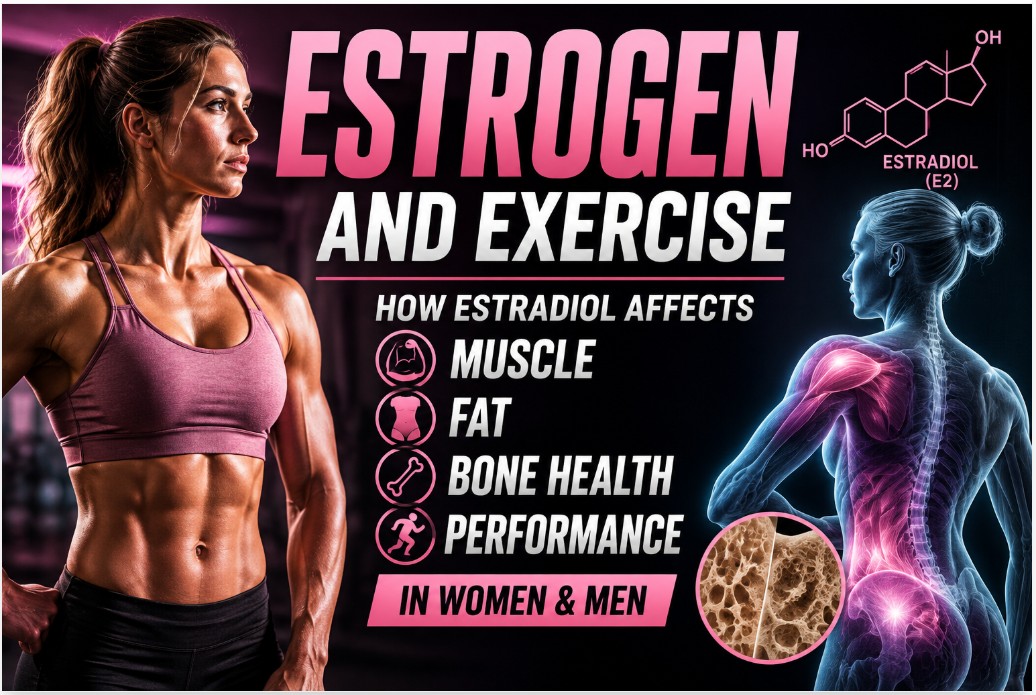
Estrogen is often labeled the “female hormone,” just as testosterone is labeled the “male hormone.” Both descriptions are misleading. The real relationship between estrogen and exercise touches muscle, bone, metabolism, fat distribution, connective tissue, and reproductive physiology — in both women and men. And here’s the theme that runs through this entire article: more estrogen is not automatically better — just as lower estrogen is not automatically better.
That framing might sound obvious once stated plainly, but it runs counter to much existing fitness content in both directions. Female-focused content sometimes treats estrogen fluctuations as something to train around obsessively; male-focused bodybuilding content sometimes treats estrogen as a contaminant to be suppressed as low as possible. Neither instinct holds up against the actual physiology, and this article walks through why.
QUICK ANSWER: Estrogen is not a direct “muscle-building switch,” but estrogen receptors exist throughout skeletal muscle, where estrogen participates in muscle function and metabolism. It’s also essential for bone health and influences broader metabolic physiology and body-fat distribution — in both women and men. Large, sustained shifts in estrogen, like the menopausal decline, are physiologically far more significant than chasing small daily or cyclical hormone fluctuations through training or diet.
What Is Estrogen?
Estrogen is actually a family of hormones, not a single molecule. Estradiol (E2) is the dominant and most potent form during reproductive years. Estrone (E1) and estriol (E3) are the other two. When people casually say “estrogen,” they’re usually referring primarily to estradiol — and so is this article, unless noted otherwise.
Where is it produced? In women, the ovaries are the primary source before menopause. In men, a substantial share comes from aromatization — the conversion of testosterone into estradiol via the aromatase enzyme. Beyond the gonads, adipose tissue, bone, brain, and skeletal muscle itself all contribute to estrogen production and local activity. That aromatase pathway matters enough for the rest of this article that it’s worth remembering the shorthand: testosterone → aromatase → estradiol.
How Estrogen Works: Estrogen Receptors Explained
Estradiol binds to estrogen receptors — primarily ERα and ERβ, plus some membrane-associated signaling — which then drives tissue-specific cellular effects. The key message worth carrying through the rest of this article: estrogen does not have one universal effect. Its actions depend on tissue, receptor distribution, hormone concentration, and physiological context. That’s why “estrogen is good” or “estrogen is bad” is the wrong frame.
Estrogen and Skeletal Muscle
This is where the article earns its keep for a bodybuilding audience. Muscle isn’t a passive recipient of reproductive hormones — it has its own estrogen receptors and, as it turns out, its own local estrogen production. A 2025/2026 review on estrogen in skeletal muscle describes how skeletal muscle expresses the steroidogenic enzymes needed to locally synthesize “myogenic estrogen,” which then acts in an autocrine or paracrine manner within the tissue — meaning muscle can produce and use its own estrogen signal, somewhat independent of circulating ovarian output. The same review notes this local production becomes particularly important as circulating estrogen declines during the menopausal transition, and that exercise itself can enhance the expression of the precursor substances and enzymes involved.
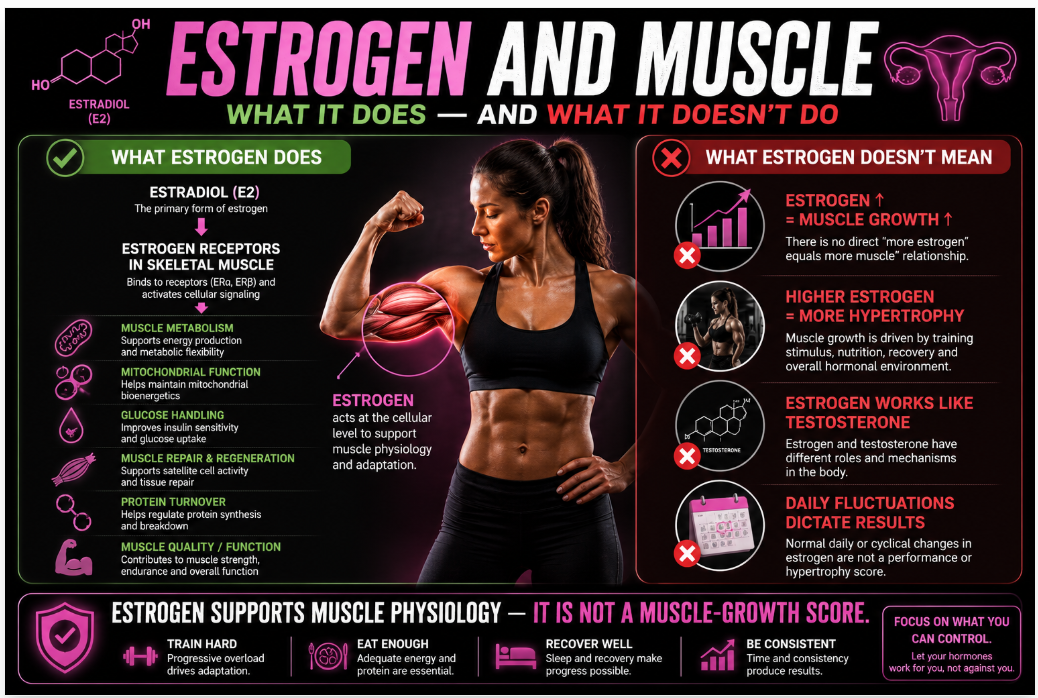
Within muscle, estrogen signaling has been linked to mitochondrial function, glucose handling, muscle repair and regeneration, protein turnover, and overall muscle quality. The mechanistic case is genuinely substantial: estrogen-related receptor signaling influences myofiber type, vascularization, and regeneration, and estrogen receptor activity in muscle has been tied to preserving mitochondrial health and insulin sensitivity. This tissue actively participates in its own local hormonal environment, not passively waiting for signals from the ovaries or testes.
But don’t turn “estrogen is involved in muscle physiology” into “estrogen is an anabolic hormone like testosterone.” That’s a different, much stronger claim than the evidence supports. The mechanistic pathways are real; the leap to “more estrogen means more muscle” is not.
Does Estrogen Build Muscle?
Not in the simple bodybuilding sense. This is a good place to explicitly name and reject the oversimplified model that so much fitness content defaults to: estrogen rises → protein synthesis rises → hypertrophy follows. There’s biological plausibility that estrogen participates in muscle maintenance and adaptation — the receptor biology and local synthesis covered above are real. But the size of normal circulating hormonal fluctuations is not a simple predictor of hypertrophy outcomes — a theme that runs consistently through the broader literature on endogenous hormones and hypertrophy, echoed in our articles on testosterone, growth hormone, and IGF-1. Estrogen supports muscle physiology; it is not a muscle-growth score.
Estrogen and Resistance Training
Does lifting weights change estrogen levels? There’s an acute response and a separate question of chronic adaptation — but this article isn’t going to be built around chasing acute hormonal spikes, for the same reasons we’ve explained throughout this hormone category: a transient blood-hormone measurement after a single session is a poor predictor of long-term training outcomes.
Does estrogen affect strength? Biological plausibility exists — estrogen receptors are present in relevant tissues, and the mechanisms described above (mitochondrial function, protein turnover) are all genuinely connected to performance capacity. But real-world performance comes from far more than one circulating hormone: training history, technique, neural efficiency, recovery, and sheer consistency all outweigh any single hormonal input.
Does it affect hypertrophy? Same answer: hormone physiology is not a predictable hypertrophy outcome on its own — and women very clearly achieve substantial strength and hypertrophy adaptations through resistance training, which is itself strong evidence against treating any single sex hormone as the deciding factor. If estrogen alone determined muscle-building capacity, the outcome for female lifters would look very different than it actually does. For a closer look at how male and female hypertrophy rates actually compare, see our article on whether men build muscle faster than women — and for a deeper dive specifically into women’s strength training and hormones, see our complete guide to estrogen and strength training for women.
Estrogen, Muscle Damage and Recovery
Worth a brief mention because it’s a popular fitness claim, particularly in content aimed at female lifters. Mechanistic hypotheses suggest estrogen has membrane-stabilizing, antioxidant, anti-inflammatory, and regenerative effects; it has been proposed to help protect muscle membranes from exercise-induced damage and to modulate the inflammatory response after a hard training session. Some of this mechanistic work comes from animal models and cell studies, which is a genuinely different level of evidence than a demonstrated real-world training benefit in humans.
There’s a real difference between mechanistic plausibility and the popular claim that “high estrogen means faster recovery.” This article isn’t going to promise that a woman automatically recovers better during a particular hormonal phase — the practical evidence for that specific claim isn’t strong enough to build training advice around, and as covered in the menstrual cycle section below, even performance and adaptation outcomes across cycle phases don’t show the kind of clean pattern this claim would require.
Estrogen and Fat Metabolism
Estrogen genuinely influences lipid metabolism, insulin sensitivity and glucose metabolism, adipose tissue behavior, and body-fat distribution — and these effects shift meaningfully around menopause, when fat distribution tends to move toward a more central, abdominal pattern as estrogen declines. But there’s an important distinction worth making explicit: estrogen and fat storage is not the same claim as “estrogen makes you fat.” That’s an internet oversimplification. Estrogen deficiency can be associated with unfavorable shifts in body composition and fat distribution — which is a different, more precise claim than blaming the hormone itself for fat gain. For the broader picture of how body composition differs between sexes, see our guide to gender differences in fat distribution.
Does High Estrogen Cause Fat Gain?
Not that simply. This requires separating two different things: energy balance versus fat distribution and metabolic regulation. Fat gain, at its core, still requires a positive energy balance — estrogen influences where fat tends to be stored and how metabolism is regulated, not whether you’re in a surplus or a deficit. It’s also worth distinguishing water retention from actual body-fat gain — these get conflated constantly in bodybuilding culture, and they’re not the same physiological event.
Coach’s Note: For lifters, estrogen is another example of why “more” and “less” are usually the wrong way to think about hormones. The goal isn’t to maximize or suppress a hormone — it’s to create a training, nutrition, and recovery environment that supports normal physiology while progressively challenging the muscle. For women specifically: if menstrual symptoms consistently affect training, adjust the program to the individual — not to an infographic telling every woman how she should feel on a specific cycle day.
Estrogen and Bone Health
This is a genuinely important section, and it connects directly to our broader coverage of skeletal anatomy. Estrogen is a major regulator of bone remodeling — the ongoing cycle of bone breakdown (resorption) and bone formation that keeps skeletal tissue renewed throughout life. When estrogen declines, bone resorption increases relative to formation, and bone loss risk rises accordingly. This is most pronounced during menopause, but it’s also relevant to low-energy-availability situations covered later in this article, where estrogen can drop well before menopausal age.
Resistance training plays a genuinely important role here too, working through the same mechanical loading principle described in Wolff’s Law — bone adapts to the mechanical stress placed on it, becoming denser and stronger in response to consistent loading — though the literature on the exact size of bone mineral density benefits isn’t equally strong across every outcome measured. A 2025 meta-analysis of 17 randomized controlled trials (690 subjects) found resistance training significantly improved bone mineral density at the lumbar spine and femoral neck in postmenopausal women specifically — genuine, clinically relevant evidence that training helps counter this decline, even if effects weren’t uniform across every measured skeletal site. For the broader anatomical picture, see our guides to the human skeletal system and bone mineral density.
Estrogen, Tendons and Connective Tissue
Briefly, since we have a full tendons and ligaments and connective tissue cluster covering this in depth elsewhere: sex hormones can influence collagen and connective-tissue biology. What this article won’t do is jump to “high estrogen makes women’s ligaments weak” — that’s a considerably oversimplified leap from real, but more nuanced, underlying biology.
Estrogen Across the Menstrual Cycle
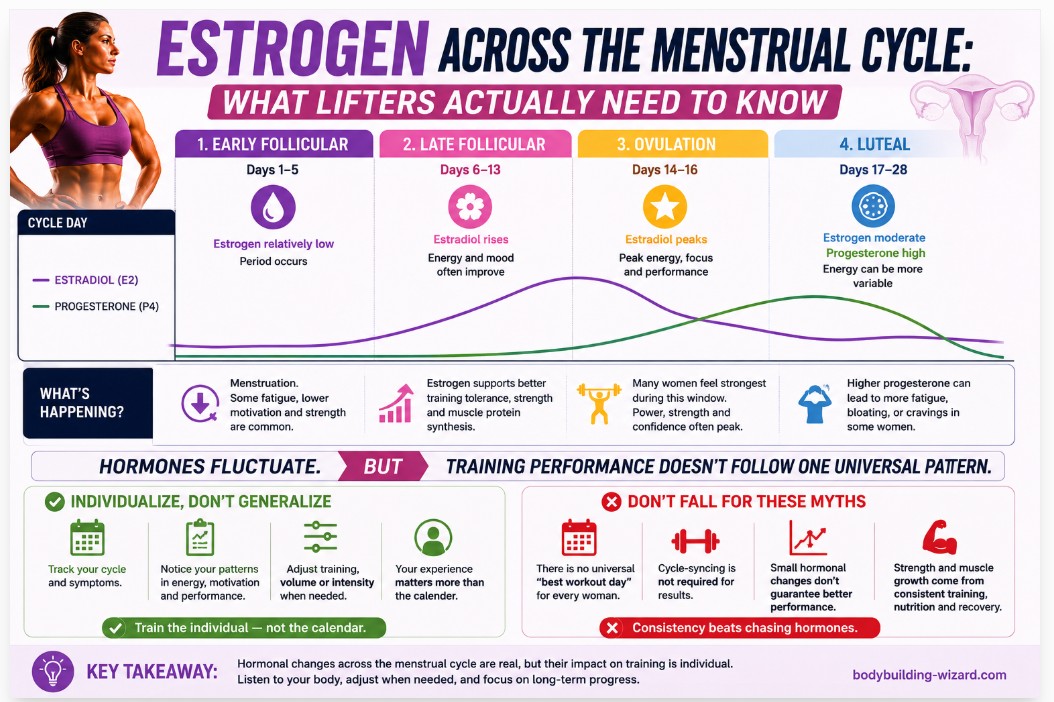
Briefly, without turning this into a menstrual-cycle article: in the early follicular phase, estrogen is relatively low. It rises through the late follicular phase, peaks around ovulation, and then estrogen and progesterone both play a role during the luteal phase.
Does the Menstrual Cycle Affect Strength and Muscle Growth?
This is one of the most important sections in the entire article because the internet is currently saturated with “train according to your hormones” content—and the evidence is far less tidy than that framing suggests.
An umbrella review examining meta-analyses and systematic reviews on menstrual cycle phase and resistance training outcomes concluded that it is premature to conclude that short-term fluctuations in reproductive hormones appreciably influence acute exercise performance or longer-term strength or hypertrophic adaptations — while also highlighting a pattern of poor and inconsistent menstrual cycle verification methods across the existing literature. Many of the studies underpinning popular “cycle-sync your training” advice didn’t confirm participants’ cycle phase with actual hormone testing, relying instead on self-reported calendar dates—a genuinely significant methodological weakness given how variable real menstrual cycles are between individuals and even cycle to cycle in the same person.
A more recent 2025 systematic review requiring high methodological standards found maximal and explosive strength remained largely unaffected across cycle phases, while also noting that proper serum hormone verification was rare even among elite sport studies — reinforcing the same methodological concern from a different angle. Some outcomes, like neuromuscular coordination, showed modest improvement around ovulation in that review, but the overall picture for strength and hypertrophy specifically stayed consistent: no reliable, actionable pattern worth building a universal program around.
The Bodybuilding Wizard position here: individual symptoms may matter more for programming than rigidly assigning workouts to calendar phases.
Should Women Cycle-Sync Their Strength Training?
There is currently not enough evidence to prescribe a universal cycle-synced resistance-training program. That doesn’t mean the menstrual cycle doesn’t matter—it means individual response matters, and the current evidence doesn’t justify universal programming rules like “day 14 is PR day for every woman.”
Practical advice: if a woman consistently notices severe cramps, fatigue, reduced readiness, or clear performance changes tied to her cycle, adjust her program around that real, reported experience—don’t apply a generic infographic to everyone. That’s a genuinely different approach than “train legs in your follicular phase because that’s when estrogen peaks,” which assumes a universal hormonal effect on performance that the research above simply doesn’t support. For more on this specific comparison, see our article on strength training and estrogen levels.
Estrogen During Menopause
Menopause brings a genuine, substantial decline in estradiol, which connects to bone loss, body composition changes, muscle function shifts, and broader metabolic and aging-related effects covered throughout this article. Many women also notice changes in fat distribution around this transition, tying directly back to the fat metabolism section above.
The key fitness message here is one of the most practically important takeaways in the whole piece: resistance training becomes more important, not less, during and after this transition. Systematic reviews consistently show clear strength and functional benefits of resistance training in postmenopausal women, on top of the bone density benefits already covered above — this is a population where training has an outsized, well-documented protective role, not a group for whom exercise recommendations should get more conservative. See our dedicated, hormone-friendly guide to resistance training during menopause for the practical programming side of this topic.
Estrogen in Men: Why Male Lifters Need It Too
This is where this article earns its bodybuilding-specific value most directly — no generic women’s-health resource is built to cover this angle at all.
Where does estrogen come from in men? Primarily through aromatization: testosterone converted to estradiol via the aromatase enzyme, described earlier in this article. This happens in multiple tissues, including fat, and it means male estrogen levels are tied, in part, to the same testosterone physiology covered in our dedicated testosterone article — more testosterone available for aromatization generally means more substrate for estradiol production, all else being equal.
What does estrogen do in men? Normal estrogen physiology is genuinely relevant to bone health, reproductive and sexual physiology, metabolic function, and other tissues. Estradiol plays a real, non-optional role in male bone mineral density maintenance — in fact, some research suggests estradiol may be at least as important as testosterone itself for bone health in men, which surprises a lot of lifters who’ve only ever heard estrogen discussed as something to avoid. Estrogen isn’t an unwanted contaminant of testosterone physiology—it’s a hormone male lifters need to function normally, not a byproduct to eliminate.
Is High Estrogen Bad for Male Bodybuilders?
This deserves an evidence-based answer, not the reflexive “estrogen = bad” that bodybuilding culture often defaults to, which then drives some lifters toward aggressively suppressing aromatization through aromatase-inhibiting compounds or supplements marketed for that purpose — or toward avoiding entire food groups, like soy, out of an unfounded fear it will spike estrogen. The honest picture: too high can be clinically relevant, but too low can be problematic too. Aggressively suppressed estrogen in men has been associated with negative effects on bone density, lipid profiles, joint health, and libido — genuinely counterproductive outcomes for someone whose actual goal is long-term training capacity and health. Normal physiology isn’t zero estrogen — both extremes carry real downsides. This article won’t cover AAS-adjacent dosing or protocols; that’s outside its scope.
Low Estrogen: Why Too Little Can Be a Problem
This connects both women and men. Potential consequences of low estrogen can include effects on bone health, reproductive function, sexual function, and metabolic changes, with specifics depending on sex and context. This isn’t a self-diagnosis checklist — it’s simply worth knowing that the “lower is better” instinct some male lifters apply to estrogen doesn’t hold up any better than “higher is better” does.

Estrogen and Energy Availability
Especially relevant for female athletes, and arguably more practically important than anything else in this article for that specific population. The chain matters: low energy availability—not eating enough relative to training demand—can disrupt the hypothalamic-pituitary-gonadal axis, leading to menstrual dysfunction, which reduces estrogen exposure and carries real bone health consequences via the same bone remodeling mechanism covered earlier in this article. This cascade is well-documented in athlete populations, particularly in sports with an aesthetic or weight-class component where chronic under-fueling is common.
This is a far more important consideration for a serious female athlete than anything resembling “hacking estrogen,” and it deserves real attention rather than being treated as a footnote. A missed or irregular cycle during heavy training isn’t a minor inconvenience to push through—it’s a genuine signal worth addressing through adequate fueling, not supplements or training adjustments alone.
Can Exercise Increase or Decrease Estrogen?
The honest answer is: it depends — on acute versus chronic exercise, energy availability, adiposity, age, and menopausal status, among other factors. A 2024 systematic review and meta-analysis examining exercise’s effects on sex steroid hormones in eumenorrheic women found no significant effect of exercise on free estradiol concentration. So no — there’s no good evidence for a simple “lifting boosts your estrogen” claim, the same pattern this entire hormone category keeps running into.
Can You Naturally “Optimize” Estrogen?
This won’t be a “10 Ways to Boost Estrogen Naturally” list — that’s exactly the SEO-trash direction this article is trying to avoid. What lifters can actually control: adequate energy availability, adequate dietary fat, protein, and micronutrients, sensible body-fat management, consistent resistance training, recovery, and avoiding extreme chronic dieting. These behaviors support normal physiology — they are not estrogen hacks. The distinction matters: none of these behaviors aim to push a specific hormone number in a specific direction. They aim to avoid sabotaging the physiological system that’s already working correctly in the background, which is the same practical philosophy that runs through every hormone covered in this site’s endocrine category.
What About Estrogen-Blocking Supplements?
Genuinely relevant to bodybuilding culture, so worth addressing directly: “estrogen blocker” does not equal better muscle growth or more testosterone. That’s a marketing leap, not a demonstrated physiological outcome. Normal estrogen physiology serves a real purpose in male lifters, as covered above — this article isn’t going to review individual products, because the underlying premise deserves more scrutiny than any specific brand.
What About Aromatase Inhibitors?
Briefly, as a factual note: aromatase inhibitors reduce the conversion of testosterone to estradiol. But these are prescription drugs for specific medical conditions — not casual bodybuilding hormone-optimization tools. This article isn’t the place for dosing or cycling information, and we’re not providing any.
Estrogen and Exercise: The Bodybuilder’s Take
Estrogen doesn’t replace progressive overload, adequate protein, or energy balance. But it is an important part of the physiological environment in which muscle, bone, and metabolism adapt to training. Both women and men need normal estrogen signaling — and neither maximizing nor eliminating estrogen is a sensible bodybuilding goal.
Common Estrogen Myths in Fitness
❌ Myth: Estrogen is only a female hormone.
✅ Reality: Men produce and need estrogen too, primarily through aromatization of testosterone — it’s relevant to bone health, metabolism, and other tissues in male physiology.
❌ Myth: Estrogen makes you fat.
✅ Reality: It influences metabolism and fat distribution, but actual fat gain still requires a positive energy balance.
❌ Myth: Estrogen prevents women from building muscle.
✅ Reality: Women respond strongly to resistance training, achieving substantial relative hypertrophy and strength gains despite normal female hormone levels.
❌ Myth: Higher estrogen always means better muscle growth.
✅ Reality: Hormone levels are not a hypertrophy score — the same lesson that applies to testosterone, growth hormone, and IGF-1 applies here.
❌ Myth: Low estrogen is good for male bodybuilders.
✅ Reality: Excessive suppression can disrupt normal physiology, including bone health and metabolic function — the goal is normal levels, not zero.
❌ Myth: Women should completely redesign training around menstrual-cycle phases.
✅ Reality: Current evidence does not support universal cycle-sync prescriptions — individual symptoms matter more than calendar-based rules.
❌ Myth: You can “balance estrogen” with a supplement.
✅ Reality: Endocrine regulation is considerably more complex than any single supplement can meaningfully influence.
