



Introduction
Men have far more testosterone, carry more muscle, and dominate the upper end of strength and bodybuilding. So it seems obvious that men must also build muscle much faster than women. But that conclusion misses an important distinction: absolute muscle growth and relative muscle growth are not the same thing.
Men generally start with more muscle and may gain somewhat more muscle in absolute terms. But when muscle growth is expressed relative to starting muscle size, women appear capable of remarkably similar hypertrophy. That’s exactly what a 2025 meta-analysis found: absolute growth slightly favored men, while the difference in relative growth was only about 0.7 percentage points — with a confidence interval that included essentially no difference at all. That distinction is the hook this entire guide is built around.
QUICK ANSWER: Men tend to gain slightly more muscle in absolute terms, largely because they start with more muscle mass and have substantially higher testosterone levels. However, research indicates that men and women achieve similar relative increases in muscle size when following the same resistance-training program. In other words, women may add fewer kilograms of muscle, but their percentage increase from baseline can be remarkably similar to men’s.
Men vs. Women: Absolute vs. Relative Muscle Growth
This distinction has to come first, because nothing else in this guide makes sense without it. Consider a simple example:
Man: 70 kg lean mass → gains 3 kg. Woman: 45 kg lean mass → gains 2 kg
The man gained more absolute muscle mass — a real, measurable difference. But expressed as a percentage of each person’s starting point, the man gained roughly 4.3%, and the woman gained roughly 4.4%. Proportionally, relative to where each of them started, the two results are essentially identical.
| Measure | Men | Women |
|---|---|---|
| Starting muscle mass | Higher | Lower |
| Absolute muscle gain | Usually somewhat greater | Usually somewhat lower |
| Relative hypertrophy | Similar | Similar |
| Absolute strength | Higher | Lower |
| Relative training response | Similar / context dependent | Similar / context dependent |
The most recent meta-analysis on this exact question supports this distinction directly, and it’s covered in full detail later in this guide.
Key Point: Men usually add more total kilograms of muscle. Women usually match that growth almost exactly when measured as a percentage of their own starting muscle mass. Both statements are true at the same time.
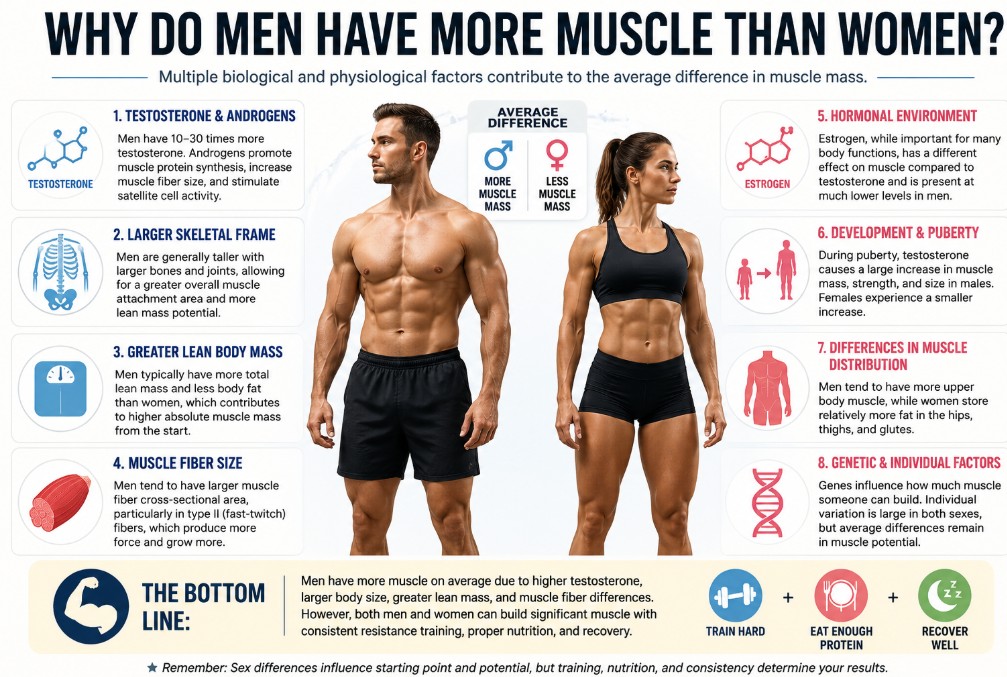
Why Do Men Have More Muscle Than Women?
Testosterone
The most obvious difference, and the one people reach for first — but it’s worth being careful not to let “testosterone” become the entire explanation, because the research doesn’t support that simplification. Men carry substantially more circulating testosterone, which drives pubertal muscle development, influences muscle protein turnover, and interacts with androgen receptors and satellite cells throughout life. The cumulative effect of decades in a higher-androgen environment is a big part of why men typically enter adulthood with more muscle mass before either sex has touched a weight. Our full guide to hormones and muscle growth covers testosterone’s actual mechanism of action in far more depth.
Body Size and Lean Mass
Men are, on average, built on a larger skeletal frame, which supports more total lean mass and more overall skeletal muscle to begin with. This larger starting frame is a big part of why absolute muscle potential differs even before training-specific factors come into play.
Muscle Fiber Size and Distribution
There are real, measurable fiber type differences between sexes, but it’s worth resisting the oversimplified version of this claim. It is not accurate to say “men are fast-twitch, women are slow-twitch.” Both sexes have a full mix of fiber types; the differences are in proportion and typical fiber size, not in category.
Can Women Build Muscle as Fast as Men?
Relatively — probably much closer than most people think. This is the heart of the entire topic, and it’s worth stating directly: a comprehensive 2025 meta-analysis that included 29 studies directly comparing men and women completing identical resistance training interventions found that absolute muscle growth slightly favored men, but relative increases in muscle size were similar between sexes.
What the Latest Research Says About Male vs. Female Hypertrophy
This systematic review with Bayesian meta-analysis, which included 29 studies directly comparing male and female responses to identical resistance training programs, is currently the most comprehensive, direct comparison available on this exact question, and its findings anchor most of the rest of this guide.
| Measure | Finding |
|---|---|
| Absolute hypertrophy | Slightly favors men |
| Relative hypertrophy | Essentially similar between sexes |
| Upper-body absolute growth | Somewhat favors men |
| Lower-body absolute growth | No clear male advantage |
| Type II (fast-twitch) fiber hypertrophy | Similar between sexes |
| Type I (slow-twitch) fiber hypertrophy | Small male advantage |
Upper-Body vs. Lower-Body Muscle Growth
This is one of the more genuinely interesting, underdiscussed findings in this research, and it’s a big part of what separates a well-researched answer from the generic version of this topic. The male advantage in absolute muscle growth was concentrated specifically in the upper body — lower-body hypertrophy showed no clear male advantage in the same analysis.
Possible explanations include baseline differences in muscle distribution between sexes, sex-specific body composition patterns, differing hormonal exposure across upper versus lower body tissue, and habitual daily activity patterns that may load the lower body more evenly across sexes than the upper body typically is. It’s worth being clear that these are plausible explanations, not proven mechanisms — the upper/lower body finding itself is well supported, but the reasons behind it are still an active area of research.
Testosterone: If Men Have So Much More, Why Isn’t the Difference Bigger?
This is the question that should logically follow from everything above, and it’s arguably the most interesting one in this entire guide. If men have several times more circulating testosterone than women, how can relative hypertrophy end up so similar?
The answer is that physiological testosterone level is not a simple, linear predictor of training-induced hypertrophy. Muscle growth depends heavily on local, intramuscular factors — androgen receptor sensitivity, the activity of satellite cells and the myonuclei they donate, intracellular signaling through pathways like IGF-1, and simple individual variability — not just how much of a given hormone happens to be circulating in the blood. Two people with very different testosterone levels can experience surprisingly similar anabolic signaling within the muscle itself, which is exactly why testosterone level alone doesn’t scale up into a proportionally larger hypertrophy advantage for men. Our full guide to hormones and muscle growth covers this local-signaling distinction in depth.
Does Estrogen Help Women Build Muscle?
Estrogen shouldn’t be thought of as simply “the female version of testosterone,” because its role in muscle physiology is genuinely different, not just a smaller-scale anabolic hormone. Research points to estrogen playing a meaningful role in muscle repair, limiting exercise-induced muscle damage, supporting connective tissue health, aiding recovery, and influencing satellite cell function and muscle protein turnover.
The honest picture here is more complex than “testosterone builds muscle, estrogen doesn’t.” Estrogen appears to support the conditions muscle growth depends on — repair, recovery, tissue quality — even if it doesn’t drive hypertrophy through the same direct receptor-mediated pathway testosterone does.
Coach’s Note: I still get female clients who show up worried that heavy squats and deadlifts are going to make them look like something they don’t want to look like. I understand where that comes from, but it’s just not how this works. Every visibly muscular physique, male or female, is the product of years of deliberate, progressive, often quite difficult training aimed specifically at that outcome. If anything, I’ve found women often out-recover and out-work their male training partners across a training block. Train like the goal, not like the myth.
Do Men and Women Respond Differently to Resistance Training?
Broadening from pure hypertrophy to the overall training response, a recent narrative review concluded that relative strength gains and hypertrophic responses are largely comparable between sexes, even though several other physiological differences do exist — particularly around neural adaptations, recovery patterns, and fatigue resistance, covered next.
Are Women More Fatigue-Resistant Than Men?
There’s real evidence for this, and it’s one of the more consistently observed sex differences in the literature. Research directly comparing fatigue during and recovery from resistance exercise has found that women demonstrate greater fatigue resistance than men, particularly during isometric contractions.
Possible explanations include differences in fiber-type characteristics, substrate utilization patterns, blood flow, the absolute amount of muscle mass involved in a given contraction, and simply lower absolute loads relative to men in many comparative study designs.
Does this mean women should do more reps or more total volume? Not necessarily. Greater fatigue resistance is a real physiological trait, but it doesn’t automatically translate into a universal prescription — individual response, recovery capacity, and training goals still matter more than sex alone in determining optimal volume for any given person.
Should Women Train Differently From Men for Muscle Growth?
The fundamental principles of hypertrophy do not change with sex. Both men and women need progressive overload, sufficient training volume, appropriate proximity to failure, adequate protein, sufficient calories, real recovery, and long-term consistency. None of that changes based on which sex is applying it.
That said, individual programming can reasonably be adjusted for factors like fatigue resistance, recovery capacity, specific training goals, muscle priorities, or menstrual symptoms — the same way any program gets individualized for any lifter, regardless of sex. What shouldn’t happen is a wholesale assumption that women need a completely different style of training by default. “Women need entirely different workouts” is a fitness myth, not a conclusion the research supports.
Do Women Need Less Protein Than Men to Build Muscle?
Not in the way this question usually gets framed. Protein needs are generally prescribed relative to body mass, not as a flat “men need X grams, women need Y grams” rule. A smaller person of either sex generally needs less total protein than a larger person, and a larger woman may well need more total daily protein than a smaller man — body mass and training goals drive the calculation, not sex directly. Our protein intake calculator accounts for this properly.
Does the Menstrual Cycle Affect Muscle Growth?
Hormonal fluctuations across the menstrual cycle can plausibly influence performance and recovery on a given day, and some research has found modestly enhanced strength during phases when estrogen is relatively higher. That said, individual variability across this research is considerable, and the current evidence isn’t strong enough to justify rigid, cycle-based programming for every woman by default. This is a real, active area of research worth being aware of — but it’s not the central factor determining how well a woman builds muscle over the course of months and years of training.
Menopause and Muscle Growth
This connects directly to a topic covered in much more depth in our dedicated guide to anabolic resistance and aging. Estrogen decline at menopause meaningfully affects muscle physiology, contributing to accelerated muscle and strength loss and increased sarcopenia risk independent of age alone, layered on top of the general anabolic resistance that affects both sexes with age. It’s worth being clear about the distinction: this is a sex-specific hormonal effect happening on top of a general aging effect, not a replacement for it — resistance training and adequate protein remain the primary countermeasures for both.
Who Has Better Genetics for Building Muscle — Men or Women?
The honest answer isn’t simply “men.” Men have a higher average absolute muscular potential, largely for the reasons covered throughout this guide, but individual genetic variation within each sex is enormous — genuinely larger than the average difference between sexes in many respects. A genetically gifted woman can be a considerably better hypertrophy responder than an average or low-responding man. Our full guides to genetics and muscle growth and how much muscle you can build naturally cover this individual variation — high and low responders, heritability ranges, and realistic natural limits — in far more depth than sex alone could ever explain.
Male vs. Female Muscle Growth: What Actually Matters Most?
| Factor | Importance |
|---|---|
| Biological sex | Influences baseline size and absolute potential |
| Genetics | Major individual influence |
| Training quality | Major modifiable influence |
| Progressive overload | Essential |
| Protein | Essential |
| Energy intake | Important |
| Sleep and recovery | Important |
| Training age | Major influence |
| Consistency | Critical |
Key Point: Sex influences your starting point and your absolute ceiling more than it changes the fundamental process of hypertrophy itself. Genetics, training quality, and consistency explain far more of the variation between any two individual lifters than sex alone ever will.
Common Myths About Men, Women and Muscle Growth
Myth: Women can’t build significant muscle naturally.
Reality: Relative to their own starting point, women build muscle at a rate statistically similar to men, according to the most comprehensive recent meta-analysis on this question.
Myth: Men always gain muscle much faster.
Reality: Men typically gain more in absolute terms, largely due to a higher starting point, but relative growth rates are comparable between sexes.
Myth: Women need light weights and high reps.
Reality: The same fundamental training principles — progressive overload, sufficient volume, proximity to failure — apply identically regardless of sex.
Myth: Testosterone is the only hormone that matters for muscle growth.
Reality: Estrogen, IGF-1, local androgen receptor sensitivity, and satellite cell activity all meaningfully contribute, and testosterone level alone doesn’t linearly predict hypertrophy outcomes.
Myth: Women become “bulky” easily.
Reality: Building a large amount of visible muscle mass requires deliberate, sustained, progressive training over years for anyone, regardless of sex — it isn’t an accidental outcome of normal strength training.
Myth: Women need completely different hypertrophy programs.
Reality: The fundamental principles are identical; individual factors like fatigue resistance or recovery may justify minor adjustments, the same as they would for any individual lifter.
Myth: Men and women should eat dramatically different amounts of protein per kilogram.
Reality: Protein needs scale primarily with body mass and training goals, not sex directly.
Conclusion
Different starting point. Same underlying rules.
Men build more muscle in raw numbers, largely because they start with more of it and carry a hormonal environment that supports a larger absolute ceiling. That part is real, and no amount of reframing changes it.
But the question most people are actually asking — “can I build muscle the way men do?” — has a much more encouraging answer than the gym folklore suggests. Relative to where you personally start, your muscle tissue responds to progressive overload, adequate protein, and consistent training in essentially the same way, regardless of sex. The 2025 meta-analysis at the center of this guide didn’t find a small asterisk next to that conclusion — it found a genuine, statistically similar response.
What actually separates two lifters isn’t which sex they were born. It’s genetics, training age, consistency, and how many years they’re willing to put in — the same handful of variables that would separate any two people training side by side. Sex sets your starting point and your absolute ceiling. It doesn’t rewrite the process that gets you there.
Train heavy. Train consistently. Let years, not myths, decide what your body becomes.
