


Introduction — Why Muscle Size Has a Hard Limit
Most lifters believe muscle growth is only about training harder, eating more protein, and optimizing hormones. But there is a deeper biological limit that almost no one talks about: the number of nuclei inside your muscle fibers.
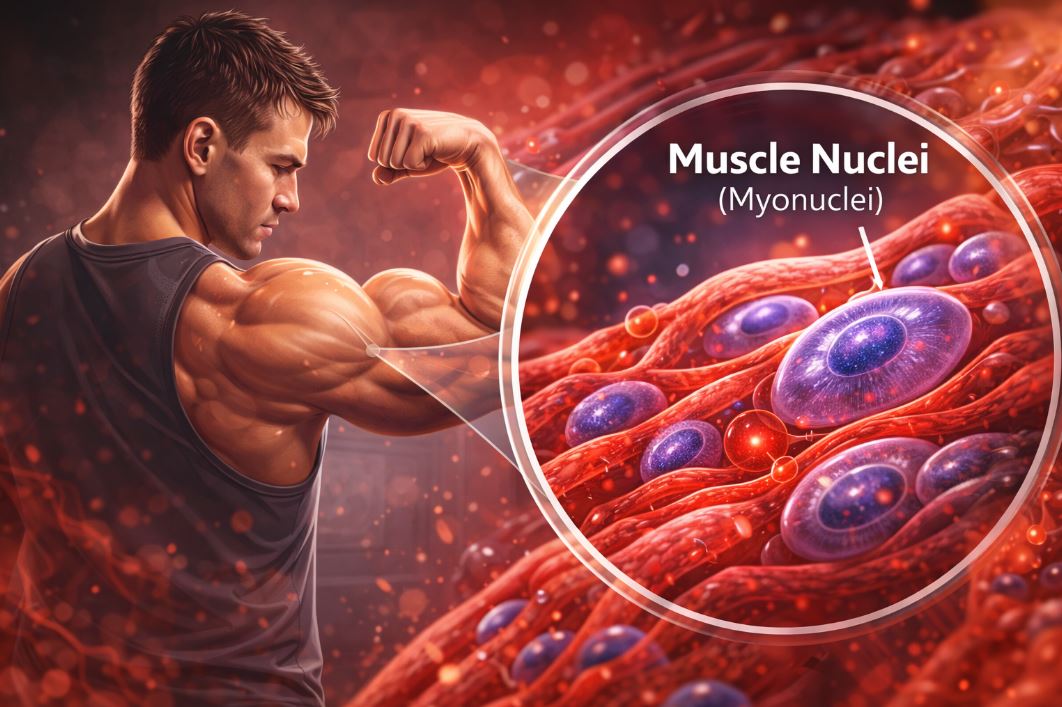
Every muscle fiber is a giant cell. Unlike most cells in the body, muscle fibers contain many nuclei. These nuclei act as control centers that regulate how much protein the fiber can build and maintain.
In simple terms, your muscles can only grow as large as their nuclei allow.
This is why two people can train and eat similarly yet end up with very different physiques. One has a muscle architecture that allows continued growth. The other hits a biological ceiling much earlier.
To understand real, long-term muscle growth, you must understand myonuclei.
What Are Muscle Nuclei (Myonuclei)?
Muscle fibers are not normal cells. They are long, multi-nucleated structures. Each nucleus controls a specific region of the muscle fiber, regulating protein production, repair, and maintenance.
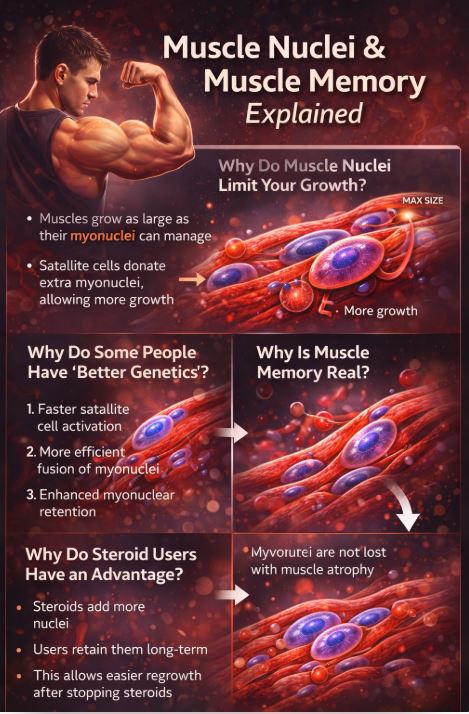
The larger a muscle fiber becomes, the more nuclei it needs to support that size. Each nucleus can only manage a limited volume of muscle tissue. This is known as the myonuclear domain.
When the fiber grows beyond what its current nuclei can support, growth slows or stops—unless new nuclei are added.
This is where satellite cells come in.
How Myonuclei Determine Your Growth Potential
Muscle hypertrophy requires two things:
- An increase in muscle protein
- An increase in the muscle’s capacity to manage that protein
The second part depends entirely on myonuclei.
Without new nuclei, your muscle fibers eventually reach a point at which they cannot efficiently synthesize or maintain more tissue. This creates a biological growth ceiling.
Some people naturally have:
- More satellite cell activity
- Better nuclear retention
- More efficient fusion of nuclei into fibers
These individuals can keep adding nuclei over time, allowing their muscles to keep growing. Others struggle to expand their nuclear pool, which limits their ultimate size.
This is the real biological basis of “good genetics.”
Satellite Cells and the Creation of New Myonuclei
Satellite cells are muscle-specific stem cells. When activated by training, hormones and sufficient energy, they divide and fuse with muscle fibers, donating their nuclei.
Every time this happens:
- The muscle fiber gains a new control center
- Its protein-building capacity increases
- Its long-term growth potential expands
This process is slow but cumulative. Over years of proper training and recovery, muscles build a larger and more powerful nuclear infrastructure.
This is why smart training builds not just muscle, but the ability to build muscle.
Muscle Memory Is Stored in Myonuclei
One of the most important discoveries in muscle biology is that myonuclei are not easily lost, even when muscle size shrinks.
When you stop training or diet aggressively, muscle fibers lose volume—but many of their nuclei remain. This gives the muscle a lasting growth advantage when training resumes.
This is the biological basis of muscle memory.
Once you earn nuclei through training, your muscles retain a blueprint for rebuilding faster in the future.
Why Steroid Users Keep Their Muscle Advantage
Anabolic steroids massively increase satellite cell activation and nuclear donation. This leads to a permanent increase in the number of myonuclei.
Even after stopping drug use and losing muscle mass, those extra nuclei remain embedded in the muscle fibers. This means former steroid users retain a structural advantage that allows them to regain size far more easily than natural lifters.
This is not a theory—it is documented in human muscle biology.
Once nuclei are added, they are very difficult to remove.
Why Myonuclei Are the True Size Limit
Muscle size is not limited by motivation, supplements, or even training intensity alone. It is limited by the amount of nuclear infrastructure your muscle fibers possess.
Training builds strength.
Protein builds tissue.
But myonuclei determine how much tissue your muscles can maintain.
This is why long-term, progressive, well-recovered training is so powerful. It builds a foundation that lasts.
Practical Training Implications of Myonuclei
If myonuclei represent the true size limit of muscle growth, then training should aim for more than short-term hypertrophy. The real objective is to gradually expand the number of nuclei within muscle fibers, thereby increasing long-term growth capacity.
This shifts how we think about program design.
1. Train for Long-Term Structure, Not Short-Term Pumps
Training that focuses solely on pump and metabolic fatigue may temporarily increase muscle size, but it does not guarantee the addition of new nuclei.
Myonuclear expansion requires:
- High mechanical tension
- Progressive overload
- Repeated exposure over time
Muscles must be forced to adapt structurally, not just metabolically.
2. Progressive Overload Is Non-Negotiable
Without progression, there is no biological reason for muscles to add new nuclei.
Myonuclei are added when existing nuclei can no longer support increasing fiber size. If load, volume, or mechanical stress does not increase, growth stalls at the nuclear level.
In practice:
- Plan progression across weeks and months, not workouts
- Prioritize core lifts that allow long-term overload
3. Compound Lifts Matter More Than You Think
Multi-joint movements generate:
- Greater fiber recruitment
- Higher mechanical stress per fiber
- Stronger satellite cell activation
Squats, deadlifts, presses, and rows are not outdated—they are biologically efficient for building nuclear infrastructure.
Isolation work has value, but it does not build the foundation.
4. Volume Must Be Recoverable
Excessive volume without recovery:
- Elevates cortisol
- Suppresses satellite cell activity
- Slows long-term nuclear addition
The goal is not maximal volume, but the highest volume you can consistently recover from.
If you are not recovering, you are not building myonuclei.
5. Training to Failure Should Be Strategic
Chronic training to failure increases neural and hormonal stress without proportionally increasing myonuclear signaling.
For long-term adaptation:
- Most sets: 1–3 reps in reserve (RIR)
- Failure: occasional and intentional
Myonuclei respond to sustained, manageable stress, not constant overload.
6. Consistency Beats Intensity Spikes
Myonuclear adaptation is slow. It occurs over:
- Months
- Years
- Repeated high-quality training cycles
A program you can sustain will always outperform a short-lived extreme approach.
7. Why This Changes How You Should Think About Training
If you train only for today’s appearance, you miss the bigger picture. Training for myonuclear expansion builds muscles that:
- Grow more easily in the future
- Resist loss during layoffs
- Rebound faster after detraining
This is the difference between short-term progress and lasting muscular capacity.
Common Myths About Muscle Nuclei
Muscle nuclei (myonuclei) are often mentioned in advanced training discussions, but they are also widely misunderstood. These myths lead many lifters to train in ways that limit long-term progress rather than enhance it.
Let’s clear them up.
Myth 1: “Muscle nuclei increase automatically when muscles get bigger.”
Muscle fibers can grow temporarily without adding new nuclei, but this growth is limited. Once the existing nuclei reach their capacity to manage protein synthesis, further hypertrophy slows or stops. Long-term growth requires new myonuclei, not just larger fibers.
Myth 2: “You lose all muscle nuclei when you stop training.”
Muscle size decreases quickly during detraining, but myonuclei are far more persistent. Research shows that nuclei gained through training can remain for long periods, even when muscle mass shrinks. This is why muscle memory exists and why regaining size is faster than building it for the first time.
Myth 3: “More protein automatically means more muscle nuclei.”
Protein supports muscle repair and growth, but it does not trigger nuclear addition. Myonuclei are primarily added through mechanical tension and satellite cell activation, not solely through nutrition. You can eat perfectly and still fail to expand your nuclear capacity if the training stimulus is insufficient.
Myth 4: “Only beginners add new muscle nuclei.”
Beginners add nuclei quickly because their muscles are highly sensitive to new stimuli, but experienced lifters continue adding myonuclei over time—just at a slower rate. Advanced growth is harder, not because it stops, but because it becomes more structurally demanding.
Myth 5: “Muscle nuclei explain everything about genetics.”
Myonuclei are part of genetic advantage, but not the whole story. Genetics influence satellite cell responsiveness and nuclear retention, while training history, recovery, and stress determine how much of that potential is expressed. Genetics sets the range; lifestyle determines where you fall within it.
Myth 6: “Training harder always adds more nuclei.”
Excessive intensity without recovery increases stress hormones and suppresses satellite cell activity. Myonuclei are added through recoverable overload, not chronic exhaustion. More effort is not always more effective.
Understanding these myths shifts the focus from chasing short-term size to building the biological infrastructure that supports long-term muscle growth. Myonuclei are not a shortcut—but they are the reason intelligent, long-term training works.
Nutrition & Recovery for Myonuclear Retention
Adding myonuclei is only half the battle. Keeping them—and allowing them to continue supporting growth—depends heavily on nutrition and recovery. When the body perceives chronic energy shortage or stress, it shifts priorities away from maintaining expensive tissue, and the nuclear advantage you’ve built becomes harder to preserve.
Here’s how to protect and support myonuclear retention over the long term.
Maintain Adequate Energy Availability
Myonuclei are energetically costly. When calories are consistently too low, the body downregulates growth-related processes and shifts toward conservation.
Practical implications:
- Prolonged aggressive dieting increases the risk of losing growth capacity
- “Always cutting” lifters struggle to maintain size, even with good training
- Strategic maintenance phases help preserve nuclear infrastructure
If your goal is long-term muscle, energy availability must periodically signal safety and abundance.
Balance Protein With Carbohydrates
Protein provides the building blocks, but carbohydrates protect the environment in which those blocks are used. Adequate carbs lower cortisol, improve insulin signaling, and support IGF-1—all of which favor satellite cell function and nuclear retention.
Low-carb approaches during high-volume training often:
- Increase stress hormones
- Impair recovery
- Reduce the effectiveness of existing myonuclei
For most lifters, carbs are not optional—they are protective.
Prioritize Sleep as a Growth Signal
Sleep is when the body decides which tissues are worth keeping. During deep sleep:
- Growth hormone peaks
- Cortisol drops
- Cellular repair accelerates
Chronic sleep restriction sends the opposite message: prioritize survival over muscle. Over time, poor sleep erodes the effectiveness of the nuclear infrastructure you’ve built.
Manage Stress to Protect Cellular Investment
Psychological and physiological stress activate the same pathways that suppress satellite cells and anabolic signaling. Even perfect nutrition cannot fully offset chronic stress.
Low-intensity recovery work—walking, mobility, breathing drills—helps shift the nervous system into a state where myonuclei are preserved rather than ignored.
Use Dieting Phases Strategically
Muscle loss is most damaging when it occurs alongside nuclear loss. While short-term size reductions are often reversible, repeated harsh dieting increases the risk of losing growth capacity.
Smarter approaches include:
- Slower fat loss rates
- Planned refeeds
- Strength-focused training during cuts
The goal is to lose fat without convincing the body to dismantle its muscle infrastructure.
Think in Years, Not Weeks
Myonuclei represent long-term biological capital. Nutrition and recovery determine whether that capital compounds or erodes. Lifters who cycle intelligently between growth, maintenance, and recovery phases preserve their advantage and continue progressing year after year.
In short, training builds the structure—but nutrition and recovery decide whether it lasts.
Conclusion
Muscle growth is not limitless or random. At its core, it is governed by biology—specifically by the number of nuclei your muscle fibers possess. Myonuclei define how much muscle tissue you can build, how well you can maintain it, and how quickly you can regain it after periods of inactivity.
Satellite cells, intelligent training, sufficient nutrition, and proper recovery work together to expand and protect this nuclear infrastructure. Short-term size can come and go, but myonuclei represent long-term muscular capacity. This is why sustainable progress favors patience, consistency, and respect for recovery over extreme approaches.
If you train with this understanding, you stop chasing muscle—and start building the foundation that keeps it.
Key Takeaways
- Myonuclei set the true size limit of your muscles, not motivation or supplements.
- Satellite cells are the only source of new muscle nuclei, activated through proper training and recovery.
- Muscle memory exists because myonuclei are retained even when muscle size temporarily shrinks.
- Progressive overload and mechanical tension are essential for long-term nuclear expansion.
- Nutrition and energy availability determine whether nuclei are preserved or lost.
- Sleep and stress management protect the biological infrastructure of muscle.
- Long-term consistency beats short-term intensity when building lasting muscle capacity.
