



Introduction
You train hard, and you eat enough protein. You may even be following essentially the same program that worked brilliantly in your twenties and thirties — but muscle seems harder to gain and easier to lose than it used to be. Is the problem simply lower testosterone, a slower metabolism, or something else entirely?
The honest answer, for most people, is something else entirely: a well-documented physiological phenomenon called anabolic resistance. And it’s worth saying clearly, right from the start, since it’s the central message this entire guide is built around: anabolic resistance does not mean older lifters can’t build muscle. It means the same stimulus produces a smaller response — which changes how much training and nutrition you need, not whether the fundamental process still works.
QUICK ANSWER: Anabolic resistance is a reduced muscle-building response to anabolic stimuli such as dietary protein and resistance exercise. With age, the same protein meal or training stimulus may produce a smaller increase in muscle protein synthesis than it would in younger muscle. This resistance can be at least partially overcome through quality resistance training, adequate protein intake, and other lifestyle factors — it’s a shift in the dose you need, not a shutdown of the underlying system.
What Is Anabolic Resistance?
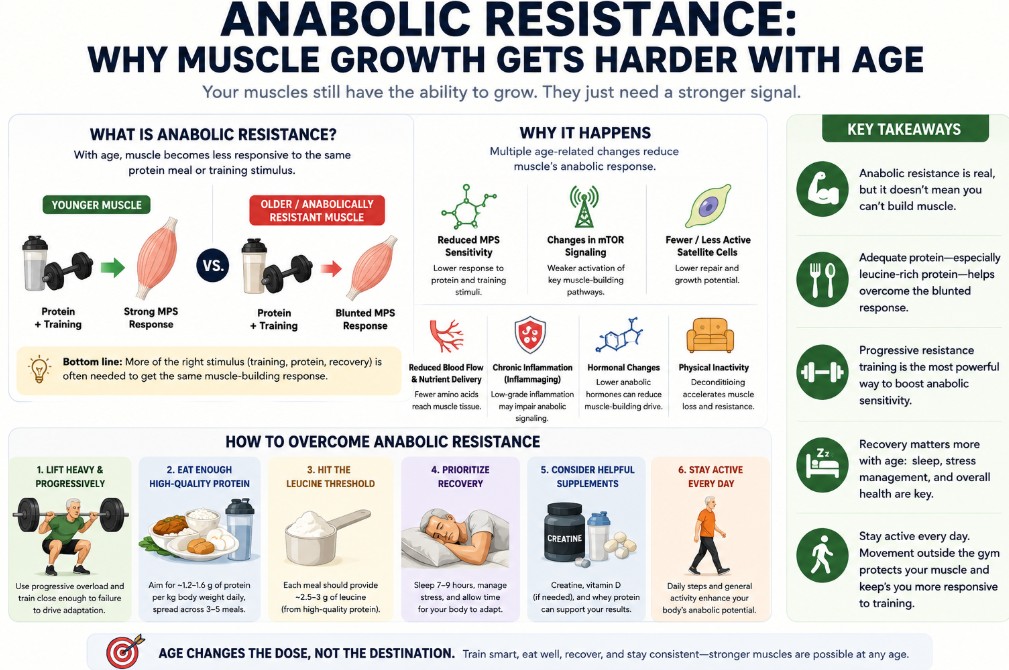
To understand anabolic resistance, it helps to understand the basic balance it disrupts. Muscle size at any given moment reflects the ongoing relationship between muscle protein synthesis (MPS) — the building side — and muscle protein breakdown (MPB) — the breakdown side. When MPS exceeds MPB, muscle grows. When the reverse is true, muscle shrinks. Under normal conditions, a meal containing enough protein, or a resistance training session, triggers a temporary rise in MPS that tips this balance toward growth.
Anabolic resistance describes what happens when that trigger stops working as well as it used to:
Young muscle: protein + training → strong MPS response. Older or anabolically resistant muscle: protein + training → blunted MPS response
A comprehensive systematic review and meta-analysis confirmed this age-related blunting of MPS responsiveness as a real, consistent finding across the available research, describing it as a central mechanism behind age-related muscle loss.
Key Point: Anabolic resistance is a change in how strongly muscle responds to a given anabolic stimulus — not an inability to respond at all.
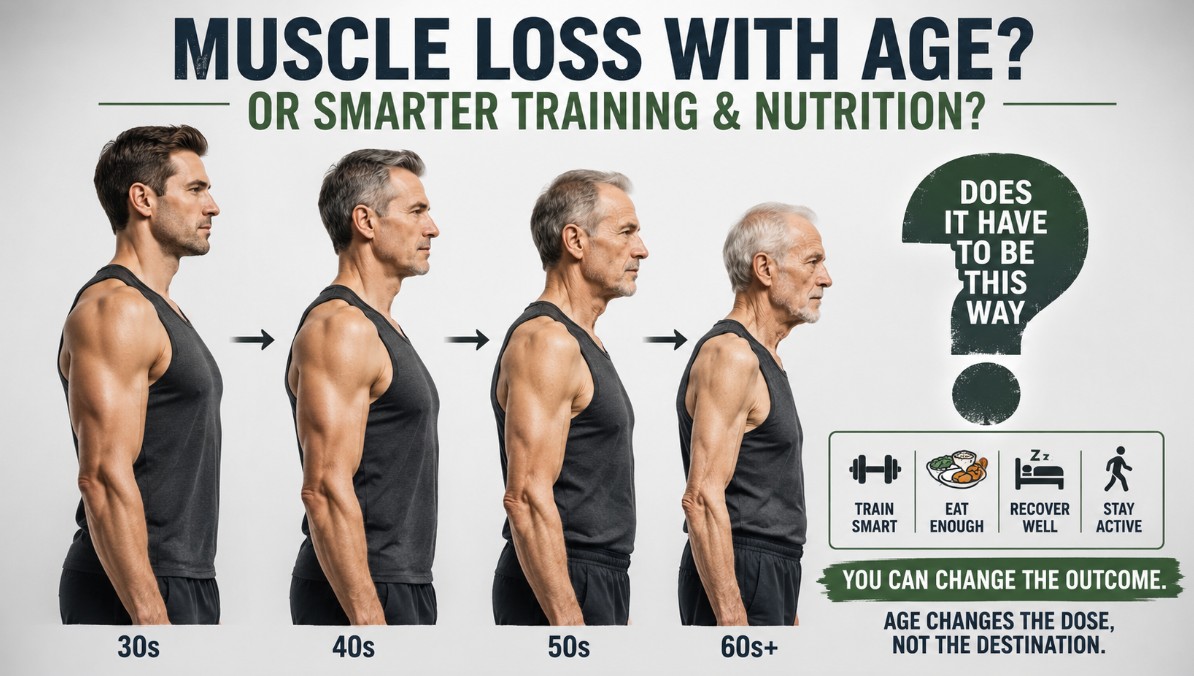
Why Does Muscle Growth Get Harder With Age?
No single mechanism explains this on its own. Several overlapping factors contribute, each covered in more depth below.
Reduced Sensitivity to Dietary Protein
The same amount of protein that once produced a strong MPS response produces a comparatively weaker one with age. This is closely tied to what’s known as the leucine threshold, covered in full detail later in this guide.
Reduced Response to Resistance Exercise
Older muscle can show a smaller MPS response to an identical training stimulus compared to younger muscle. Importantly, this does not mean resistance training stops working — it remains highly effective, just somewhat less efficient per unit of stimulus, which is exactly why the training recommendations later in this guide matter more with age, not less.
Changes in mTOR Signaling
At the cellular level, both protein and resistance exercise trigger muscle growth through a shared signaling pathway: amino acids and mechanical loading activate mTORC1, which in turn drives MPS. The mTORC1 pathway activates less robustly in older muscle in response to an identical stimulus, which is one of the more direct molecular explanations for why the same protein dose or workout produces less of a growth signal with age. Emerging research also suggests aging impairs ribosome biogenesis — the muscle’s ability to build the cellular machinery that actually manufactures new protein — in response to mechanical loading, potentially compounding the signaling deficit described above.
Satellite Cells and Muscle Regeneration
Satellite cells, the muscle-specific stem cells responsible for donating additional myonuclei during growth, also become somewhat less responsive with age — activating less readily and proliferating more slowly following a training stimulus. This contributes to the same general pattern seen elsewhere: the underlying machinery still works; it just requires more to get it running.
Hormonal Changes
Testosterone, growth hormone, IGF-1, estrogen in women, and insulin sensitivity all shift with age in ways that can influence anabolic signaling. It’s worth being careful here, though: it’s tempting to treat hormonal decline as the entire explanation for anabolic resistance, but the research doesn’t support that simplification — hormones are one contributing factor among several, not the single root cause. Our full guide to hormones and muscle growth covers this relationship in much more depth.
Reduced Blood Flow and Amino Acid Delivery
A mechanism most popular fitness content skips entirely: slower gastric emptying, reduced intestinal absorption, and diminished muscle blood flow and microvascular perfusion all mean fewer amino acids actually reach muscle tissue after a meal in older adults, independent of anything happening inside the muscle cell itself.
Inflammation and Oxidative Stress
Chronic low-grade inflammation that develops with age — sometimes called “inflammaging” — has been proposed as another contributor. Elevated inflammatory signaling, particularly through the NF-κB pathway, has been shown to interfere with anabolic signaling molecules like Akt and downstream MPS activation in mechanistic and animal research. It’s worth noting, in the interest of honesty, that the human evidence here is more mixed than the mechanistic story suggests — some human trials specifically testing whether low-grade inflammation blunts post-meal MPS in older adults have failed to find a clear effect, so this mechanism should be considered plausible and biologically supported, but not as firmly established in humans as some of the other factors on this list.
Physical Inactivity
This deserves particular emphasis, because it’s arguably the most actionable item on this entire list. A meaningful portion of what gets labeled “age-related anabolic resistance” isn’t purely a function of calendar age at all — it’s a self-reinforcing cycle: less movement leads to less muscle, which leads to a weaker anabolic response, which leads to even less muscle. Just two weeks of reduced daily step count has been shown to induce measurable anabolic resistance to protein feeding in otherwise healthy older adults — a striking demonstration that inactivity itself, not age alone, drives a significant share of this effect.
Key Point: Anabolic resistance results from the combined effect of blunted protein sensitivity, reduced signaling, slower satellite cell response, hormonal shifts, reduced amino acid delivery, low-grade inflammation, and — critically — physical inactivity, which amplifies nearly all of the above.
At What Age Does Anabolic Resistance Begin?
There’s no magic birthday after which muscle metabolism suddenly flips a switch, and it’s worth resisting the temptation to give you a single number. The differences develop gradually and depend on activity level, training history, body composition, health status, nutrition, sex, and individual biology — which is exactly why two 55-year-olds can be in completely different situations depending on decades of lifestyle differences between them.
That said, research does give us useful reference points. Studies comparing young, middle-aged (45–55), and older adults have found a measurably blunted hypertrophic response to resistance training in the middle-aged group compared to the young group, with more pronounced effects generally documented from the mid-60s onward. This is the natural bridge into a question almost everyone actually wants answered directly.
Why Is It Harder to Build Muscle After 40?
This is worth addressing head-on, because “40” carries a lot of cultural weight that the biology doesn’t fully support. Turning 40 is not a biological switch. Someone who is 45 and has trained consistently for 20 years is in a fundamentally different physiological situation than a sedentary person of the same age who has never trained.
It’s worth distinguishing two very different reasons someone in their 40s might notice slower gains:
- Slower gains because you’re an advanced lifter. As covered in our guide to how much muscle you can build naturally, gains slow dramatically with training age regardless of chronological age — a 25-year-old with a decade of serious training also gains far more slowly than they did as a beginner.
- Slower gains because of aging physiology. This is the anabolic resistance effect specifically covered throughout this guide, layered on top of whatever training-age effect is already present.
Most people experiencing slower progress after 40 are dealing with some combination of both, not purely one or the other — which matters, because the solutions overlap but aren’t identical.
Anabolic Resistance vs Sarcopenia: What’s the Difference?
These two terms are closely related but describe different things, and mixing them up is a common source of confusion in this topic.
| Feature | Anabolic Resistance | Sarcopenia |
|---|---|---|
| What it is | A reduced anabolic response to protein and training | A clinical condition: measurable loss of muscle mass and function |
| Category | Physiological mechanism | Clinical/age-related condition |
| Timing | Can precede measurable muscle loss | Represents the resulting phenotype or condition |
| Influenced by training/nutrition? | Yes, directly | Requires broader prevention and management |
| Related stats | Onset from roughly mid-40s in some research | Progresses at roughly 0.8% muscle loss per year from the 5th decade, affecting about 1 in 10 adults over 60 |
In short: anabolic resistance is the mechanism, and sarcopenia is what can develop if that mechanism goes unaddressed long enough.
Does Anabolic Resistance Mean You Can’t Build Muscle After 40, 50 or 60?
No. This is one of the central messages of this entire guide, and it’s worth stating as directly as possible. Older adults can and consistently do increase muscle mass, strength, and physical function through resistance training. The problem isn’t that the anabolic response has vanished — it’s that reaching an optimal result may require a stronger or better-optimized stimulus than it did at 25.
How Resistance Training Helps Overcome Anabolic Resistance
This is the most important practical section in this guide, because training is the single most effective countermeasure available.
- Progressive overload still applies, without exception. The principle doesn’t change with age — the training demand still needs to progressively exceed what the muscle has already adapted to.
- Sufficient training volume matters, though this doesn’t mean endlessly more. It means enough total challenging work to provide a genuine stimulus without exceeding recovery capacity, which may be somewhat lower than it was at a younger age.
- Training close enough to failure helps ensure the mechanical tension and motor unit recruitment needed to reach a meaningful stimulus, which becomes more important, not less, when the underlying anabolic signal is somewhat blunted to begin with.
- Full range of motion maximizes the tension a given exercise actually produces.
- Consistency, as always, matters more than any single session.
The single most important mechanistic point tying all of this together: resistance exercise doesn’t just build muscle on its own — it directly sensitizes skeletal muscle to amino acids afterward. In other words, training and protein aren’t two separate, independent inputs. Training makes the protein you eat more useful to your muscle. Skipping training doesn’t just remove one input — it makes your nutrition less effective too.
Coach’s Note: The Master athlete research is what changed how I talk about this with older clients. For years the assumption was that muscle loss with age is just something you manage, not something you can meaningfully prevent. The data on lifelong exercisers says otherwise — a huge chunk of what looks like “aging” is actually years of reduced activity stacking up. I’ve had clients in their 50s and 60s build real, measurable muscle once they finally trained with the volume and protein intake their age actually requires. Slower, yes. Impossible, no.
How Much Protein Do Older Lifters Need?
Given the reduced protein sensitivity covered above, protein needs shift meaningfully with age — not just in total amount, but in how that protein is distributed and sourced.
- Total daily protein. Expert position papers commonly recommend a minimum of 1.2 g of protein per kg of body weight daily for older adults, with some groups recommending ranges up to 1.2–1.6 g/kg/day specifically to account for anabolic resistance.
- Protein per meal. Given the leucine threshold shift covered in the next section, adequate protein per individual meal matters more with age than it typically does for younger lifters.
- Distribution across the day. Spreading sufficient protein across three to four meals, rather than concentrating it into one, helps keep MPS elevated more consistently throughout the day.
- Leucine-rich, high-quality protein. Fast-digesting, leucine-dense sources like whey protein have shown a particular advantage in this population.
- Post-workout protein. Consuming protein in reasonably close proximity to a training session takes advantage of the temporary increase in muscle sensitivity that exercise itself creates.
Our protein intake calculator can help translate these ranges into a personal daily target.
The Leucine Threshold: Why Protein Quality Matters More With Age
This concept deserves its own dedicated explanation, because it’s one of the more practically useful — and least understood — findings in this entire field.
Younger muscle: a smaller amount of leucine → strong MPS response. Older muscle: a larger stimulus required → to reach a similar MPS response
The practical translation is simple: it’s not that older muscle stops responding to protein. It’s that the amount needed to fully trigger that response is measurably higher than what a younger lifter needs — which is exactly why protein per meal, not just per day, deserves specific attention as you age.
Can Supplements Help?
A few supplements have genuine, reasonably well-supported evidence in this specific context — without needing to lean on supplement-industry hype to make the case.
- Whey protein. A practical, leucine-rich, fast-digesting protein source that directly addresses the higher leucine threshold covered above. See our full whey protein guide for more.
- Creatine. A 2025 systematic review and meta-analysis found that creatine supplementation combined with resistance training produced statistically significant improvements in lower-limb muscle strength and lean tissue mass in older adults, making it one of the better-supported supplements specifically for this population. Our creatine monohydrate guide covers dosing and use in more depth.
- Essential amino acids/leucine. May offer a targeted way to help meet the higher per-meal threshold, though they don’t replace a genuinely adequate overall diet.
- Vitamin D. Relevant primarily for those with insufficient status specifically, rather than as a universal “fix” for anabolic resistance regardless of baseline levels — see our guide to vitamin D for athletes for more.
None of these substitute for consistent resistance training and adequate total protein — they’re additive tools, not shortcuts around the fundamentals covered elsewhere in this guide.
Other Factors That Make Anabolic Resistance Worse
| Factor | Effect |
|---|---|
| Physical inactivity | Reduces anabolic sensitivity |
| Bed rest/immobilization | Reduces muscle protein synthesis rapidly |
| Insufficient protein intake | Limits available amino acids for MPS |
| Chronic energy deficit | Undermines the overall muscle-building environment |
| Poor sleep | Impairs recovery and hormonal support for MPS |
| Obesity / metabolic dysfunction | May impair anabolic signaling |
| Chronic inflammation | May interfere with MPS via NF-κB signaling |
This table is a useful reminder that reducing anabolic resistance to “aging = low testosterone” leaves out most of the picture — and most of what you can actually influence.
Can Anabolic Resistance Be Reversed?
It may not be possible to completely eliminate every age-related change in muscle physiology, but anabolic sensitivity can be substantially improved through resistance exercise, adequate protein intake, physical activity, and good metabolic health. This is best framed as meaningful mitigation, not a complete cure — and the evidence for that mitigation is genuinely strong. Studies comparing lifelong “Master athletes” to age-matched sedentary adults have found that Master athletes maintain muscle mass, body composition, and physiological responses to exercise strikingly similar to people decades younger, and are generally considered unlikely to experience the same degree of anabolic resistance untrained older adults typically show.
Key Point: A meaningful portion of what gets labeled “normal aging” in muscle research appears to be a preventable disuse effect layered on top of a smaller true aging effect — which is genuinely encouraging news for anyone willing to stay consistent.
Muscle-Building Strategy After 40
Bringing everything in this guide together into a practical framework:
- Training. Roughly 3–5 quality resistance sessions per week, adjusted for individual experience and recovery capacity.
- Protein. Adequate total daily intake, with sufficiently large, high-quality servings spread across meals.
- Progressive overload. Still mandatory — the underlying principle never changes, only the required dose.
- Recovery. Potentially even more important as both training age and chronological age increase.
- Calories. Avoid chronic underfeeding if muscle growth or maintenance is a genuine goal.
- Creatine. A reasonable, well-supported addition for this population specifically.
- Daily activity. Don’t become sedentary outside the gym — the step-reduction research above shows how quickly inactivity alone can move the needle in the wrong direction.
Common Myths About Building Muscle With Age
Myth: You can’t build muscle after 40.
Reality: Older adults consistently gain muscle and strength from well-designed resistance training. The response is blunted, not absent.
Myth: Low testosterone is the only reason muscle growth slows.
Reality: Hormonal changes are one contributing factor among several, including signaling changes, satellite cell responsiveness, amino acid delivery, inflammation, and inactivity.
Myth: Older lifters need completely different exercises.
Reality: The same fundamental training principles apply — progressive overload, adequate volume, and proximity to failure all still drive results. Adjustments in recovery and volume matter more than a wholesale change in exercise selection.
Myth: You need huge amounts of protein.
Reality: The increase in protein needs is real but moderate — typically 1.2–1.6 g/kg/day, not an extreme multiple of younger-adult recommendations.
Myth: Sarcopenia is inevitable.
Reality: Research on lifelong exercisers shows that a substantial portion of age-related muscle loss reflects preventable inactivity rather than an unavoidable biological process.
Myth: Heavy resistance training is inappropriate simply because you’re older.
Reality: Appropriately programmed heavy resistance training remains both safe and highly effective for most older adults, and is one of the strongest available countermeasures to anabolic resistance itself.
Conclusion
Aging changes the dose-response relationship. It doesn’t change the fundamental rules of muscle growth.
Progressive resistance training, adequate protein, real recovery, and long-term consistency still work — they just need to be applied a little more deliberately than they did at 25.
Your muscles aren’t done listening. They just need you to speak up.
