

Close Menu
Bodybuilding Wizard

    Subscribe to Updates

    Join our mailing list to receive the latest updates from our team.

    Facebook X (Twitter) Instagram
    Trending
    • Decline Machine Press (Hammer Strength Decline Press): How To, Muscles Worked, Benefits & Alternatives
    • Ring Dips: How To, Muscles Worked, Benefits & Alternatives
    • Reverse-Grip Incline Dumbbell Press: How To, Muscles Worked, Benefits & Alternatives
    • Landmine Chest Press: How To, Muscles Worked, Benefits & Alternatives
    • Reverse-Grip Bench Press: How-To, Muscles Worked, Benefits & Alternatives
    • Dumbbell Squeeze Press (Hex Press): How To, Muscles Worked, Benefits & Alternatives
    • Muscle-Tendon Unit: How Muscles Transfer Force to Bones
    • Anatomical Position and Directional Terms: A Guide for Lifters
    RSS Facebook X (Twitter) LinkedIn YouTube Pinterest Instagram
    Bodybuilding Wizard
    Subscribe Login
    • Home
    • Tools
      • Interactive Muscle Anatomy
      • Interactive Human Skeleton
      • Bodybuilding & Fitness Calculators
      • Dietary & Nutrition Calculators
      • Body Measurement Calculators
      • Fitness Tests
      • Bodybuilding Glossary
      • DIY Projects
    • Training
      • Weight training basics
      • Advanced bodybuilding
      • Strength training for women
      • Workout programs
      • Home weight training programs
      • Cardio workout
      • Exercise equipment
      • Weight training accessories
      • Weight lifting injuries
      • Weight training for sports
    • Exercises
      • Chest exercises
        • Middle chest exercises
        • Upper chest exercises
        • Lower chest exercises
      • Back exercises
        • Middle back (latissimus dorsi)
        • Upper back (trapezius)
        • Lower back (erector spinae)
      • Arm exercises
        • Bicep exercises
        • Tricep exercises
        • Forearm exercises
        • Grip-strengthening exercises
      • Shoulder exercises
        • Front deltoid
        • Side deltoid
        • Rear deltoid
        • Rotator Cuff
        • Scapular & Shoulder Stability
        • Neck strengthening exercises
      • Leg and glute exercises
        • Quadricep exercises
        • Hamstring exercises
        • Calf exercises
        • Glute & Hip exercises
        • Shin exercises
      • Abdominal exercises
        • Upper abdominal exercises
        • Lower abdominal exercise
        • Oblique exercises
      • Core exercises
      • Kettlebell exercises
      • Foam rolling & Stretching
      • Explosive (dynamic) lifts
    • Motivation
      • Greatest physiques
      • Motivation techniques & tips
      • Events and competitions
      • Latest fitness news
      • Videos
        • Funny gym reels
        • Motivational videos
        • Funny workout videos
      • Pictures
      • Quotes
      • Funny Fitness
      • Transformations
    • Diet
      • Nutrition Fundamentals
      • Diet Types & Strategies
      • Foods & Superfoods for Athletes
      • Muscle Building & Performance Nutrition
      • Weight Loss & Fat Management
      • Food Psychology & Myths
      • Recipes & Meal Ideas
    • Supplements
      • Supplements Review
      • Muscle Building Supplements
      • Anabolic Steroids
      • Fat Burners & Weight Loss
      • Pre-Workout & Energy Boosters
      • Recovery & Sleep Aids
      • Cognitive & Nootropic Support
      • General Supplement Advice
      • Health Supplements
        • Joint & Bone Support
        • Gut Health & Digestion
        • Vitamins & Minerals
        • Superfoods & Greens
      • Steroid Alternatives
    • Anatomy
      • Upper-Body Muscles
      • Lower-Body Muscles
      • Bones & Skeletal Anatomy
      • Muscle Growth & Genetics
      • Joints, Tendons & Connective Tissue
      • Hormones & Endocrine System
      • Physiology & Body Systems
      • Body Composition & Fat
      • General Anatomy & Basics
    • Health
    Bodybuilding Wizard
    You are at:Home»Anatomy»Muscle Growth & Genetics»Muscle Fiber Type Test: How to Find Out If You’re Fast-Twitch or Slow-Twitch
    Muscle Growth & Genetics

    Muscle Fiber Type Test: How to Find Out If You’re Fast-Twitch or Slow-Twitch

    No Comments14 Mins ReadkrunoslavBy krunoslavAugust 2, 2026
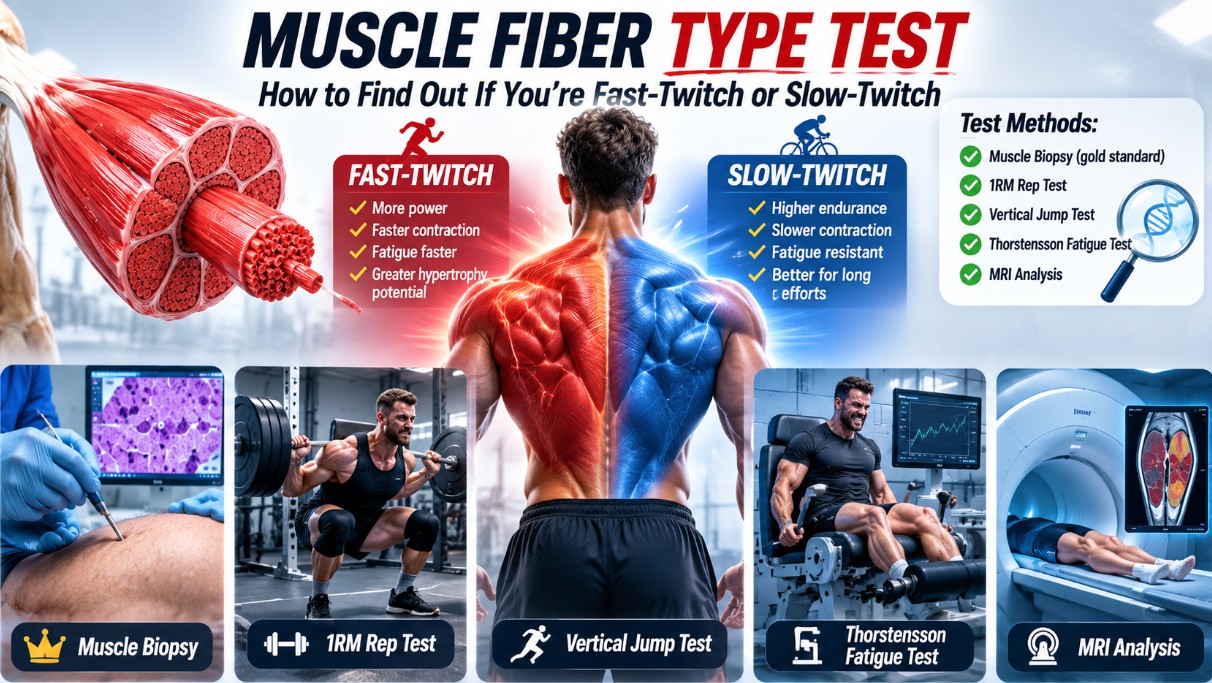
    Muscle fiber type test comparing fast-twitch and slow-twitch muscle characteristics using different testing methods
    Share
    Facebook Twitter Pinterest LinkedIn Email Tumblr WhatsApp Telegram
    Table of Contents
    • Introduction
    • Quick Facts About Muscle Fiber Type Testing
    • Why Does Knowing Your Fiber Type Matter?
    • The Gold Standard: Muscle Biopsy
    • Method 1: The Rep-Test (Percentage of 1RM Test)
    • Method 2: The Vertical Jump (Power) Test
    • Method 3: The Thorstensson Fatigue Test
    • Method 4: MRI
    • Tests We Don't Recommend
    • Which Test Should You Choose?
    • How to Use Your Results to Train Smarter
    • Coach's Note
    • Common Myths About Fiber Type Testing
    • Conclusion
    • Frequently Asked Questions About Muscle Fiber Type Testing
    • References

    Introduction

    You’ve probably noticed it in the gym: some people seem built to move heavy weight explosively, while others can grind out set after set without ever really slowing down. A lot of that comes down to muscle fiber type — and while the only fully precise way to measure it involves a needle and a lab, you don’t need either to get a genuinely useful estimate of your own.

    This guide walks through every practical method for testing your muscle fiber type, from the gold-standard lab technique down to simple tests you can run in a normal gym with nothing more than a barbell or a measuring tape. You’ll learn exactly how to perform each one, how to interpret your results, and which methods are actually worth your time.

    Quick Facts About Muscle Fiber Type Testing

    What the Tests Estimate
    Muscle fiber tests estimate whether you lean more toward fast-twitch or slow-twitch characteristics.
    Gold Standard
    A muscle biopsy provides the most direct and precise measurement of muscle fiber composition.
    Best Gym-Based Option
    The percentage-of-1RM rep test offers a practical way to estimate fiber-type tendencies during resistance training.
    Best Power-Based Option
    The vertical jump test estimates explosive lower-body power, which may provide an indirect clue about fast-twitch dominance.
    Laboratory Fatigue Test
    The Thorstensson Fatigue Test measures how quickly force declines during repeated maximal contractions.
    Important Limitation
    Performance tests cannot directly measure the exact percentage of Type I, Type IIa, and Type IIx fibers.
    Results Are Muscle-Specific
    Fiber-type composition can differ between muscles, so one test cannot perfectly describe your entire body.
    Best Practical Approach
    Use test results as a rough training guide, not as a permanent label or a reason to avoid certain rep ranges.

    Why Does Knowing Your Fiber Type Matter?

    Knowing whether you lean fast-twitch or slow-twitch gives you a genuinely useful lens for thinking about your own training: which rep ranges you might respond to most naturally, why certain sports or lifts might come easier to you than to a training partner, and where your realistic strengths and weaknesses probably sit. For the full physiological picture — what fiber types actually are, how they differ, and how to train each one — see our complete guide to muscle fibers. This article focuses specifically on how to find out where you personally fall.

    predominant muscle fiber type

    The Gold Standard: Muscle Biopsy

    If you want a precise, direct answer, a muscle biopsy is the only method that actually delivers one. The standard technique, developed by Bergström in 1962, uses a hollow needle to extract a small sample of muscle tissue — typically from the vastus lateralis — which is then analyzed under a microscope to directly identify and count fiber types.

    This is genuinely the gold standard used in research settings, and it’s the only method that gives you an exact percentage breakdown rather than an estimate. That said, it’s invasive, requires a qualified professional, isn’t cheap, and is completely unnecessary for the vast majority of lifters. Every method below is a practical, non-invasive alternative that trades some precision for accessibility.

    Key Point: A muscle biopsy is the only method that gives a precise, direct measurement of fiber-type composition. For nearly everyone outside a research setting, the practical methods below offer a reasonable estimate without the needle.

    Method 1: The Rep-Test (Percentage of 1RM Test)

    This is, in my experience, the single most practical option for anyone who already trains with weights — no special equipment, no dynamometer, no lab, just a barbell you already have access to.

    How it works: The test is based on a simple physiological reality — fast-twitch fibers generate more force but fatigue faster than slow-twitch fibers, so how many reps you can perform at a given percentage of your one-rep max (1RM) gives a rough proxy for your fiber-type leaning.
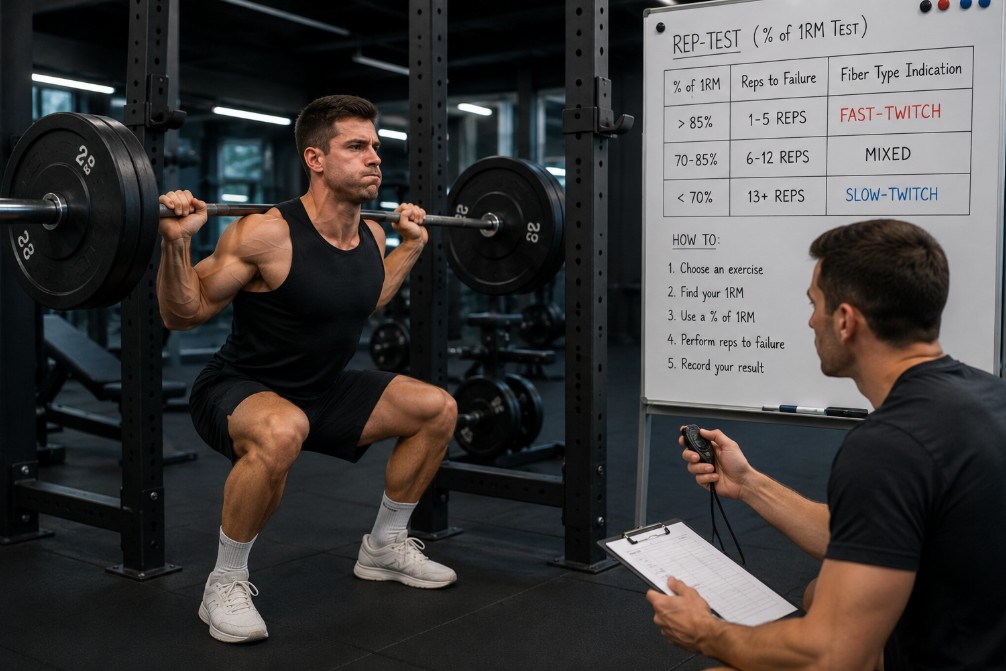
    Muscle fiber type test showing an athlete performing the Rep-Test with a percentage of one-repetition maximum to estimate muscle fiber characteristics

    Protocol:

    1. Establish (or estimate from a recent working set) your 1RM on a compound lift — the leg press or back squat are the most commonly used exercises for this test.
    2. Rest fully, then load the bar to 80% of your 1RM.
    3. Perform as many strict repetitions as possible with that load.
    4. Record the number of reps completed.

    Interpreting your results: Several versions of this rep-based estimate exist, most commonly attributed to Pipes, Hatfield, and Poliquin, with slightly different rep thresholds for each. As a general guide, using the original Pipes protocol at 80% of 1RM: completing fewer than 7 reps suggests a fast-twitch dominance, around 7–9 reps suggests a relatively even mix, and more than 9 reps suggests a slow-twitch dominance. Because the exact cutoffs vary slightly between protocols, treat the result as a general lean rather than an exact percentage.

    Method 2: The Vertical Jump (Power) Test

    The vertical jump test estimates fiber-type dominance from raw lower-body power output — the idea being that fast-twitch-dominant lifters generate more explosive force, and therefore jump higher relative to their body weight, than slow-twitch-dominant lifters.

    Protocol:

    1. Stand next to a wall with a piece of chalk (or use a vertical jump mat/device if available), and reach up to mark your standing reach height.
    2. From a static position, jump as high as possible and mark the peak height reached.
    3. Record your jump height in meters, along with your body mass in kilograms.
    4. Repeat 2–3 times and use your best attempt.
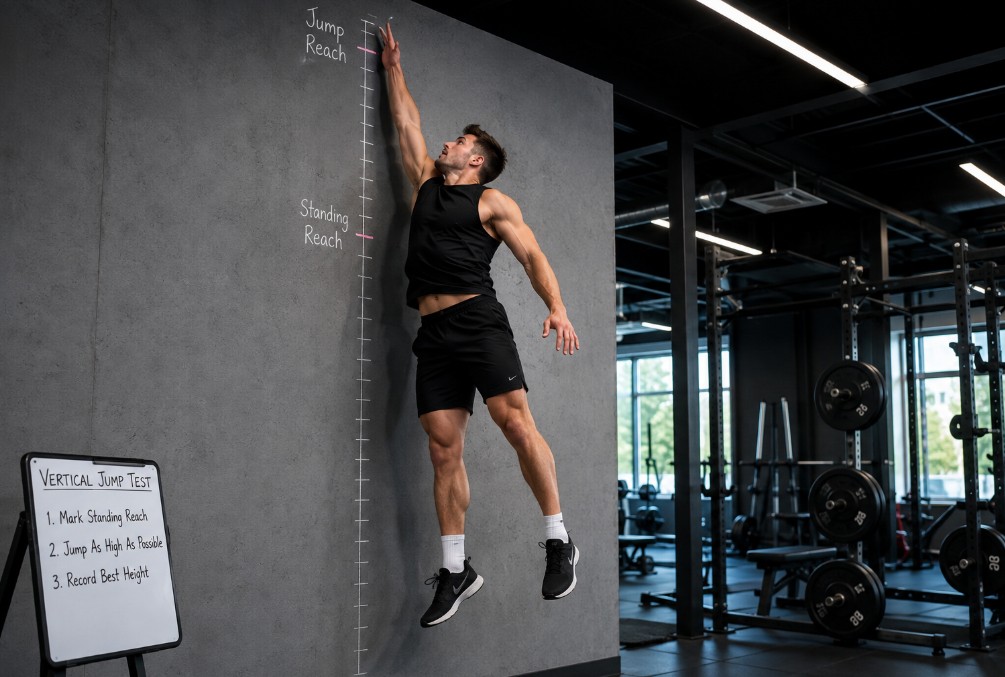
    Muscle fiber type test using the vertical jump test to estimate fast-twitch muscle fiber dominance

    Calculating your power output: A commonly used formula for estimating peak power output from a vertical jump is the Sayers equation:

    Peak Power (Watts) = (60.7 × jump height in cm) + (45.3 × body mass in kg) − 2055

    Interpreting your results: Once you have your power number, compare it against normative data for your age, sex, and body mass. Higher relative power output is associated with greater fast-twitch dominance, while lower relative power output is associated with greater slow-twitch dominance. As with the rep test, this method gives you a range compared to your peers rather than an exact fiber percentage — but it’s a genuinely useful, well-established field test for exactly that purpose, and vertical jump performance has been shown to correlate meaningfully with lower-body strength measures like the back squat, reinforcing its general validity as a power/strength proxy.

    Because vertical jump performance also depends on technique, tendon stiffness, and neuromuscular coordination, it should be viewed as an indirect indicator rather than a direct measure of muscle fiber composition.

    Method 3: The Thorstensson Fatigue Test

    This test takes a different approach entirely: instead of measuring peak power, it measures how quickly your force output declines under repeated, fast, maximal effort — since fast-twitch fibers fatigue considerably faster than slow-twitch fibers.

    How it works: The original version of this test, developed by Thorstensson and Karlsson in the 1970s, uses an isokinetic dynamometer — a specialized leg-extension machine that measures force output at a fixed speed across repeated contractions.

    Thorstensson Fatigue Test: Determining Muscle Fiber Composition
    Thorstensson Fatigue Test: Determining Muscle Fiber Composition

    Protocol:

    1. Secure yourself into an isokinetic dynamometer, positioned to isolate knee extension.
    2. Perform 50 consecutive maximal-effort repetitions as fast as possible.
    3. The machine records your force output for each repetition, tracking how much it declines from the first repetitions to the last.
    4. A fatigue index is calculated from the rate of decline.

    Interpreting your results: The faster your force output drops across the 50 repetitions, the higher your estimated proportion of fast-twitch fibers. A slower, more gradual decline indicates greater slow-twitch dominance.

    Access and limitations: The main barrier here is equipment — isokinetic dynamometers are specialized machines typically found in university exercise-science labs, physical therapy clinics, or sports-performance facilities rather than commercial gyms. It’s worth calling around to local universities, physiotherapy clinics, or hospital rehab departments, since the full test takes only about 20 minutes. It’s also worth knowing that more recent research has questioned how accurately the original Thorstensson equations estimate fiber type in resistance-trained individuals specifically, compared with the general population the original equations were built on — worth keeping in mind if you’re already an experienced lifter.

    Method 4: MRI

    Magnetic resonance imaging can offer useful, non-invasive insight into overall muscle composition without a needle. In practice, though, it’s a less practical option for most lifters than the tests above — it requires access to imaging equipment, isn’t cheap, and depends on a technician or radiologist specifically experienced in interpreting muscle-composition findings, which isn’t a routine part of most standard MRI readings.
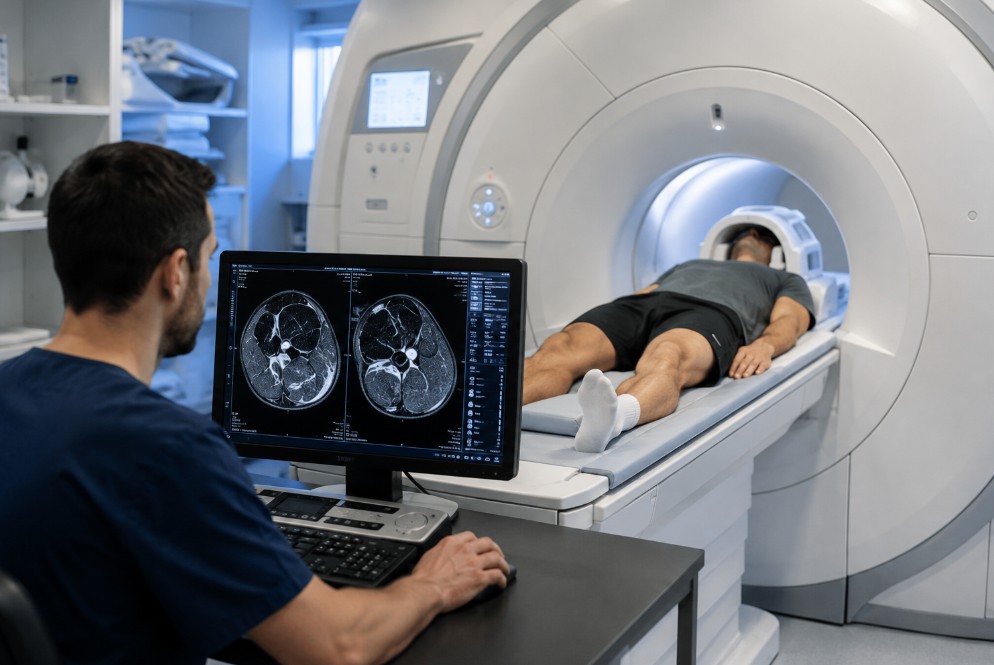
    Muscle fiber type test using MRI to assess skeletal muscle characteristics in an athlete

    Tests We Don’t Recommend

    A few other tests occasionally come up in older fitness literature, but each has practical drawbacks that make the methods above better choices for most people:

    • The Wingate Test — a 30-second maximal-effort cycling test that can genuinely estimate anaerobic capacity, but it’s exhausting enough that your legs may not function well for a while afterward, and it requires a specialized ergometer.
    • The Margaria Stair Climb Test — requires precise timing equipment on a staircase that most people don’t have access to.
    • The Anaerobic Step Test — physically demanding enough that it’s difficult for anyone who isn’t already well-conditioned to complete properly.
    • Generic bench press-based tests — these mostly reflect upper-body strength and technique rather than fiber composition specifically, and shouldn’t be relied on for this purpose.

    Which Test Should You Choose?

    MethodAccuracyEquipment NeededAccessibility
    Muscle BiopsyHighest (exact)Medical/lab settingVery low
    Rep-Test (% of 1RM)ModerateBarbell onlyVery high
    Vertical Jump TestModerateWall, chalk, or jump matVery high
    Thorstensson TestModerate-highIsokinetic dynamometerLow
    MRIHighImaging centerLow
    Table 1. Comparing Muscle Fiber Type Tests

    For nearly everyone reading this, the Rep-Test and Vertical Jump Test offer the best combination of accessibility and usefulness — both can be done today, with equipment you likely already have. The Thorstensson Test and MRI are worth pursuing if you have genuine access to the equipment (through a university, clinic, or sports facility), but they’re not worth chasing down if you don’t.

    How to Use Your Results to Train Smarter

    Once you have a reasonable estimate of your fiber-type leaning, the practical application is straightforward: lean into your strengths while still training the full spectrum. A more fast-twitch-dominant lifter may respond especially well to heavier loads, lower reps, and explosive work, while a more slow-twitch-dominant lifter may find they recover faster between sets and handle higher training volumes particularly well. Neither result is a reason to neglect the other end of the rep-range spectrum — our full guide to training different fiber types covers exactly how to structure that.

    Coach’s Note

    One thing I’ve learned after coaching countless clients is that almost nobody is purely “fast-twitch” or “slow-twitch.” We all have a mixture of fiber types throughout our muscles, although one profile usually tends to be more dominant than the other. In many cases, people recognize this long before they ever take a test. Some naturally excel at sprinting, jumping, heavy lifting, or explosive movements, while others seem built for long-distance running, cycling, rowing, or other endurance-based activities. Those natural preferences don’t prove your muscle fiber composition, but they often provide useful clues. That’s why I encourage people to treat muscle fiber tests as tools that refine what they already observe about their own performance—not as labels that define their potential or limit how they should train.

    Common Myths About Fiber Type Testing

    Myth: These tests give you an exact fiber-type percentage.

    Reality: Only a muscle biopsy provides an exact percentage. Every other method in this guide gives you a general lean or range compared to your peers, not a precise number.

    Myth: You need expensive lab equipment to get any useful information.

    Reality: The Rep-Test and Vertical Jump Test require nothing more than a barbell or a wall and a measuring tape, and both provide genuinely useful, well-established estimates.

    Myth: Your fiber-type test result tells you which sport you should do.

    Reality: Fiber type is one factor among many — including skill, motivation, biomechanics, and training history — that contribute to athletic success. A test result is context, not a verdict.

    Myth: If you score as “slow-twitch dominant,” heavy training won’t work for you.

    Reality: Everyone benefits from a well-rounded program that includes both heavier and lighter loading. A slow-twitch lean simply means your response profile may skew slightly differently, not that an entire training style is off the table.

    Conclusion

    You don’t need a biopsy to get useful information about your own body. A barbell, a wall, and a few minutes will tell you more than you might expect.

    None of these tests are perfect. They weren’t designed to be. What they give you is a reasonable lean — fast-twitch, slow-twitch, or somewhere comfortably in between — and that’s genuinely enough to work with. Treat the result as one more piece of context for how you program your training, not as a fixed identity or an excuse to avoid an entire style of lifting.

    Pick the method that matches what you actually have access to. For most people, that’s the Rep-Test or the Vertical Jump Test — both take a few minutes, cost nothing, and can be repeated any time you want a fresh read. If you happen to have access to a dynamometer through a university or clinic, the Thorstensson Test is worth the trip.

    Whatever you find out, keep training the full spectrum. A well-rounded program that includes both heavy, low-rep work and lighter, higher-rep work gives every fiber type in your body a reason to adapt — regardless of which one happens to be dominant.

    Frequently Asked Questions About Muscle Fiber Type Testing

    Can you accurately determine your muscle fiber type without a biopsy?

    Not exactly. A muscle biopsy is the only method that directly measures the percentage of different muscle fiber types. Practical methods such as the Rep-Test and Vertical Jump Test can provide useful estimates of your fast-twitch or slow-twitch tendency, but they cannot determine your exact fiber-type composition.

    Which muscle fiber test is the most practical for gym-goers?

    For most lifters, the Rep-Test performed with approximately 80% of your one-repetition maximum offers the best balance of simplicity, accessibility, and usefulness. It requires no specialized equipment and can provide a reasonable estimate of whether you lean more toward fast-twitch or slow-twitch characteristics.

    Can different muscles have different fiber-type compositions?

    Yes. Fiber-type distribution varies between muscles depending on their primary function. For example, the soleus typically contains a much higher proportion of slow-twitch fibers than the gastrocnemius. This is one reason why a single test cannot perfectly describe the fiber composition of your entire body.

    Can your muscle fiber type change over time?

    Your overall fiber-type profile is influenced by genetics, but training can modify how certain fibers behave. In particular, Type IIx fibers often become more fatigue-resistant and take on Type IIa characteristics with consistent resistance or endurance training. However, complete conversion between Type I and Type II fibers has not been demonstrated in healthy humans.

    Does having more fast-twitch fibers mean you’ll build muscle more easily?

    Fast-twitch fibers generally have greater hypertrophy potential, but muscle growth depends on far more than fiber type alone. Progressive overload, training volume, effort, recovery, protein intake, sleep, and genetics all play major roles in determining your long-term results.

    Should you train differently based on your muscle fiber test results?

    Test results should guide your training, not dictate it. Someone with a fast-twitch bias may naturally excel with heavier loads, while someone with a slow-twitch bias may tolerate higher training volumes. However, the best programs challenge all muscle fiber types by using a variety of loads, repetition ranges, and training intensities.

    Is it worth paying for muscle fiber testing?

    For competitive athletes or researchers, laboratory testing may provide valuable information. For most recreational lifters, however, simple field tests combined with careful observation of your training performance usually provide enough insight to optimize your workouts without the expense or inconvenience of specialized testing.

    References

    1. Microbiopsy Sampling for Examining Age-Related Differences in Skeletal Muscle Fiber Morphology and Composition. PMC
    2. Topend Sports. Muscle Fiber Composition Calculator (Pipes, Hatfield, Poliquin Protocols). Topend Sports
    3. Estimation of Maximum Lower Limb Muscle Strength from Vertical Jumps. PMC
    4. Bagley JR, McLeland KA, Arevalo JA, Brown LE, Coburn JW, Galpin AJ. Skeletal Muscle Fatigability and Myosin Heavy Chain Fiber Type in Resistance-Trained Men. Journal of Strength and Conditioning Research. 2017;31(3):602–607. Journal of Strength & Conditioning Research
    Share. Facebook Twitter Pinterest LinkedIn Tumblr Email WhatsApp
    krunoslav
    • X (Twitter)

    Hey! My name is Kruno, and I'm the owner and author of Bodybuilding Wizard. I am a licensed fitness trainer with a Ph.D. in kinesiology. Throughout my career, I have dedicated myself to helping individuals achieve their health and fitness goals through personalized training programs. In addition to my academic qualifications, I have completed various specialized courses, including certifications in nutrition and strength training, which have further enhanced my ability to provide comprehensive fitness guidance. I started this website back in late 2014, and it has been my pet project ever since. My goal is to help you learn proper weight training and nutrition principles so that you can get strong and build the physique of your dreams!

    Related Posts

    Anabolic Resistance: Why Muscle Growth Gets Harder With Age

    Do Men Build Muscle Faster Than Women? Sex Differences in Muscle Growth

    How Much Muscle Can You Build Naturally? Understanding Your Genetic Limits

    Leave A Reply Cancel Reply

    You must be logged in to post a comment.

    WE ARE SOCIAL
    • Facebook 3.6K
    • Twitter
    • YouTube 134
    • Instagram
    RECENT POSTS
    October 10, 2026

    Decline Machine Press (Hammer Strength Decline Press): How To, Muscles Worked, Benefits & Alternatives

    October 10, 2026

    Ring Dips: How To, Muscles Worked, Benefits & Alternatives

    October 6, 2026

    Reverse-Grip Incline Dumbbell Press: How To, Muscles Worked, Benefits & Alternatives

    October 4, 2026

    Landmine Chest Press: How To, Muscles Worked, Benefits & Alternatives

    October 3, 2026

    Reverse-Grip Bench Press: How-To, Muscles Worked, Benefits & Alternatives

    RECENT COMMENTS
    • Justin Dew on Designing your own home gym
    • krunoslav on How Skeletal Muscles Are Named: A Simple Guide to Muscle Names
    • Christina on How Skeletal Muscles Are Named: A Simple Guide to Muscle Names
    • igtropin on Stiff-Leg Deadlift: Proper Form, Muscles Worked & Hamstring Growth Guide
    • teragon labs on Barbell Back Squat: Proper Form, Benefits, Muscles Worked & Expert Tips
    LATEST GALLERIES

    Subscribe to Updates

    Join our mailing list to receive the latest updates from our team.

    ABOUT
    ABOUT

    We are a group of bodybuilding enthusiasts and this is our effort to have all the details about bodybuilding on a single website. We strive to educate and inform our visitors so that they can make the correct training, nutrition, and supplement decisions on their own. Bodybuilding Wizard will make your dream body your reality and take you to a whole new level!

    POPULAR POSTS
    April 2, 2014

    Lying Leg Curl: Complete Guide to Hamstring Isolation, Strength & Muscle Growth

    February 18, 2019

    How Skeletal Muscles Are Named: A Simple Guide to Muscle Names

    March 28, 2014

    Free weights: The main tool for building muscles

    BODYBUILDING WIZARD
    Bodybuilding Wizard Footer Logo
    Facebook X (Twitter) Instagram Pinterest YouTube
    • About
    • Authors
    • Editorial Policy
    • Write for us
    • Privacy
    • Contact
    • Terms of Use
    • Advertising
    • FAQ
    Copyright © 2014-2026 BodybuildingWizard. All rights reserved. Powered by WordPress. Made with love and lots of caffeine.

    Type above and press Enter to search. Press Esc to cancel.

    Sign In or Register

    Welcome Back!

    Login to your account below.

    Lost password?