



Introduction
Ask most lifters what builds muscle, and they’ll say protein synthesis, training, maybe recovery. Almost nobody mentions the other side of the equation: muscle protein breakdown (MPB). In fifteen-plus years of coaching lifters and working through the biomechanics and physiology side of kinesiology, this is one of the most consistently misunderstood concepts I run into — people treat muscle growth as if only one process were running, when in reality it’s the balance between two opposing processes that decides the outcome.
Muscle protein breakdown is the process by which your body continuously degrades and removes muscle proteins. It happens every single day, in every person, trained or untrained. That might sound like bad news, but it isn’t — MPB is not the enemy of muscle growth. It’s one half of a constant tug-of-war with muscle protein synthesis (MPS), and understanding how that tug-of-war actually works is what separates people who train hard but plateau from people who train hard and consistently add muscle.
This guide covers what muscle protein breakdown actually is, the cellular pathways that carry it out, what increases and decreases it, how resistance training affects it (the answer surprises most people), and the practical, evidence-based strategies that keep MPB from working against your goals. For the other half of the picture, see our companion guide to muscle protein synthesis, and for how these processes fit into the bigger picture of growth, our guides to muscle hypertrophy and mechanical tension.
What Is Muscle Protein Breakdown?
Muscle protein breakdown is the continuous process by which the body degrades existing muscle proteins into their component amino acids. Those amino acids are then either reused to build new proteins, used as fuel, or released into the bloodstream. It’s not damage, and it’s not a malfunction — it’s normal, ongoing tissue turnover, the same basic principle behind bone remodeling: old material gets cleared out so new, functional material can take its place.
Every protein in your muscle fibers — the contractile proteins actin and myosin, structural proteins, enzymes — has a limited functional lifespan. Some are degraded because they’re damaged or misfolded. Others are broken down simply as part of the normal metabolic housekeeping that every cell in the body performs. Without MPB, your muscles would accumulate old, dysfunctional protein indefinitely, with no mechanism to clear it out and replace it with newer, better-functioning tissue.
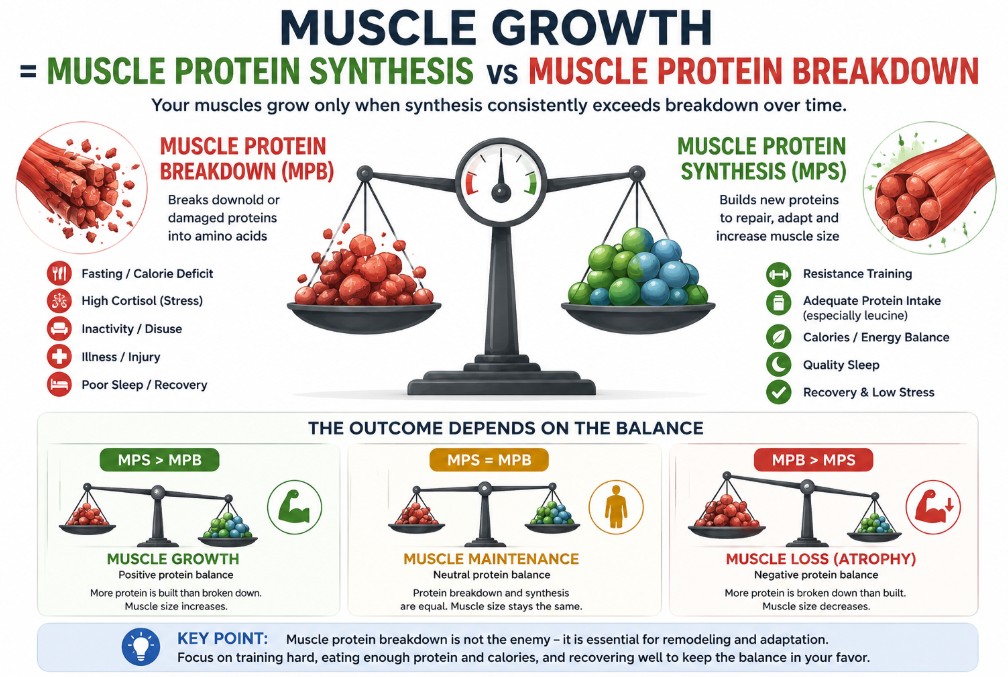
The clinically important point — and the one I try to get across to every client who’s convinced that “breakdown” must be bad — is that muscle mass is not determined by MPB in isolation. It’s determined by the net balance between MPB and MPS over time. If synthesis consistently outpaces breakdown, muscle grows. If breakdown consistently outpaces synthesis, muscle shrinks — a state generally referred to as muscle atrophy or catabolism. Most of the time, in a healthy, adequately fed adult, the two processes are close enough to balanced that muscle mass stays relatively stable from day to day.
Key Point: Muscle protein breakdown is the normal, ongoing degradation of muscle proteins — not damage or failure. Muscle growth or loss depends entirely on the balance between MPB and muscle protein synthesis over time, not on either process alone.
Why Muscle Protein Breakdown Is Essential for Muscle Growth
This is the single biggest misconception I run into, so it deserves its own section rather than living as a side note buried in the introduction: without muscle protein breakdown, muscle growth couldn’t happen at all.
Muscle remodeling — the process that actually makes a muscle fiber bigger, stronger, and better adapted to training — isn’t pure addition. It’s replacement. Old, damaged, or structurally outdated proteins have to be cleared out before new, functionally superior proteins can be integrated into the fiber. MPB is the demolition crew that makes room for the construction crew (MPS) to do its job. Skip the demolition, and the construction has nowhere to go.
This is also why elite-level bodybuilders and strength athletes — who arguably have the most efficient muscle remodeling machinery of anyone — still show elevated MPB after every hard training session, not despite their training success, but because of it. A muscle fiber that never broke down old protein would be a fiber that never adapted: it would simply accumulate whatever protein it already had, indefinitely, with no mechanism to improve its structure or function over time.
The actual goal was never to eliminate MPB. It was always to keep muscle protein synthesis winning the balance against it, consistently, over the long run — while letting MPB do the essential structural housekeeping it’s there for in the first place.
Key Point: Muscle protein breakdown isn’t an obstacle to muscle growth — it’s a required part of the remodeling process that makes growth possible at all. The goal is a favorable balance between MPS and MPB, not the absence of breakdown.
MPS vs MPB: The Balance That Determines Muscle Growth
I find this comparison is the single most useful mental model for clients trying to understand why muscle growth feels so much slower and more unpredictable than they expect.
| Aspect | Muscle Protein Synthesis (MPS) | Muscle Protein Breakdown (MPB) |
|---|---|---|
| What it is | Building new muscle proteins | Degrading existing muscle proteins |
| Primary triggers | Resistance training, protein/amino acid intake, insulin | Fasting, cortisol, inactivity, illness, aging |
| Response to a meal | Rises after protein intake | Falls after protein/insulin exposure |
| Response to training | Rises significantly after resistance training | Also rises after resistance training, but by less |
| Net effect on muscle | Growth when it exceeds MPB | Loss when it exceeds MPS |
| Best-known regulator | mTOR pathway | Ubiquitin-proteasome and autophagy-lysosome pathways |
Neither process is inherently “good” or “bad.” Muscle growth is the arithmetic of MPS minus MPB, accumulated across thousands of hours, not just what happens in the two hours after a workout.
How Does Muscle Protein Breakdown Actually Happen?
At the cellular level, MPB isn’t a single process — it’s carried out by several distinct proteolytic (protein-degrading) systems working together. Understanding these mechanisms in at least broad strokes is, in my opinion, what separates a genuinely evidence-based approach to training from advice built on gym folklore.
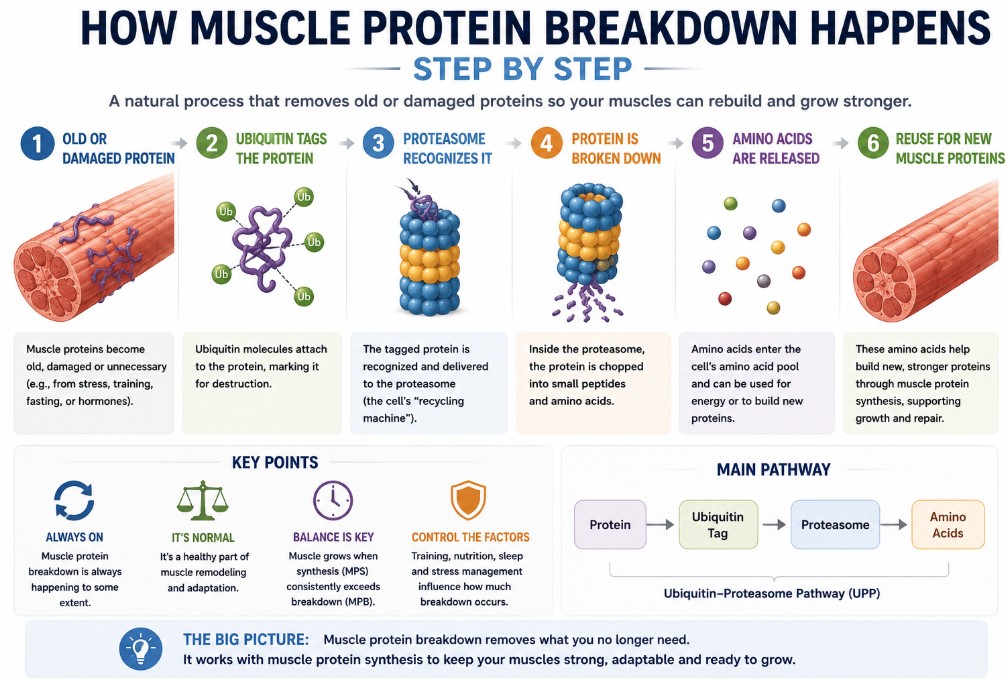
- The ubiquitin-proteasome system (UPS). This is the primary pathway responsible for degrading most intracellular muscle proteins, including the contractile proteins actin and myosin. Proteins targeted for breakdown are tagged with a small marker called ubiquitin, then fed into a barrel-shaped structure called the proteasome, which chops them into smaller fragments.
- The autophagy-lysosome pathway. This system degrades damaged organelles, protein aggregates, and other cellular debris using enzyme-filled compartments called lysosomes. It plays a larger role during prolonged fasting, illness, and certain forms of stress.
- Calpains. These are calcium-activated enzymes that don’t fully degrade proteins on their own, but disassemble the structural components of the sarcomere — the muscle’s basic contractile unit — making those proteins accessible to the ubiquitin-proteasome system.
- Caspases. Primarily known for their role in programmed cell death, caspases also contribute to the early stages of myofibrillar protein breakdown in certain catabolic conditions.
In a healthy, actively training adult, these systems run at a modest, steady baseline rate. They ramp up considerably under specific conditions — which is exactly what the next section covers.
Key Point: Muscle protein breakdown is carried out by multiple cellular pathways, most notably the ubiquitin-proteasome system and the autophagy-lysosome pathway, working alongside calpains and caspases to disassemble and remove muscle proteins.
What Increases Muscle Protein Breakdown?
Several distinct situations reliably increase MPB above its normal baseline rate. Recognizing these is genuinely useful — in my coaching practice, I’ve seen far more clients unintentionally sabotage their own progress through one of these factors than through any training program mistake.
Fasting and Low Protein Availability
When amino acids aren’t available from a recent meal, the body shifts toward a more catabolic state to liberate amino acids from existing tissue, including muscle, for use elsewhere. This is a normal part of the fasted state and isn’t inherently harmful over a normal overnight fast, but chronically inadequate protein intake keeps this shift running for longer than is useful for anyone trying to build or preserve muscle.
Elevated Cortisol
Cortisol is the body’s primary stress hormone, and one of its central physiological roles is mobilizing amino acids from muscle tissue for use elsewhere — particularly for gluconeogenesis during periods of physical or psychological stress. Chronically elevated cortisol, whether from illness, injury, severe caloric restriction, or unmanaged life stress, is a well-documented driver of increased muscle protein breakdown.
Inactivity and Immobilization
This is one I see constantly in a rehab context: a client comes out of a cast, a brace, or a prolonged period of bed rest after surgery, and is shocked at how much muscle they’ve lost in just a few weeks. Muscle disuse — whether from bed rest, limb immobilization, or simple prolonged inactivity — shifts the balance of muscle protein turnover unfavorably, and the resulting atrophy can happen considerably faster than most people expect.
Overtraining and Inadequate Recovery
Resistance training itself modestly increases MPB (more on this below), but training without adequate recovery, sleep, or nutrition compounds this effect without providing the offsetting rise in MPS needed to keep the balance in your favor.
Illness, Injury, and Inflammation
Acute illness, surgical recovery, and significant injury all trigger systemic inflammatory signaling that measurably accelerates muscle protein breakdown, which is part of why muscle loss during hospitalization or extended recovery can be so rapid and disproportionate to the actual time spent inactive.
Aging
Aging is associated with a persistent, low-grade shift in this balance — a topic significant enough that it deserves its own section below.
Key Point: Muscle protein breakdown rises above baseline during fasting, elevated cortisol, physical inactivity or immobilization, inadequate recovery from training, and illness or injury. Most of these factors are at least partially within your control.
Does Resistance Training Increase MPB Too?
Yes — and this genuinely surprises most clients the first time I explain it. Resistance training doesn’t just stimulate muscle protein synthesis; it also produces a measurable, temporary increase in muscle protein breakdown, largely due to the mechanical strain, microscopic remodeling, and metabolic demand placed on the working muscle fibers.
This isn’t a design flaw. It’s the mechanism by which damaged, older, or suboptimal proteins get cleared out to make room for the new contractile proteins being produced in response to training — the same remodeling logic that governs how mechanical tension drives adaptation throughout the body. The critical detail is the relative magnitude of the two responses: following resistance training, particularly when adequate protein is consumed afterward, the rise in MPS substantially outpaces the rise in MPB, producing a net positive protein balance and, over repeated sessions, muscle growth.
This is precisely why resistance training remains the single most effective tool for building and preserving muscle, even though it technically elevates both sides of the equation simultaneously. Skipping training to “avoid breakdown” is one of the more counterproductive pieces of advice I still hear repeated in gyms — it removes the stimulus for MPS entirely while doing very little to change baseline MPB.
Key Point: Resistance training increases both muscle protein synthesis and muscle protein breakdown, but the rise in synthesis is typically larger, particularly with adequate post-training protein intake — which is exactly why training builds muscle rather than eroding it.
How to Minimize Excessive Muscle Protein Breakdown
You cannot, and should not try to, eliminate MPB entirely — it’s a necessary, healthy process. The realistic goal is keeping it from running higher than it needs to, so that MPS has the best possible chance of winning the balance over time. In practice, this comes down to a short list of genuinely well-supported strategies.
Eat Enough Protein, Consistently
Regular intake of dietary protein, and specifically the essential amino acids it provides, is one of the most effective ways to suppress excessive muscle protein breakdown while simultaneously stimulating synthesis. Spreading protein intake across the day rather than concentrating it into one meal helps keep this suppressive effect more consistent. Our protein intake calculator is a good starting point for figuring out your daily target.
Don’t Neglect Carbohydrates and Insulin
Insulin — released primarily in response to carbohydrate and protein intake — has a well-established suppressive effect on muscle protein breakdown, independent of its effect on synthesis. This is one reason severely restrictive, very-low-carbohydrate approaches can sometimes make body recomposition harder than expected, even with adequate protein: the insulin signal that normally helps rein in MPB is blunted.
Prioritize Leucine-Rich Protein Sources
Among the essential amino acids, leucine in particular has been shown to help suppress muscle protein breakdown, alongside its well-known role in stimulating MPS. Whey protein, eggs, and lean meat are all relatively rich, practical leucine sources.
Avoid Chronic, Severe Calorie Deficits
Aggressive, prolonged caloric restriction elevates cortisol and shifts the hormonal environment toward greater catabolism. A moderate deficit, combined with adequate protein and continued resistance training, preserves far more muscle during a cut than an overly aggressive one.
Keep Training — Don’t Fall Into Extended Rest
As covered above, inactivity is one of the strongest drivers of unfavorable MPB. Beyond your normal recovery days, extended breaks from training remove the anabolic stimulus while doing nothing to lower baseline breakdown.
Manage Sleep and Life Stress
Poor sleep and chronic psychological stress both elevate cortisol, which — as covered above — is one of the more reliable drivers of increased MPB. This is a factor I probably underweighted early in my career and now consider just as important as the training program itself for a lot of clients.
Key Point: Minimizing excessive muscle protein breakdown comes down to consistent protein intake, adequate carbohydrate and insulin exposure, leucine-rich food choices, avoiding overly aggressive calorie deficits, staying consistently active, and managing sleep and stress.
Muscle Protein Breakdown and Aging
If there’s one topic in this space I think deserves far more attention than it gets, it’s this one. Aging is associated with a chronic, low-grade shift in the MPS/MPB balance that contributes directly to sarcopenia — the progressive, age-related loss of muscle mass and strength. Much of the research and public conversation around aging and muscle loss focuses on a blunted MPS response to training and feeding — commonly called anabolic resistance — but the breakdown side of the equation matters just as much and gets discussed far less.
Practically, this means that as clients get older, the training and nutritional margin for error narrows. The same missed protein meal or extended break from training that a 25-year-old client can absorb without consequence has a measurably larger impact on an older adult’s muscle mass. This isn’t a reason for older clients to be discouraged — resistance training remains highly effective at any age — but it is a reason for more consistent protein intake and more consistent training frequency as the years go on.
Common Myths About Muscle Protein Breakdown
Myth 1: Muscle Protein Breakdown Is Always Bad
Reality: MPB is a normal, necessary process that clears out old and damaged protein. Problems only arise when it chronically exceeds muscle protein synthesis.
Myth 2: You Should Eat Every Few Hours to “Prevent Catabolism”
Reality: Total daily protein intake and overall training consistency matter far more than rigid meal timing. Going several hours without eating does not meaningfully “waste” your training effort.
Myth 3: Cardio Causes Muscle Loss by Increasing Breakdown
Reality: Moderate cardio does not meaningfully drive muscle loss when protein intake and resistance training are adequate. Muscle loss during high-volume endurance training is more strongly linked to inadequate calories and protein than to cardio itself.
Myth 4: If a Workout Increases MPB, It’s Counterproductive
Reality: Resistance training reliably increases MPS more than MPB when followed by adequate protein intake, producing a net anabolic effect despite the temporary rise in breakdown.
Myth 5: Fasted Training Destroys Muscle
Reality: A single fasted training session does not meaningfully undermine muscle growth in someone consuming adequate total daily protein. Total daily intake and long-term consistency matter far more than whether a given workout happens fasted or fed.
Myth 6: High-Protein Diets Stop Muscle Protein Breakdown Completely
Reality: Protein reduces excessive MPB, but it cannot — and shouldn’t — eliminate it entirely. Normal protein turnover is essential for muscle remodeling; the goal is a favorable balance, not shutting breakdown off altogether.
Conclusion
Muscle growth isn’t one process. It’s two, pulling in opposite directions.
MPB isn’t the villain here. It’s half the equation, not the enemy.
Feed your muscles. Train them consistently. Manage stress and sleep. Get that balance tipped toward synthesis, and hold it there for years, not weeks.
