


Introduction
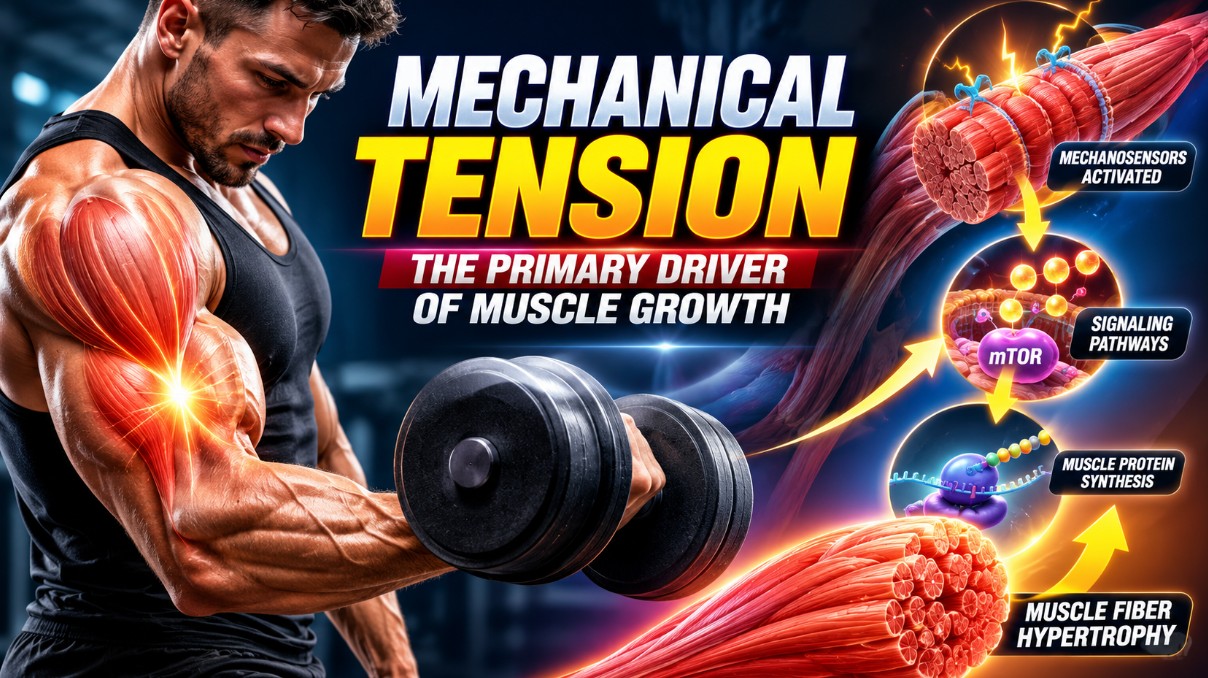
If you’ve ever wondered why lifting weights makes muscles grow, the answer begins with mechanical tension. Every repetition you perform places force on your muscle fibers, and that force acts as the primary signal telling your body to adapt by building larger and stronger muscles.
Although muscle growth depends on several factors—including proper nutrition, recovery, and sufficient protein intake—research consistently identifies mechanical tension as the most important training stimulus for muscle hypertrophy. It activates the cellular pathways responsible for muscle protein synthesis and triggers the long-term adaptations that increase muscle size.
However, simply lifting heavy weights isn’t enough. The amount of mechanical tension your muscles experience depends on multiple factors, including exercise technique, range of motion, training intensity, exercise selection, and how close you train to muscular failure. Learning how to maximize mechanical tension allows you to stimulate more muscle fibers and make every workout more effective.
In this guide, you’ll learn what mechanical tension is, how it stimulates muscle growth, why it matters more than muscle soreness, and the best evidence-based strategies for maximizing it during resistance training. Whether you’re a beginner or an experienced lifter, understanding this principle can help you build muscle more efficiently and get better results from every workout.
What Is Mechanical Tension?
Mechanical tension is the force generated within a muscle when it contracts against resistance. Every time you lift, push, pull, or control a weight, your muscle fibers produce force to overcome that load. The greater the force your muscles generate—and the longer they sustain it—the greater the mechanical tension experienced by the muscle tissue.
Unlike muscle soreness or the “pump,” mechanical tension is not something you can directly feel. Instead, it is a biomechanical stimulus that your muscle fibers detect through specialized structures called mechanosensors. These sensors convert mechanical force into biochemical signals that activate muscle protein synthesis and initiate the adaptations responsible for muscle hypertrophy.
Mechanical tension develops whenever a muscle actively produces force, but not all tension stimulates muscle growth equally. The most effective hypertrophy stimulus typically occurs when muscles generate high levels of force while actively lengthening or shortening under control, particularly when sets are performed close to muscular failure.
For example, consider a set of barbell squats. As you lower into the squat, your quadriceps and glutes generate force while controlling the descent. During the upward phase, these muscles continue producing high levels of force to lift the weight back to the starting position. Throughout both phases, the working muscles experience mechanical tension that signals them to adapt and become larger and stronger.
It’s also important to distinguish external load from mechanical tension. Simply using heavier weights does not automatically produce greater muscle-building tension. Exercise technique, range of motion, movement control, and the amount of effort you apply all influence how much tension reaches the target muscle. In many cases, a lighter weight performed with excellent technique and close to muscular failure creates a stronger hypertrophy stimulus than a heavier weight performed with poor form.
Ultimately, mechanical tension is the primary signal that tells your muscles they must adapt. Without sufficient tension, the cellular processes responsible for muscle growth are only weakly activated, regardless of how much muscle soreness or fatigue you experience afterward.
Key Point: Mechanical tension is the force produced within working muscles during resistance training. It is widely considered the primary trigger for muscle hypertrophy because it activates the biological pathways that increase muscle protein synthesis and drive long-term muscle growth.
Why Is Mechanical Tension the Primary Driver of Muscle Growth?
Scientists have proposed several mechanisms that contribute to muscle hypertrophy, including mechanical tension, metabolic stress, and muscle damage. While all three may play a role, current evidence consistently identifies mechanical tension as the most important stimulus for muscle growth.
The reason is simple: your muscles adapt to force. When resistance training repeatedly exposes muscle fibers to high levels of mechanical tension, your body interprets this as a signal that the muscles need to become larger and stronger to better handle similar loads in the future.
Mechanical Tension Initiates the Growth Process
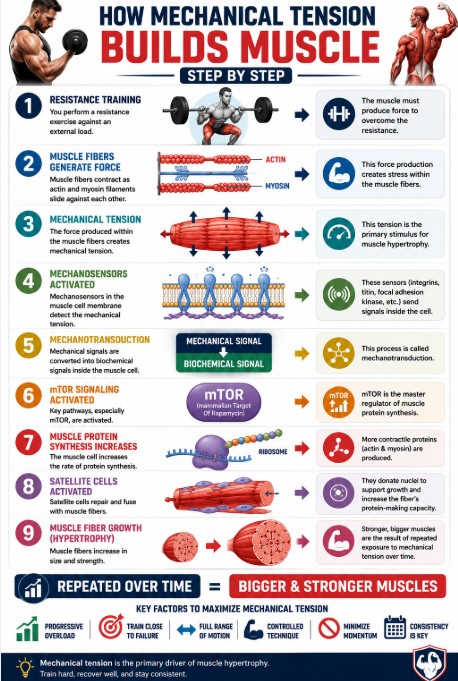
Mechanical tension is the first step in the chain of events that leads to muscle hypertrophy. As muscle fibers generate force against resistance, specialized mechanosensors detect this tension and convert it into biochemical signals inside the muscle cell.
These signals activate pathways such as mTOR, which increase muscle protein synthesis and promote the repair and growth of muscle fibers. Over time, repeated exposure to sufficient mechanical tension results in progressively larger muscles.
More Tension Means a Greater Growth Stimulus
Not every repetition creates the same level of mechanical tension. Several factors determine how much tension your muscles experience, including:
- Load lifted
- Level of muscular effort
- Exercise technique
- Range of motion
- Movement control
- Training close to muscular failure
The more effectively these factors are optimized, the stronger the stimulus for muscle hypertrophy.
Why Muscle Soreness Isn’t Enough
Many lifters assume that muscle soreness indicates an effective workout. However, soreness is primarily a response to unfamiliar exercise or tissue damage—not necessarily to the amount of mechanical tension generated during training.
A workout can produce significant mechanical tension with little soreness, while another workout may leave you extremely sore without providing an optimal stimulus for muscle growth.
Why the “Pump” Isn’t the Main Driver
The muscle pump feels satisfying because blood, fluids, and metabolites temporarily accumulate within working muscles. Although the pump often accompanies productive training, it is not the primary cause of muscle hypertrophy.
A large pump without sufficient mechanical tension is unlikely to maximize muscle growth, whereas high mechanical tension can stimulate hypertrophy even when the pump is relatively modest.
Mechanical Tension Is the Foundation of Effective Training
Nearly every evidence-based hypertrophy program is built around maximizing mechanical tension through progressive resistance training. Training variables such as exercise selection, load, repetition range, tempo, and progressive overload are ultimately tools for increasing the amount of effective tension experienced by the target muscles.
Key Point: Mechanical tension is considered the primary driver of muscle hypertrophy because it directly activates the biological processes responsible for muscle growth. While muscle damage and metabolic stress may contribute, neither consistently stimulates hypertrophy as effectively as repeated exposure to high mechanical tension.
How Mechanical Tension Stimulates Muscle Hypertrophy
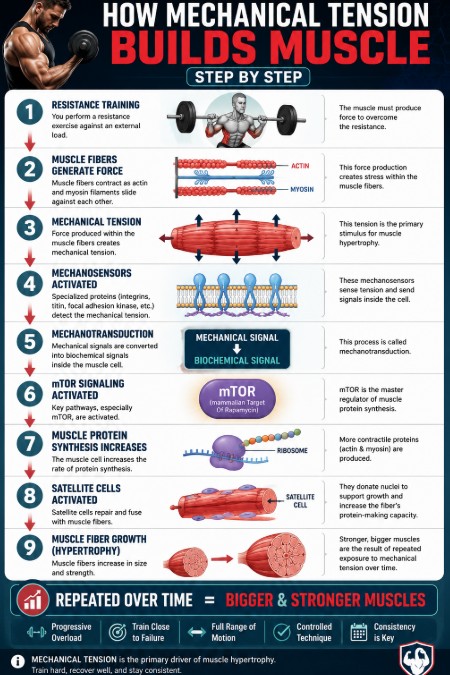
Mechanical tension doesn’t build muscle directly. Instead, it acts as the trigger that initiates a series of biological processes inside muscle fibers. These processes ultimately increase muscle protein synthesis, repair damaged structures, and enlarge existing muscle fibers.
Although the entire process is highly complex, it can be understood in a few key steps.
1. Muscle Fibers Generate Force
Everything begins when your muscles contract against resistance. Whether you’re performing a squat, bench press, or pull-up, muscle fibers generate force to move or control the load.
The heavier the demand—or the closer you work to muscular failure—the more muscle fibers are recruited to produce force.
2. Mechanosensors Detect Mechanical Tension
Embedded within muscle fibers are specialized proteins known as mechanosensors. These structures continuously monitor the amount of mechanical tension placed on the muscle.
When sufficient tension is detected, mechanosensors convert this physical force into biochemical signals through a process called mechanotransduction.
This is the critical step that transforms a training stimulus into a biological response.
3. Cellular Signaling Pathways Are Activated
The biochemical signals generated by mechanotransduction activate several intracellular pathways involved in muscle adaptation.
One of the most important is the mTOR (mechanistic target of rapamycin) pathway, which regulates muscle protein synthesis by increasing the production of new contractile proteins.
At the same time, other signaling pathways coordinate cellular repair, energy availability, and structural remodeling.
4. Muscle Protein Synthesis Increases
As mTOR and related pathways become activated, muscle protein synthesis (MPS) rises above its normal resting level.
New proteins such as actin and myosin are produced and incorporated into existing muscle fibers, making them thicker and stronger over time.
If muscle protein synthesis exceeds muscle protein breakdown, net muscle growth occurs.
5. Satellite Cells Support Long-Term Growth
When training provides a sufficiently large stimulus, satellite cells become activated. These muscle stem cells donate additional nuclei (myonuclei) to growing muscle fibers — a process covered in more depth in our guide to satellite cells.
Additional myonuclei increase the muscle fiber’s capacity to produce proteins, supporting continued hypertrophy over months and years of training.
6. The Muscle Adapts
After recovery, the muscle is slightly better prepared to tolerate similar levels of mechanical tension in the future.
Repeated cycles of training, recovery, and adaptation gradually produce larger, stronger muscle fibers. This is the essence of muscle hypertrophy.
Key Point: Mechanical tension initiates muscle growth by activating mechanosensors, triggering intracellular signaling pathways such as mTOR, increasing muscle protein synthesis, and, when the stimulus is repeated over time, promoting long-term muscle hypertrophy through continuous adaptation.
Mechanical Tension vs Muscle Damage
For many years, muscle damage was believed to be one of the primary drivers of muscle hypertrophy. The idea seemed logical: lift weights, damage your muscles, and they grow back larger during recovery.
Today, research paints a more nuanced picture. While some degree of muscle damage can occur during resistance training, it is not required for muscle growth and is no longer considered the primary stimulus for muscle hypertrophy. Instead, mechanical tension appears to play the leading role.
What Is Muscle Damage?
Muscle damage refers to the microscopic disruption of muscle fibers and their surrounding structures that can occur after strenuous or unfamiliar exercise. This damage is especially common during exercises that emphasize the eccentric (lowering) phase of a movement.
Muscle damage may contribute to:
- Temporary inflammation
- Muscle soreness (DOMS)
- Reduced strength for several days
- Tissue repair during recovery
Although these responses are normal, they should not be mistaken for indicators of muscle growth.
Muscle Damage Is a Consequence, Not the Goal
A challenging workout may produce both mechanical tension and muscle damage, but the two are not the same.
Mechanical tension acts as the signal that tells muscles to adapt.
Muscle damage is simply a possible consequence of exposing muscles to high training loads—particularly when performing new exercises or unusually high training volumes.
Excessive muscle damage can actually interfere with training by prolonging recovery and reducing performance in subsequent workouts.
Why More Damage Doesn’t Mean More Muscle
Many lifters intentionally chase soreness because they believe it reflects an effective workout. However, studies consistently show that greater muscle damage does not necessarily produce greater hypertrophy.
In fact, excessive muscle damage may:
- Delay recovery
- Reduce training frequency
- Lower training quality
- Limit total weekly training volume
For long-term muscle growth, consistently exposing muscles to high mechanical tension is far more important than maximizing tissue damage.
The Best Hypertrophy Programs Prioritize Tension
Modern evidence-based hypertrophy programs focus on creating high mechanical tension while managing unnecessary muscle damage.
This allows lifters to:
- Recover faster
- Train more consistently
- Maintain higher weekly training volumes
- Continue applying progressive overload
These factors support greater long-term muscle growth than repeatedly trying to make muscles as sore as possible.
Key Point: Mechanical tension is the primary stimulus that drives muscle hypertrophy, whereas muscle damage is simply a possible by-product of resistance training. Building muscle depends on consistently applying sufficient mechanical tension—not on creating as much soreness or tissue damage as possible.
Coach’s Note
One of the biggest mistakes I see in the gym is that people confuse working harder with creating more mechanical tension. They chase heavier weights, bigger pumps, or crippling soreness, believing these are the keys to muscle growth. In reality, none of those things guarantee that the target muscle is receiving the stimulus it needs to grow.
Instead of asking yourself, “How much weight did I lift?”, start asking, “How much force did my target muscle actually have to produce?” Those are two very different questions. Perfect technique with a moderate load often creates more effective mechanical tension than moving a heavier weight with poor form and excessive momentum.
Focus on controlled repetitions, a full range of motion, progressive overload, and finishing most sets close to muscular failure while maintaining good technique. If you consistently apply these principles, you’ll expose your muscles to high-quality mechanical tension workout after workout—the stimulus that truly drives long-term muscle hypertrophy.
Remember, muscles don’t grow because you lift the heaviest weight in the gym. They grow because you repeatedly give them a reason to adapt. Mechanical tension is that reason.
Mechanical Tension vs Metabolic Stress
So, mechanical tension and metabolic stress are both produced during resistance training, but they are not equally important for muscle growth. While metabolic stress may contribute to hypertrophy under certain conditions, mechanical tension remains the primary stimulus that drives long-term increases in muscle size.
Understanding the difference helps explain why some training methods build muscle more effectively than others.
What Is Metabolic Stress?
Metabolic stress refers to the accumulation of metabolites inside working muscles during exercise. As muscles repeatedly contract, substances such as lactate, inorganic phosphate, and hydrogen ions build up within the muscle tissue.
This accumulation contributes to familiar sensations including:
- The muscle pump
- Burning muscles
- Temporary muscle swelling
- Local fatigue
These effects are especially common during moderate- to high-repetition sets with relatively short rest periods.
Does the Muscle Pump Build Muscle?
Many lifters associate a strong muscle pump with an effective workout. Although the pump often accompanies productive training, it should not be confused with the actual cause of muscle growth.
The pump is primarily the result of increased blood flow and fluid accumulation within working muscles. It creates a temporary increase in muscle size that disappears after the workout.
While metabolic stress may enhance the hypertrophic response, it cannot replace the stimulus provided by high mechanical tension.
Why Mechanical Tension Is More Important
Mechanical tension directly activates the mechanosensors and signaling pathways responsible for muscle protein synthesis.
Metabolic stress appears to have a more supportive role by potentially:
- Increasing muscle fiber recruitment as fatigue develops
- Promoting temporary cell swelling
- Extending time under muscular tension
- Enhancing the overall training stimulus in certain situations
However, without sufficient mechanical tension, these effects alone are unlikely to maximize muscle hypertrophy.
The Best Hypertrophy Programs Combine Both
Effective hypertrophy training naturally produces both mechanical tension and metabolic stress.
For example, a challenging set performed close to muscular failure with controlled technique generates:
- High mechanical tension through force production
- Moderate to high metabolic stress as fatigue accumulates
This combination is one reason why a wide range of repetition schemes can successfully build muscle.
Don’t Chase the Pump Alone
Training solely to maximize the pump often leads people to use weights that are too light or prioritize fatigue over effective loading.
Instead of asking, “Did I get a good pump?”, a better question is:
“Did I expose the target muscle to enough mechanical tension to stimulate adaptation?”
When mechanical tension is consistently high, the pump becomes a beneficial by-product rather than the primary goal.
Key Point: Metabolic stress may contribute to muscle hypertrophy, but it plays a supporting role. Mechanical tension remains the primary driver of muscle growth because it directly activates the biological mechanisms responsible for increasing muscle size.
What Increases Mechanical Tension?
Mechanical tension is not determined by the amount of weight on the bar alone. Instead, it is influenced by several training variables that affect how much force the target muscles must generate during an exercise.
By optimizing these variables, you can create a stronger hypertrophy stimulus without necessarily lifting the heaviest possible weights.
Lift With Sufficient Intensity
Mechanical tension increases as muscles are required to produce more force. Heavier loads generally create greater tension, but moderate and even lighter loads can produce similar levels of mechanical tension when sets are performed close to muscular failure.
The key is not simply choosing a heavy weight—it’s challenging the target muscles enough that they must recruit a large number of motor units.
Apply Progressive Overload
As your muscles adapt, the same training stimulus becomes less effective.
To continue generating high mechanical tension, you must gradually increase the demands placed on your muscles. Progressive overload can be achieved by increasing:
- Weight lifted
- Number of repetitions
- Number of sets
- Training frequency
- Exercise difficulty
- Overall training quality
Without progressive overload, mechanical tension eventually plateaus, and muscle growth slows.
Train Through a Full Range of Motion
Performing exercises through a full, controlled range of motion generally exposes muscles to mechanical tension over a greater portion of the movement.
Use Proper Exercise Technique
Poor technique often shifts the workload away from the intended muscles and onto supporting muscles, momentum, or passive structures such as joints and ligaments.
Controlled repetitions with good technique help maximize the amount of mechanical tension experienced by the target muscle.
Minimize Momentum
Using excessive momentum allows inertia to move the weight instead of the muscles doing the work.
Controlling both the lifting and lowering phases of each repetition keeps tension on the target muscles throughout the exercise.
Train Close to Muscular Failure
Motor unit recruitment increases as fatigue develops. Sets performed close to muscular failure typically produce higher levels of effective mechanical tension because more muscle fibers are required to continue generating force.
This does not mean every set must end in failure, but consistently stopping several repetitions too early may reduce the hypertrophic stimulus.
Choose Stable Exercises
Exercises that provide sufficient stability often allow the target muscles to produce more force because less effort is spent maintaining balance.
Both free weights and machines can effectively generate mechanical tension when used appropriately, provided the target muscles remain the limiting factor.
Key Point: Mechanical tension is maximized by combining progressive overload, sufficient training intensity, controlled technique, a full range of motion, minimal momentum, and training close to muscular failure. Together, these factors create the strongest stimulus for long-term muscle hypertrophy.
Best Training Strategies to Maximize Mechanical Tension
Understanding mechanical tension is valuable, but applying it correctly in the gym is what drives muscle growth. Fortunately, maximizing mechanical tension doesn’t require complicated techniques. Instead, it depends on consistently following a few evidence-based training principles.
Prioritize Compound Exercises
Compound exercises such as squats, deadlifts, bench presses, overhead presses, rows, and pull-ups allow you to generate high levels of force while recruiting large amounts of muscle mass.
Because these exercises typically permit heavier loads and greater overall force production, they are excellent for creating substantial mechanical tension.
Isolation exercises also have an important role, particularly for targeting individual muscles, but they generally complement rather than replace compound lifts.
Control Every Repetition
Mechanical tension is highest when muscles—not momentum—move the weight.
Avoid swinging, bouncing, or using excessive body movement to complete repetitions. Instead, lift with intent and lower the weight under control while keeping continuous tension on the target muscle.
Train Close to Muscular Failure
You don’t need to reach absolute failure on every set, but most hypertrophy-focused sets should finish with only 0–3 repetitions in reserve (RIR).
Stopping far from failure often means many muscle fibers are never fully challenged, reducing the overall hypertrophy stimulus.
Progress Gradually
Progressive overload doesn’t always mean adding more weight to the bar.
You can also increase mechanical tension by:
- Performing more repetitions with the same weight
- Improving exercise technique
- Using a larger range of motion
- Increasing training volume
- Improving movement control
- Reducing unnecessary momentum
Small improvements performed consistently produce substantial results over time.
Match the Exercise to the Muscle
Different exercises place mechanical tension on muscles in different ways.
For example:
- Romanian deadlifts emphasize the hamstrings at longer muscle lengths.
- Incline dumbbell presses place greater tension on the upper chest than flat presses.
- Lateral raises effectively load the middle deltoids through their primary function.
Selecting exercises that match a muscle’s anatomy helps maximize the tension placed on the intended muscle fibers.
Be Consistent
Mechanical tension only produces meaningful muscle growth when applied repeatedly over months and years.
One great workout won’t transform your physique, but hundreds of progressively challenging workouts performed consistently will.
Key Point: The best way to maximize mechanical tension is to train with controlled technique, prioritize progressive overload, perform most sets close to muscular failure, choose exercises that effectively load the target muscles, and remain consistent over the long term.
Common Mistakes That Reduce Mechanical Tension
Many lifters believe they are training hard enough to maximize muscle growth, yet small mistakes in exercise execution or program design can significantly reduce mechanical tension. Correcting these issues often leads to better results without changing the entire workout program.
Using Too Much Momentum
Swinging the weight or relying on body movement reduces the amount of force the target muscles must generate.
For example, aggressively swinging during biceps curls or using excessive leg drive during lateral raises shifts much of the workload away from the intended muscles.
Using controlled repetitions keeps mechanical tension where it belongs—on the working muscles.
Stopping Sets Too Early
Many people end a set as soon as it becomes uncomfortable rather than when the target muscles are truly challenged.
Because motor unit recruitment increases as fatigue develops, stopping several repetitions short of muscular failure often reduces the amount of effective mechanical tension experienced by the muscle.
Sacrificing Technique for Heavier Weights
Adding weight too quickly often leads to shortened range of motion, poor lifting mechanics, and compensation from other muscle groups.
Although the external load increases, the target muscle may actually experience less mechanical tension because other muscles—or momentum—perform much of the work.
Using a Limited Range of Motion
Partial repetitions have specific applications, but relying on them exclusively often reduces the amount of tension experienced across the muscle’s full functional range.
For most hypertrophy-focused training, a controlled full range of motion provides a more effective growth stimulus.
Choosing the Wrong Exercise
Not every exercise loads every muscle equally well.
Selecting exercises that match a muscle’s anatomy and primary function allows you to generate higher levels of mechanical tension in the intended muscle rather than distributing the workload to surrounding muscles.
Ignoring Progressive Overload
Repeating the same weights, repetitions, and training volume month after month gradually reduces the challenge placed on your muscles.
Without progressive overload, mechanical tension eventually plateaus, limiting further muscle growth.
Chasing Soreness or the Pump Instead of Tension
Many lifters judge workout quality by how sore they feel or how large the muscle pump becomes.
While both can occur during productive training, neither is a reliable indicator of mechanical tension. The goal should always be to maximize the force produced by the target muscles—not simply to create fatigue or discomfort.
Key Point: The most common mistakes that reduce mechanical tension include excessive momentum, poor technique, stopping sets too early, using a limited range of motion, neglecting progressive overload, and focusing on soreness or the pump instead of generating high-quality muscular force.
Common Myths About Mechanical Tension
Mechanical tension is one of the most misunderstood concepts in strength training. Many lifters unknowingly rely on myths that can reduce training quality and limit muscle growth. Here are some of the most common misconceptions—and what the evidence actually shows.
Myth 1: Heavier Weights Always Create More Mechanical Tension
Reality: Heavy weights can generate high mechanical tension, but they are not the only way to do so. Moderate and even lighter loads can produce similar levels of mechanical tension when sets are performed close to muscular failure with proper technique.
Myth 2: Muscle Soreness Means High Mechanical Tension
Reality: Muscle soreness (DOMS) is not a reliable indicator of mechanical tension. You can experience significant soreness after an unfamiliar workout without creating an optimal hypertrophy stimulus, while highly effective workouts may produce little soreness.
Myth 3: A Bigger Muscle Pump Means More Mechanical Tension
Reality: The muscle pump is primarily caused by increased blood flow and fluid accumulation within the muscles. Although it often accompanies productive training, it does not directly measure the amount of mechanical tension placed on muscle fibers.
Myth 4: Mechanical Tension Only Comes From Heavy Compound Lifts
Reality: Compound exercises are excellent for generating mechanical tension, but isolation exercises can also create a powerful hypertrophy stimulus when they effectively load the target muscle through a controlled range of motion.
Myth 5: Training to Absolute Failure Is Always Necessary
Reality: Mechanical tension increases as you approach muscular failure, but reaching absolute failure on every set is usually unnecessary. Most hypertrophy training can be highly effective when sets end with 0–3 repetitions in reserve (RIR).
Myth 6: Slower Repetitions Automatically Increase Mechanical Tension
Reality: Performing repetitions more slowly does not automatically create greater mechanical tension. What matters is that the target muscles generate high levels of force while controlling the movement—not simply moving as slowly as possible.
Myth 7: Momentum Helps Build More Muscle
Reality: Excessive momentum often shifts the workload away from the target muscles, reducing the mechanical tension they experience. Controlled repetitions generally produce a stronger hypertrophy stimulus than swinging or bouncing the weight.
Myth 8: Mechanical Tension Is Only Important for Bodybuilders
Reality: Mechanical tension is the primary stimulus for muscle adaptation in virtually everyone who performs resistance training. Whether your goal is muscle growth, strength, improved athletic performance, or healthy aging, generating sufficient mechanical tension is essential — it’s the same underlying principle behind why bones get stronger with training too.
Key Point: Mechanical tension is driven by the force produced within working muscles—not by soreness, the muscle pump, or simply lifting the heaviest possible weights. Understanding this principle allows you to train more effectively and maximize long-term muscle growth.
