


Introduction
The wide-grip pull-up is widely regarded as the king of back exercises — and for good reason. Few movements challenge upper-body strength, muscular coordination, and structural control the way pulling your entire bodyweight over a fixed bar does. Unlike machine-based alternatives, the wide-grip pull-up demands full-body tension, scapular control, and raw pulling strength.
If bent-over rows build back thickness, wide-grip pull-ups build back width. The movement emphasizes shoulder adduction and scapular depression — biomechanical actions that heavily recruit the outer fibers of the latissimus dorsi. This creates the dramatic V-taper that defines a powerful physique.
This exercise is deceptively simple. Grab a bar. Pull your body upward. Lower under control. But beneath that simplicity lies a highly complex coordination of lats, scapular stabilizers, elbow flexors, core musculature, and even gluteal tension.
For decades, elite bodybuilders, gymnasts, climbers, and combat athletes have relied on pull-ups as a primary strength builder. Machines can simulate the movement. They cannot replicate the neuromuscular demand of lifting your own body through space.
Required Equipment
- Fixed pull-up bar
- Optional: weighted belt
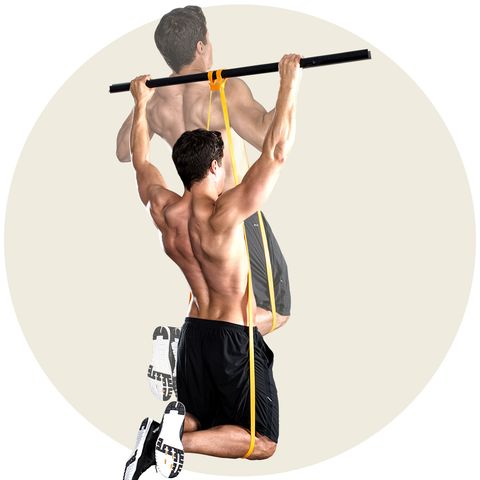
- Optional: resistance band (assisted version)
Unlike machine exercises, no external stabilization is provided. Your body must create its own stability.
Other Names for Wide-Grip Pull-Ups
- Wide Overhand Pull-Ups
- Wide-Grip Pronated Pull-Ups
- Wide Pull-Up
- Overhand Wide Chins (incorrect but commonly used)
The defining factor is a pronated grip + hand spacing wider than shoulder-width.
How to Perform the Wide-Grip Pull-Up
Starting Position (Setup)
- Grip bar slightly wider than shoulder width
- Overhand grip (palms facing away)
- Arms fully extended
- Dead hang position
- Legs straight or slightly bent
- Core braced
Initiate each rep from a controlled dead hang.
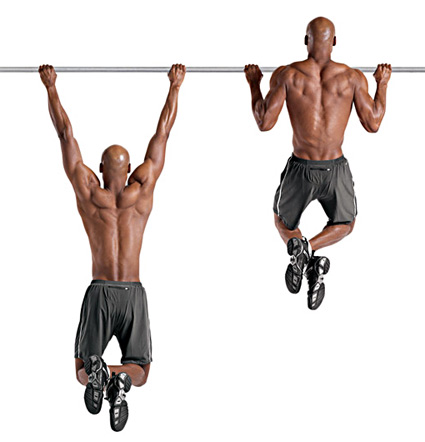
Execution Phase
- Depress and retract the shoulder blades first
- Pull elbows downward toward ribs
- Lift the chest toward the bar
- Chin passes the bar level
- Lower under control
Do not jerk. Do not swing. Control both phases.
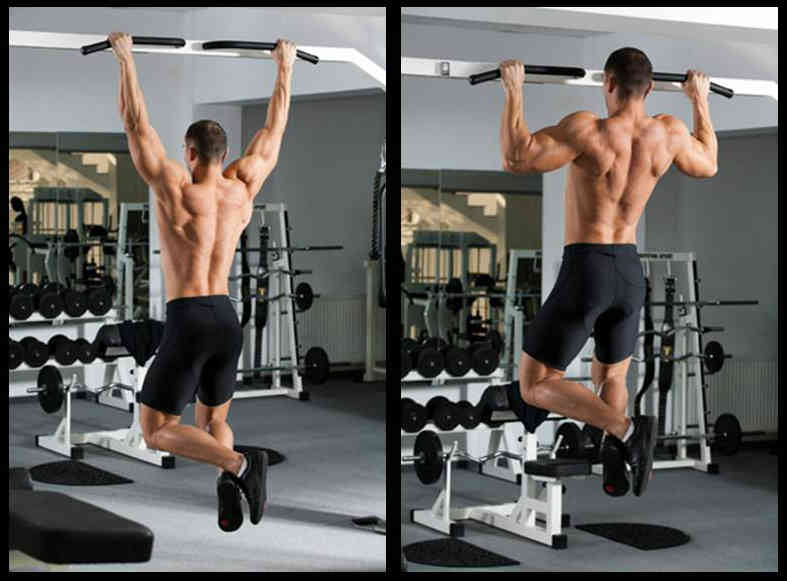
Quick Form Checklist — Wide-Grip Pull-Ups
Before increasing volume or adding external weight, ensure every repetition meets these strict technical standards. Mastering these fundamentals is what separates strong lifters from those who simply “survive” the movement.
- Full dead hang start (arms fully extended, controlled shoulders)
- Scapular depression before elbow bend
- No kipping or swinging
- The chest leads upward, not the chin
- Elbows travel downward, not backward excessively
- Bar path stays vertically aligned with the mid-body
- Controlled eccentric (2–4 seconds down)
- Core braced and glutes lightly engaged
- No excessive neck jutting or head thrusting
- Maintain a consistent torso angle throughout the set
If more than two of these break down, the set should be terminated — quality deteriorates quickly in bodyweight pulling movements.
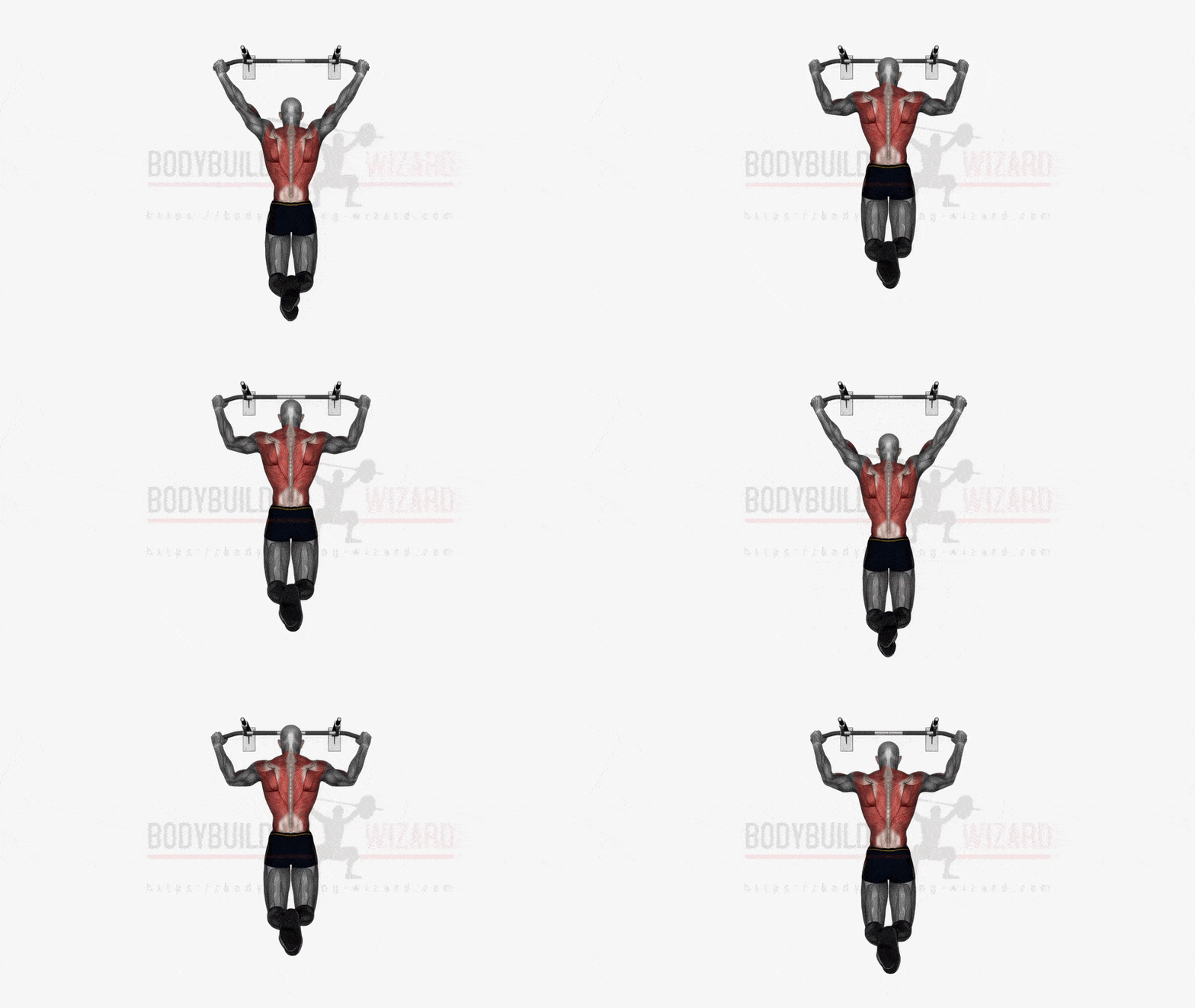
Wide-Grip Pull-Ups Common Mistakes
Despite its apparent simplicity, the wide-grip pull-up is frequently performed incorrectly. Most technical errors stem from ego lifting, insufficient strength, or poor scapular control.
- Swinging or kipping to generate momentum
- Performing partial repetitions without full extension or full chin-over-bar position
- Initiating the pull with the biceps instead of the scapulae
- Hyperextending the neck to “cheat” the chin over the bar
- Using an excessively wide grip that limits the range of motion
- Failing to control the eccentric (dropping too quickly)
- Allowing the shoulders to collapse at the bottom position
- Raising the hips forward excessively during the pull
- Losing core tension and creating unnecessary spinal movement
When these errors occur, the lats stop being the primary driver of the movement—and the exercise loses much of its intended benefit.
Mechanical Resistance Analysis
Unlike cable machines, pull-ups use bodyweight as resistance. This means:
- The load remains constant (your body mass)
- Torque changes based on joint angles
- The hardest phase is typically mid-range
Because your lower body is not supported, abdominal activation is mandatory to maintain efficient pulling mechanics.
This is one reason pull-ups place greater neuromuscular demand on the muscles than lat pulldowns.
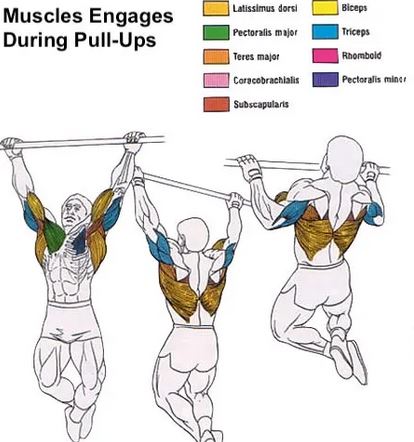
Muscles Involved in Wide-Grip Pull-Ups
Wide-grip pull-ups are an excellent (though very demanding) exercise that targets the entire back (particularly the latissimus dorsi), as well as the biceps, part of the triceps, and the forearms.
- MAIN MUSCLES: latissimus dorsi, biceps (short head), teres major
- SECONDARY MUSCLES: pectoralis major (lower and outside), triceps (long head), teres minor, rhomboids, brachioradialis, biceps (long head), deltoid (front and rear)
- ANTAGONISTS: deltoid, pectoralis major (upper), triceps
Wide-Grip Pull-Ups — Pros and Cons
The wide-grip pull-up is widely considered one of the most effective back-building movements ever created. However, like all demanding compound exercises, it comes with both powerful advantages and important limitations that must be understood before programming it aggressively.
Advantages
- Superior Back Width Development. The wide pronated grip increases shoulder adduction demands and places the biceps in a mechanically weaker position. This shifts more load onto the latissimus dorsi — especially the outer fibers — making it one of the most effective exercises for building the V-taper and upper-back width.
- High Neuromuscular Demand. Because you are lifting your entire bodyweight in space, the nervous system must coordinate scapular depression, elbow flexion, and core stabilization simultaneously. This produces a powerful strength stimulus that machine-based exercises cannot fully replicate.
- Full-Body Stabilization. Unlike lat pulldowns, pull-ups require abdominal, gluteal, and spinal stabilization. The lower body is not locked into place, meaning the core must actively control movement. This improves functional strength and intermuscular coordination.
- Direct Relative Strength Indicator. Few exercises measure relative strength as clearly as pull-ups. The ability to perform multiple strict reps demonstrates excellent strength-to-bodyweight ratio — a key marker of athletic performance.
- Minimal Equipment Requirement. All that is required is a fixed bar. No machines, no weight stacks, no cables. This makes pull-ups universally accessible and ideal for both gym and calisthenics training environments.
- Excellent Athletic Carryover. Pull-ups transfer well to sports that require climbing, grappling, pulling, or upper-body endurance. Combat athletes, climbers, and gymnasts rely heavily on vertical pulling strength.
Potential Drawbacks
- High Entry Strength Requirement. Beginners often cannot perform even a single strict rep. This makes the movement inaccessible without assistance methods such as resistance bands or assisted pull-up machines.
- Increased Joint Stress with Poor Form. If scapular control is lacking, excessive strain may be placed on the shoulders and elbows. Extremely wide grips can increase stress on the AC joint and reduce range of motion.
- Limited Progressive Overload (Initially). Unlike barbell movements, progression depends primarily on bodyweight. Without an added weight (dip belt), overload becomes limited once higher repetitions are achieved.
- Technical Breakdown Under Fatigue. As fatigue sets in, lifters often begin swinging, kipping, or shortening the range of motion. This reduces lat activation and increases injury risk.
- Bodyweight Sensitivity. Heavier individuals may struggle disproportionately compared to lighter athletes. Because resistance equals total body mass, even small weight increases significantly affect the difficulty.
Pull-Up Variations
While the wide-grip pull-up is often considered the gold standard for back width, strategic variations allow you to shift muscular emphasis, manage joint stress, and apply progressive overload more effectively.
Weighted Pull-Ups
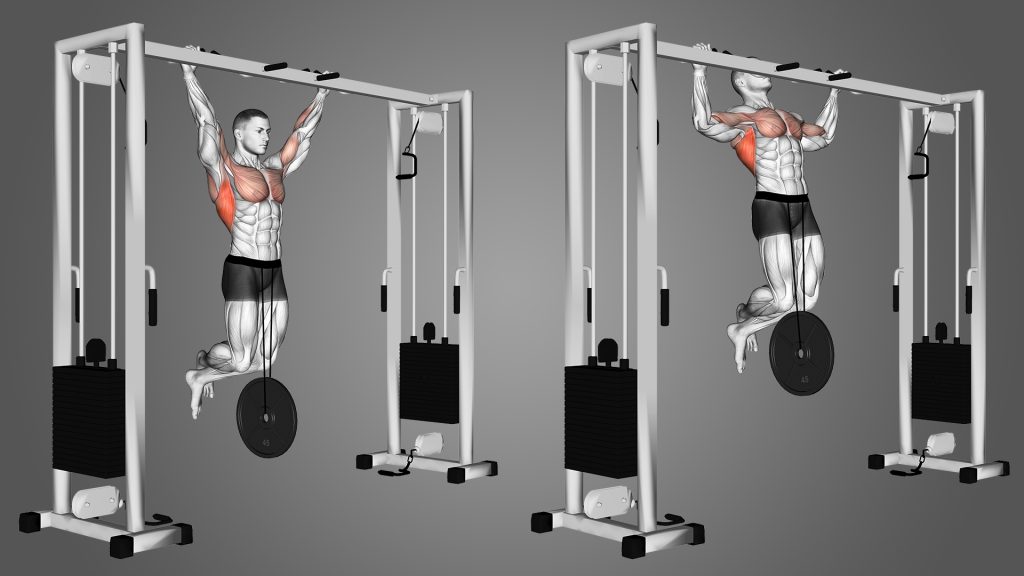
Once bodyweight repetitions exceed 10–12 strict reps, external loading becomes essential for continued strength and hypertrophy gains. A dip belt with weight plates allows measurable progressive overload while preserving strict mechanics. Weighted pull-ups significantly increase activation of the lats, upper back, and core, making them ideal for advanced lifters focused on maximal strength development.
Neutral-Grip Pull-Ups
Using a neutral (palms-facing) grip reduces shoulder external rotation stress and is generally more joint-friendly than a wide pronated grip. This variation allows a more natural elbow path and increases biceps contribution, often enabling higher repetition performance. It is an excellent option for lifters managing shoulder discomfort while still training vertical pulling strength.
Chin-Ups
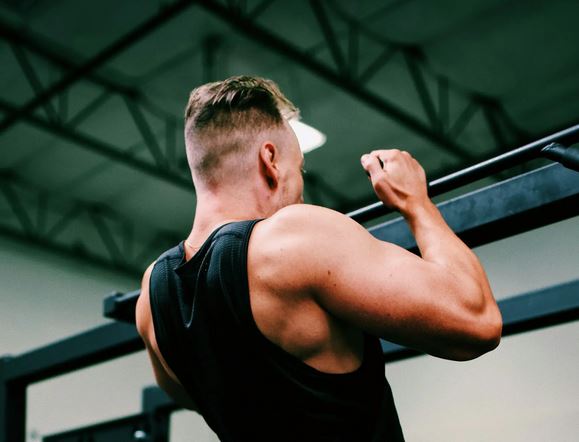
Chin-ups use a supinated (underhand) grip, placing the biceps in a mechanically stronger position. This makes the movement easier for many lifters and allows greater involvement of the lower lats and lower trapezius. Because elbow flexors contribute more, chin-ups are often the first bodyweight vertical pull that beginners successfully master.

Assisted Pull-Ups
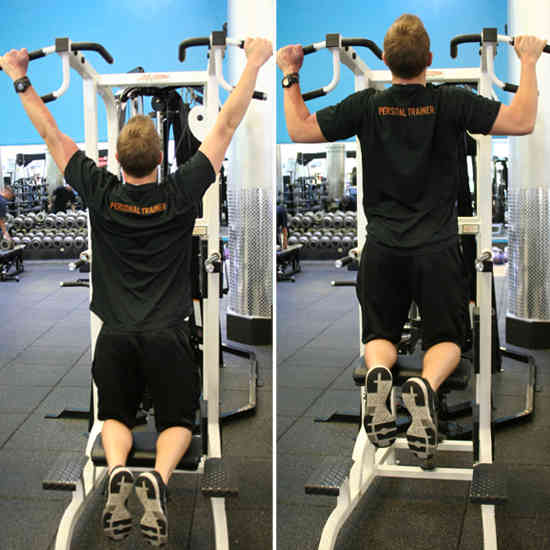
Assistance methods such as resistance bands or machine-assisted pull-up stations reduce the effective bodyweight being lifted. This allows beginners to practice proper scapular mechanics and a full range of motion without compromising form. Assisted variations are valuable stepping stones toward unassisted strict pull-ups.
Behind-the-Neck Pull-Ups
This advanced variation involves pulling the bar toward the back of the neck rather than the upper chest. While it can increase upper-back engagement, it significantly increases shoulder joint stress through extreme external rotation and reduced scapular mobility. Because of the risk of injury, it should be used cautiously and only by individuals with excellent shoulder health and mobility.
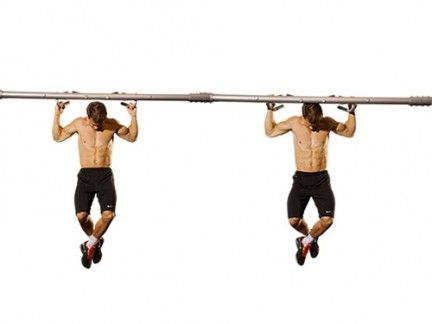
Pull-ups challenge grip strength, upper-back strength, scapular control, and bodyweight management all at once. If you need a smarter way to train for your first rep, this guide lays everything out clearly.
View the Full Pull-Up ArticleReplacement Exercises / Substitutes for Back Width
If wide-grip pull-ups are currently too demanding — or if joint stress, fatigue, or programming structure requires an alternative — several other exercises can effectively target back width through vertical pulling mechanics and shoulder adduction patterns.
These movements emphasize the latissimus dorsi, particularly the outer fibers responsible for V-taper development, without requiring full bodyweight control.
Wide-Grip Lat Pulldown
The closest machine-based alternative to wide-grip pull-ups. Because the lower body is stabilized, this variation allows better isolation of the lats and is ideal for beginners or high-volume hypertrophy phases. However, core activation is significantly lower than in pull-ups.
Neutral-Grip Lat Pulldown
Using a parallel grip reduces shoulder stress while still maintaining vertical pulling mechanics. It often allows heavier loading and improved mind–muscle connection, making it a practical substitute during recovery phases.
Single-Arm Lat Pulldown
This unilateral cable variation improves neuromuscular control and corrects left–right strength imbalances. It allows precise control of elbow trajectory and can enhance low-latency activation without excessive systemic fatigue.
Straight-Arm Lat Pulldown
Although technically an isolation movement, this exercise directly trains shoulder extension and lat engagement without elbow flexion. It is particularly effective at improving the mind–muscle connection necessary for strong pull-ups.
Vertical Traction Machine
This plate-loaded or selectorized machine simulates the pull-up pattern while providing back support. It reduces stabilization demands and allows overload progression for lifters not yet capable of strict bodyweight reps.
Resistance Band Lat Pulldown (Home Alternative)
For home training, anchoring resistance bands overhead provides a controlled vertical pulling pattern that mimics a lat pulldown. While resistance profiles differ from gravity-based pull-ups, it remains useful for activation and high-repetition work.
Behind-the-Neck Lat Pulldown
This variation involves pulling the bar behind the head toward the upper trapezius region. While it can increase upper-back involvement, it places the shoulder joint in a more externally rotated and potentially vulnerable position. For individuals with limited shoulder mobility or a history of shoulder discomfort, this version may increase injury risk and should be used cautiously.
Wide-Grip Pull-Ups vs Wide-Grip Lat Pulldowns
| Criteria | Pull-Up | Lat Pulldown |
|---|---|---|
| Resistance | Bodyweight | Machine |
| Core Demand | High | Low |
| Stability | Self-controlled | Guided |
| Width Development | Superior | Good |
| Strength Carryover | Higher | Moderate |
Conclusion: Pulldowns are useful. Pull-ups are superior.
A lot of lifters are surprised when they can pull their bodyweight (or more) on the lat pulldown machine, yet can’t perform a single strict pull-up. The reason is simple: lat pulldowns and pull-ups are not the same strength test, even though they look similar.
On a lat pulldown, your pelvis and legs are locked in place, the path is guided, and the machine lets you “find leverage” more easily. On a pull-up, your entire body becomes the moving load, meaning you must also control scapular depression, core stiffness, anti-swing stability, and even breathing/bracing while pulling. If your shoulders collapse in the dead hang or your trunk can’t stay rigid, your lats never get a clean line of force — and the rep fails before “lat strength” is even tested.
There’s also a measurement reality: many pulldown stacks are not perfectly calibrated, and attachment friction plus cable angles can make “100 kg” feel very different than lifting 100 kg of actual bodyweight. In practice, the best approach is to use pulldowns to build capacity, then bridge to pull-ups with assisted pull-ups, slow eccentrics, and scapular pull-ups until strict reps become repeatable.
Which One Should You Choose?
The table clearly shows that both exercises effectively target back width — but under very different mechanical and neuromuscular conditions.
Wide-grip pull-ups demand full-body coordination and stabilization. Because the body is suspended in space, the lifter must control scapular depression, core tension, and spinal alignment simultaneously. This increases overall neuromuscular load, making pull-ups a superior tool for developing relative strength and integrated athletic performance.
Lat pulldowns, on the other hand, provide greater loading precision and lower stabilization demands. The machine guides the movement path and eliminates the need for lower-body control, allowing the lifter to focus almost entirely on lat contraction. This makes pulldowns particularly effective during hypertrophy-focused training blocks, rehabilitation phases, or for beginners building foundational pulling strength.
In practical programming terms:
- If your goal is maximal relative strength and structural back development → prioritize pull-ups.
- If your goal is controlled hypertrophy, volume accumulation, or technical learning → use lat pulldowns strategically.
The strongest physiques typically include both. Pulldowns build capacity. Pull-ups build dominance.
Pull-Ups vs Chin-Ups — What’s the Difference?
Although pull-ups and chin-ups are both vertical pulling exercises performed with bodyweight, the primary difference lies in grip position — a small change that significantly alters muscle emphasis and difficulty.
Pull-ups use a pronated (overhand) grip, which places the biceps in a mechanically weaker position and shifts more emphasis onto the upper and outer fibers of the latissimus dorsi, as well as the upper back. This typically makes pull-ups more challenging for most lifters.
Chin-ups use a supinated (underhand) grip, which places the biceps in a stronger mechanical position. As a result, chin-ups generally allow more repetitions and greater elbow flexor contribution, while still strongly activating the lats — particularly the lower fibers.
In short:
- Pull-ups emphasize upper-back and outer-lat width with less biceps assistance.
- Chin-ups allow more biceps involvement and are usually easier to perform.
Programming Recommendations
- Beginners: assisted 3×6–8
- Intermediate: bodyweight 4×8–10
- Advanced: weighted 4×5–8
Train 1–2x per week.
Pull-Up Progression Tips — From Zero Reps to Your First Strict Pull-Up
If you cannot perform a single strict pull-up yet, that does not mean you lack potential — it simply means you need structured progression. Pull-ups are highly sensitive to strength-to-bodyweight ratio and scapular control. The key is to build the pattern in layers, not to force repetitions prematurely.
Step 1 — Build Scapular Strength First
Start with scapular pull-ups (also called active hangs). Hang from the bar and practice pulling your shoulders down without bending your elbows. This teaches proper initiation and strengthens the lower trapezius and lat engagement pattern. Aim for 3–4 sets of 8–12 controlled reps.
Step 2 — Strengthen the Lats in Isolation
Use lat pulldowns or straight-arm pulldowns to build raw lat strength. Focus on the full range of motion and controlled eccentrics. This develops the base pulling capacity required for bodyweight work.
Step 3 — Assisted Pull-Ups
Use a resistance band or assisted pull-up machine to reduce effective bodyweight. Choose assistance that allows you to perform 6–8 strict reps with clean form. Gradually decrease assistance over time.
Step 4 — Eccentric (Negative) Pull-Ups
Jump or step to the top position (chin over bar) and lower yourself slowly for 3–5 seconds. This builds eccentric strength, which is often stronger than concentric strength and accelerates progress toward your first full rep.
Step 5 — Partial Range Reps
Practice pulling from the bottom to halfway up, or from halfway to the top. Strength gains are angle-specific, so working through partial ranges strengthens weak points.
Step 6 — Improve Bodyweight Efficiency
If applicable, modest fat loss can significantly improve pull-up performance. Because resistance equals body mass, small changes in body composition can dramatically affect your strength-to-weight ratio.
Final Thoughts about the Wide-Grip Pull-Ups
After years of coaching lifters of all levels, I can confidently say that wide-grip pull-ups are one of the most honest exercises in strength training. The bar doesn’t lie. You either control your body through space — or you don’t.
I’ve seen athletes who could move impressive numbers on lat pulldown machines struggle to complete a single strict pull-up. And I’ve seen relatively light lifters with excellent technique dominate the bar with clean, controlled reps. That’s because pull-ups reward structure, discipline, and true strength-to-bodyweight efficiency — not just stack numbers.
If your goal is to build real back width, improve shoulder control, and develop upper-body strength that transfers to sport and life, wide-grip pull-ups should remain a staple in your program. But they must be earned. Master the dead hang. Control the eccentric. Initiate with the scapula. Respect the movement.
Machines can assist you. Bands can help you. But eventually, it’s you versus gravity.
And that’s exactly why this exercise has earned its reputation as the king of back exercises.
Are wide-grip pull-ups better for back width?
Yes, wide-grip pull-ups are highly effective for building back width because they emphasize shoulder adduction and activate the outer fibers of the latissimus dorsi. The wider grip reduces biceps contribution and increases lat dominance, which enhances V-taper development.
What muscles do wide-grip pull-ups work the most?
Wide-grip pull-ups primarily target the latissimus dorsi, especially the upper and outer fibers. Secondary muscles include the rhomboids, middle trapezius, teres major, posterior deltoids, and biceps.
Are wide-grip pull-ups harder than chin-ups?
Yes, wide-grip pull-ups are generally harder than chin-ups because the pronated grip places the biceps in a weaker mechanical position. This increases reliance on the lats and upper back, making the movement more demanding.
How many wide-grip pull-ups should I be able to do?
For men, performing 8–12 strict reps is considered strong. For women, 5–8 strict reps indicates excellent relative upper-body strength. However, quality of form matters more than total repetitions.
Do wide-grip pull-ups build more width than lat pulldowns?
Wide-grip pull-ups build width effectively while also requiring greater core stabilization and relative strength. Lat pulldowns can isolate the lats more easily, but pull-ups create superior overall neuromuscular demand.
Should beginners start with pull-ups or lat pulldowns?
Beginners who cannot perform at least one strict pull-up should start with assisted pull-ups and lat pulldowns. These exercises build foundational strength while allowing controlled progression toward full bodyweight pull-ups.
Is a wider grip always better for back width?
Not necessarily. A grip slightly wider than shoulder width is optimal for most lifters. Excessively wide grips reduce range of motion and may increase shoulder stress without significantly increasing lat activation.
Can wide-grip pull-ups hurt your shoulders?
Wide-grip pull-ups are safe when performed with proper scapular control and shoulder mobility. However, extremely wide grips or incomplete scapular depression can increase stress on the shoulder joint.
How do I increase my pull-up strength?
To increase pull-up strength, focus on assisted pull-ups, eccentric (negative) reps, scapular pull-ups, and progressive overload through weighted pull-ups once strict bodyweight reps are mastered.
Are weighted wide-grip pull-ups worth doing?
Yes, weighted wide-grip pull-ups are highly effective once you can perform 10–12 strict bodyweight reps. Adding load increases mechanical tension and promotes continued strength and hypertrophy gains.
