



Introduction: Why Muscles Can’t Grow Without Satellite Cells
Most people believe that muscle growth is simply a matter of lifting weights and eating enough protein. While both are essential, they are only part of the story. Behind every lasting increase in muscle size and strength lies a deeper biological mechanism that determines whether your body is even capable of building new muscle tissue.
That mechanism is driven by satellite cells.
Two lifters can follow the same program, eat the same macros, and train with similar intensity—yet one continues to grow while the other plateaus. The difference often has little to do with motivation and everything to do with what is happening inside the muscle fibers themselves. Without satellite cell activation, muscles quickly reach a structural limit beyond which further growth becomes impossible.
Satellite cells are why beginners grow quickly, former athletes regain muscle faster, and experienced lifters can keep building size over the years rather than weeks. They are also the missing link between training, hormones, recovery, and long-term hypertrophy. To understand real muscle growth—not just temporary swelling or pump—you must understand how these cells work.
What Are Satellite Cells?
Definition:
Satellite cells are muscle-specific stem cells that live on the outer surface of muscle fibers, tucked between the muscle cell membrane and the surrounding connective tissue.
In a resting muscle, they remain dormant—hence the name “satellite,” as they sit alongside the fiber like small biological sentinels.
When muscle tissue is stressed by resistance training, injury, or intense mechanical loading, these cells become activated. Once active, they begin to divide, mature, and eventually merge with existing muscle fibers, donating new nuclei to the cell.
This process is critical because:
Each muscle fiber can only grow as large as its number of nuclei allows.
By adding new nuclei, satellite cells expand the fiber’s capacity to produce muscle proteins, enabling long-term hypertrophy rather than short-lived increases in size.
In simple terms, satellite cells are what turn training stress into structural growth. Without them, muscles can swell and recover, but they cannot continue to get bigger.
The Role of Satellite Cells in Muscle Growth
When people talk about muscle growth, they usually focus on protein intake, training volume, or hormones. But none of those factors can produce lasting hypertrophy unless satellite cells do their job. These cells are the biological mechanism that allows a muscle fiber to transition from simply repairing itself to becoming structurally larger and stronger.
Every muscle fiber contains multiple nuclei, and each nucleus controls protein synthesis within a specific region of that fiber. As a fiber grows thicker, its existing nuclei eventually reach their limit. At that point, the fiber cannot meaningfully increase protein production unless new nuclei are added. This is where satellite cells become indispensable.
When activated by resistance training, satellite cells divide and fuse with existing muscle fibers, donating new nuclei. This expands the fiber’s ability to produce contractile proteins, allowing it to support greater cross-sectional area and force output. In practical terms, satellite cells increase the muscle’s growth capacity, not just its short-term recovery.
This is why muscle growth happens in phases. Early gains often come from improved neural efficiency, fluid shifts, and basic protein turnover. Long-term hypertrophy, however, depends on the gradual accumulation of new nuclei provided by satellite cells. Without them, muscle fibers hit a ceiling and plateau—even if training and nutrition remain optimal.
Satellite cells also explain why heavy, progressive resistance training produces different results than light, high-repetition work alone. High mechanical tension and controlled muscle damage are powerful stimuli for satellite cell activation. These signals tell the body that the muscle is under sufficient load to justify structural expansion rather than mere maintenance.
In essence, satellite cells convert training stress into biological permission to grow. They are what turn repeated workouts into a larger, more powerful muscle over time rather than just a temporarily fatigued one.

Satellite Cells vs. Muscle Protein Synthesis
One of the biggest misunderstandings in bodybuilding and fitness is the idea that muscle growth is driven primarily by muscle protein synthesis (MPS). While MPS is essential, it is not what determines your long-term muscle-building potential. Satellite cells do.
Muscle protein synthesis is the process by which your body repairs and rebuilds muscle fibers after training. It increases after workouts and after protein intake, but it is temporary. Within 24–48 hours, MPS returns to baseline, even if you keep eating and training.
Satellite cells, on the other hand, control something far more important:
The structural capacity of the muscle fiber to grow.
When a satellite cell fuses with a muscle fiber, it adds a new nucleus. That nucleus permanently increases the fiber’s ability to produce proteins in the future. This is why satellite cells are the biological basis of:
- long-term hypertrophy
- muscle memory
- lasting size gains
You can stimulate muscle protein synthesis all you want, but if the muscle fiber does not receive new nuclei, growth eventually plateaus. The muscle simply does not have enough genetic “machinery” to keep expanding.
This is also why some lifters look “trained” but never truly get big. Their training and nutrition support short-term repair, but they do not create the level of mechanical tension and hormonal environment required to activate satellite cells.
In practical terms:
Protein builds the muscle.
Satellite cells decide how much muscle can be built.
Without satellite cell activation, muscle protein synthesis can only maintain what you already have. With satellite cell activation, the muscle gains the ability to become larger, stronger, and more resilient over time.
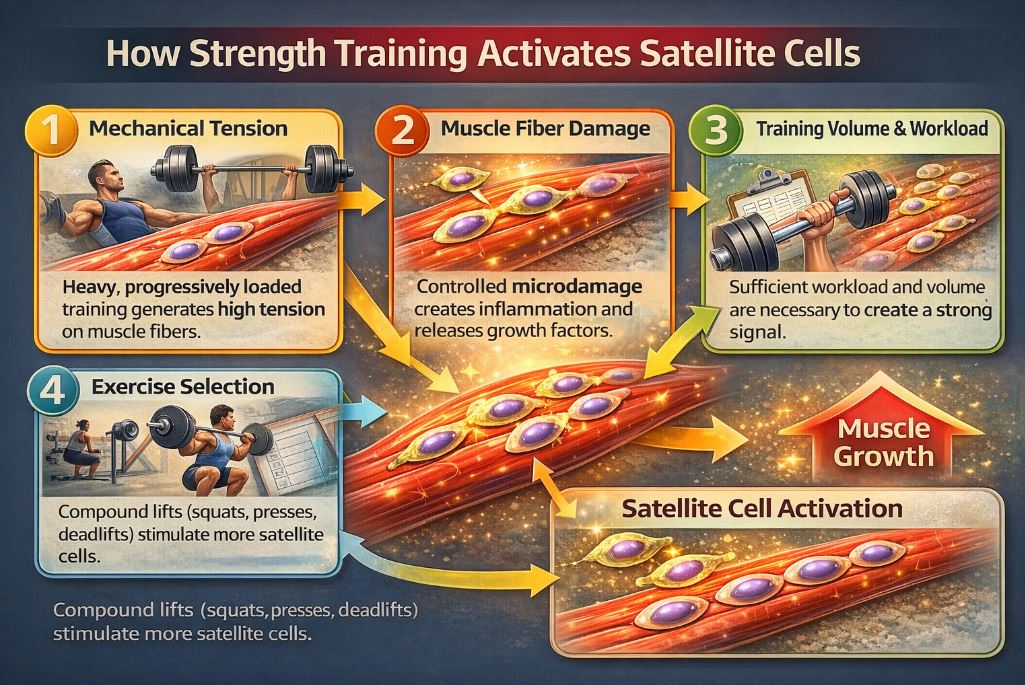
How Strength Training Activates Satellite Cells
Satellite cells are not activated by light activity, casual movement, or random exercise. They respond to specific mechanical and physiological signals that indicate a muscle is under sufficient demand to justify structural expansion. Strength training provides those signals in a way no other form of exercise can.
The most powerful activators of satellite cells are:
Mechanical Tension
Heavy, progressively loaded resistance training places high tension on muscle fibers. This tension physically deforms the fiber and its surrounding matrix, triggering molecular signals that “wake up” satellite cells. The body interprets this as a demand for a stronger, thicker muscle capable of handling future loads.
This is why compound lifts, controlled eccentrics, and progressively heavier weights are so effective at driving long-term hypertrophy.
Muscle Fiber Damage
While soreness itself is not the goal, controlled microdamage to muscle fibers stimulates satellite cell activation. This damage triggers a local inflammatory response that releases growth factors, drawing satellite cells to the area to participate in repair and reinforcement.
Training that includes:
- challenging eccentrics
- full range of motion
- adequate load
is far more effective at triggering this process than short, partial movements.
Training Volume and Workload
Satellite cells respond not just to intensity, but to total mechanical workload. Enough volume must be present to create a meaningful signal, but excessive volume without recovery suppresses the very hormones that satellite cells depend on.
This is why intelligent programming—balancing hard sets with recovery—is more effective than simply doing more.
Exercise Selection
Multi-joint movements such as squats, presses, rows, and deadlifts activate large amounts of muscle mass and generate strong systemic growth signals. These exercises stimulate satellite cells more broadly and more powerfully than isolated, low-load movements.
Isolation work has value, but it does not replace the satellite cell stimulus created by heavy, compound loading.
Progressive Overload
Perhaps the most important factor is progression. Satellite cells are most active when the body is forced to adapt to higher demands over time. Repeating the same weights and volumes eventually produces maintenance, not growth.
Progression signals the need for more nuclei, more protein synthesis capacity, and ultimately, more muscle.
Strength training does not just damage muscle —
it sends a biological message that the muscle must become
bigger, stronger, and more capable.
Satellite cells are the mechanism that turns that message into
lasting structural change.
Hormones and Satellite Cells
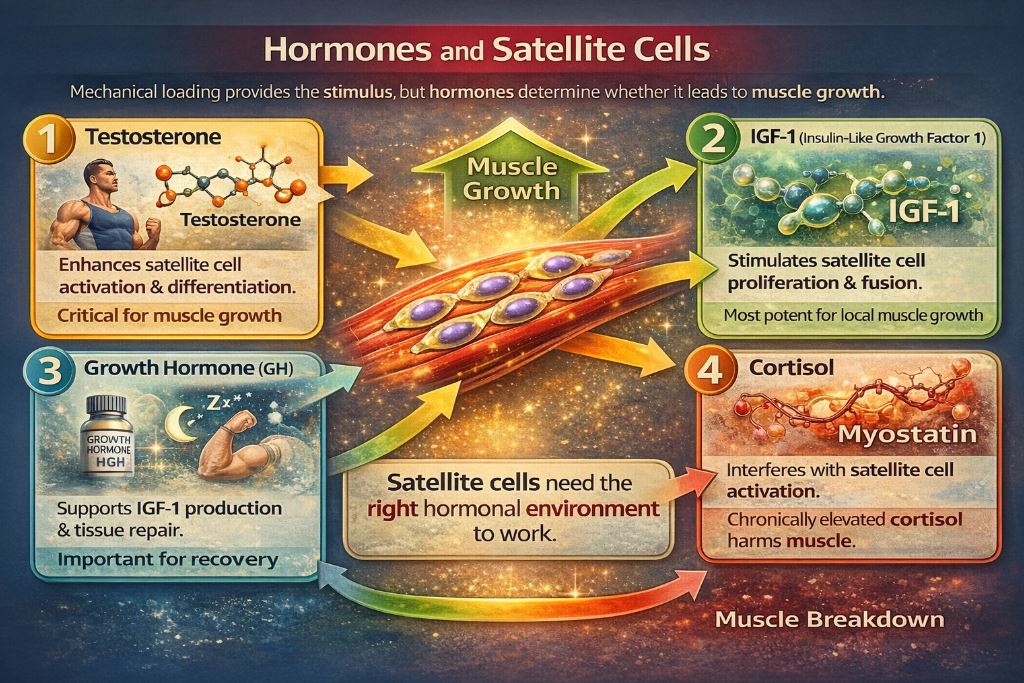
Satellite cells do not operate in isolation. Their activation, proliferation, and fusion with muscle fibers are strongly regulated by the hormonal environment. In other words, training creates the mechanical signal—but hormones decide whether that signal will be translated into real, structural muscle growth.
A favorable hormonal profile makes satellite cells more responsive, while a catabolic environment can block their activity even when training quality is high.
Testosterone
Testosterone plays a key role in satellite cell behavior. It increases the sensitivity of muscle tissue to growth signals and promotes satellite cell activation and differentiation. When testosterone levels are adequate, satellite cells are more likely to migrate toward damaged fibers and fuse with them, increasing the muscle’s nuclear count and growth potential.
Low testosterone does not entirely prevent muscle growth, but it significantly reduces its efficiency.
IGF-1 (Insulin-Like Growth Factor 1)
IGF-1 is one of the most powerful local stimulators of satellite cells. It promotes both their proliferation and their fusion into muscle fibers. Mechanical loading from resistance training increases IGF-1 expression directly inside the muscle, creating a highly localized growth signal exactly where it is needed.
This is one reason why heavy resistance training produces different adaptations than light activity or cardio.
Growth Hormone (GH)
Growth hormone supports satellite cell function indirectly by increasing IGF-1 availability and enhancing tissue repair. While GH does not directly cause muscle fibers to grow larger, it creates a recovery-friendly environment that allows satellite cells to perform their regenerative and growth-supporting roles.
Poor sleep, excessive dieting, and chronic stress all reduce GH output, limiting this support.
Cortisol
Cortisol has the opposite effect. Chronically elevated cortisol interferes with satellite cell activation and reduces their ability to contribute new nuclei to muscle fibers. While short-term cortisol increases after training are normal, persistent elevation signals that the body should prioritize survival over tissue building.
In this state, even good training stimuli fail to produce long-term hypertrophy.
Myostatin
Myostatin acts as a direct brake on satellite cell activity. High myostatin levels reduce satellite cell proliferation and limit their ability to fuse with muscle fibers. This is one of the main reasons inactivity, aging, and prolonged energy deficits make it so difficult to build or even maintain muscle mass.
Resistance training and adequate nutrition help suppress myostatin, allowing satellite cells to do their job.
Satellite cells need the
right hormonal environment to work.
Mechanical loading provides the
stimulus, but hormones determine whether that stimulus becomes
lasting muscle growth or just temporary fatigue.
Satellite Cells and Muscle Memory
One of the most fascinating aspects of muscle biology is muscle memory—the ability to regain lost muscle far faster than it was originally built. This phenomenon is not psychological or motivational. It is cellular, with satellite cells at its center.
When satellite cells fuse with a muscle fiber, they donate new nuclei. These nuclei are not temporary. Even if you stop training and lose muscle size, many of those nuclei remain inside the muscle fibers for a very long time—potentially for years. When training resumes, those extra nuclei allow the muscle to rebuild protein and regain size much faster than before.
This is why:
- Former athletes regain muscle rapidly
- People who have been trained in the past respond faster when returning
- “First gains” are often easier to regain than to build initially
Muscle memory is essentially nuclear memory. The muscle does not remember workouts—it remembers how many nuclei it has.
From a practical standpoint, this means that every serious training phase is an investment in your future muscle-building potential. Even if you lose size later due to injury, stress, or lifestyle changes, the nuclei added by satellite cells make it far easier to come back.
This also explains why protecting satellite cell activity during dieting, injury, or aging is so important. When muscle loss occurs without loss of nuclei, recovery is fast. When nuclei are lost, rebuilding becomes much harder.
In other words, satellite cells don’t just help you grow—they help you stay a lifter for life.
Aging, Satellite Cells, and Sarcopenia
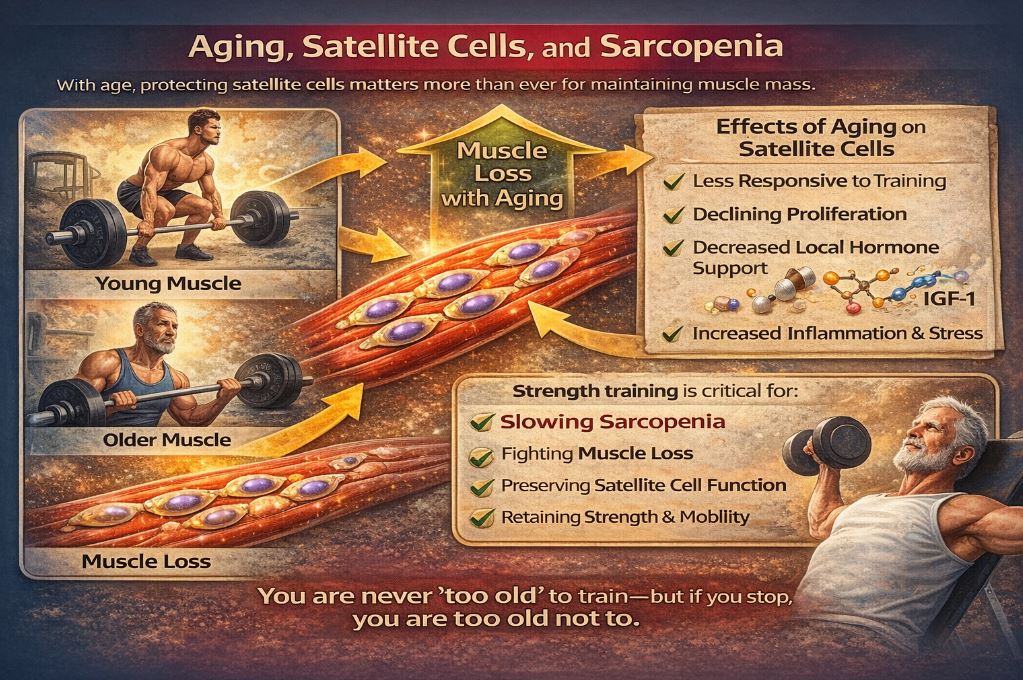
As we age, losing muscle is not just a cosmetic issue—it becomes a medical and functional problem. This age-related decline in muscle mass and strength is known as sarcopenia, and satellite cells play a central role in its pathogenesis.
In younger individuals, satellite cells are highly responsive to training and injury. They activate easily, multiply efficiently, and readily fuse with muscle fibers. This allows muscles to repair themselves quickly and add new nuclei when exposed to resistance training.
With aging, however, several changes occur:
- Satellite cells become less responsive to mechanical loading
- Their ability to proliferate and fuse declines
- The local hormonal environment becomes less supportive
- Inflammatory and stress signals increase
As a result, older muscle has a harder time replacing lost nuclei and restoring damaged fibers. Over time, this leads to a gradual reduction in muscle size, strength, and recovery capacity—even in physically active people.
This does not mean that muscle growth is impossible with age. Resistance training still activates satellite cells in older adults, but the stimulus needs to be stronger, more consistent, and better supported by recovery and nutrition. When older lifters stop training, satellite cell activity drops quickly, accelerating muscle loss.
The encouraging reality is that strength training is one of the few interventions proven to slow or even reverse aspects of sarcopenia. By repeatedly activating satellite cells, resistance training preserves the biological machinery needed to maintain muscle tissue throughout life.
In practical terms, satellite cells are one of the reasons you are never “too old” to train—but you are too old not to.
Can You Increase Satellite Cells Naturally?
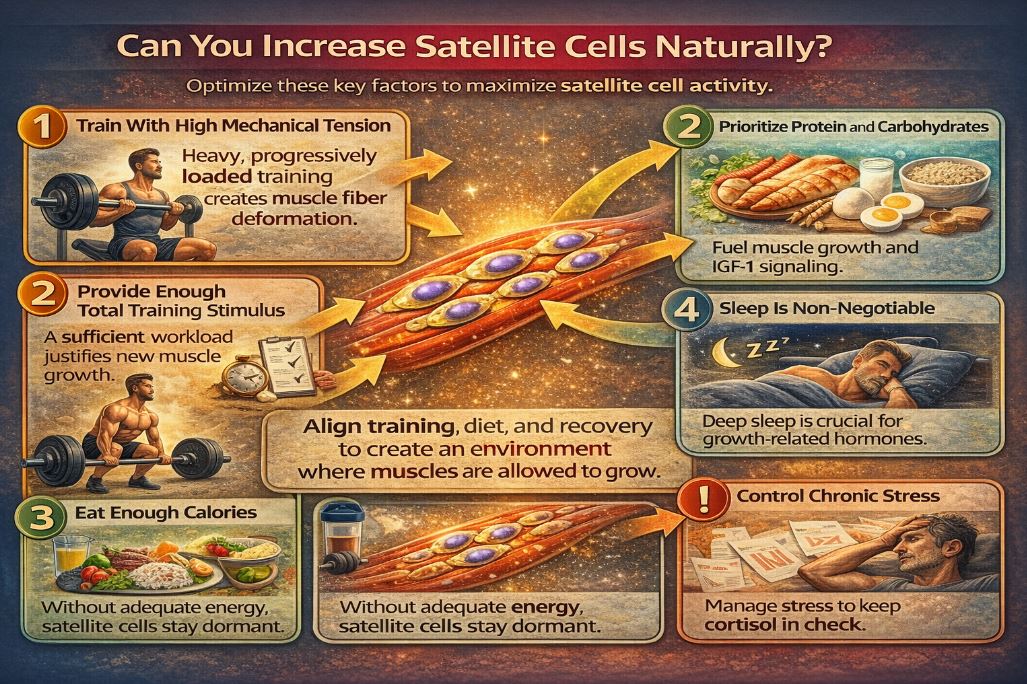
You cannot create satellite cells out of thin air—but you can strongly influence how active, responsive, and effective they are. In practical terms, this is what determines how much muscle you are capable of building over time.
Your body constantly adjusts satellite cell behavior in response to mechanical load, energy availability, hormones, and recovery. When these signals are favorable, satellite cells multiply and fuse with muscle fibers. When they are not, satellite cells remain dormant or are even lost.
Here is how you maximize their activity naturally.
Train With High Mechanical Tension
Satellite cells respond most strongly to heavy, progressively loaded resistance training. Lifting challenging weights through a full range of motion creates the deformation and stress signals that activate them.
Light weights, machines, and cardio do not produce the same effect.
Provide Enough Total Training Stimulus
Satellite cells need sufficient workload to justify growth. Too little training produces no signal. Too much training without recovery suppresses the hormones that satellite cells depend on.
Productive hypertrophy lives in the middle ground: hard training supported by recovery.
Eat Enough Calories
Energy availability is one of the strongest regulators of satellite cell behavior. When calories are too low, the body suppresses growth-related processes to preserve survival.
Prolonged dieting, aggressive cutting, or chronic under-eating can reduce satellite cell activity, even when protein intake is high.
Prioritize Protein and Carbohydrates
Protein provides the building blocks for new muscle, but carbohydrates are just as important. They reduce stress hormone output, improve training performance, and support IGF-1 signaling—all of which favor satellite cell activation.
Low-carb diets during intense training phases often reduce satellite cell responsiveness.
Sleep Is Non-Negotiable
Most growth-related hormones are released during deep sleep. Poor sleep increases cortisol, lowers GH, and reduces insulin sensitivity—all of which interfere with satellite cell function.
Consistent, high-quality sleep is one of the most powerful “supplements” for muscle growth.
Control Chronic Stress
Psychological and physiological stress both elevate cortisol and suppress anabolic signaling. Even perfect training and nutrition cannot overcome a chronically stressed nervous system.
Reducing stress restores the hormonal environment that enables satellite cells to perform their function.
Satellite cells are not magic — but they are highly sensitive to
how you train, eat, and recover.
When these factors are aligned, you create a biological environment
where your muscles are
allowed to grow — not just temporarily,
but structurally and long term.
Common Myths About Satellite Cells
Despite their central role in muscle growth, satellite cells are surrounded by misinformation. Clearing up these myths is important because misunderstanding satellite cells leads to poor training decisions, unnecessary supplements, and unrealistic expectations.
Myth 1: “Satellite cells get used up.”
Satellite cells do not run out like fuel. They can self-renew, meaning they divide into new satellite cells and muscle-supporting cells. While aging and inactivity reduce their number and responsiveness, training actually helps preserve and maintain them.
The real danger is not using them, not using them too much.
Myth 2: “Only steroids activate satellite cells.”
Anabolic drugs amplify satellite cell activity, but they do not create the mechanism. Resistance training is the natural trigger. Heavy mechanical loading, muscle tension, and IGF-1 release all activate satellite cells without the need for drugs.
Steroids bypass limits. Training builds capacity.
Myth 3: “If you eat enough protein, satellite cells will activate.”
Protein supports muscle repair, but it does not activate satellite cells. Mechanical stress and hormonal signaling do. You can eat perfectly and still fail to grow if training does not provide the right stimulus.
Myth 4: “Satellite cells only matter for beginners.”
Beginners grow because their satellite cells are highly responsive—but experienced lifters depend on them even more. Long-term hypertrophy, muscle memory, and maintaining size with age all depend on satellite cell activity.
Myth 5: “You lose satellite cells when you stop training.”
You lose muscle size quickly, but you do not lose all the nuclei donated by satellite cells. This is why muscle memory exists. The biological infrastructure for regaining muscle often remains even after long breaks.
Conclusion
Satellite cells are the missing link between lifting weights and building lasting muscle. Training provides the stimulus, protein provides the raw material, and hormones create the environment—but satellite cells are what determine whether your muscles actually gain the structural capacity to grow.
Without satellite cell activation, muscle growth becomes short-lived and limited. With it, each training phase builds a biological foundation that supports bigger, stronger, and more resilient muscles over time. This is why intelligent strength training, proper recovery, and hormonal balance matter far more than chasing pumps or short-term progress.
If you want muscle that lasts—not just muscle that swells—then protecting and activating your satellite cells should be at the center of your training philosophy.
Key Takeaways
- Satellite cells are the stem cells of muscle that make long-term growth possible.
- Each muscle fiber can only grow as large as its number of nuclei allows.
- Satellite cells add new nuclei, expanding the muscle’s capacity to build protein.
- Mechanical tension and progressive overload are the strongest triggers of satellite cell activation.
- Hormones like testosterone, IGF-1, and GH support satellite cells, while cortisol and myostatin suppress them.
- Muscle memory exists because nuclei remain even after muscle size is lost.
- Proper training, nutrition, sleep, and stress control determine how active satellite cells become.
Can satellite cells be damaged or reduced by extreme dieting?
Yes. Severe calorie restriction and rapid weight loss reduce satellite cell activity and impair their ability to support muscle repair and growth.
Do women have fewer satellite cells than men?
No. Women have similar satellite cell numbers, but hormonal differences influence how strongly those cells are activated by training.
Can endurance training interfere with satellite cell activation?
High-volume endurance training can blunt satellite cell signaling when combined with inadequate recovery or low energy intake.
Do satellite cells respond to blood flow or “muscle pump”?
Not directly. Satellite cells respond primarily to mechanical tension and biochemical signals, not temporary swelling.
Can injury permanently reduce satellite cell function?
Severe or repeated injuries can impair satellite cell pools locally, which is one reason chronically injured muscles often struggle to regain size.
Are satellite cells involved in muscle stiffness and fibrosis?
Yes. When satellite cell function is impaired, muscles may heal with connective tissue instead of muscle tissue, increasing stiffness.
Can supplements increase satellite cell numbers?
No supplement has been proven to increase satellite cell count. Training, nutrition, sleep, and stress control are the real drivers.
Do satellite cells behave differently in fast-twitch vs slow-twitch muscle fibers?
Yes. Fast-twitch fibers tend to show greater satellite cell activation during resistance training.
Can satellite cells affect injury risk?
Yes. Muscles with more satellite cell-derived nuclei repair faster and are more resilient to future damage.
Do satellite cells play a role in muscle shape and density?
They do. By increasing nuclear density within fibers, satellite cells help muscles become fuller, thicker, and more structurally stable.
