
Introduction: Why Muscle Loss Is a Hormonal Problem—Not Just a Training Mistake
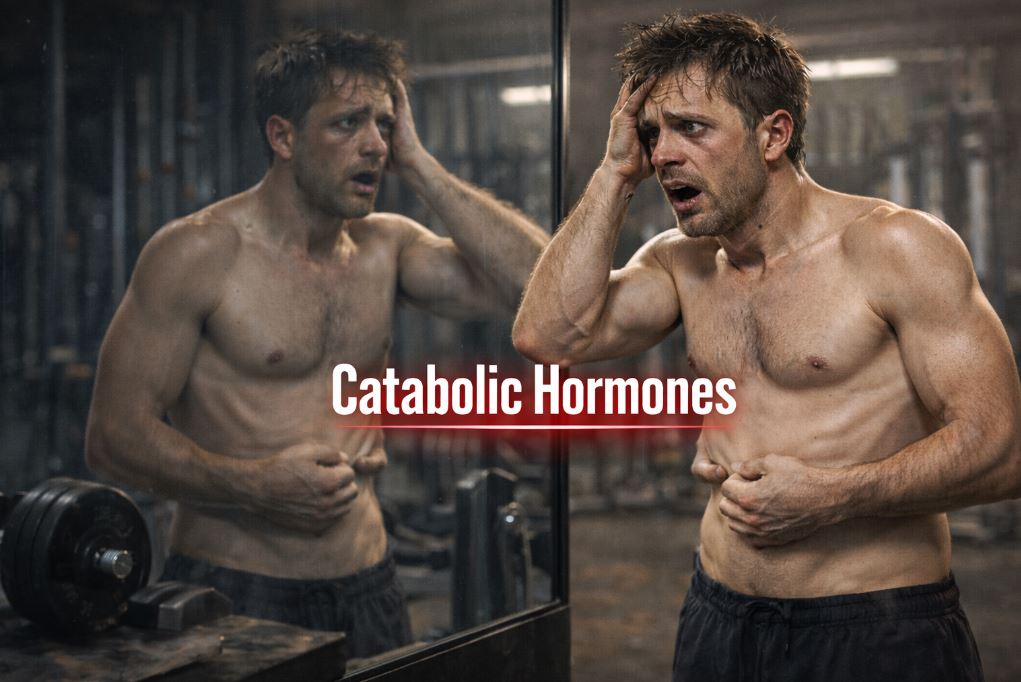
Losing muscle is rarely the result of a single bad workout or a missed meal. In practice, muscle loss is often a hormonal problem before it becomes a training problem. Many lifters train consistently, eat “clean,” and still watch their strength and size slowly slip away. The missing piece is usually not effort but how the body responds hormonally to stress.
Catabolism is a normal, necessary biological process. Every training session creates stress, tissue breakdown, and energy demand. In a healthy system, that stress is followed by recovery and adaptation. Problems arise when stress becomes chronic, and recovery falls behind. In that state, catabolic hormones begin to dominate, overriding anabolic signals and shifting the body toward conservation rather than growth.
For natural lifters especially, this balance is unforgiving. Without pharmacological buffers, chronically elevated stress hormones can quietly erode muscle mass, even when training volume and protein intake look “correct” on paper. More training does not automatically fix this—in many cases, it accelerates the problem.
This article explains catabolic hormones from a practical, physiology-first perspective. We’ll clarify which hormones are involved, why they exist, and—most importantly—when and why they start working against muscle retention. Understanding this side of the equation is essential if you want to protect muscle mass, improve recovery, and make anabolic training actually work.
What Are Catabolic Hormones?
Definition:
Catabolic hormones promote tissue breakdown, energy mobilization, and stress adaptation.
In muscle tissue, they increase protein breakdown, suppress anabolic signaling, or shift resources away from growth toward survival. For strength training athletes, this translates into losing muscle despite consistent training.
It’s critical to make one distinction early:
Catabolism itself is not the enemy. Chronic, unmanaged catabolism is.
In normal physiology, catabolic hormones:
- Mobilize fuel during training
- Help regulate inflammation
- Initiate tissue remodeling
These processes are essential for adaptation. However, when catabolic signaling remains elevated for prolonged periods—due to excessive training stress, under-eating, poor sleep, or psychological load—it outpaces recovery and suppresses muscle maintenance.
In this article, we focus on the catabolic hormones most relevant to muscle loss in active individuals:
- Cortisol – the primary stress hormone driving muscle protein breakdown under chronic load
- Myostatin – a growth-regulating protein that limits muscle size and recovery capacity
- Stress hormones (adrenaline and noradrenaline) – necessary acutely, but damaging when constantly elevated
These hormones do not exist to “destroy muscle.” Their role is to prioritize survival and energy efficiency. Muscle loss occurs when the body perceives prolonged stress and insufficient recovery, signaling that maintaining large amounts of muscle tissue is metabolically risky.
Understanding catabolic hormones is not about eliminating stress—it’s about controlling the conditions that allow stress to become chronic. In the sections that follow, each hormone will be analyzed using the same structured framework, focusing on training, nutrition, and lifestyle factors that determine whether muscle is preserved or lost.

Cortisol – The Primary Catabolic Hormone Under Chronic Stress
1. Physiological Role in Muscle Breakdown
Cortisol is the body’s primary stress hormone and a central regulator of energy availability during physical and psychological stress. From a physiological standpoint, cortisol is not inherently harmful—it is essential for survival, fuel mobilization, and adaptation to training stress.
Its core actions relevant to muscle tissue include:
- Protein breakdown: Cortisol increases proteolysis, releasing amino acids for energy production and gluconeogenesis during stress.
- Energy mobilization: It elevates blood glucose by promoting hepatic glucose output, ensuring the brain and working muscles have access to fuel.
- Inflammation control: Cortisol modulates the inflammatory response following intense training, preventing excessive tissue damage.
In normal physiology, these actions are temporary and adaptive. Problems arise when cortisol signaling becomes chronically elevated, shifting the balance away from repair and toward ongoing breakdown.
2. When Cortisol Becomes a Muscle-Loss Trigger
Cortisol, a regulatory hormone, becomes a driver of muscle loss when stress outpaces recovery for prolonged periods. This is especially relevant for natural lifters, who lack pharmacological buffers to offset chronic catabolic signaling.
Situations where cortisol becomes problematic include:
- Chronic psychological stress (work, sleep deprivation, emotional strain)
- Persistent energy deficits from aggressive dieting
- High training volume without adequate recovery
- Long-term under-sleeping
In these states, cortisol does more than mobilize energy—it suppresses anabolic signaling, interferes with testosterone and IGF-1 activity, and accelerates net muscle protein loss. Over time, this leads to stalled progress, declining performance, and visible muscle loss despite continued training effort.
3. Training Factors That Elevate Cortisol
Training is a powerful stressor—and cortisol responds accordingly. Acute increases are normal; chronic elevation is the issue.
Key training-related contributors include:
- Excessive weekly volume: Too many sets, sessions, or exercises without sufficient recovery elevates baseline cortisol.
- Prolonged training sessions: Very long workouts increase stress hormone exposure without proportional hypertrophic benefit.
- Constant training to failure: Frequent all-out sets significantly increase systemic stress and fatigue.
- Lack of periodization: Programs without deloads or variation accumulate stress week after week.
From a coaching perspective, cortisol often rises not because training is “too hard,” but because it is too hard for too long.
4. Nutritional Factors That Worsen Cortisol Output
Cortisol is highly sensitive to energy availability and blood glucose stability.
Nutritional factors that amplify cortisol signaling include:
- Chronic calorie restriction: Prolonged energy deficits elevate baseline cortisol levels.
- Insufficient carbohydrate intake: Low glycogen availability increases stress hormone output during training.
- Poor meal timing: Long gaps between meals around training can intensify cortisol release.
- Excessive stimulant use: High caffeine intake, especially when under-fueled, compounds stress responses.
Adequate nutrition does not eliminate cortisol, but it prevents unnecessary hormonal stress layered on top of training stress.
5. Lifestyle Stressors and Recovery Failure
For many lifters, cortisol elevation has less to do with training and more to do with life outside the gym.
Major contributors include:
- Sleep deprivation: Consistently short or poor-quality sleep raises cortisol and impairs recovery.
- Psychological stress: Mental stress activates the same hormonal pathways as physical stress.
- Circadian disruption: Irregular sleep–wake schedules blunt normal cortisol rhythms.
- Invisible stress load: Combined life, work, and training stress that exceeds recovery capacity.
In practice, many plateaus blamed on “bad genetics” are actually recovery failures driven by unmanaged stress.
6. Practical Coach’s Guidelines to Control Cortisol
From a coaching standpoint, cortisol management is about stress control, not stress elimination.
Key guidelines include:
- Keep training sessions focused and time-efficient
- Avoid chronic maximal effort and constant failure training
- Match training volume to actual recovery capacity
- Support hard training with adequate carbohydrate intake
- Treat sleep as a non-negotiable recovery tool
- Schedule deloads proactively, not reactively
Cortisol is necessary for adaptation—but only when paired with sufficient recovery. When stress becomes chronic and unmanaged, cortisol shifts from a regulator of progress to a primary driver of muscle loss.

Myostatin – The Genetic Brake on Muscle Growth
1. Physiological Role in Limiting Muscle Size
Myostatin is a growth-regulating protein belonging to the transforming growth factor-β (TGF-β) family. Its primary biological function is simple but powerful: to limit excessive muscle growth. From an evolutionary standpoint, this makes sense—muscle tissue is metabolically expensive, and unchecked growth would be inefficient for survival.
In muscle physiology, myostatin:
- Inhibits muscle protein synthesis by downregulating anabolic signaling pathways
- Suppresses satellite cell activation, limiting the muscle’s ability to add new nuclei
- Restrains muscle fiber hypertrophy, acting as a built-in size regulator
Unlike cortisol, which responds dynamically to stress, myostatin acts as a chronic regulator of muscle mass. It doesn’t fluctuate dramatically day to day—it sets the upper ceiling for growth.
2. Why Myostatin Matters for Muscle Loss
Myostatin is highly relevant to muscle loss because elevated myostatin activity shifts the body toward muscle conservation and reduction rather than growth.
Situations associated with increased myostatin signaling include:
- Prolonged inactivity or detraining
- Aging and sarcopenia
- Chronic illness or inflammation
- Severe or prolonged energy deficits
In these states, myostatin doesn’t just slow muscle gain—it can actively accelerate muscle loss by preventing normal anabolic recovery after training. This is one reason why some lifters feel “stuck” or notice muscle shrinking despite maintaining a basic training routine.
Importantly, myostatin explains why not all muscle loss is caused by poor training effort. Sometimes the body signals that maintaining muscle mass is no longer a priority.
3. Training Factors That Influence Myostatin
The most effective natural way to suppress myostatin signaling is consistent resistance training. Mechanical loading sends a powerful signal that muscle tissue is needed.
Key training-related factors include:
- Progressive resistance training:
Regular exposure to mechanical tension reduces myostatin expression in muscle tissue. - Avoiding inactivity:
Even short periods of detraining can increase myostatin levels, accelerating muscle loss. - Training volume balance:
Adequate volume supports hypertrophic signaling, but excessive volume without recovery may blunt adaptive responses. - Intensity exposure:
Challenging loads appear to be more effective at counteracting myostatin than very light training alone.
In practical terms, a muscle that is regularly loaded is a muscle the body is less willing to give up.
4. Nutrition and Energy Availability
Myostatin activity is strongly influenced by overall energy and protein availability.
Key nutritional considerations include:
- Adequate protein intake:
Sufficient dietary protein supports muscle maintenance and counteracts myostatin-related inhibition. - Energy sufficiency:
Chronic caloric restriction increases signals that favor muscle conservation and breakdown—including myostatin. - Avoiding extreme dieting:
Aggressive fat-loss phases often elevate myostatin activity, making muscle retention more difficult.
Nutrition does not “turn off” myostatin, but it prevents unnecessary upregulation that accelerates muscle loss.
5. Aging, Inactivity, and Myostatin
Myostatin plays a significant role in age-related muscle loss (sarcopenia). As activity levels decline and recovery capacity changes, myostatin signaling becomes more dominant.
Key points include:
- Aging muscles are more sensitive to inactivity
- Resistance training remains effective at reducing myostatin—even in older adults
- Muscle loss with age is not inevitable, but inactivity makes it far more likely
This is why strength training is one of the most powerful interventions for preserving muscle mass across the lifespan.
6. Practical Coach’s Guidelines
From a coaching perspective, managing myostatin is about sending consistent “use it” signals to the body.
Key guidelines include:
- Train muscles regularly with progressive resistance
- Avoid long periods of inactivity or detraining
- Maintain adequate protein and calorie intake during hard training phases
- Be cautious with a prolonged aggressive dieting
- Focus on long-term consistency, not short training bursts
- Ignore supplement claims promising “myostatin blockers.”
Myostatin exists for a reason—but it responds to how you live and train. When muscles are regularly loaded, adequately fueled, and consistently challenged, the body receives a clear message that muscle mass is worth maintaining.
Stress Hormones – Adrenaline, Noradrenaline, and Muscle Breakdown
1. Acute vs. Chronic Stress Hormone Response
Adrenaline (epinephrine) and noradrenaline (norepinephrine) are central to the body’s fight-or-flight response. Acutely, they are beneficial: they increase alertness, mobilize energy, and enhance short-term performance. During intense training, these hormones help you lift, sprint, and focus.
The problem is chronic activation. When stress hormones remain elevated day after day, the body stays in survival mode. In this state, resources are diverted toward immediate energy needs rather than tissue repair—muscle maintenance becomes a lower priority.
2. How Stress Hormones Contribute to Muscle Breakdown
While adrenaline and noradrenaline don’t directly “eat muscle,” they set the conditions that accelerate muscle loss:
- Increased energy demand: Persistent sympathetic activation raises baseline energy expenditure, increasing reliance on stored substrates—including amino acids when glycogen is low.
- Cortisol amplification: Stress hormones potentiate cortisol release, compounding protein breakdown and suppressing anabolic signaling.
- Recovery interference: Elevated arousal reduces parasympathetic activity, impairing sleep quality and post-training recovery processes.
Over time, this hormonal environment favors net protein loss, even if training remains consistent.
3. Training-Induced Stress vs. Life Stress
A critical distinction for natural lifters is the source of stress:
- Training stress is planned, time-limited, and ideally followed by recovery.
- Life stress (work pressure, poor sleep, emotional strain) is often continuous and unmanaged.
Problems arise when both are stacked together. Adding more high-intensity training to an already stressed system increases total sympathetic load, keeping stress hormones elevated around the clock. In this scenario, more effort produces less adaptation.
4. Nutrition, Stimulants, and Nervous System Load
Dietary and supplement choices strongly influence stress hormone output:
- Stimulant overuse: High-caffeine and aggressive pre-workout formulas can amplify sympathetic activity, especially when used daily.
- Under-fueling: Low carbohydrate availability increases reliance on stress hormones to mobilize energy during training.
- Irregular eating patterns: Long fasting windows combined with intense training can prolong stress hormone elevation in some lifters.
Used strategically, stimulants can enhance performance. Used chronically, they keep the nervous system “on” when it needs to power down.
5. Practical Coach’s Guidelines to Manage Stress Hormones
From a coaching standpoint, managing stress hormones is about controlling arousal and restoring balance:
- Reserve stimulants for key sessions; avoid daily dependence
- Match training intensity to overall life stress
- Include lower-arousal sessions (technique work, moderate volume)
- Support training with adequate carbohydrates
- Prioritize sleep routines that promote parasympathetic recovery
- Periodically reduce intensity to reset nervous system load
Adrenaline and noradrenaline are powerful performance allies—but only when used acutely and intentionally. When the nervous system is kept in a constant state of activation, stress hormones quietly accelerate catabolism and undermine muscle retention.
How Catabolic Hormones Override Anabolic Signals
One of the most frustrating experiences for lifters is doing “everything right” on paper—training hard, eating enough protein, following a solid program—yet still seeing stalled progress or gradual muscle loss. The reason often lies in a simple physiological truth:
Anabolic hormones cannot do their job in a chronically catabolic environment.
Muscle growth is not determined by how strong one signal is, but by which signal dominates over time.
Anabolism vs. Catabolism: A Hierarchy, Not a Tug-of-War
It’s tempting to think of anabolic and catabolic hormones as equals pulling in opposite directions. In reality, catabolic signaling has priority when the body perceives ongoing stress.
When stress is high and recovery is insufficient, the body shifts into a protective mode:
- Survival > performance
- Energy availability > tissue building
- Short-term stability > long-term growth
In this state, even normal or above-average levels of anabolic hormones may fail to produce results.
Myostatin Sets a Lower Ceiling Under Chronic Stress
When stress and energy restriction persist, myostatin activity often increases. This creates a second layer of limitation:
- Hypertrophy signaling is actively restrained
- Satellite cell activation is reduced
- Muscle size is treated as metabolically “excess.”
Even with good programming, progress slows because the body is biologically signaling restraint rather than adaptation.
Stress Hormones Amplify the Problem
Adrenaline and noradrenaline intensify the catabolic environment by:
- Keeping the nervous system in constant activation
- Promoting cortisol release
- Impairing parasympathetic recovery processes
Over time, this combination suppresses anabolic responsiveness. The issue is not a lack of stimulus—it’s too much stimulus without resolution.
Why “More Anabolic Support” Rarely Fixes the Problem
Many lifters respond to stalled progress by:
- Adding volume
- Increasing intensity
- Chasing supplements or “boosters.”
In a catabolically dominant state, these strategies often worsen the imbalance. Adding more stress to an already stressed system deepens the problem rather than solving it.
The more effective approach is usually the opposite:
- Reduce unnecessary stress
- Restore recovery capacity
- Normalize energy availability
Once catabolic pressure is reduced, existing anabolic signals become effective again.
The Core Principle
Muscle growth does not fail because anabolic hormones disappear.
It fails because catabolic hormones take control of the system.
When stress is managed, recovery is respected, and energy intake matches demand, anabolic signaling reasserts itself—often without changing the training program at all.
Why Natural Lifters Are More Vulnerable to Catabolic Hormones
Natural lifters operate within a much narrower physiological margin than enhanced athletes. Without pharmacological support, their ability to tolerate stress and recover from training is entirely dependent on endogenous hormone regulation. This makes them significantly more vulnerable to the negative effects of catabolic hormones.
No Pharmacological Buffer Against Stress
Enhanced athletes can artificially maintain anabolic signaling even under extreme stress. Natural lifters cannot. When cortisol, myostatin, and stress hormones rise, there is no external mechanism to counterbalance their effects.
As a result:
- Recovery slows sooner
- Performance drops faster
- Muscle loss appears earlier
What an enhanced athlete might experience as “fatigue,” a natural lifter often experiences as regression.
Smaller Recovery Error Margin
For natural lifters, the margin between productive training stress and excessive catabolic stress is much smaller.
Common issues include:
- Stacking high-volume training with poor sleep
- Aggressive dieting combined with intense training
- Chronic life stress layered on top of hard training
Because anabolic hormones cannot override a catabolic environment, these errors quickly translate into stalled progress or muscle loss.
Training Stress Is Not Isolated From Life Stress
The body does not distinguish between stress from:
- Heavy training
- Poor sleep
- Work pressure
- Emotional strain
All stress feeds into the same hormonal pathways. Natural lifters who attempt to “out-train” life stress often worsen catabolic dominance rather than solving it.
Why More Effort Often Backfires
When progress slows, many natural lifters respond by:
- Adding more volume
- Training harder
- Increasing frequency
In a catabolic state, these strategies increase hormonal stress without increasing adaptation. The result is a downward spiral of fatigue, declining performance, and gradual muscle loss.
The Natural Lifter’s Advantage—If Used Correctly
Despite these limitations, natural lifters have one major advantage: they respond extremely well to proper recovery management.
When stress is controlled, sleep is prioritized, and energy intake matches demand:
- Anabolic signaling becomes more effective
- Training adaptations accumulate reliably
- Muscle mass is preserved even during challenging phases
The key is recognizing that muscle retention is a recovery-driven process, not just a training-driven one.
Coach’s Note
In real-world coaching, natural lifters who progress long-term are not those who train the hardest—they are those who manage stress the best. Understanding catabolic hormones allows natural athletes to work with their physiology instead of constantly fighting it.
Coach’s Note — The Master Lesson
Muscle loss is rarely caused by a lack of effort.
In most cases, it is the result of chronic stress, insufficient recovery, and prolonged catabolic dominance.
The strongest, leanest physiques are not built by constantly pushing harder, but by knowing when to push and when to pull back.
Control stress, respect recovery, and muscle retention becomes the natural outcome.
Conclusion: Protecting Muscle Means Managing Stress, Not Just Training Hard
Muscle loss does not happen overnight, and it is rarely caused by a single mistake in training or nutrition. In most cases, it is the cumulative effect of chronic stress, inadequate recovery, and prolonged catabolic dominance. Cortisol, myostatin, and stress hormones are not inherently harmful—but when they remain elevated for too long, they quietly override anabolic signals and shift the body away from muscle preservation.
For natural lifters, especially, protecting muscle mass requires more than discipline in the gym. It requires respecting recovery, matching training stress to life stress, and ensuring sufficient energy availability. When catabolic pressure is reduced, the body regains its ability to respond to training, and muscle retention becomes the default outcome rather than a constant battle.
Understanding catabolic hormones is not about fear—it’s about control. Manage stress intelligently, recover consistently, and muscle loss stops being inevitable.
Key Takeaways
- Catabolic hormones are not the enemy — chronic, unmanaged catabolic dominance is.
- Cortisol drives muscle loss only when stress and recovery are chronically imbalanced.
- Myostatin limits muscle growth by acting as a biological brake, especially during inactivity and energy deficits.
- Stress hormones amplify catabolism when the nervous system stays in constant activation mode.
- Anabolic signals cannot function in a chronically catabolic environment.
- Natural lifters are more vulnerable due to the lack of pharmacological buffering.
- Managing stress and recovery is often more effective than increasing training volume or intensity.
Can catabolic hormones cause muscle loss even if protein intake is high?
Yes. High cortisol or myostatin can suppress muscle protein synthesis even when protein intake is sufficient, meaning nutrients are not fully used for rebuilding muscle.
Do catabolic hormones increase with age?
They do. Aging is associated with higher baseline cortisol and greater myostatin activity, which is one reason muscle becomes harder to maintain over time.
Can overtraining raise catabolic hormones even if calories are adequate?
Yes. Excessive training volume or intensity can elevate cortisol and stress hormones regardless of caloric intake, especially when recovery is insufficient.
Are catabolic hormones higher during fat-loss diets?
Almost always. Calorie deficits, especially aggressive ones, increase cortisol and myostatin, which is why muscle loss risk rises during cutting phases.
Does poor sleep increase catabolic hormone activity?
Yes. Even a few nights of poor sleep significantly raise cortisol and reduce anabolic responsiveness, accelerating muscle breakdown.
Can psychological stress cause muscle loss without changes in training?
It can. Emotional and cognitive stress activate the same hormonal pathways as physical stress, increasing catabolic signaling even if training stays the same.
Do stimulants like caffeine affect catabolic hormones?
High or frequent stimulant use increases adrenaline and cortisol, which may worsen muscle loss when combined with heavy training and poor recovery.
Can low carbohydrate intake increase muscle breakdown?
Yes. Low glycogen raises stress hormone output and increases reliance on amino acids for energy, promoting muscle protein breakdown.
Is muscle soreness a sign of catabolic hormone activity?
Not directly, but prolonged soreness often reflects poor recovery and elevated stress hormones, which can contribute to muscle loss over time.
Can managing stress improve muscle retention without changing training?
Absolutely. Reducing sleep debt, psychological stress, and nervous system overload often improves muscle retention even before any training changes are made.
