



A muscle can produce force, but without a tendon, that force never effectively reaches the skeleton. A joint can allow movement, but without ligaments to guide and restrain it, that movement loses much of its passive stability. Every squat, deadlift, press, curl, or jump you perform depends on tendons and ligaments doing their job — connective tissues most lifters only notice once something starts to hurt.
So here’s the question this guide is built around: what actually happens to your tendons and ligaments as the weight on the bar gets heavier?
Tendons and ligaments are often introduced with the same throwaway line: tendons connect muscle to bone, ligaments connect bone to bone. That’s true, but it’s also where most explanations stop — and it barely scratches the surface of what a lifter actually needs to know. Knowing where tendons and ligaments sit tells you almost nothing about how they behave under load, why one tendon stores elastic energy while another barely does, or why “getting stronger” doesn’t mean every tissue in the system adapted at the same rate. That’s the gap this guide fills — working from anatomy, into biomechanics, into what it actually means for how you train.
Quick Answer
Tendons and ligaments are dense, collagen-rich connective tissues that transmit force and stabilize the musculoskeletal system, but they serve different roles. Tendons connect muscle to bone and transmit the force a muscle produces so it can move a joint. Ligaments connect bone to bone and provide passive stability, guiding and limiting joint motion. Both are living, mechanically responsive tissues that adapt to training — just on a slower and different timeline than muscle.
1. What Are Tendons and Ligaments?
At the most basic level, tendons and ligaments are defined by what they connect.
Tendons sit in the chain: muscle → tendon → bone. A tendon is the structure that transmits the force a contracting muscle generates to the skeleton, making movement possible.
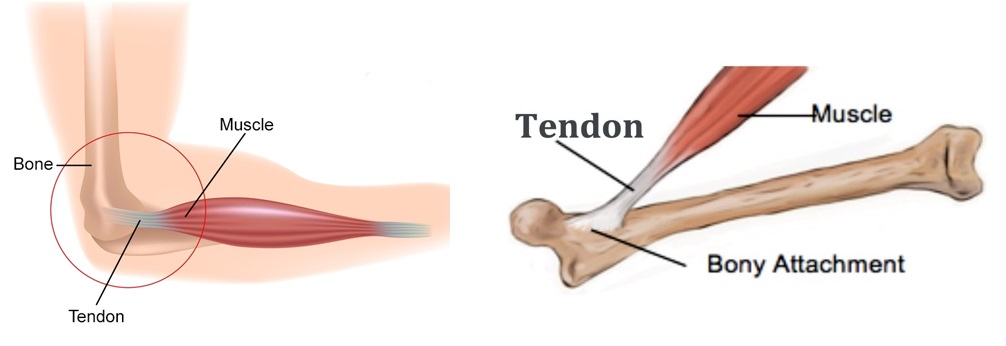
Ligaments sit in a different chain: bone → ligament → bone. A ligament connects one bone directly to another, primarily across a joint, providing passive restraint that helps guide and limit how that joint moves.

That’s the textbook version, and it’s accurate as far as it goes — but it describes where tendons and ligaments are located, not what they actually do mechanically. In practice, both structures do considerably more than simply “connect” two things.
Tendons contribute to:
- Force transmission from muscle to bone
- Enabling joint movement by transferring that force across a joint
- Elastic energy storage and return, in certain tendons far more than others
- Overall muscle-tendon mechanics — how a muscle behaves is inseparable from the tendon it’s attached to
Ligaments contribute to:
- Passive restraint of joint motion, without requiring active muscular effort
- Guiding and limiting movement within a joint’s normal range
- Joint stability, working alongside the joint capsule and muscles crossing that joint
- A sensory and proprioceptive role — ligaments contain mechanoreceptors that feed the nervous system information about joint position and movement
Tendons and ligaments, in other words, are not simply “rope” or “strapping” holding the body together. They’re active, functionally sophisticated tissues — and understanding that is the foundation for everything else in this guide.
2. Tendon vs Ligament: What’s the Difference?
Because this is one of the most commonly searched questions about connective tissue, it’s worth addressing directly and early.

| Feature | Tendon | Ligament |
|---|---|---|
| Primarily connects | Muscle to bone | Bone to bone |
| Main role | Force transmission | Joint restraint/stability |
| Main tissue | Dense, collagen-rich connective tissue | Dense, collagen-rich connective tissue |
| Dominant collagen | Primarily type I | Primarily type I, with a somewhat higher proportion of type III relative to tendon |
| Mechanical demand | Primarily tensile (along one direction of pull) | Tensile, but multidirectional, since ligaments must resist joint motion in several planes |
| Training relevance | Transfers the force your muscles produce into movement | Helps constrain and guide joint motion during that movement |
We already have a detailed article about the differences between the tendon and ligament.
What tendons and ligaments have in common
Comparison articles on the internet tend to stop at the table above and treat tendons and ligaments as two entirely separate materials. The research picture is more interesting than that. Tendons and ligaments share a very similar extracellular matrix composition and overlapping mechanical properties — both are dense, hierarchically organized, collagen-dominant tissues built to resist tension — and are better understood as variations on a structural theme, each shaped by the specific functional demands placed on it, rather than as two fundamentally different materials.
That distinction matters for a lifter. It means the biomechanical concepts you’ll learn in this guide for tendons — stiffness, load-bearing capacity, mechanical adaptation — largely transfer to how you should think about ligaments too, even though the two tissues aren’t identical and the underlying research base isn’t equally developed for both, something we’ll come back to later in this guide.
3. Tendon Anatomy: From Collagen Molecules to the Whole Tendon
To understand how a tendon behaves under load, it helps to see how it’s actually built — not as a single uniform cord, but as a hierarchy of structures nested inside one another.
The organization runs, roughly, from the smallest scale to the largest:
Collagen molecules → fibrils → fibers → fascicles → the whole tendon.

Individual type I collagen molecules — the dominant structural protein in tendon — self-assemble into fibrils, which bundle together into larger fibers, which in turn organize into fascicles. Fascicles are bound together by a thin connective tissue sheath called the endotenon, and the entire tendon is wrapped by an outer sheath, the epitenon. In tendons that experience friction against surrounding tissue, an additional sliding layer called the paratenon or a synovial tendon sheath may also be present.
This isn’t just inert scaffolding. Embedded throughout the tendon are tenocytes (tendon fibroblasts) — living cells that sit within the extracellular matrix and actively sense mechanical load, a property that becomes central later in this guide when we cover how tendons adapt to training. Surrounding the collagen fibers is an extracellular matrix rich in proteoglycans and water, which contributes to the tissue’s ability to resist compressive and shear forces in addition to tension. Under a microscope, healthy tendon collagen also shows a wave-like pattern called crimp — a subtle structural feature that allows the tendon to absorb small amounts of strain before the collagen fibers themselves are pulled taut.
Modern tendon research is explicit on this point: a tendon is not an inert bundle of collagen rope. It’s an organized, biologically active, cell-populated tissue that continuously remodels itself in response to the mechanical environment it experiences (Kjaer, 2004) — a theme this guide returns to repeatedly, because it’s the reason training changes tendon tissue at all.
4. Ligament Anatomy: How Ligaments Are Built for Joint Stability
Ligament structure closely parallels what you just read about tendons, which makes sense given how much the two tissues have in common. But the details differ in ways that reflect what a ligament is actually asked to do.
Like tendons, ligaments are built from densely packed collagen (predominantly type I, with a somewhat higher relative contribution from type III than tendon typically shows), organized into fibers and fascicular bundles, populated by resident cells — fibroblasts, sometimes referred to specifically as ligament cells — that maintain and remodel the surrounding extracellular matrix. Ligament collagen also displays the characteristic crimp pattern seen in tendon, allowing for a small amount of give before the fibers are pulled fully taut.

Where ligament architecture diverges from tendon is in orientation and attachment. Because a ligament typically has to resist forces from more than one direction as a joint moves through its range of motion, ligament fiber bundles are often organized less uniformly in a single direction than tendon fibers are, which tend to align very consistently along the single axis of pull from the muscle they serve. Ligaments also generally have lower vascularity and sparser innervation than many tendons, which is part of why ligament injuries can be slow to heal and why ligament tissue itself is less directly involved in producing the kind of protective sensation (like Golgi tendon organ signaling) that some tendon structures contribute.
It’s worth correcting a common misconception directly: a ligament is not a passive safety strap that only “kicks in” once a joint moves too far. Ligaments are under varying degrees of tension throughout much of a joint’s normal range of motion, not just at its end ranges, and they actively participate in guiding how the joint moves — not merely stopping it once it goes too far. This is why ligament structure is inseparable from joint mechanics generally, a connection covered in depth in our guide to joints in the human body.
5. Where Tendons and Ligaments Attach
Tendons and ligaments don’t simply merge seamlessly into the tissues around them. The points where they attach are specialized, biomechanically distinct zones in their own right — and understanding them explains a lot about why these attachment sites are common trouble spots for lifters.
The myotendinous junction: where muscle meets tendon
The myotendinous junction (MTJ) is the interface where muscle fiber hands off force to tendon. This is a mechanically demanding transition: muscle tissue is soft, contractile, and relatively compliant, while tendon is stiff and largely inextensible by comparison. To manage that mismatch, the muscle cell membrane at the MTJ folds into extensive interdigitations that dramatically increase the surface area over which force is transferred, spreading the load rather than concentrating it at a single weak interface. This is one of the reasons strains — tears at the muscle-tendon interface — are such a common injury pattern; it’s a zone specifically built to manage very high mechanical stress, but it isn’t limitless.
The enthesis: where tendon or ligament meets bone
The enthesis is the attachment site where a tendon or ligament meets bone, and it’s every bit as specialized as the myotendinous junction — arguably more so. Rather than tendon collagen ending abruptly against hard bone (a transition that would concentrate enormous stress at a single point), the enthesis is organized as a structurally continuous gradient from soft, uncalcified tendon tissue through progressively stiffer fibrocartilage and calcified fibrocartilage, before finally reaching bone itself (Benjamin et al., 2006).
Entheses are generally classified into two broad types:
- Fibrous entheses, where tendon or ligament attaches directly (or via the periosteum) to bone without an intervening cartilage zone — more common at attachment sites away from the immediate joint margin.
- Fibrocartilaginous entheses, which show the full graded transition described above, and are typically found close to joints, where the angle between tendon and bone changes throughout the range of motion.
This gradual transition in tissue stiffness exists for a specific mechanical reason: it dissipates stress gradually rather than concentrating it sharply at the boundary between two very differently behaving materials — a general engineering principle, not something unique to the body, but one the body applies elegantly. It’s also precisely why entheses are common sites of overuse injury in lifters (conditions like patellar tendinopathy at the inferior pole of the patella, or lateral epicondyle tendinopathy at the elbow, both originate at or near an enthesis) — these zones are engineered to manage high, repetitive stress, but that doesn’t make them immune to it, particularly when loading changes faster than the tissue can adapt.
The enthesis is also where tendon and ligament anatomy connects directly to skeletal anatomy — worth a look at our guide to the major bones of the skeletal system if you want the fuller picture of what these tissues are actually attaching to.
6. How Tendons Transfer Muscle Force to Bone
This is where the guide shifts from anatomy into biomechanics — and it’s one of the central ideas in understanding how tendons and ligaments actually behave under a loaded bar.
The basic chain of force transmission runs: sarcomere contraction → muscle fiber shortening → tendon → bone → joint torque → movement. But that simplified chain hides something important: a tendon is not a rigid cable. If it were perfectly rigid, all of the force a muscle produced would transfer instantly and without loss — but real tendon deforms under load, and that deformation is central to how the whole system works, not a flaw in it.

A few mechanical concepts are worth understanding here, without getting lost in the math:
- Stress — the force applied to the tendon relative to its cross-sectional area.
- Strain — how much the tendon elongates relative to its resting length under that stress.
- Stiffness — how much force is required to produce a given amount of tendon elongation. A stiffer tendon deforms less for the same force.
- Compliance — essentially the inverse of stiffness: how readily a tendon deforms under a given load.
None of these properties are fixed. They depend on the specific tendon, its cross-sectional area, its collagen organization, and — critically for this guide — how that tendon has been loaded over time through training. We’ll return to stiffness and compliance in more depth shortly, because it’s a property lifters routinely misunderstand.
Coach’s Note: When you add 20 kg to a lift, you’re not simply asking the prime mover to produce more force. The entire force-transmission system — muscle, tendon, and the bone it anchors to — has to manage that increased demand simultaneously. A muscle that’s ready to produce more force doesn’t automatically mean the tendon transmitting that force is equally ready to handle it, which is exactly why progressive loading matters as much for connective tissue as it does for the muscle itself.
For the complete picture of how this force-transmission pathway works — from muscle fiber through connective tissue and tendon to bone — see our dedicated guide to the Muscle-Tendon Unit.
7. How Ligaments Stabilize and Guide Joints
Where tendons transmit force generated by a contracting muscle, ligaments work differently: they provide restraint without needing to be “switched on” by the nervous system.
This maps onto a distinction covered in more depth in our joints in the human body guide: passive stability versus dynamic muscular stability. Ligaments are a primary source of a joint’s passive stability — resisting and guiding motion by virtue of their structure and position, independent of active muscular effort. Muscles crossing that same joint provide dynamic stability, actively adjusting tension moment to moment in response to load and position.
Neither replaces the other. A ligament is not a substitute for muscular control, and muscular control is not a substitute for ligamentous restraint — the two work as a coordinated system, and a deficit in one typically places greater demand on the other.
A few well-known examples illustrate how specific ligaments perform this role, though this guide won’t turn into a regional anatomy breakdown of each — that’s a job for dedicated joint-specific content:
- ACL and PCL at the knee, restraining anterior and posterior tibial translation respectively
- MCL and LCL at the knee, resisting excessive side-to-side (valgus and varus) stress
- Ankle ligaments (such as the anterior talofibular ligament), commonly involved in inversion sprains
- Glenohumeral ligaments, contributing to shoulder stability alongside the labrum and rotator cuff
8. The Muscle-Tendon Unit: Muscle and Tendon Work as a System
What a lifter experiences as “the muscle working” is never really an isolated event happening in muscle fibers alone. Muscle and tendon function as a single mechanical system — the muscle-tendon unit — combining a contractile component (the muscle fibers themselves) with elastic components, primarily the tendon and the connective tissue within the muscle itself.
Because tendon deforms under load rather than staying rigid, it can:
- Store elastic energy as it’s stretched under tension
- Return a significant portion of that energy as it recoils
- Influence how the muscle fascicles behind it are allowed to behave — in some movements, the tendon does much of the lengthening and shortening, while the muscle fascicles themselves stay closer to a constant length
- Meaningfully affect movement economy and performance, particularly in fast, repetitive, or elastic movements like running, jumping, or plyometric training
The Achilles tendon is the textbook example of an energy-storing tendon. Research tracking its mechanical behavior during locomotion has found that tendons can return roughly 90–95% of the elastic strain energy they store during recoil, making the gastrocnemius-Achilles muscle-tendon unit remarkably efficient at reusing mechanical energy rather than requiring the muscle to generate it fresh with every stride or jump (Finni & Vanwanseele, 2023). Not every tendon is built for this role to the same degree — different tendons across the body show different functional specializations, with some prioritizing energy return and others prioritizing precise, minimally compliant force transmission.
9. Tendon Stiffness vs Compliance: Why Both Matter
This is a property lifters and even some coaches routinely oversimplify, so it’s worth being precise about it: a stiffer tendon is not automatically a healthier tendon, and a more compliant tendon is not automatically a weaker one.
Stiffness and compliance are mechanical properties, not health markers on their own. What matters is how well a given tendon’s mechanical behavior matches the demands placed on it. A stiffer tendon transmits force more directly and with less energy lost to deformation — useful in movements that prioritize precise, rapid force transmission. A more compliant tendon deforms more under a given load, which can be advantageous in movements that benefit from elastic energy storage and return, or from a degree of “give” that protects muscle fibers from excessively rapid stretch.
The relationship between tendon stiffness and outcomes lifters care about is genuinely nuanced:
- Higher tendon stiffness is generally associated with more efficient transmission of force for maximal strength expression
- Lower stiffness (greater compliance) can benefit certain power and elastic movements by allowing more effective energy storage and return
- Rate of force transmission — how quickly force reaches the skeleton — is influenced by stiffness, which matters for movements requiring rapid force development
- The “ideal” stiffness genuinely depends on the movement type and goal, not a single universal target
Resistance training does change tendon stiffness. A systematic review and meta-analysis of exercise intervention studies found that mechanical loading consistently produced increases in tendon stiffness across a wide range of training protocols, though the magnitude varied considerably depending on the specific loading conditions used — intensity, contraction duration, and training frequency all influenced the outcome (Bohm, Mersmann & Arampatzis, 2015).
Coach’s Note: In strength training, “stiffer” should not automatically be read as “better.” The useful mechanical properties of a tendon depend partly on what that tendon is being asked to do — a powerlifter’s Achilles and a sprinter’s Achilles are being trained toward somewhat different mechanical priorities, even though both are training the same tissue with the same basic loading principles.
10. How Tendons and Ligaments Sense Mechanical Load
None of the adaptations this guide covers next happens by magic — it happens because tendon and ligament tissue can actually detect mechanical loading at the cellular level and respond to it. This process is called mechanotransduction.
The basic sequence runs: mechanical loading → cellular signaling → matrix remodeling. When a tendon or ligament is loaded, the resident cells — tenocytes in tendon, fibroblasts in ligament — experience that mechanical stress through their connection to the surrounding extracellular matrix. Cell-surface structures called integrins are strongly implicated in sensing this tension, triggering intracellular signaling cascades that ultimately influence gene expression related to collagen synthesis and matrix remodeling (Kjaer, 2004). In simple terms: mechanical loading gets translated into a biological instruction to adapt the tissue.
This is the mechanistic answer to a question lifters rarely think to ask: your tendon doesn’t know that you performed “3 sets of 8.” It has no concept of sets, reps, or training programs. It responds to the mechanical environment those repetitions actually created — the magnitude of load, the duration under tension, the rate of loading, and how consistently that stimulus was repeated over time. Two different training programs that create a similar mechanical loading profile on a given tendon can produce broadly similar adaptive signals, even if the rep schemes on paper look completely different — and, just as importantly, a program that never creates a sufficient mechanical stimulus won’t drive meaningful tendon adaptation no matter how much muscular fatigue it produces.
That distinction — between what a program looks like on paper and what mechanical signal it actually delivers to connective tissue — is exactly the bridge into how tendons and ligaments adapt to resistance training, which is where this guide turns next.
11. How Tendons Adapt to Resistance Training
Given everything covered so far — tendon as a living, mechanically responsive tissue rather than inert rope, capable of sensing load and remodeling in response — the natural next question is what that adaptation actually looks like.

Several distinct properties can change with training:
- Stiffness — as covered above, tendon stiffness reliably increases in response to sufficiently high mechanical loading
- Material properties — the intrinsic quality of the tissue itself, independent of size, such as its elastic modulus
- Collagen turnover and remodeling — the ongoing synthesis and breakdown of collagen that underlies structural adaptation
- Cross-sectional area — tendon can modestly hypertrophy, though this response is generally smaller and less consistent than the stiffness response
- Overall mechanical behavior — how the tendon deforms and recovers under a given load profile
It’s worth being direct about a myth that circulates in strength training circles: “tendons get stronger exactly like muscles do.” They don’t. Tendon adaptation is real, well-documented, and meaningfully influenced by training — a systematic review and meta-analysis of exercise intervention studies confirmed that mechanical loading consistently increases tendon stiffness across a wide range of protocols (Bohm, Mersmann & Arampatzis, 2015) — but it follows a different mechanism, timeline, and dose-response relationship than skeletal muscle hypertrophy.
What actually drives the size and nature of that adaptive response depends on several factors working together, not any single one in isolation: the magnitude of load, the strain it produces in the tendon, the duration the tendon spends under tension per repetition, the frequency of loading sessions, the individual’s training history, their age, and — importantly — which specific tendon is being examined, since different tendons in the body don’t necessarily respond identically to a comparable relative stimulus.
12. How Ligaments Respond to Mechanical Loading
Here, this guide has to be more careful than it was with tendon adaptation — not because ligament tissue is fundamentally different in its basic biology, but because the human research base behind ligament training adaptation is considerably thinner than what exists for tendon.
What can be said with reasonable confidence: ligament tissue is mechanically responsive. Like tendon, it contains cells capable of sensing load and initiating remodeling, and changes in loading — whether increased mechanical stress or immobilization — do measurably alter ligament mechanical properties. Consistent, appropriate loading tends to support or restore ligament tissue quality, while unloading and immobilization tend to have the opposite effect, reducing tissue mass and mechanical competence over time.
Where the picture gets genuinely uncertain is human resistance-training data specifically. A systematic review examining whether mechanical loading restores ligament biomechanics after injury found that the vast majority of controlled evidence on this question comes from animal models, not humans — the review identified only two human studies providing indirect support for the idea that ligaments hypertrophy in response to mechanical loading, and both relied on cross-sectional imaging rather than direct mechanical testing (Bleakley & Netterström-Wedin, 2023).
That’s an important caveat to state plainly rather than paper over: we should not simply borrow tendon evidence and apply it to ligaments as if the two tissues had been studied to the same standard. The underlying biology is closely related, and it’s reasonable to expect broadly similar principles apply — but the direct human evidence supporting specific ligament training claims is meaningfully thinner than what backs the tendon adaptation section above, and a rigorous guide should say so rather than implying otherwise.
13. Do Muscles Adapt Faster Than Tendons and Ligaments?
This is one of the biggest practical questions a lifter can ask about connective tissue, and it deserves a real answer rather than the oversimplified version that circulates online: “muscles grow in weeks, tendons take months.”
That version isn’t exactly wrong, but it flattens something considerably more layered. A few distinct processes are happening on different timelines:
- Neural adaptations — improvements in motor unit recruitment and coordination — can produce meaningful strength gains within the first few weeks of a new training stimulus, often before any measurable structural change has occurred anywhere in the system
- Muscle hypertrophy has its own timeline, generally becoming measurable over weeks to a few months of consistent training
- Tendon structural and material adaptation — the stiffness and collagen remodeling changes covered above — generally proceeds on a longer timeline than muscle hypertrophy, and research specifically comparing muscle and tendon adaptation has documented that these two tissues can develop at meaningfully different rates within the same training program, creating periods where muscle capacity outpaces tendon adaptation (Mersmann, Bohm & Arampatzis, 2017)
- Ligament adaptation data, as covered in the previous section, is even less clearly mapped in humans specifically
The central coaching message that falls out of this isn’t a specific number of weeks to memorize — it’s a principle:
The fact that you can lift more weight does not automatically mean every tissue involved has increased its load capacity by the same amount. Strength gains driven primarily by neural adaptation, in particular, can outpace connective tissue adaptation considerably, especially early in a training block or after a return from a layoff.
14. Progressive Overload Isn’t Just for Muscle
This is the payoff section — where everything covered so far turns into something you can actually apply the next time you’re planning a training block.
Most lifters think about progressive overload in a fairly narrow way: more weight → more reps → more muscle. That’s not wrong, but it’s incomplete. A more accurate framing, given everything this guide has covered: more load means greater demand on the entire musculoskeletal system — muscle, tendon, ligament, and bone simultaneously, each adapting on its own timeline.
That reframing has practical consequences worth building into how you plan training, particularly around a few recurring risk periods:
- Gradual progression generally gives every tissue in the system a reasonable chance to keep pace with increasing demand, rather than letting the fastest-adapting tissue (typically neural drive, then muscle) race ahead of the slowest.
- Sudden load spikes — a big jump in weight, volume, or intensity within a short window — are a recurring theme in how overuse issues develop, precisely because they can outrun what connective tissue has had time to adapt to.
- Training after layoffs deserves particular caution. Strength — especially neurally-driven strength — can return faster than tendon and ligament properties that detrained during the time off, creating a mismatch between what a lifter feels capable of and what their connective tissue is actually prepared to handle.
- Beginners are progressing every system at once for the first time, which is generally favorable, but rapid early neural strength gains can still outpace tendon adaptation if loading is increased too aggressively too soon.
- Returning lifters — coming back from time off, whether from injury, illness, or simply life — often retain more strength than their connective tissue “remembers,” which is a version of the same layoff problem above.
- Rapid strength gains from any source (a new program, a change in technique efficiency, resumed use of certain compound lifts) deserve the same caution — a fast jump in what you can lift is not, by itself, evidence that every supporting tissue adapted at the same pace.
- Volume and intensity interact — very high volume at moderate loads and lower volume at very high loads can both represent meaningful mechanical stimuli to connective tissue, and neither is automatically “safer” without considering the full loading picture.
None of this amounts to a guarantee that following these principles will prevent injury — connective tissue adaptation is one piece of a much larger picture that includes technique, recovery, individual anatomy, and training history. But respecting the different adaptation timelines of muscle, tendon, and ligament is a meaningfully different — and more defensible — approach to progressive overload than simply chasing numbers on the bar as fast as strength allows.
15. Training for Strong, Resilient Tendons and Ligaments
Everything in this guide leads here: what does it actually mean to train in a way that respects tendon and ligament biology?
It’s worth resisting the temptation toward false precision. You’ll sometimes see claims along the lines of “4 sets of 6 at 80% builds tendons” stated as if it were a settled protocol. It isn’t — the research covered throughout this guide shows real variation in what stimulates tendon adaptation, and even less certainty for ligament-specific protocols. What’s more defensible is a set of evidence-grounded principles, along with the reasoning behind each one.

- Load them regularly. Tendon and ligament tissue is mechanosensitive — it needs a consistent mechanical stimulus to maintain and improve its properties, the same underlying logic covered in the mechanotransduction section above.
- Progress loading gradually. Because connective tissue generally adapts more slowly than the neural and muscular systems driving your strength gains, gradual progression gives every tissue in the chain a reasonable chance to keep pace with increasing demand.
- Use meaningful mechanical tension. Based on the tendon adaptation research covered earlier, sufficiently high loading magnitude appears to matter for driving stiffness and material adaptations — training that never creates real mechanical strain in a tendon is unlikely to meaningfully adapt it, regardless of training volume.
- Train through an appropriate, controlled range of motion. Consistent with the joint training principles covered in our companion guide, tendons and ligaments benefit from experiencing load across the ranges they’ll actually be asked to perform in, rather than only in a narrow, protected range.
- Don’t ignore long layoffs. As covered above, connective tissue readiness doesn’t necessarily track strength on the way back from time off — treat a return to training as a genuine ramp-up period, not simply picking up where you left off.
- Manage sudden workload changes. Rapid jumps in load, volume, or training frequency are a recurring theme in how overuse issues develop, precisely because they can outrun connective tissue’s adaptive capacity.
- Build muscular strength around joints. Since dynamic, muscular stability works alongside the passive stability ligaments provide (as covered in section 7), strengthening the muscles crossing a joint is itself a meaningful contributor to that joint’s overall resilience.
- Allow sufficient recovery. Tendon and ligament remodeling is an ongoing biological process that requires adequate time between loading sessions to actually occur — training stimulus without adequate recovery is an incomplete half of the adaptation equation.
16. Tendon and Ligament Injuries: Know the Difference
This guide has been about healthy anatomy and training adaptation from the beginning, and it’s worth being explicit about staying inside that lane here, briefly, before closing.
Tendon injuries generally fall into two broad categories: tendinopathy (a broad term covering persistent, overuse-related tendon pain and dysfunction, distinct from an acute tear) and strain or tear (a more acute disruption of tendon tissue, ranging from partial to complete).
Ligament injuries are typically described as sprains, graded by severity from mild stretching (Grade I) through partial tearing (Grade II) to complete rupture (Grade III).
That’s as far as this guide goes on the topic. This article explains healthy anatomy and training adaptation — injury diagnosis and rehabilitation require a different level of assessment than a general anatomy guide can responsibly provide. If you’re dealing with a suspected tendon or ligament injury, that’s a conversation for a qualified clinician, not a self-diagnosis exercise. For general injury-prevention content relevant to lifters, see our weight lifting injuries content.
17. Tendons, Ligaments and Aging
A brief note on aging is worth including here, given how relevant it is to a lifting population that increasingly trains well past 40 and 50.
Tendon tissue changes with age in fairly consistent ways. Research examining leg extensor tendons in older adults has found reductions in tendon stiffness and elastic modulus with age — changes driven predominantly by alterations in the material properties of the tendon itself, rather than a straightforward loss of tendon size (McCrum et al., 2018). This tracks with broader patterns of reduced collagen turnover and declining physical activity that often accompany aging, both of which can compound the effect.
The genuinely encouraging finding from that same research is this: aging tendons appear to retain their mechanosensitivity — meaning they remain capable of responding adaptively to mechanical loading even in older age, rather than losing that capacity entirely. Continued, appropriately dosed loading remains a meaningful lever for older lifters, not something that stops mattering past a certain age.
This isn’t an anti-aging pitch, and it shouldn’t be read as a promise that training reverses every age-related change. It’s simply this: the same core principle running through this entire guide — that tendons and ligaments are living tissue that responds to mechanical loading — continues to apply as you get older, even as baseline properties shift.
Key Takeaways
- ✓Tendons transmit muscular force to bone; ligaments primarily stabilize and guide joint motion — different roles built from closely related tissue.
- ✓Both are living, mechanically responsive connective tissues — not inert straps — capable of sensing load and remodeling in response to it.
- ✓Their collagen-rich structure gives both high tensile capacity, but their mechanical behavior and fiber organization differ according to the specific demands of their function.
- ✓Tendon stiffness and compliance are functional properties matched to a tendon’s specific role, not simple markers of “good” or “bad” tissue quality.
- ✓Resistance training affects far more than muscle — tendons and ligaments also respond to repeated mechanical loading, on their own distinct timelines.
- ✓Progressive overload should respect the capacity of the entire musculoskeletal system, not just what the prime movers are capable of lifting.
References
- Kjaer, M. (2004). Role of extracellular matrix in adaptation of tendon and skeletal muscle to mechanical loading. Physiological Reviews, 84(2), 649–698. https://doi.org/10.1152/physrev.00031.2003
- Benjamin, M., Toumi, H., Ralphs, J. R., Bydder, G., Best, T. M., & Milz, S. (2006). Where tendons and ligaments meet bone: attachment sites (‘entheses’) in relation to exercise and/or mechanical load. Journal of Anatomy, 208(4), 471–490. pubmed.ncbi.nlm.nih.gov/16637873
- Finni, T., & Vanwanseele, B. (2023). Towards modern understanding of the Achilles tendon properties in human movement research. Journal of Biomechanics, 152, 111583. https://doi.org/10.1016/j.jbiomech.2023.111583
- Bohm, S., Mersmann, F., & Arampatzis, A. (2015). Human tendon adaptation in response to mechanical loading: a systematic review and meta-analysis of exercise intervention studies on healthy adults. Sports Medicine – Open, 1(1), 7. https://doi.org/10.1186/s40798-015-0009-9
- Bleakley, C., & Netterström-Wedin, F. (2023). Does mechanical loading restore ligament biomechanics after injury? A systematic review of studies using animal models. BMC Musculoskeletal Disorders, 24, 511. https://doi.org/10.1186/s12891-023-06653-x
- Mersmann, F., Bohm, S., & Arampatzis, A. (2017). Imbalances in the development of muscle and tendon as risk factor for tendinopathies in youth athletes: A review of current evidence and concepts of prevention. Frontiers in Physiology, 8, 987. https://doi.org/10.3389/fphys.2017.00987
- McCrum, C., Leow, P., Epro, G., König, M., Meijer, K., & Karamanidis, K. (2018). Alterations in leg extensor muscle-tendon unit biomechanical properties with ageing and mechanical loading. Frontiers in Physiology, 9, 150. https://doi.org/10.3389/fphys.2018.00150
What is the difference between a tendon and a ligament?
A tendon primarily connects muscle to bone, while a ligament primarily connects bone to bone. That simple distinction reflects their different mechanical roles. Tendons transmit muscular force to the skeleton so that joints can move, while ligaments help guide joint motion and resist excessive movement.
Both are collagen-rich connective tissues composed predominantly of type I collagen, but their structure is organized according to the forces they normally experience. For lifters, this means stronger muscles alone do not determine how the musculoskeletal system handles a heavier squat, press, or deadlift—the tendons transmitting force and the structures stabilizing the joints also matter.
Do tendons and ligaments get stronger with exercise?
Tendons clearly adapt to repeated mechanical loading, including resistance training. Research has documented changes in tendon stiffness, material properties and, to a smaller degree, cross-sectional area after chronic loading.
Ligaments are also biologically responsive to mechanical loading, but direct human resistance-training evidence is much more limited. Therefore, it is reasonable to say that both tissues can remodel in response to their mechanical environment, but we should not assume that ligaments respond to lifting in exactly the same way or at the same rate as tendons.
For lifters, the practical principle is simple: progressive loading trains more than muscle.
How long do tendons take to adapt to strength training?
There is no universal number of weeks after which a tendon becomes “adapted.” Tendon responses depend on the tendon being studied, training history, loading magnitude and duration, age, exercise selection and other factors.
Measurable changes in tendon mechanical properties have been observed over weeks to months of consistent training, while structural remodeling can continue over longer periods. This is one reason lifters should not assume that rapid increases in muscular strength mean every load-bearing tissue has adapted equally quickly.
Think in terms of consistent progressive exposure over months, rather than searching for a specific day when your tendons have “caught up.”
Do muscles grow stronger faster than tendons?
Muscle strength and tendon mechanical properties do not necessarily adapt in parallel. Early strength gains can occur relatively quickly because of neural adaptations, while muscle hypertrophy and tendon remodeling follow their own time courses.
Research in some athletic populations has documented periods in which muscular strength and tendon mechanical properties develop at different rates. That does not mean there is a universal formula such as “muscle takes X weeks and tendon takes Y months.”
The training implication is more useful than an arbitrary timeline: being able to lift more weight does not automatically mean every tissue involved has increased its load capacity by the same amount.
Can you strengthen tendons with weight training?
Yes. Progressive resistance training is one of the mechanical stimuli capable of producing tendon adaptation. Consistent loading can increase tendon stiffness and alter material properties, with smaller changes sometimes occurring in tendon size.
However, tendons do not need a magical “tendon exercise.” They respond to the mechanical demands created when muscles produce force through them. Heavy resistance training can provide a strong stimulus, but appropriate loading depends on the tendon, exercise, training goal and individual.
For a healthy lifter, the broader principle is regular, progressive and well-managed loading, not trying to isolate every tendon in the body.
Do ligaments get stronger from lifting weights?
Ligaments are living connective tissues capable of remodeling in response to mechanical loading, but we have much less direct human evidence showing how ordinary resistance training changes ligament mechanical properties than we have for tendons.
This distinction matters. Tendon research should not simply be copied and presented as ligament research.
Resistance training can nevertheless improve the dynamic muscular stability surrounding a joint, while ligaments contribute passive restraint and sensory information. In practice, building strong muscles and good neuromuscular control around a joint complements—but does not replace—the structural role of its ligaments.
Why do tendons and ligaments heal more slowly than muscles?
Tendons and ligaments generally have lower metabolic activity and more limited vascularity than skeletal muscle, although blood supply varies considerably between tissues and regions. Their extracellular matrix is also dominated by densely organized collagen that must be synthesized, reorganized and remodeled during repair.
That makes healing a much more complex process than simply “sending more blood” to the injured area. Significant tendon or ligament injuries can therefore require prolonged biological remodeling even after pain decreases or basic function returns.
For lifters, an important distinction follows: feeling better is not necessarily the same thing as complete tissue recovery.
Are tendons elastic, or are they stiff?
They are both. A tendon is mechanically stiff enough to transmit substantial muscular force, yet it can also deform under load and return toward its original length when that load is removed.
Different tendons are specialized for different functions. Long energy-storing tendons such as the Achilles can store and return elastic strain energy during running and jumping, while other tendons function more heavily toward force transmission and positional control.
This is why “stiffer” does not automatically mean “better.” The useful balance between stiffness and compliance depends partly on the tendon and the movement it is required to perform.
What type of collagen are tendons and ligaments made of?
Type I collagen is the predominant collagen in healthy tendons and ligaments. Its densely organized fibers provide the high tensile strength these tissues need to withstand pulling forces.
Other collagen types and extracellular-matrix components are also present and contribute to tissue organization and mechanical behavior. This is different from articular cartilage, where type II collagen is the predominant collagen type.
For lifters, collagen is not merely structural “packing.” Its organization is fundamental to how tendons transmit force and how ligaments resist and guide joint motion.
How can lifters build stronger, more resilient tendons and ligaments?
There is no single exercise or loading trick that makes every tendon and ligament “bulletproof.” A better strategy is to build tissue capacity progressively over time.
Use consistent resistance training, increase loads and volume gradually, train through controlled and appropriate ranges of motion, maintain muscular strength around the joints, and be particularly careful with sudden workload increases after layoffs. Recovery also matters because connective-tissue adaptation occurs between repeated exposures to training, not during a single workout. Current sports guidance similarly emphasizes progressive strength loading rather than a special isolated exercise for all connective tissues.
Most importantly, don't confuse resilience with invulnerability. The goal is not to eliminate stress from tendons and ligaments. The goal is to progressively develop the capacity to tolerate the stresses your training requires.
