



We know muscles get bigger and stronger when we lift weights. Bones also adapt to mechanical loading, as covered in our guide to joints in the human body. But what happens to the tendons connecting those muscles to bone? Do they actually get stronger too?
They do adapt — but not in the same way, and not necessarily at the same speed, as muscle. That distinction is the core of everything this guide covers.
Quick Answer
Yes. Tendons adapt to progressive mechanical loading from resistance training. These adaptations can include increased tendon stiffness, changes in material properties such as Young’s modulus, and smaller increases in tendon cross-sectional area. Unlike skeletal muscle, however, tendon adaptation is driven less by large increases in tissue size and more by changes in the mechanical and material properties of the tendon. The magnitude of tendon strain appears particularly important for stimulating adaptation.
1. What Does a Tendon Actually Do During Lifting?
This guide won’t re-derive the full anatomical picture here — that’s covered in depth in our Tendons and Ligaments guide, and our dedicated guide to the tendon’s place within the broader connective tissue family. A quick refresher: muscle contracts, the tendon transmits that force, and bone moves as a result.
But a tendon is not simply a rigid cable passively relaying force. It elongates measurably under force, transmits that force to bone, and — particularly in certain tendons — stores and releases elastic energy as part of normal movement. In vivo human research has directly demonstrated meaningful tendon lengthening during active loading, underscoring that tendons are dynamic, deformable structures actively participating in movement mechanics, not fixed, inert connectors.

2. What Does “Stronger Tendons” Actually Mean?
This is worth addressing directly, because “strong tendon” isn’t one single physiological variable — treating it as one leads to confused expectations.
Several distinct properties get lumped under that phrase:
- Tendon stiffness — how much the tendon deforms in response to a given force. Higher stiffness means less deformation per unit of force.
- Young’s modulus — a material property describing the tendon material’s inherent stiffness, independent of the tendon’s size.
- Cross-sectional area (CSA) — the physical size of the tendon.
- Ultimate strength/failure properties — how much force the tissue can tolerate before failing, which isn’t something that can simply be extrapolated from typical human training studies for ethical and practical reasons.
A tendon becoming better adapted to load does not necessarily mean it simply becomes much larger, the way a muscle does. Keeping these variables distinct matters for understanding what actually changes with training—and, as later sections cover, why “stronger” isn’t quite the right word for some of what happens.
3. How Does Strength Training Change Tendons?
A comprehensive, recent meta-analysis pooling 61 studies and 763 participants — with resistance training as the dominant intervention type across 49 of those studies — found that mechanical loading produced moderate increases in tendon stiffness (SMD 0.74), large increases in Young’s modulus (SMD 0.82), and only small increases in cross-sectional area (Lazarczuk et al., 2022).
The pattern worth internalizing: stiffness and modulus — the mechanical and material properties — change considerably more than tendon size does. Training doesn’t primarily make tendons bigger; it primarily makes the existing tendon tissue mechanically stiffer and materially different.
4. Tendon Stiffness: Is a Stiffer Tendon Better?
Worth clearing up a semantic mix-up immediately: tendon stiffness does not mean your body feels “stiff.” Mechanical stiffness is a specific engineering concept describing the relationship between force and elongation — how much a structure deforms under a given load. It has nothing to do with the subjective sensation of tightness people describe after a hard training session or a long car ride.
Greater tendon stiffness can allow more efficient force transmission — less energy lost to tendon deformation before that force reaches the joint it’s acting on. But more stiffness is not automatically better, or infinitely better. Optimal mechanical behavior depends heavily on the specific function and activity involved — a topic this guide returns to later. It would be a mistake to conclude “stiffer tendon equals healthier tendon” as a blanket rule; the evidence doesn’t support that simple equation.
5. Do Tendons Get Bigger Like Muscles?
Yes, tendons can increase their cross-sectional area — but the magnitude of that change is considerably smaller than what happens with muscle hypertrophy, and it’s worth being precise about that gap rather than letting “tendons can grow” imply something closer to what muscle does.
The same meta-analysis above found CSA increases were modest compared with the much larger changes in stiffness and modulus (Lazarczuk et al., 2022). Picture the contrast this way:
Muscle adaptation — 💪 visible, substantial hypertrophy is a well-established, expected outcome of resistance training.
Tendon adaptation — ⚙️ disproportionately mechanical and material changes, with size change playing a distinctly smaller role.
If your mental model of “tendon getting stronger” is “tendon gets visibly bigger, like a muscle,” you need to update it. The tendon adapts — just mostly through changes you can’t see by looking at it.
6. How Does Tendon Remodeling Work?
The basic biological pathway: mechanical loading is sensed by tendon cells (tenocytes) through mechanotransduction, which triggers signaling within the extracellular matrix, which in turn drives collagen synthesis and ongoing matrix turnover — the same mechanotransduction concept covered in our Tendons and Ligaments guide and referenced throughout this connective tissue series (Kjaer, 2004).
It’s worth being careful with the word “remodeling” here, though, since it can create a misleading picture. This doesn’t mean the tendon completely rebuilds itself after every training session, the way that phrase might suggest. Turnover within the mature tendon core can be genuinely slow — but that doesn’t mean nothing is happening. Exercise can stimulate collagen synthesis and other biological responses well before those changes translate into measurable shifts in the tendon’s mechanical properties.
7. What Type of Loading Builds Stronger Tendons?
This is where the evidence gets genuinely useful for programming decisions, and it deserves a precise answer rather than a vague one.
Loading magnitude matters. Systematic reviews of tendon adaptation research consistently point to the magnitude and strain of the mechanical loading as a key driver of adaptation. That doesn’t mean this guide will hand you a specific percentage — something like “87.5% of 1RM is optimal” — because the evidence doesn’t support that level of precision as a universal prescription. What can be said with confidence: tendons generally require a sufficiently strong mechanical stimulus; simply moving the joint through its range is not equivalent to providing an adaptation-producing tendon load.
8. Heavy vs Light Resistance Training for Tendons
The evidence here genuinely favors sufficiently high tendon strain — but with an important technical caveat worth understanding, not skipping over.
A meta-analysis directly comparing loading intensities found that interventions using contraction intensities above 70% of maximal voluntary contraction (or 1RM) produced a substantially larger effect on tendon stiffness (SMD 0.90) than interventions using lower intensities (SMD 0.04, not statistically significant) (Bohm, Mersmann & Arampatzis, 2015). That’s a meaningfully large gap favoring higher-intensity loading.
Here’s the caveat: external load does not perfectly equal tendon strain. The strain a tendon experiences depends not just on the weight on the bar, but on the muscle force required to move it, the joint angle throughout the movement, the moment arm at that joint angle, and the exercise’s specific mechanics. This guide won’t oversimplify this into “heavy weights always strengthen tendons more” as a blanket rule — the relationship between external load and actual tendon strain is genuinely more complex than that shorthand implies, even though the general direction (higher strain tends to favor greater adaptation) is well supported.
9. Eccentric vs Concentric vs Isometric: Does Contraction Type Matter?
Popular fitness content has treated eccentric training as something close to tendon magic for years. The evidence doesn’t support that framing.
The same meta-analysis covered in section 8 examined contraction type as a potential moderator of tendon stiffness adaptation and found it was not a significant factor — loading intensity mattered, but whether the loading was applied through eccentric, concentric, or isometric contraction did not significantly change the stiffness adaptation observed (Bohm, Mersmann & Arampatzis, 2015).
Eccentric loading is a valid strategy. Isometric loading is a valid strategy. Combined concentric/eccentric resistance training is a valid strategy. The tendon responds to the mechanical stimulus — not to an exercise label. None of these approaches holds an evidence-supported monopoly on tendon adaptation; what matters more is whether the loading involved provides a sufficient mechanical stimulus in the first place.
10. How Long Do Tendons Take to Get Stronger?
Worth resisting the appeal of a single clean number here — there isn’t one that applies universally, and this guide won’t pretend otherwise.
That said, the general timeline direction is reasonably consistent across the literature. Longitudinal studies show measurable tendon adaptations occurring over weeks to months of consistent training, and the meta-analysis covered earlier in this guide found a trend toward larger effect sizes specifically in interventions lasting 12 weeks or longer, compared to shorter interventions (Bohm, Mersmann & Arampatzis, 2015). Think months, not workouts. That’s the most defensible practical framing this evidence supports — tendon adaptation is a genuinely gradual process, not something that shifts meaningfully across a handful of sessions.
11. Do Muscles Get Stronger Faster Than Tendons?
This might be the most practically important question in this entire guide, and it deserves careful framing rather than a tidy, universal-sounding answer.
Muscle can increase its capacity relatively quickly through improved neural output and strength gains, eventually followed by measurable hypertrophy. Tendon adaptation, as covered throughout this guide, can follow a different time course — driven by different biological mechanisms, responding to different aspects of the loading stimulus. This creates a genuine possibility worth taking seriously: muscular capacity can rise faster than tendon adaptation keeps pace with, at least in some training contexts.
It’s worth being careful not to overstate this into a fixed, universally proven timing formula, though — the honest version is simply that muscle and tendon do not necessarily adapt at the same rate or to the same training stimulus. This has real practical relevance for beginners experiencing rapid early strength gains, lifters returning to training after a layoff, and athletes using performance-enhancing strategies that can further accelerate muscular strength gains relative to connective tissue adaptation.
12. Why Rapid Strength Gains Can Challenge Tendons
This section naturally bridges to a topic covered in far more depth in our tendinopathy guide.
The basic scenario: strength rises, often driven substantially by neural and muscular adaptation happening on a faster timeline than tendon adaptation. Training load rises accordingly, since a stronger lifter naturally progresses to heavier weights. Tendon exposure to load rises along with it. If that progression outpaces the tendon’s current capacity to adapt, the tendon can end up under more demand than it’s currently prepared to tolerate.
It’s important to be precise about what this does and doesn’t mean: this isn’t a claim that strength gains directly cause tendinopathy as some kind of inevitable outcome. It describes one plausible mechanism behind the load-capacity mismatch covered in depth in our tendinopathy guide — relevant context, not a scare story about the dangers of getting stronger.
13. Does Bodybuilding Training Strengthen Tendons?
Yes — resistance training used specifically for hypertrophy purposes can absolutely provide a tendon-loading stimulus, and this deserves direct confirmation for a bodybuilding-focused audience.
But adaptation depends on the actual mechanical stimulus involved, not simply on which broad training category the work falls into. The relevant question isn’t really “8–12 reps versus 3–5 reps” as competing camps—it’s the tendon loading and strain a given approach actually produces. This is a genuine differentiator worth stating plainly: bodybuilding-style training isn’t somehow disconnected from tendon adaptation just because its primary goal is muscular hypertrophy rather than tendon-specific outcomes.
14. Do Tendons Adapt to High-Rep Training?
Reasonably well, though reps alone aren’t the cleanest way to think about tendon stimulus.
Twenty repetitions performed with relatively low tendon force isn’t necessarily equivalent, from a tendon-loading perspective, to six controlled repetitions performed with substantially higher tendon force — but total loading exposure across a session also carries genuine context that a simple rep-count comparison misses. The evidence doesn’t support declaring one universal “best” rep range specifically for tendon health, separate from everything else this guide has already covered about loading magnitude and strain.
15. What Happens to Tendons During Detraining?
A genuinely practical question, since every lifter eventually faces a period away from training.
Reduced mechanical stimulus during detraining can influence tendon properties and capacity over time—relevant during injury layoffs, extended vacations, illness, or simply months away from consistent lifting. The coaching point worth internalizing: your previous working weights may return faster than your tolerance for immediately repeating your old training volume. Muscle memory and neural recall can bring strength back quickly. Tendon capacity that declined during time off doesn’t necessarily rebound on the same accelerated timeline — a genuine mismatch worth respecting when returning to training after a break.
16. Do Tendons Still Adapt as You Get Older?
Yes — and this deserves clear confirmation, since it’s directly relevant to an aging lifter population that might otherwise assume otherwise.
Aging does change tendon biology and baseline mechanical properties, but that’s a different claim than “old tendons cannot adapt.” The comprehensive meta-analysis covered throughout this guide specifically examined whether the magnitude of tendon adaptation differs between age groups, finding that positive tendon adaptations occurred across different age groups studied, even though the magnitude of that adaptation can vary (Lazarczuk et al., 2022). Tendons remain genuinely capable of responding to training loading later in life — the capacity to adapt doesn’t simply disappear at some threshold age.
17. Can Tendons Become Too Stiff?
A more advanced question, and one where “more stiffness equals always better” genuinely breaks down as a rule.
The muscle-tendon system requires a working balance between force transmission, elastic energy storage and return, and the specific movement demands of whatever activity is being performed. What counts as optimal tendon stiffness for one context doesn’t necessarily transfer to another — a bodybuilder, a sprinter, and a distance runner have genuinely different mechanical demands placed on their tendons, and “stiffer is better” doesn’t hold uniformly across all three contexts. This is a case where the right answer depends on the specific goal, not a universal target.
18. Does Stretching Make Tendons More Flexible?
Worth separating two things that get conflated constantly: range of motion/flexibility and tendon mechanical properties are not the same thing.
Increased range of motion following a stretching program doesn’t simply mean “the tendon became looser” in a straightforward structural sense. Recent evidence on stretching mechanisms suggests that range-of-motion improvements are explained mainly by increased stretch tolerance and reduced perceived stiffness, without requiring measurable structural changes in muscle fascicle length—a similar principle likely applies to how flexibility gains relate to tendon tissue specifically (Ingram et al., 2025). Improved flexibility after stretching is a real, meaningful outcome — it just isn’t good evidence that the tendon itself has been structurally “loosened.”
19. Can Supplements Strengthen Tendons?
Briefly, since this guide won’t turn into a supplement review here.
Collagen and gelatin supplementation, along with vitamin C, represent a genuinely active area of nutrition research related to connective tissue physiology. But the honest summary is straightforward: no supplement substitutes for progressive mechanical loading. Where nutrition evidence for tendon-specific outcomes remains less robust or less directly applicable to general training contexts, this guide won’t overstate what it actually supports. Supplements might play a supportive role within a broader picture — they aren’t the mechanism driving the adaptations covered throughout this guide.
20. How to Train for Stronger Tendons
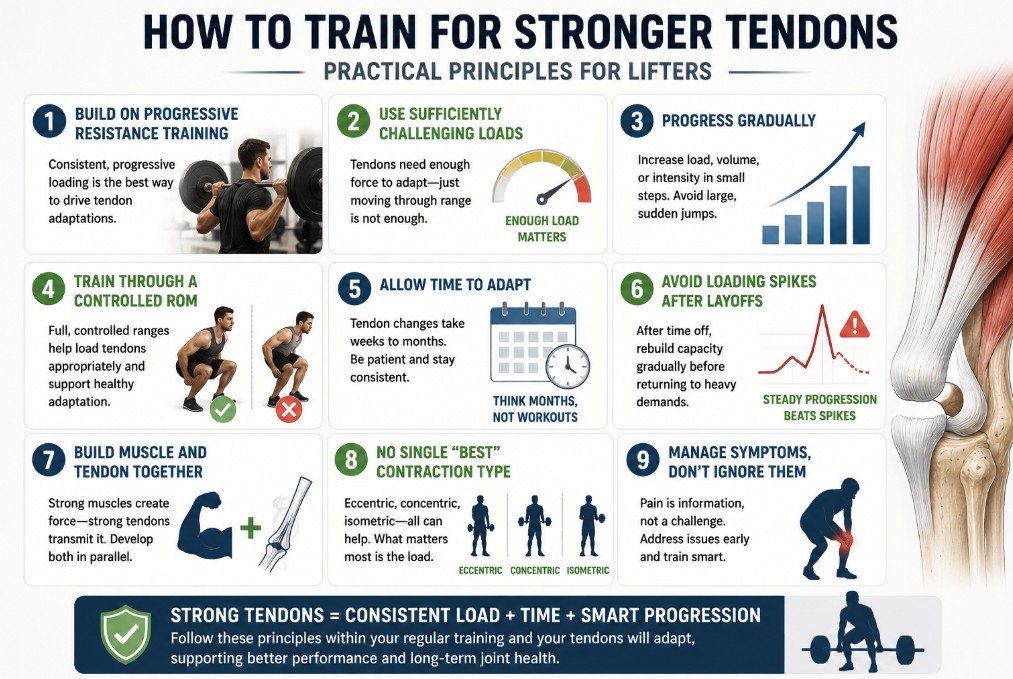
Not a special “tendon workout” — a set of principles that apply within whatever training program you’re already running.
- Use progressive resistance training as the foundation.
- Provide sufficiently challenging mechanical loading — as section 7 established, simply moving through range isn’t enough.
- Progress loading gradually, avoiding large, sudden jumps.
- Train through a controlled range of motion.
- Allow adequate adaptation time — think months, as section 10 established.
- Avoid abrupt loading spikes after layoffs, respecting the detraining dynamics covered in section 15.
- Build muscle and tendon capacity together, rather than treating them as separate training goals.
- Don’t chase one magical contraction type — section 9 already established that none holds a monopoly on adaptation.
- Manage symptoms rather than ignoring them, consistent with the guidance in our tendinopathy guide.
21. Training Implications for Lifters
A short synthesis of everything covered above.
Tendons adapt. They don’t adapt exactly like muscles do. Size isn’t the whole story — mechanical and material properties matter enormously more than tendon cross-sectional area. Loading magnitude matters more than contraction type. Eccentrics aren’t magic. Adaptation takes real time, measured in months, not sessions. And progressive, consistent loading remains the common denominator across essentially everything covered in this guide.
Coach’s Note: You don’t need a separate collection of exotic “tendon exercises” to build stronger tendons. You need consistent, progressive loading that gives the tendon enough stimulus to adapt without repeatedly overwhelming its current capacity. Muscles may get most of the visual attention in bodybuilding, but every kilogram of force they produce still has to travel through a tendon.
Key Takeaways
- ✓Tendons genuinely adapt to resistance training — through increased stiffness, changes in material properties, and smaller increases in size.
- ✓Unlike muscle, tendon adaptation is driven far more by mechanical and material property changes than by visible size increase.
- ✓Loading magnitude and intensity matter considerably more for tendon adaptation than contraction type — eccentric, concentric, and isometric loading all show similar effects when matched for intensity.
- ✓External load doesn’t perfectly equal tendon strain — joint angle, moment arm, and exercise mechanics all shape the actual demand placed on a tendon.
- ✓Tendon adaptation typically takes months of consistent training, not individual workouts.
- ✓Muscle and tendon do not necessarily adapt at the same rate — a mismatch relevant to rapid strength gains, layoffs, and return-to-training decisions.
- ✓Tendons remain capable of adapting later in life, even though the magnitude of adaptation may vary with age.
- ✓No supplement substitutes for progressive mechanical loading as the driver of tendon adaptation.
Frequently Asked Questions
Do tendons get stronger from lifting weights? +
Yes. Tendons adapt to progressive mechanical loading through increased stiffness, changes in material properties like Young’s modulus, and smaller increases in cross-sectional area. The adaptation is driven more by mechanical and material changes than by tendon size increasing, unlike muscle hypertrophy.
How long does it take for tendons to get stronger? +
Generally months rather than individual workouts. Research shows measurable tendon adaptations over weeks to months of consistent training, with a trend toward larger effects specifically in interventions lasting 12 weeks or longer.
Do tendons grow bigger like muscles? +
Only modestly. Tendons can show small increases in cross-sectional area with training, but this change is considerably smaller than the mechanical stiffness and material property changes that occur, and much smaller than typical muscle hypertrophy.
What type of exercise strengthens tendons? +
Resistance training that provides sufficiently high mechanical loading, regardless of specific contraction type. Loading magnitude and intensity matter more than whether the exercise emphasizes eccentric, concentric, or isometric contraction.
Are heavy weights better for strengthening tendons? +
Generally, higher-intensity loading (above roughly 70% of maximal voluntary contraction) produces meaningfully larger tendon stiffness adaptations than lower-intensity loading. However, external load doesn’t perfectly equal actual tendon strain, since joint angle, moment arm, and exercise mechanics also influence the real demand on the tendon.
Are eccentric exercises best for tendons? +
Not uniquely. Research has found that contraction type (eccentric, concentric, or isometric) is not a significant factor in tendon stiffness adaptation when loading intensity is accounted for. The tendon responds to the mechanical stimulus, not to a specific exercise label.
Do high reps strengthen tendons? +
Reasonably well, though rep count alone isn’t the clearest way to think about tendon stimulus. What matters more is the actual mechanical loading and strain the tendon experiences, which depends on more than just how many repetitions are performed.
Do muscles get stronger faster than tendons? +
Often, at least in some training contexts. Muscle strength can improve relatively quickly through neural adaptation, while tendon adaptation follows a different biological time course. This mismatch is particularly relevant for beginners, lifters returning after a layoff, and situations involving rapid strength gains.
Can tendons still get stronger after 40 or 50? +
Yes. Research examining tendon adaptation across different age groups found positive adaptations occur at older ages too, even though the magnitude of adaptation may vary. Tendons don’t lose their fundamental capacity to respond to training loading later in life.
Can collagen supplements strengthen tendons? +
No supplement substitutes for progressive mechanical loading as the primary driver of tendon adaptation. Collagen and related nutrition research is an active area of study, but current evidence doesn’t support supplements as a replacement for appropriate training stimulus.
References
- Lazarczuk, S. L., Maniar, N., Opar, D. A., Duhig, S. J., Shield, A., Barrett, R. S., & Bourne, M. N. (2022). Mechanical, Material and Morphological Adaptations of Healthy Lower Limb Tendons to Mechanical Loading: A Systematic Review and Meta-Analysis. Sports Medicine, 52(10), 2405–2429. https://doi.org/10.1007/s40279-022-01695-y
- Bohm, S., Mersmann, F., & Arampatzis, A. (2015). Human tendon adaptation in response to mechanical loading: a systematic review and meta-analysis of exercise intervention studies on healthy adults. Sports Medicine – Open, 1, 7. https://doi.org/10.1186/s40798-015-0009-9
- Kjaer, M. (2004). Role of extracellular matrix in adaptation of tendon and skeletal muscle to mechanical loading. Physiological Reviews, 84(2), 649–698. https://doi.org/10.1152/physrev.00031.2003
- Ingram, L. A., Tomkinson, G. R., d’Unienville, N. M. A., Gower, B., Gleadhill, S., Boyle, T., & Bennett, H. (2025). Mechanisms Underlying Range of Motion Improvements Following Acute and Chronic Static Stretching: A Systematic Review, Meta-analysis and Multivariate Meta-regression. Sports Medicine, 55(6), 1449–1466. https://doi.org/10.1007/s40279-025-02204-7
