



You squat down, and your knees crack. You rotate your shoulder before a press and hear a click. Your ankles pop during calf raises. If nothing hurts, should you care?
Quick Answer
Joints can crack, pop, click, or grind for several reasons. Common causes include pressure changes and cavity formation within synovial joints, tendons or ligaments moving over nearby structures, and movement between joint surfaces. Painless joint noises are extremely common and usually do not mean that a joint is being damaged. Cracking deserves more attention when it appears with pain, swelling, locking, instability, loss of function, or after an acute injury.
1. What Is Crepitus?
Crepitus is the general clinical term for audible and/or palpable joint noise or sensation — cracking, popping, clicking, grinding, or crunching. Most of the mechanisms behind it are specific to synovial joints, the freely movable joints covered in our joints in the human body guide, since it’s their fluid-filled joint cavity and surrounding soft tissue that make most of these sounds possible in the first place. It’s worth being precise here rather than lumping every sound together: these aren’t necessarily all the same underlying phenomenon. A sharp crack from a knuckle, a soft click from a shoulder, and a gritty crunch from a knee can have genuinely different mechanical origins, which is exactly what the next section unpacks.
2. Why Do Joints Crack?
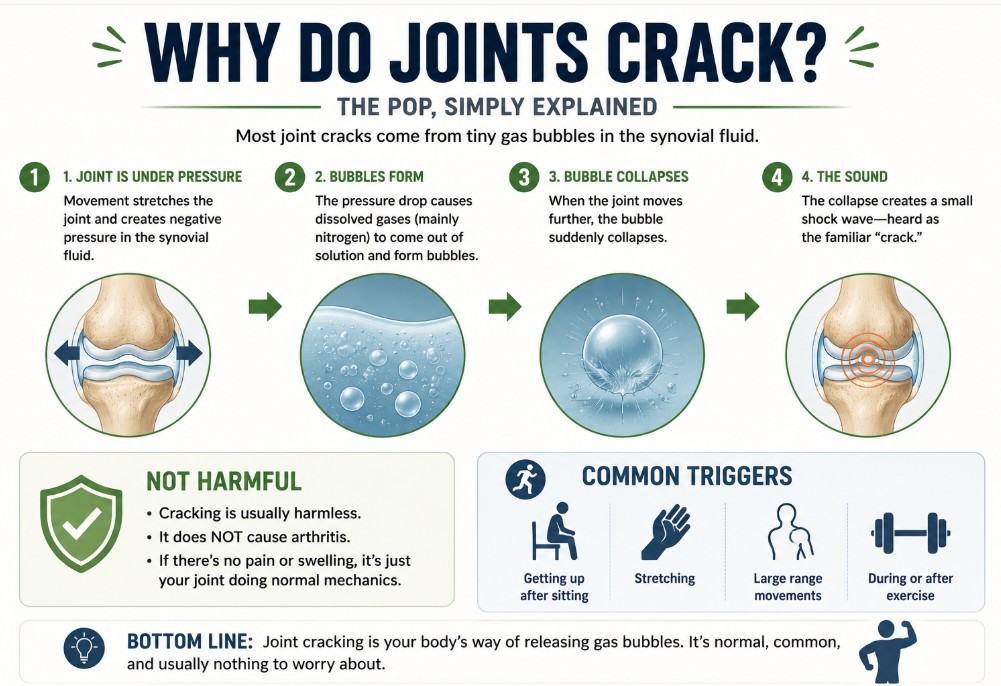
Joint Cavitation / Tribonucleation
This is the mechanism most people picture, and it’s worth explaining accurately rather than relying on the outdated “gas bubble popping” image many people still carry.
Real-time cine-MRI research directly imaging finger joints during cracking found that the sound is associated with rapid cavity formation as joint surfaces separate—not the collapse of a pre-existing bubble, as long assumed (Kawchuk et al., 2015). As the joint surfaces are pulled apart, pressure within the fluid-filled joint space drops, and a gas cavity forms rapidly at a critical point of separation — a process called tribonucleation. This rapid cavity formation produces the crack. This connects directly to the physiology covered in our synovial fluid guide — this mechanism depends entirely on the fluid-filled environment inside a synovial joint.
Tendons and Ligaments Moving Over Structures
A second common source of joint noise, particularly clicks and snaps: a tendon or ligament can shift position as it moves over an adjacent bony or soft-tissue structure during a movement. This is a mechanical, largely benign event — a structure briefly changing its path relative to a neighboring one, not tissue damage. It shows up commonly around the shoulder, hip, knee, and ankle, anywhere tendons travel close to bone through a meaningful range of motion, a topic covered in more depth in our Tendons and Ligaments guide. Worth distinguishing directly: this kind of painless snapping is a different phenomenon entirely from tendinopathy, a genuinely painful tendon condition covered in its own dedicated guide.
Joint Surfaces and Cartilage
A third category involves the joint surfaces themselves — including articular cartilage. It’s important not to overreach here: crunching or grinding sounds are not automatically evidence of cartilage damage. Changes in how joint surfaces interact can be one contributor to this type of noise, but as later sections of this guide establish, sound alone doesn’t tell you what’s actually happening at the tissue level.
3. Why Do My Knees Crack When I Squat?
This deserves its own section, because it’s one of the most common specific complaints lifters bring to this topic.
During a squat, the patella moves through the femoral trochlear groove, tendons and other soft tissues shift position around the joint, and joint pressure and loading change continuously through the range of motion — all plausible contributors to noise at various points in the movement, as covered in more anatomical depth in our knee joint anatomy guide. Painless popping during a weighted squat is genuinely common and, by itself, isn’t evidence of a problem. A noisy squat is not automatically a damaging squat.
4. Why Do My Shoulders Click During Presses?
The shoulder combines an enormous range of motion at the glenohumeral joint with coordinated scapulothoracic movement, tendons, a labrum, and bursae — all covered in detail in our shoulder joint anatomy guide. Given how much relative motion happens between all of these structures through a large range, it’s not surprising that the shoulder produces noise fairly often.
Worth stating directly: a click is not the same thing as a rotator cuff tear, and a click is not the same thing as a labral tear — not without other signs present, like pain, weakness, or instability. A painless click during a bench press or overhead press is a common, usually unremarkable finding on its own.
5. Why Do Ankles and Hips Pop?
Briefly, since the underlying mechanisms mirror what’s already been covered above.
At the hip, popping and snapping sensations commonly relate to soft tissue or tendon movement over the bony structures of the hip, covered in more depth in our hip joint anatomy guide. At the ankle, both tendon movement and joint cavitation can contribute to popping sensations during movements like calf raises or squatting through a deep ankle range.
6. Is Joint Cracking Bad for You?
Usually not, if it’s painless — and that qualifier matters more than the sound itself.
Joint noise on its own, without other symptoms, generally doesn’t indicate a serious problem and doesn’t by itself require treatment. But it’s worth being precise about what that does and doesn’t mean: the sound alone is not a diagnosis. A joint that cracks without pain is a very different situation from one that cracks alongside pain, swelling, or loss of function — a distinction this guide returns to directly in section 10.
7. Does Cracking Your Joints Cause Arthritis?
This carries enormous search interest, and the evidence here is genuinely reassuring — worth separating from the related-but-different question of spontaneous joint noise covered elsewhere in this guide.
Specifically regarding deliberate knuckle cracking: a retrospective case-control study comparing habitual knuckle crackers to non-crackers, using radiographically confirmed hand osteoarthritis, found the prevalence of osteoarthritis was statistically similar between the two groups — 18.1% among crackers versus 21.5% among non-crackers, a difference that was not statistically significant (deWeber, Olszewski & Ortolano, 2011). In other words, this specific study found no evidence that habitual knuckle cracking increases arthritis risk.
Myth: Cracking your joints wears away cartilage. Reality: Joint noise alone is not evidence that cartilage is being damaged.
8. Does Joint Cracking Mean Your Cartilage Is Worn Out?
No — not by itself, and the actual research relationship here is more nuanced than a simple yes-or-no.
A recent systematic review and meta-analysis on knee crepitus found it’s genuinely common across the board: the pooled prevalence was 36% in pain-free individuals and 81% in people with diagnosed knee osteoarthritis (Couch et al., 2025). The review found a statistical association between crepitus and radiographic osteoarthritis features but explicitly rated the certainty of that evidence as low to very low, and noted the results should be interpreted with caution given the significant overlap: over a third of people with zero knee symptoms have detectable crepitus too.
The practical takeaway is genuinely important: crepitus is not the same thing as osteoarthritis, and osteoarthritis does not mean every cracking knee has it. A noisy knee with no pain, swelling, or functional limitation is a common, usually unremarkable finding — not a self-diagnosis of joint disease.
9. Why Do Joints Crack More With Age?
Changes in cartilage, tendon properties, joint structures generally, previous injury history, and shifts in movement patterns over time can all make joint noise more noticeable as people get older. But consistent with everything covered above, age-related noise is not automatically evidence of pathology — it’s a common finding that, on its own, doesn’t confirm a specific underlying problem.
10. Should You Worry About Cracking Joints?
Context matters more than the sound itself.
- Painless cracking — usually not concerning on its own.
- Cracking with pain — worth paying more attention to.
- Cracking with swelling — worth proper evaluation.
- Locking or catching — worth proper evaluation.
- Instability or a sense of the joint giving way — worth proper evaluation.
- A sudden pop during an injury — a fundamentally different situation from the chronic, painless noise covered throughout most of this guide.
That last category deserves particular emphasis. If you experience a sudden pop accompanied by immediate pain, swelling, weakness, or loss of function — during a deadlift, squat, press, or any other lift — that’s not the same phenomenon as painless cracking you’ve noticed for years. That combination warrants proper assessment, not self-reassurance based on everything else covered in this guide.
11. Should You Stop Lifting If Your Joints Crack?
Not simply because they make noise.
If there’s no pain, no swelling, no loss of function, and no instability, the sound by itself is generally not a reason to stop training or avoid an exercise. Your joints do not need to be silent to be healthy. Plenty of perfectly functional, well-trained joints make noise regularly, and that noise doesn’t mean anything is wrong.
12. Can Strength Training Make Joints Crack More?
Possibly, and it’s worth understanding why without jumping to alarm. Increased range of motion, repeated joint movement through training, more frequent tendon movement over adjacent structures, and a change in overall training exposure can all make joint noise more noticeable than before you started training that pattern regularly. This doesn’t mean lifting is causing pathology — it means a joint that’s moving more, and moving through more of its available range, is producing more opportunities for the same benign mechanisms covered throughout this guide to occur.
13. Can You Reduce Joint Cracking?
Worth a direct, honest answer: if the cracking is painless, there may not be a compelling reason to try to reduce it at all.
If a specific movement reliably produces a clicking sensation you’d rather not have, adjusting warm-up, exercise setup, range of motion, technique, or load can sometimes change how or whether the noise occurs. But training shouldn’t aim to make every joint silent. Chasing silence for its own sake, when nothing is actually wrong, isn’t a meaningful training objective.
14. Joint Cracking During Major Exercises
| Exercise | Common Noisy Area | Is Noise Alone Concerning? |
|---|---|---|
| Squat | Knee/hip/ankle | Usually no |
| Leg press | Knee/hip | Usually no |
| Bench press | Shoulder/elbow | Usually no |
| Overhead press | Shoulder | Usually no |
| Pull-ups | Shoulder/elbow | Usually no |
| Calf raises | Ankle | Usually no |
This table reflects general patterns, not a diagnosis — the context covered in section 10 (pain, swelling, instability, sudden injury) still applies regardless of which exercise produced the noise.
15. When to Get a Noisy Joint Checked
Worth closing with a direct, practical list. Joint cracking accompanied by any of the following deserves proper professional assessment rather than self-management: pain, swelling, warmth, locking, catching, instability, loss of range of motion, weakness, acute trauma, or a sudden functional change. This guide isn’t meant to diagnose any of these—the goal is simply to flag when general reassurance about painless noise no longer applies.
16. Training Implications for Lifters
Five principles, drawn from everything covered above.
- Noise isn’t damage. The mechanisms behind most joint cracking and popping are mechanical and benign, not signs of tissue breakdown.
- Pain changes the context. Painless noise and painful noise are genuinely different situations, not variations of the same thing.
- Don’t modify a good exercise solely because a healthy joint makes harmless noise. Removing a well-tolerated movement over sound alone isn’t a defensible training decision.
- Don’t ignore a sudden, painful pop. As section 10 established, that’s a different category from chronic painless cracking and deserves proper attention.
- Joint health is about function and load tolerance — not silence. A quiet joint isn’t automatically healthier than a noisy one, and a noisy joint isn’t automatically less capable.
Coach’s Note: After years in the gym, you’ll hear plenty of knees crack, shoulders click, and ankles pop — including your own. Don’t judge a joint by its soundtrack. Judge it by how it moves, how it tolerates load, whether it hurts, and whether it continues to do its job.
Key Takeaways
- ✓Joint cracking has several distinct mechanisms — cavity formation in synovial fluid, tendons or ligaments shifting over adjacent structures, and joint surface movement — not one single cause.
- ✓Painless joint noise is extremely common and does not, by itself, indicate damage.
- ✓Research directly comparing habitual knuckle crackers to non-crackers found no significant difference in arthritis prevalence between the two groups.
- ✓Crepitus is common even in pain-free people — a systematic review found it in roughly a third of people with no knee symptoms at all.
- ✓Crepitus and osteoarthritis are related but not equivalent — one does not confirm the other.
- ✓A sudden pop with immediate pain, swelling, or weakness during an injury is a fundamentally different situation from chronic painless cracking.
- ✓Joints don’t need to be silent to be healthy — function, load tolerance, and the presence or absence of pain matter far more than sound.
Frequently Asked Questions
Why do my joints crack all the time? +
Frequent joint cracking is usually explained by normal mechanisms — cavity formation within the joint’s synovial fluid, tendons or ligaments shifting position as they move over nearby structures, or movement between joint surfaces. On its own, without pain or other symptoms, frequent cracking is common and not typically a cause for concern.
Is joint cracking bad for you? +
Usually not, if it’s painless. Joint noise alone generally doesn’t indicate a serious problem. It becomes more relevant to pay attention to when it’s accompanied by pain, swelling, locking, instability, or loss of function.
Why do my knees crack when I squat? +
Knee cracking during squats commonly relates to the patella moving through the femoral trochlear groove, soft tissue shifting around the joint, and changing joint pressure through the range of motion. Painless popping during a weighted squat is common and not, by itself, evidence of a damaging movement.
Does cracking your joints cause arthritis? +
Research directly comparing habitual knuckle crackers to non-crackers found no statistically significant difference in arthritis prevalence between the groups. This specific evidence doesn’t support the popular belief that deliberately cracking your knuckles causes arthritis.
What is crepitus? +
Crepitus is the general clinical term for audible and/or palpable joint noise or sensation, including cracking, popping, clicking, grinding, or crunching. Different sounds can have different underlying mechanisms rather than all representing the same phenomenon.
Why do my shoulders click when I lift weights? +
The shoulder’s large range of motion means a lot of relative movement between tendons, the labrum, bursae, and surrounding structures — a common source of clicking. A painless click alone is not the same thing as a rotator cuff tear or labral tear.
Should I stop exercising if my joints crack? +
Not simply because of noise. If there’s no pain, swelling, instability, or loss of function, the sound alone generally isn’t a reason to stop training or avoid a well-tolerated exercise. Joints don’t need to be silent to be healthy.
Does joint cracking mean cartilage damage? +
Not by itself. A systematic review found knee crepitus present in roughly a third of pain-free individuals, meaning the sound is common even without any underlying pathology. Crepitus and structural cartilage changes are related but not equivalent.
Why do joints crack more as you get older? +
Changes in cartilage, tendon properties, joint structures, prior injury history, and movement patterns can all make joint noise more noticeable with age. This doesn’t automatically indicate pathology — it’s a common finding on its own.
When should I worry about joint popping? +
Pay closer attention when cracking or popping occurs alongside pain, swelling, warmth, locking, catching, instability, loss of range of motion, weakness, or after a sudden acute injury. A sudden pop with immediate pain during a lift is a different situation from chronic, painless noise and deserves proper assessment.
References
- Kawchuk, G. N., Fryer, J., Jaremko, J. L., Zeng, H., Rowe, L., & Thompson, R. (2015). Real-Time Visualization of Joint Cavitation. PLoS ONE, 10(4), e0119470. https://doi.org/10.1371/journal.pone.0119470
- deWeber, K., Olszewski, M., & Ortolano, R. (2011). Knuckle Cracking and Hand Osteoarthritis. The Journal of the American Board of Family Medicine, 24(2), 169–174. https://doi.org/10.3122/jabfm.2011.02.100156
- Couch, J. L., King, M. G., De Oliveira Silva, D., Whittaker, J. L., Bruder, A. M., Serighelli, F., Kaplan, S., & Culvenor, A. G. (2025). Noisy knees – knee crepitus prevalence and association with structural pathology: a systematic review and meta-analysis. British Journal of Sports Medicine, 59(2), 126–132. https://doi.org/10.1136/bjsports-2024-108866
