



You’ve probably heard that warming up “lubricates your joints.” There’s some truth behind the idea — but synovial fluid does much more than simply act like oil inside a machine. It exists within synovial joints and participates in lubrication, cartilage nutrition, and overall joint homeostasis, making it a genuinely active part of how your joints function under load, not just a passive pool of fluid sitting between two bones.
Quick Answer
Synovial fluid is the viscous fluid found inside synovial joint cavities, including the knee, hip, shoulder, and elbow. It is derived largely from an ultrafiltrate of blood plasma and modified by substances produced within the joint, including hyaluronan and lubricin. Synovial fluid reduces friction between articulating surfaces, contributes to joint lubrication, and helps transport nutrients to avascular articular cartilage. Its mechanical properties also change with movement and loading, making it an active part of normal joint function rather than simply a passive pool of fluid.
1. Where Is Synovial Fluid Found?
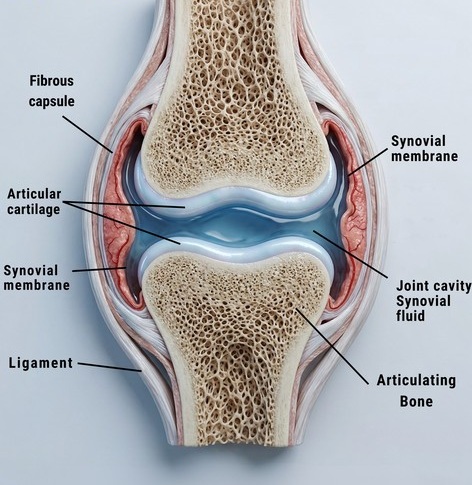
Synovial fluid fills the joint cavity of every synovial joint — the knee, hip, shoulder, elbow, wrist, ankle, and the joints of the hands and feet among them.
Worth noting directly: not every joint contains synovial fluid. Fibrous and cartilaginous joints, covered in our joints in the human body guide, don’t have the joint cavity that defines a synovial joint in the first place, so there’s no synovial fluid to speak of at those connections.
2. Where Does Synovial Fluid Come From?
This gets oversimplified constantly, usually to something like “the synovial membrane secretes the fluid.” That’s not quite accurate.
Synovial fluid is more precisely described as an ultrafiltrate of blood plasma, meaning it originates from plasma that filters across the synovial membrane, combined with additional contributions actively secreted by cells within the joint — chondrocytes and synoviocytes among them (Hui et al., 2012). Those cellular contributions matter enormously for function: synoviocytes are responsible for adding hyaluronan, and both synoviocytes and chondrocytes contribute lubricin (also known as proteoglycan-4, or PRG4) — the two molecules primarily responsible for the fluid’s distinctive lubricating properties. So synovial fluid isn’t simply filtered blood plasma sitting in a cavity; the joint actively modifies that plasma into something mechanically specialized.
3. What Is Synovial Fluid Made Of?
| Component | Main Relevance |
|---|---|
| Water/plasma ultrafiltrate | The base fluid medium |
| Hyaluronan | Viscosity and lubrication |
| Lubricin (PRG4) | Boundary lubrication at the cartilage surface |
| Proteins | Various biological and regulatory functions |
| Electrolytes and nutrients | Joint environment and cartilage nutrition |
This isn’t an exhaustive biochemical breakdown — the practical point is that synovial fluid’s components work together to produce its function, not a single ‘lubricant’ ingredient acting alone.
4. What Does Synovial Fluid Do?

Four core functions:
- Reduces friction between the articulating cartilage surfaces during movement.
- Contributes to joint lubrication, working alongside the cartilage surface itself rather than acting alone.
- Helps nourish articular cartilage, which — as covered in our articular cartilage guide — has no blood supply of its own and depends on this route for nutrient delivery.
- Supports overall joint homeostasis, contributing to the regulatory and metabolic environment inside the joint, not just its mechanical function.
5. How Synovial Fluid Lubricates a Joint
The “oil in an engine” analogy is a useful starting image, but it undersells what’s actually happening. Joint lubrication involves an interaction between synovial fluid, the cartilage surface itself, specific lubricant molecules, and fluid pressurization within the cartilage — a combination of mechanisms working together rather than a single fluid layer doing all the work (An et al., 2022), as covered in more depth in our synovial joints guide. Synovial fluid works as part of a lubrication system; it isn’t simply oil sitting between two hard surfaces.
6. How Synovial Fluid Nourishes Articular Cartilage
Articular cartilage is avascular — it has no blood supply of its own (Roseti & Grigolo, 2022), a point covered extensively in our dedicated guide to that tissue. That means nutrient delivery to cartilage can’t work the way it does in most other tissues, where blood vessels do the job directly.
Instead, nutrients reach cartilage through diffusion from the surrounding synovial fluid, supported by the mechanical exchange that happens as cartilage compresses and re-expands under loading and unloading. This is precisely why synovial fluid and articular cartilage function as a connected system rather than two independent structures that happen to sit next to each other.
7. What Happens to Synovial Fluid When You Move?
Joint movement changes fluid distribution within the joint, cartilage compression, fluid exchange between the joint cavity and load-bearing cartilage, and the specific lubrication conditions present at any given moment.
It’s worth being precise here rather than reaching for an appealing but inaccurate shorthand: movement doesn’t produce a “fresh batch” of synovial fluid with every repetition. What actually happens is that joint movement redistributes existing fluid and shifts it between the joint cavity and the cartilage surface as joint angles and loading change throughout a movement.
8. Does Warming Up Really “Lubricate” Your Joints?
This is worth a direct answer, since it’s one of the most commonly repeated claims in gym culture.
Partially, yes — but the “adding oil to a dry joint” analogy is too simple. What warming up actually does: it redistributes synovial fluid within the joint, alters cartilage fluid dynamics through graduated loading, prepares the surrounding muscles and nervous system for upcoming demand, and progressively exposes joint tissues to load rather than jumping straight to a heavy working set. A warm-up doesn’t simply “add oil” to a dry joint—it’s a broader physiological preparation process that includes fluid redistribution as one component among several.
9. Does Exercise Increase Synovial Fluid?
This deserves nuance, because the intuitive follow-up—”so more exercise means more fluid, and more fluid is better”—doesn’t hold up.
Joint effusion is also an increase in fluid volume within a joint, and it’s associated with irritation, inflammation, or injury, not something you’d want more of (Seidman & Limaiem, 2023). That means “more synovial fluid” isn’t automatically a training benefit — the relevant distinction is between normal, healthy synovial fluid physiology and the abnormal fluid accumulation that characterizes effusion. Exercise that supports normal joint function is genuinely different from exercise that produces measurably more fluid, and conflating the two leads to a misleading conclusion.
10. What Happens to Synovial Fluid During Resistance Training?
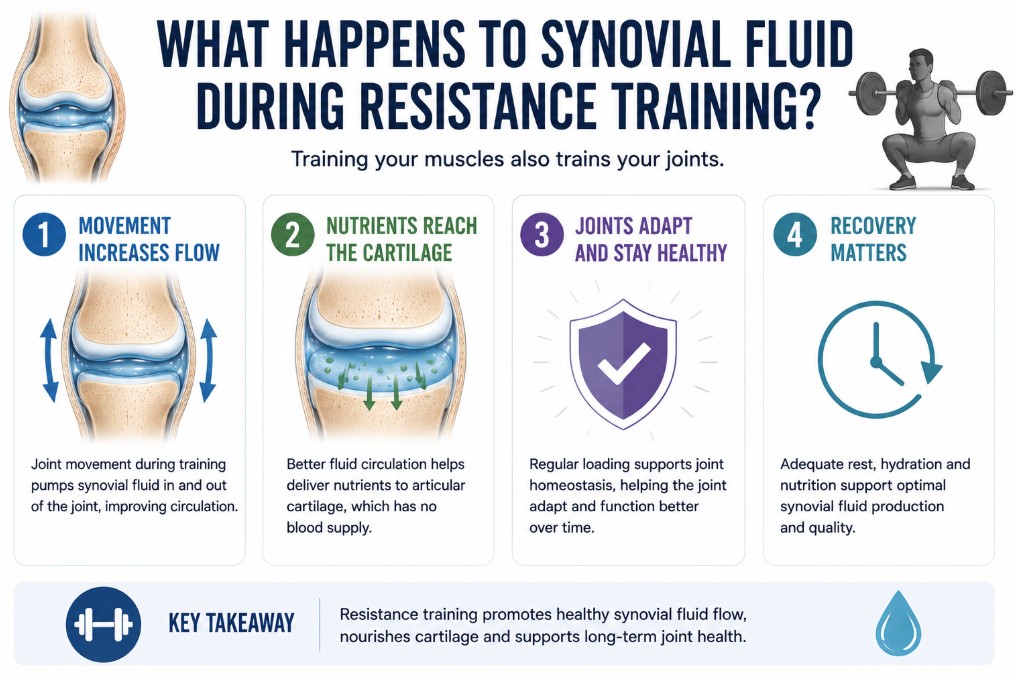
During movements like a squat (loading the knee and hip, covered in our knee and hip joint anatomy guides) or a press (loading the shoulder and elbow, covered in our shoulder joint anatomy guide), joint angles change continuously through each repetition, the contact surfaces between articulating cartilage shift, cartilage compresses and decompresses in response, and fluid distribution within the joint changes accordingly.
The principle worth repeating from earlier sections of this guide: normal loading is not the same thing as damage. A healthy synovial joint is built to experience exactly this kind of mechanical activity during resistance training — it isn’t evidence of something going wrong.
11. Does More Synovial Fluid Mean Healthier Joints?
No — and this is worth stating plainly, because the assumption runs in the opposite direction from what people often expect.
A healthy joint doesn’t require or benefit from a maximal amount of synovial fluid. As covered above, excess synovial fluid is more likely to represent joint effusion than a marker of joint health. This directly corrects a popular but backward assumption: more lubrication does not equal a healthier joint.
12. Synovial Fluid vs Joint Effusion
Worth a brief, clear distinction rather than a long section.
Normal synovial fluid is a physiological, functional component of a healthy joint — present at a stable volume that supports lubrication and cartilage nutrition. Joint effusion is an abnormal, excess accumulation of fluid, typically associated with inflammation, injury, or an underlying joint condition. Persistent swelling after training is not evidence that a workout “lubricated the joint well”—if anything, it points to the opposite and warrants attention, not a shrug.
13. Can You Improve Synovial Fluid With Exercise, Diet or Supplements?
Worth addressing directly, since this carries real search interest.
Exercise: normal movement and activity support overall joint function, but that’s a different claim from saying training is specifically “maximizing” synovial fluid as a goal in itself.
Hydration: general hydration matters for normal physiology, but there’s no basis for the simplistic version — “drink more water, get more joint lubrication” — as a direct, targeted effect.
Supplements: this guide won’t turn into a glucosamine or collagen review here. The honest summary: no simple supplement literally fills healthy joints with more synovial fluid. If you’re interested in the supplement research specifically, dedicated supplement-focused content covers that ground better than an anatomy guide can.
14. Training Implications for Lifters
Five practical principles, drawn from everything above.
- Move before heavy loading. A warm-up makes sense — not because of the oversimplified “oil the joint” story, but because of the broader preparation process covered in section 8.
- Progress loading gradually. The joint system, including synovial fluid, benefits from consistent exposure rather than sudden jumps in demand.
- Use controlled movement through appropriate range of motion. Movement itself contributes to normal joint-fluid and cartilage mechanics, as covered throughout this guide.
- Don’t chase “more joint fluid.” As sections 9 and 11 established, more isn’t better here—it’s often a sign of a problem, not a training win.
- Persistent swelling isn’t normal lubrication. Treat it as a signal worth proper assessment, not confirmation that a workout went well.
Coach’s Note: Think of synovial fluid as one component of a living joint system, not as oil in a machine. Your goal before lifting isn’t to “fill” the joint with lubricant — it’s to progressively prepare the entire joint, muscles, and nervous system for the loads you’re about to use.
Key Takeaways
- ✓Synovial fluid is found inside synovial joint cavities — not every joint has it, since fibrous and cartilaginous joints lack a joint cavity entirely.
- ✓It’s derived largely from a plasma ultrafiltrate and actively modified by joint cells, chiefly through added hyaluronan and lubricin.
- ✓Synovial fluid contributes to lubrication and helps nourish avascular articular cartilage through diffusion.
- ✓Joint lubrication involves more than fluid alone — it’s a system involving cartilage, fluid, and lubricant molecules together.
- ✓Movement affects fluid distribution and cartilage fluid exchange, but doesn’t produce a “fresh batch” of fluid with every repetition.
- ✓Warming up does more than simply “add lubrication” — it’s a broader physiological preparation process.
- ✓More synovial fluid is not automatically better — excessive fluid can represent joint effusion, not enhanced joint health.
- ✓Resistance training normally loads and moves synovial fluid without that implying joint damage.
Frequently Asked Questions
What is synovial fluid? +
Synovial fluid is the viscous fluid found inside synovial joint cavities. It’s derived largely from a plasma ultrafiltrate and modified by substances produced within the joint, including hyaluronan and lubricin, giving it lubricating and nutrient-transport functions.
What is the function of synovial fluid? +
Synovial fluid reduces friction between articulating cartilage surfaces, contributes to joint lubrication, helps transport nutrients to avascular articular cartilage, and supports overall joint homeostasis.
Where is synovial fluid found? +
Synovial fluid is found inside the joint cavity of synovial joints, including the knee, hip, shoulder, elbow, wrist, ankle, and the joints of the hands and feet. Fibrous and cartilaginous joints don’t contain synovial fluid, since they lack a joint cavity.
What is synovial fluid made of? +
Synovial fluid is primarily a plasma ultrafiltrate combined with hyaluronan and lubricin (PRG4) secreted by joint cells, along with various proteins, electrolytes, and nutrients that support the joint environment and cartilage nutrition.
How does synovial fluid lubricate joints? +
Synovial fluid lubricates joints through a combination of mechanisms involving the fluid itself, the cartilage surface, specific lubricant molecules like hyaluronan and lubricin, and fluid pressurization within the cartilage — not through a single fluid layer acting alone, the way engine oil works.
Does exercise increase synovial fluid? +
Normal exercise supports healthy joint function and fluid dynamics, but this is different from claiming exercise simply produces “more” synovial fluid as a training benefit. A genuine increase in joint fluid volume is more often associated with joint effusion — linked to irritation, inflammation, or injury — rather than a marker of improved joint health.
Does warming up lubricate your joints? +
Partially, but the “adding oil” analogy oversimplifies it. Warming up redistributes synovial fluid, alters cartilage fluid dynamics through graduated loading, and prepares muscles and the nervous system for upcoming demand — a broader physiological process, not simply lubricant being added to a dry joint.
How does synovial fluid nourish cartilage? +
Because articular cartilage has no blood supply of its own, it relies on diffusion from surrounding synovial fluid for nutrients, a process supported by the mechanical exchange that occurs as cartilage compresses and re-expands under joint loading and unloading.
Can you increase synovial fluid naturally? +
There’s no well-supported way to deliberately “increase” synovial fluid as a training or health goal, and doing so isn’t actually desirable — a genuine increase in joint fluid volume is more closely associated with effusion than with joint health. Normal movement and general hydration support healthy joint physiology, but neither works by directly maximizing fluid volume.
Is too much synovial fluid bad? +
Yes — an excess accumulation of synovial fluid is called joint effusion, and it’s typically associated with inflammation, injury, or an underlying joint condition rather than being a marker of a well-functioning joint. Persistent swelling after training deserves attention rather than being interpreted as a sign of good joint lubrication.
References
- Hui, A. Y., McCarty, W. J., Masuda, K., Firestein, G. S., & Sah, R. L. (2012). A systems biology approach to synovial joint lubrication in health, injury, and disease. Wiley Interdisciplinary Reviews: Systems Biology and Medicine, 4(1), 15–37. https://doi.org/10.1002/wsbm.157
- Seidman, A. J., & Limaiem, F. (2023). Synovial Fluid Analysis. StatPearls. StatPearls Publishing. ncbi.nlm.nih.gov/books/NBK537114
- An, H., Liu, Y., Yi, J., Xie, H., Li, C., Wang, X., & Chai, W. (2022). Research progress of cartilage lubrication and biomimetic cartilage lubrication materials. Frontiers in Bioengineering and Biotechnology, 10, 1012653. https://doi.org/10.3389/fbioe.2022.1012653
- Roseti, L., & Grigolo, B. (2022). Current concepts and perspectives for articular cartilage regeneration. Journal of Experimental Orthopaedics, 9, 61. pmc.ncbi.nlm.nih.gov/articles/PMC9249961
