
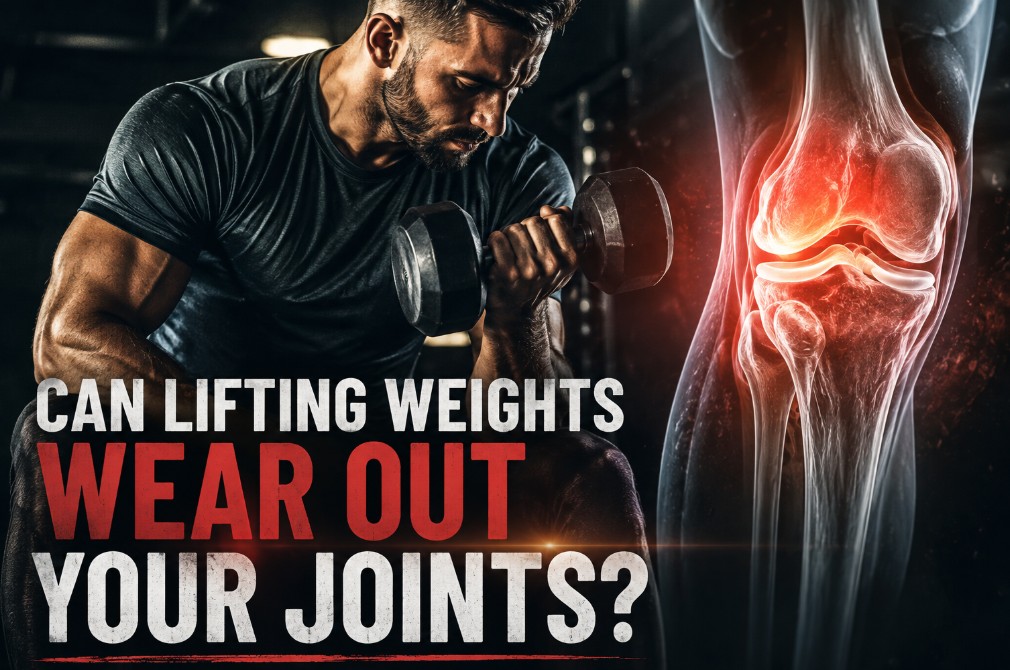
Every squat puts pressure through your knees. Heavy presses load your shoulders. Deadlifts place enormous forces through the hips and spine. So after years of lifting, are you gradually wearing your joints out?
Mechanical load doesn’t automatically damage joints. Living tissues respond to load. That’s the central idea this guide is built around — and it’s worth saying upfront that this article isn’t written to reassure you no matter what the evidence shows. Where the research is genuinely nuanced, or points somewhere less flattering for lifters, this guide says so directly.
Quick Answer
For most healthy people, appropriately programmed resistance training does not appear to simply “wear out” the joints. Joints are living biological systems that tolerate and adapt to mechanical loading. Problems are more likely when loading exceeds current tissue capacity, increases too rapidly, is combined with injury or inadequate recovery, or is performed despite significant symptoms. Heavy loading and joint damage are therefore not the same thing — though the picture is more nuanced for competitive strength sports specifically than for recreational training, a distinction this guide addresses directly.
1. Why the “Wear and Tear” Model of Joints Is Misleading
The mental model most people carry around is essentially mechanical: a joint is like a car tire, accumulating mileage until it eventually wears out and needs replacing. It’s an intuitive image. It’s also a poor description of how a joint actually works.
A joint isn’t a static mechanical part — it’s a living system. Articular cartilage is living tissue with its own (limited but real) biological activity. Bone continuously remodels in response to the forces it experiences. Tendons and ligaments adapt their material properties over time, as covered in our Tendons and Ligaments guide. Muscles crossing a joint can be strengthened, directly changing how load is distributed at that joint. The synovial environment itself responds to movement, as covered in our synovial fluid guide. Your joints are not mechanical parts with a fixed number of repetitions built into them. This same theme runs through our joints in the human body guide — a joint is better understood as a biological system with a capacity that changes over time than as a component with a countdown timer.
2. What Actually Happens to a Joint When You Lift Weights?
During a squat, muscular force combines with the external load to produce compression and shear at the knee and hip; cartilage deforms in response, interstitial fluid within that cartilage redistributes, and the resulting force gets distributed across the joint surfaces involved — the same biomechanical chain covered in our Synovial Joints guide.
It’s worth being precise about the vocabulary here, because these three terms get conflated constantly: mechanical stress (the force acting on a tissue) is a normal, expected consequence of loading. Mechanical strain (the resulting deformation of that tissue) is simply what stress produces — tissues are supposed to deform somewhat under load. Tissue damage is a separate concept entirely, and it is not a synonym for either of the first two. A joint experiencing stress and strain during a heavy set is doing exactly what it’s built to do. Whether that stress and strain crosses into actual damage depends on magnitude, frequency, and the tissue’s current capacity to tolerate that specific loading — not on the mere fact that stress and strain occurred.
3. What Happens to Articular Cartilage During Resistance Training?
This deserves particular attention, since cartilage health is usually the biggest underlying worry behind “does lifting damage my joints?”
As covered in depth in our articular cartilage guide, cartilage behaves as a biphasic material — compression under load causes interstitial fluid to redistribute within the tissue, load gets distributed across the joint surface, and unloading allows that fluid balance to recover. This is the tissue’s normal mechanical behavior, not a sign of something going wrong. Compression itself is not cartilage damage. The relevant question isn’t whether cartilage experiences compression during lifting — it always will, and it’s built to — but whether the magnitude, frequency, and context of that compression exceeds what the tissue currently has the capacity to tolerate.
4. Does Heavy Lifting Wear Down Cartilage?
Not simply because the load is heavy — and it’s worth resisting the pull toward an equally oversimplified answer in the other direction.
Two claims deserve equal skepticism: “heavy weights are good for cartilage” and “heavy weights destroy cartilage.” Both flatten a genuinely more complicated picture into a slogan. What matters is the distinction between healthy cartilage exposed to progressive, well-managed loading over time, an already injured or diseased joint loaded in a way it’s poorly prepared to tolerate, and acute traumatic loading events entirely distinct from routine training. Lumping all three scenarios into one blanket statement about “heavy lifting and cartilage” — in either direction — misrepresents what the evidence actually supports.
5. Does Weightlifting Cause Arthritis?
This is one of the most important questions this guide can address, and it deserves a genuinely evidence-based answer rather than either reflexive reassurance or reflexive alarm.
Osteoarthritis is considerably more complex than a simple “years of friction wore the cartilage away” story. As established in our Articular Cartilage guide, modern understanding frames osteoarthritis as a whole-joint disease involving cartilage alongside subchondral bone, the synovium, the joint capsule, and ligaments — not one tissue failing in isolation (Salman et al., 2023). Recognized risk factors include previous significant joint injury, age, genetics, body composition and metabolic factors, individual joint morphology, and occupational or sport-specific exposures — a considerably longer and more complicated list than “used the joint a lot.”
Evidence specifically examining resistance training history in the general population is reassuring. A large cross-sectional study using data from the Osteoarthritis Initiative — over 2,600 participants — found that a history of strength training was associated with 23% lower odds of symptomatic knee osteoarthritis compared to no strength training history, with the researchers suggesting improved biomechanics, reduced injury risk, better weight management, and preserved mobility as plausible explanations (Lo et al., 2024). For general, recreational resistance training, this is a genuinely positive finding — not a reason for lifters to worry about arthritis risk from training itself.
6. What About Powerlifters and Bodybuilders?
Here’s where this guide has to depart from simple reassurance, because the evidence genuinely looks different once you move from recreational training to elite, competitive strength sport — and pretending otherwise would misrepresent what the research shows.
It’s essential to separate two very different exposures. Recreational resistance training — the three-to-five sessions per week most readers of this guide are doing — is a fundamentally different exposure than decades of competitive strength sport at an elite level, involving extreme absolute loads, very high cumulative training volume, a higher rate of significant injuries along the way, and performance demands that go well beyond general fitness training. Generalizing findings from one population to the other, in either direction, is a mistake.
And the evidence for elite competitive strength athletes specifically is less reassuring than the recreational picture above. A study of 117 former Finnish top-level athletes found that former elite weight lifters had a radiographically confirmed knee osteoarthritis prevalence of 31% — compared to just 3% among a low-load comparison group (competitive shooters) — with the study’s authors concluding that soccer players and weight lifters specifically were at increased risk of premature knee osteoarthritis (Kujala et al., 1995). It’s worth noting an important nuance the study’s authors highlighted: they attributed part of the elevated risk in weight lifters to higher body mass as a contributing factor, not loading history alone — a genuine confound, not a reason to dismiss the finding.
A separate, larger cohort study of former elite athletes found that those in power sports (including weightlifting and wrestling) had more than double the age-adjusted risk of hospital admission for osteoarthritis compared to non-athlete controls (odds ratio 2.17) — a similarly elevated risk to that seen in mixed-sport athletes, and higher than in endurance athletes specifically (Kujala, Kaprio & Sarna, 1994).
Taken together, this is a genuinely different picture than the recreational training data. This guide won’t paper over that difference to make lifting sound uniformly protective at every level of participation — the honest answer depends on which population and which level of exposure you’re actually asking about. For the overwhelming majority of people reading this guide — recreational and enthusiast lifters, not decades-long elite competitors — the more reassuring recreational-training evidence is the more directly applicable picture. But it would be dishonest to claim the elite competitive data doesn’t exist or doesn’t matter for anyone.
7. Are Squats Bad for Your Knees?
This is perhaps the single most persistent joint-health worry in the gym, and it deserves a direct answer without turning into a standalone squat technique guide — the full anatomical picture is covered in our knee joint anatomy guide.
Squatting involves knee compression, patellofemoral loading, and tibiofemoral loading that all change continuously through the range of motion, with depth, absolute load, and individual anatomical tolerance all shaping the specific demands at any given point in the movement. One popular version of the “squats are bad for knees” concern centers on a specific cue: that letting the knees travel past the toes destroys the joint. The evidence doesn’t support this. A classic biomechanics study directly testing restricted versus unrestricted forward knee travel during the squat found that blocking the knees from passing the toes decreased knee torque — but significantly increased hip torque, meaning the mechanical demand didn’t disappear; it simply shifted elsewhere in the kinetic chain (Fry, Smith & Schilling, 2003). “Knees past toes equals knee destruction” is a myth this specific research directly contradicts.
8. Are Deep Squats Bad for Your Knees?
A closely related but distinct question, and one worth its own brief section given how much search interest it carries.
Deeper squatting generally changes—and often increases—mechanical demand on particular knee structures compared to a shallower range, as covered in more depth in our knee joint anatomy guide. But greater demand at a specific depth does not automatically mean harmful demand. A scoping review specifically examining the impact of deep squatting on knee joint structures found no consistent evidence that deep squatting is inherently harmful to healthy knees (Rojas-Jaramillo et al., 2024). Training history, gradual progression into that range, individual mobility and anatomy, technique, and any pre-existing pathology all shape how well a given lifter’s knees tolerate a given depth — depth alone isn’t the determining factor.
9. Is Heavy Bench Press Bad for Your Shoulders?
Shoulder loading during pressing movements is considerably more nuanced than the number on the bar alone, as covered in detail in our shoulder joint anatomy guide.
Grip width, range of motion, bar path, shoulder position throughout the movement, training volume, session frequency, previous injury history, and individual anatomical variation all meaningfully influence how a given bench press loads the shoulder — not simply how much weight is on the bar. A detailed musculoskeletal modeling study examining bench press technique variations found that specific setup choices — retracting the scapula, using a moderate rather than very wide grip — measurably changed shoulder joint loading patterns, including reducing posterior shear forces and rotator cuff demand with certain adjustments, while wider grips increased acromioclavicular joint compression (Noteboom et al., 2024). In other words, “is bench press bad for shoulders” isn’t answerable as a single yes-or-no — the specific technique variables used change the answer meaningfully.
10. What About Deadlifts and Your Hips and Spine?
Briefly, since this guide isn’t the place for a dedicated spine anatomy deep-dive — the hip side of this question is covered in more depth in our hip joint anatomy guide.
The deadlift produces substantial mechanical force through the hips and spine—that much is accurate biomechanics, not a red flag on its own. Large mechanical force is not automatically pathological force. As with every other movement covered in this guide, the relevant question is whether that force, applied consistently and progressively over time, stays within what the involved tissues have the capacity to tolerate — not whether the force is large in an absolute sense.
11. Does Resistance Training Actually Strengthen Your Joints?
Here’s a genuine reframe worth sitting with: “strengthen a joint” isn’t actually a precise anatomical statement, because a joint isn’t a single tissue — it’s a system, as established throughout our joints in the human body guide.
Training can meaningfully influence several components of that system, each through its own mechanism — tendon, ligament, and cartilage are all members of the broader connective tissue family, each solving a different mechanical problem and adapting on its own terms: muscle gains strength and control; tendon can adapt in stiffness and capacity, as covered in our Tendons and Ligaments guide; bone can remodel bone mineral density in response to load; ligaments show some evidence of mechanobiological adaptation, though human evidence here remains thinner than for tendon; cartilage shows a slower, more constrained mechanobiological response given its avascular nature; and the neuromuscular system improves joint control and stability through training exposure. Talking about “strengthening a joint” as if it were one uniform process glosses over the fact that these are genuinely different tissues adapting through genuinely different mechanisms, on different timelines.
12. When Does Loading Become Too Much?
This might be the single most practically important question in this entire guide, and it’s the same underlying concept covered in depth in our tendinopathy guide, applied here at the level of the whole joint system.
The problem was never that load exists. The problem arises when applied load exceeds the tissue’s current capacity. Several factors commonly create that mismatch: a sudden increase in training volume, a sudden jump in intensity, introducing a new exercise the relevant tissues aren’t accustomed to, unusually high training frequency, accumulated fatigue, insufficient recovery between sessions, previous injury that altered baseline tissue capacity, and a rapid return to previous training levels after a layoff. This framing — load versus capacity, not load in isolation — is the thread connecting nearly everything else in this guide.
13. Does Joint Pain Mean You Are Damaging the Joint?
Not necessarily — but this isn’t permission to ignore it either, and both halves of that sentence matter equally.
As established in our tendinopathy and articular cartilage guides, pain and structural damage are not tightly linked — imaging abnormalities occur in genuinely asymptomatic people, and meaningful pain can occur without a dramatic corresponding structural finding. Pain is not a direct, reliable meter of tissue damage. That said, you shouldn’t ignore pain either. Persistent or worsening pain, swelling, instability, and locking all change the situation meaningfully, and deserve proper attention rather than either catastrophizing or dismissal.
14. What About Joint Cracking and Popping?
Briefly, since this deserves its own dedicated treatment — covered in full in our guide, Why Do My Joints Crack and Pop?
The short version: noise alone is not evidence of wear and tear. A noisy joint is not necessarily a damaged joint, and painless cracking during training is extremely common and generally unremarkable on its own.
15. Does Training Through a Full Range of Motion Damage Joints?
A common intuition here deserves direct pushback: many lifters assume “deep equals dangerous” as a general rule. It isn’t, at least not as a blanket statement.
Full range of motion training does increase demand at certain joint positions compared to a partial range — that’s straightforward mechanics, not evidence of pathology. It doesn’t automatically translate into damage. It’s also worth being clear that “full range of motion” isn’t identical for every lifter — individual anatomy, covered throughout our shoulder, knee, and hip guides, meaningfully shapes what a comfortable, well-controlled full range actually looks like for a given person.
16. Machines vs Free Weights: Which Are Easier on Your Joints?
A genuinely good question, and the honest answer resists the simple “machines are safer” assumption many lifters carry.
An 8-week controlled study directly comparing free-weight and machine-based training — matched for exercise selection (squat, bench press, row, shoulder press) and training variables — found both modalities produced similar gains in strength and hypertrophy, with no meaningful difference in joint discomfort between groups (Hernández-Belmonte et al., 2023). Both machines and free weights can be joint-friendly or poorly tolerated depending on execution — machines offer a more constrained movement path, free weights involve more degrees of freedom, and individual context determines tolerance more than the equipment category itself.
17. High Reps vs Heavy Weights: Which Are Better for Joint Health?
Another question that resists a simple answer, for good reason.
The instinct to declare “heavy is bad for joints, light is safe for joints” (or the reverse) oversimplifies what actually determines tissue exposure. Load, repetitions, range of motion, session frequency, accumulated fatigue, and current tissue capacity all interact to determine the total mechanical exposure a joint experiences—no single variable in that list determines outcomes on its own. A high-rep set taken close to failure through a large range of motion can represent a substantial mechanical exposure, just as a heavy, low-rep set can — neither rep range has a monopoly on being “the safe one.”
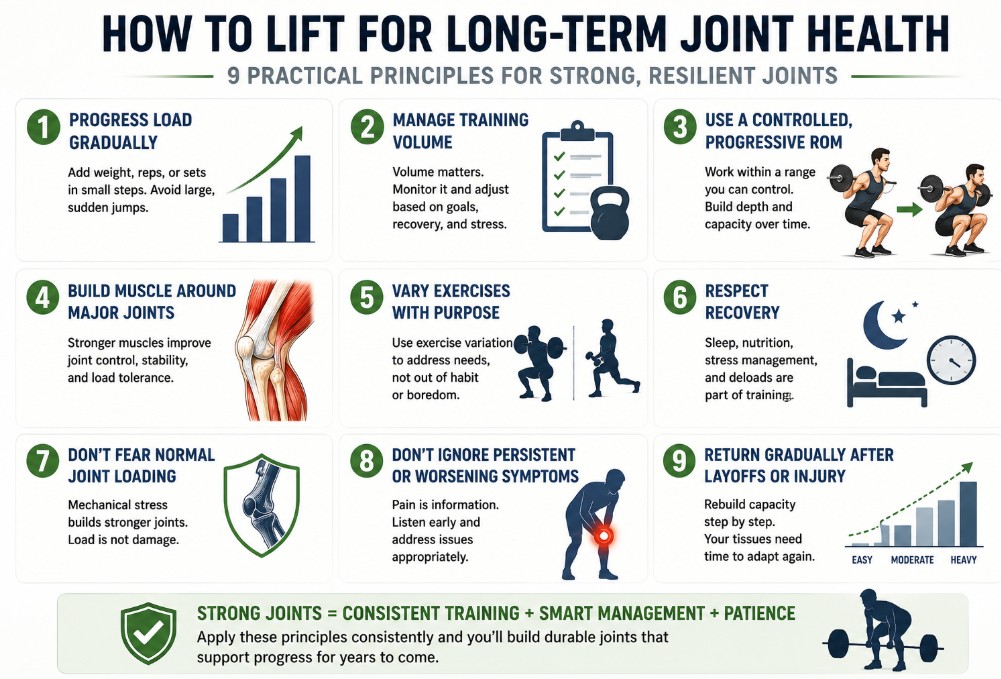
18. How to Lift for Long-Term Joint Health
Practical principles, drawn from everything covered above.
- Progress load gradually rather than making large, sudden jumps in volume or intensity.
- Manage training volume as a genuine variable, not an afterthought.
- Use a range of motion you can control and progressively develop, rather than either avoiding depth entirely or forcing it before you’re ready.
- Build muscle around major joints — the neuromuscular and muscular contribution to joint control genuinely matters, as covered throughout our regional joint guides.
- Vary exercises when it serves a purpose — not randomly, but not never either.
- Respect recovery as part of the loading equation, not separate from it.
- Don’t fear normal joint loading. As this entire guide has established, mechanical stress is not synonymous with damage.
- Don’t ignore persistent or worsening symptoms. As section 13 covered, pain deserves attention, not dismissal.
- Return gradually after layoffs or injury, rather than picking up where you left off.
19. When Joint Symptoms Deserve More Attention
A brief, direct list to close on. Persistent or worsening pain, significant swelling, joint locking, instability or a sense of the joint giving way, loss of function or range of motion, a sudden traumatic pop, and marked weakness all warrant proper professional assessment rather than self-management based on the general reassurance covered throughout most of this guide.
20. Training Implications for Lifters
Four core messages, drawn from everything this guide has covered.
- Loading joints is normal. It’s not something to avoid — it’s the mechanism through which the tissues in and around a joint adapt.
- Mechanical stress is not synonymous with damage. The distinction covered in section 2 runs through this entire guide.
- Joint tissues exist within a biological system capable of adaptation — not a fixed mechanical part counting down toward failure.
- The goal isn’t to avoid loading your joints — it’s to develop enough capacity for the loads you want them to tolerate, while being honest about where the evidence genuinely differs between recreational and elite competitive contexts.
Coach’s Note: After decades of hearing that squats ruin knees and heavy weights wear out joints, many lifters become afraid of the very loading their bodies are designed to tolerate and adapt to. Respect load, progress it intelligently, and respond to symptoms — but don’t confuse mechanical stress with mechanical destruction.
Key Takeaways
- ✓Resistance training does not simply “wear out” healthy joints in most recreational contexts — a history of strength training is associated with lower, not higher, odds of symptomatic knee osteoarthritis.
- ✓Mechanical loading and joint damage are not synonymous — stress, strain, and damage are three distinct concepts.
- ✓Articular cartilage is a living, load-responsive tissue that compresses and recovers under normal loading — compression itself is not damage.
- ✓Elite, competitive strength athletes show a genuinely different risk picture than recreational lifters — this guide doesn’t obscure that difference.
- ✓Osteoarthritis is a whole-joint disease shaped by many risk factors, not simply accumulated mechanical “wear.”
- ✓“Knees past toes” and “deep squats destroy knees” are both myths specifically contradicted by direct biomechanical research.
- ✓Sudden changes in training load matter more than lifting itself — the relevant concept is load versus current tissue capacity.
- ✓Long-term joint health depends on balancing loading demands with tissue capacity, not on avoiding load altogether.
Frequently Asked Questions
Does weightlifting damage your joints? +
For most healthy people engaged in recreational resistance training, the evidence does not support that weightlifting simply damages joints — a history of strength training is actually associated with lower odds of symptomatic knee osteoarthritis. Problems are more closely tied to load exceeding current tissue capacity, sudden training changes, or training despite significant symptoms, not to lifting weights itself.
Does lifting weights cause arthritis? +
For recreational lifters, evidence suggests strength training is associated with lower, not higher, arthritis risk. The picture is more nuanced for elite competitive strength athletes specifically, where some studies have found higher osteoarthritis rates than in some comparison groups — though contributing factors like body mass have also been identified alongside training exposure.
Can heavy lifting wear out cartilage? +
Not simply because the load is heavy. Cartilage is a living tissue that compresses and recovers under normal loading. Problems relate more to load exceeding current tissue capacity, acute trauma, or loading an already compromised joint, rather than heavy loading itself being inherently destructive.
Are squats bad for your knees? +
Not inherently. Research directly testing the popular “knees past toes” concern found that restricting forward knee travel decreased knee torque but significantly increased hip torque — the demand shifted rather than disappeared, contradicting the idea that knee travel alone determines injury risk.
Are deep squats bad for your knees? +
Not inherently. A scoping review examining deep squatting’s impact on knee joint structures found no consistent evidence that it’s inherently harmful to healthy knees. Training history, gradual progression, individual anatomy, and technique all shape tolerance for a given depth.
Is heavy lifting bad for your shoulders? +
Not simply because of load magnitude. Grip width, range of motion, bar path, shoulder position, and technique all measurably change shoulder joint loading during pressing movements — research shows specific setup choices, not the weight alone, determine how the shoulder is loaded.
Does weightlifting strengthen your joints? +
“Strengthening a joint” isn’t a precise concept, since a joint is a system of different tissues. Training can improve muscle strength, tendon capacity, bone density, and neuromuscular control around a joint, each through its own mechanism and timeline, rather than the joint “strengthening” as one uniform process.
Are machines better for your joints than free weights? +
Not necessarily. A controlled study directly comparing matched free-weight and machine-based training found no meaningful difference in joint discomfort between the two modalities, alongside similar strength and hypertrophy outcomes. Individual context matters more than the equipment category.
Are lighter weights better for joint health? +
Not automatically. Load, repetitions, range of motion, frequency, and fatigue all interact to determine total mechanical exposure. A high-rep set near failure can represent substantial joint loading, just as a heavy, low-rep set can — neither approach has an inherent joint-health advantage.
Can you lift weights safely as you get older? +
Generally yes, with the same core principles covered throughout this guide — gradual progression, appropriate load management, and attention to genuine symptoms. Joint tissues remain capable of responding to loading later in life, even as baseline tissue properties shift with age.
References
- Salman, L. A., Ahmed, G., Dakin, S. G., Kendrick, B., & Price, A. (2023). Osteoarthritis: a narrative review of molecular approaches to disease management. Arthritis Research & Therapy, 25, 27. https://doi.org/10.1186/s13075-023-03006-w
- Lo, G. H., Richard, M. J., McAlindon, T. E., Kriska, A. M., Price, L. L., Rockette-Wagner, B., Eaton, C. B., Hochberg, M. C., Kwoh, C. K., Nevitt, M. C., & Driban, J. B. (2024). Strength Training Is Associated With Less Knee Osteoarthritis: Data From the Osteoarthritis Initiative. Arthritis & Rheumatology, 76(3), 377–383. https://doi.org/10.1002/art.42732
- Kujala, U. M., Kettunen, J., Paananen, H., Aalto, T., Battié, M. C., Impivaara, O., Videman, T., & Sarna, S. (1995). Knee osteoarthritis in former runners, soccer players, weight lifters, and shooters. Arthritis & Rheumatism, 38(4), 539–546. https://doi.org/10.1002/art.1780380413
- Kujala, U. M., Kaprio, J., & Sarna, S. (1994). Osteoarthritis of weight bearing joints of lower limbs in former élite male athletes. BMJ, 308(6923), 231–234. pubmed.ncbi.nlm.nih.gov/8111258
- Fry, A. C., Smith, J. C., & Schilling, B. K. (2003). Effect of knee position on hip and knee torques during the barbell squat. Journal of Strength and Conditioning Research, 17(4), 629–633. pubmed.ncbi.nlm.nih.gov/14636100
- Rojas-Jaramillo, A., Cuervo-Arango, D. A., Quintero, J. D., Ascuntar-Viteri, J. D., Acosta-Arroyave, N., Ribas-Serna, J., González-Badillo, J. J., & Rodríguez-Rosell, D. (2024). Impact of the deep squat on articular knee joint structures, friend or enemy? A scoping review. Frontiers in Sports and Active Living, 6, 1477796. https://doi.org/10.3389/fspor.2024.1477796
- Noteboom, L., Belli, I., Hoozemans, M. J. M., Seth, A., Veeger, H. E. J., & Van Der Helm, F. C. T. (2024). Effects of bench press technique variations on musculoskeletal shoulder loads and potential injury risk. Frontiers in Physiology, 15, 1393235. https://doi.org/10.3389/fphys.2024.1393235
- Hernández-Belmonte, A., Martínez-Cava, A., Buendía-Romero, Á., Franco-López, F., & Pallarés, J. G. (2023). Free-Weight and Machine-Based Training Are Equally Effective on Strength and Hypertrophy: Challenging a Traditional Myth. Medicine & Science in Sports & Exercise, 55(12), 2316–2327. https://doi.org/10.1249/MSS.0000000000003271
