
Are deep squats bad for the knees? There are many myths associated with strength training. A few of the most significant ones still impact the effectiveness of a strength training program for athletes. Fears of medical problems are related to the development of these myths.
One of the most enduring myths of strength training is the danger of squats or deep knee bends on the integrity of the knee. If you are among the people who still believe in the validity of the thesis that says that deep squatting is harmful to the knees of healthy individuals and that, despite the good form of execution, it in itself causes injury, you should definitely read this article.
Full versus partial squats
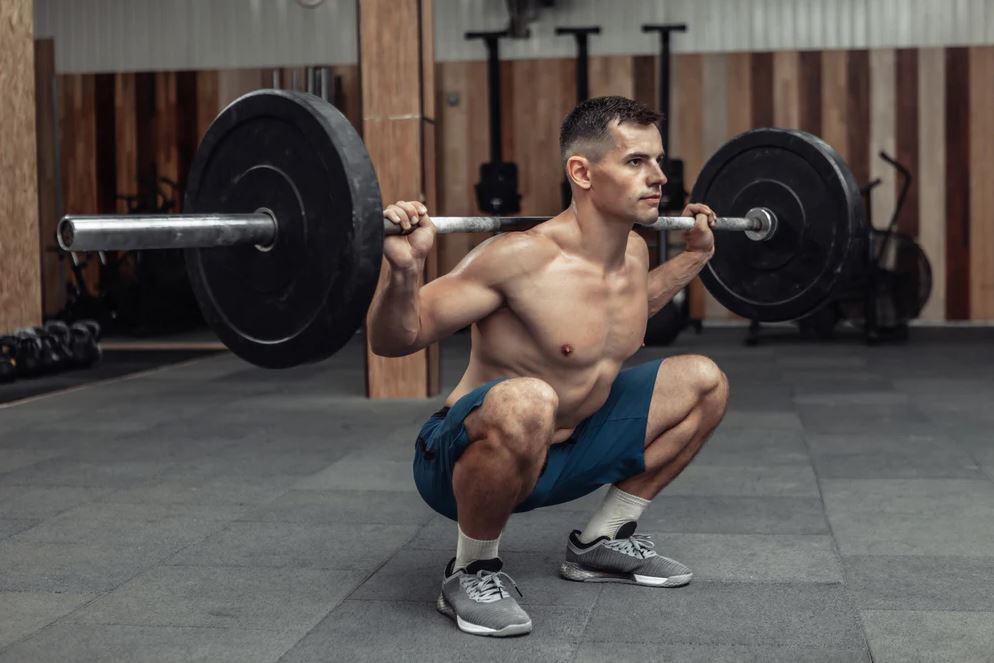
Different ranges of motion are used and recommended for squat training. Quarter squats consist of squatting down only a quarter of the trajectory to an approximate knee angle of 120 degrees. Parallel squats are carried out until the top of the thighs are parallel to the floor, while during deep squats the hips pass well below knee height (the posterior thigh comes in contact with the calf) which typically occurs between 130 and 150-degree knee flexion.
Muscle activation during the squat exercise
Muscle activation during the squat exercise is dependent on both training load and squat depth. Activation of both the hip and knee extensors increases with greater squat depth, while heavier loads only augment hip extensor activity. Deep squats seem to be required to maximize knee extensor activation. This is in accordance with research findings that observed deep squat training elicits superior increments in strength and thigh hypertrophy compared to partial squat training.
Deep squat training also results in a superior increase in jump performance compared to quarter squat training. Despite lower training loads, deep and parallel squats induce higher levels of knee extensor activation and tension for the improvement of hypertrophy and strength.
Where did this fear come from?
How did the misconception that deep squats cause knee injuries come about? At the end of the fifties of the last century, Dr. Karl Klein published a paper based on the fact that the cause of frequent injuries in Olympic weightlifters and American football players is precisely the performance of deep squats.
According to the theory, the deep squat stretched the knee ligaments, making them more susceptible to injury. More precisely, dr. Klein stated that deep squats could increase the laxity of the knee ligaments (collateral and anterior cruciate ligament laxity).
There is no convincing evidence that squats are injurious to the knee. One suspects that this impression derives from power athletes who, by the nature of competition, are performing at the physical limits of their tissue, and injure themselves performing 1-RM squats.
More than 60 years have passed since then, and over the years we have developed more advanced and reliable research methods in the fields of biomechanics and anatomy. With these achievements, we now have real insight into things that Dr. Klein could not have known then.
The real truth about the deep squat and knee ligaments
The ligaments that are the object of fear in the deep squat are the anterior and posterior cruciate ligaments.
Interestingly, all later studies have refuted Klein’s findings (Meyers. 1971: Steiner et al, 1986: Chandler et al, 1989; Panariello et al, 1994). Studies have demonstrated that the risk of injury to the knee is significantly lower in the deepest part of the squat.
In the case of the anterior cruciate ligament, research shows that the greatest stress is in the first 15 to 30 degrees of knee flexion when we descend in the negative part of the squat. As the depth of the squat increases, the tension on the anterior cruciate ligament actually decreases.

Also, the forces acting on the anterior cruciate ligament during squatting are less than 25% of its total ability to withstand the same force without damage.
The posterior cruciate ligament experiences the greatest forces at about 90 degrees of knee flexion, at the so-called “parallel”, and the greatest forces acting on it during squatting are 50% of what it can bear.
Deep squatting may also have a protective effect on the knee ligaments, due to compression of the soft tissue within the knee joint (Li et al, 2004) — in other words, there is reduced motion of the lower leg in the deepest part of the squat. While the greatest risk for injury during deep squatting would theoretically be to the menisci and cartilage, there is little evidence to show a cause-effect relationship in healthy subjects. So there is no fear of ligament injury in the deep squat!
What is the connection between the deep squat and muscle growth?
In terms of muscular development, deep squats can help to develop and maintain a structural balance between the hamstrings and quads, increase glute activation more than parallel squats, and specifically target the vastus medialis obliquus muscle (Caterisano et al. 2002).
If we are talking about maximizing muscle growth, a greater range of motion gives us multiple benefits. First of all, in the ratio of stimulus and fatigue, a deep squat with a lower weight always wins, rather than a half squat with a slightly higher load. Why? When we put less weight on our back, our joints and central nervous system suffer much less fatigue, and by increasing the range of motion (in this case, by increasing the depth of the squat), we actually give our muscles a greater stimulus, which, if the recovery factor is met, will end up as muscle growth.
We will do more total work, that is, a greater volume of training, which is the main cause of hypertrophy. Deep and parallel squats provide better neural and tension stimuli to the knee and hip extensors, which results in greater hypertrophy, strength, and power gains.
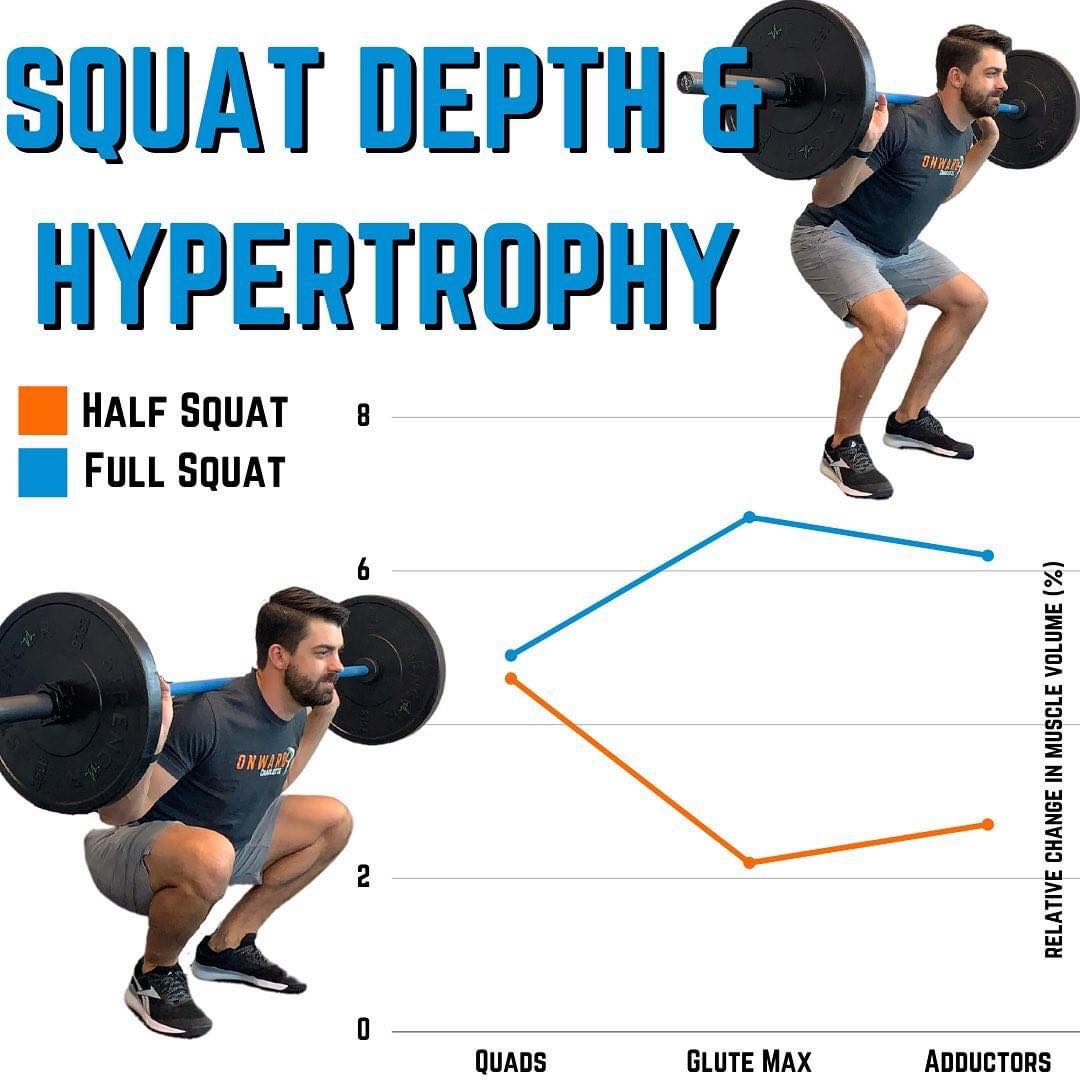
The higher movement velocities and activation level of the leg extensor muscles during deep squats compared to partial squats result in enhanced fast-twitch muscle fiber recruitment.
A lot of research has already been done on this topic. For example, one study showed a larger quadriceps cross-section in a group that performed a full-range squat (deep squat) as opposed to a half squat.
Also, by reducing ego lifting, we will comparatively reduce the chance of potential injury. Avoiding ego lifting is not avoiding intense and heavy sets, it is adjusting the intensity to be optimal for progress. Your goal is not to impress any onlookers who happen to be using a nearby squat rack.
If you sacrifice range of motion and form for the purpose of only lifting unreasonable weights on the bar, you are doing something wrong.
Be aware of the danger resulting from quarter squats
During quarter squats excessive weight has to be lifted to provide a training stimulus. These high loads increase the axial loading and compressive forces on the lumbar spine, which increases shear forces and intradiscal pressure.
Even novice lifters can handle loads of up to four times their body weight during quarter squats. Such a high load places an extremely high demand on the lower back extensors to stabilize the spine. Rather than the legs, the lower back would limit performance during the quarter squat. The overload and training effect for the legs is therefore limited during quarter squats.
Strict partial-range squat training does not provide adequate lower body hypertrophy and strength stimulus and compromises the transfer to athletic performance.
Conclusion – Are deep squats bad for the knees?
Deep, controlled squats not only are NOT “bad for the knees”, they are, in fact, good for the knees.
Properly performed, deep squats evenly and proportionately strengthen all muscles which stabilize and control the knee (in addition to strengthening the muscles of the hip and posterior chain, upper back, shoulder girdle, etc). When the hips are lowered in a controlled fashion below the level of the top of the patella, full hip flexion has occurred, and this will activate the hamstrings and glutes. In doing so, the hamstrings are stretched at the bottom of the motion and they pull the tibia backward (toward the butt) which counteracts the forward-pulling force the quadriceps apply during the motion.
As a result, the stress on the knee tendons is lessened since the hamstrings assist the patellar tendon in the stabilization of the knee. A muscle supporting a tendon that supports the kneecap is going to be better than the tendon having to take up the entirety of the strain by itself.
If you are a healthy individual, have sufficient mobility, do not have pain in the joints and your goal is to develop strength and muscle mass, a properly executed squat below parallel is the optimal thing for you and your goals.
