



Introduction
The deadlift is one of the most effective exercises for building total-body strength, muscle mass, and athletic performance. It trains multiple muscle groups simultaneously, including the glutes, hamstrings, core, upper back, and spinal erectors, making it a staple in many strength-training programs.
However, it is also one of the most common exercises associated with lower back discomfort.
Many lifters finish a deadlift workout only to notice soreness, stiffness, or even pain in their lower back later that day or the following morning. This often leads to an important question:
“Is this normal, or did I do something wrong?”
The answer depends on the situation.
In some cases, feeling your lower back after deadlifts is completely normal. The muscles that support and stabilize the spine work hard during the exercise and can become sore just like any other muscle group.
In other cases, persistent discomfort may indicate technical errors, poor bracing, excessive loading, muscle imbalances, or recovery issues that require attention.
As a coach working with lifters and athletes, I’ve found that many people immediately assume the worst whenever they feel their lower back after deadlifting. In reality, not all lower back discomfort means injury. The key is understanding why it happens and learning how to distinguish normal training-related soreness from signs that something needs to change.
In this article, we’ll explore the most common reasons your lower back may hurt after deadlifts and explain what you can do to improve your technique, reduce discomfort, and deadlift with greater confidence.
Why Does My Lower Back Hurt After Deadlifts? (Quick Answer)
Is It Normal to Feel Your Lower Back After Deadlifts?
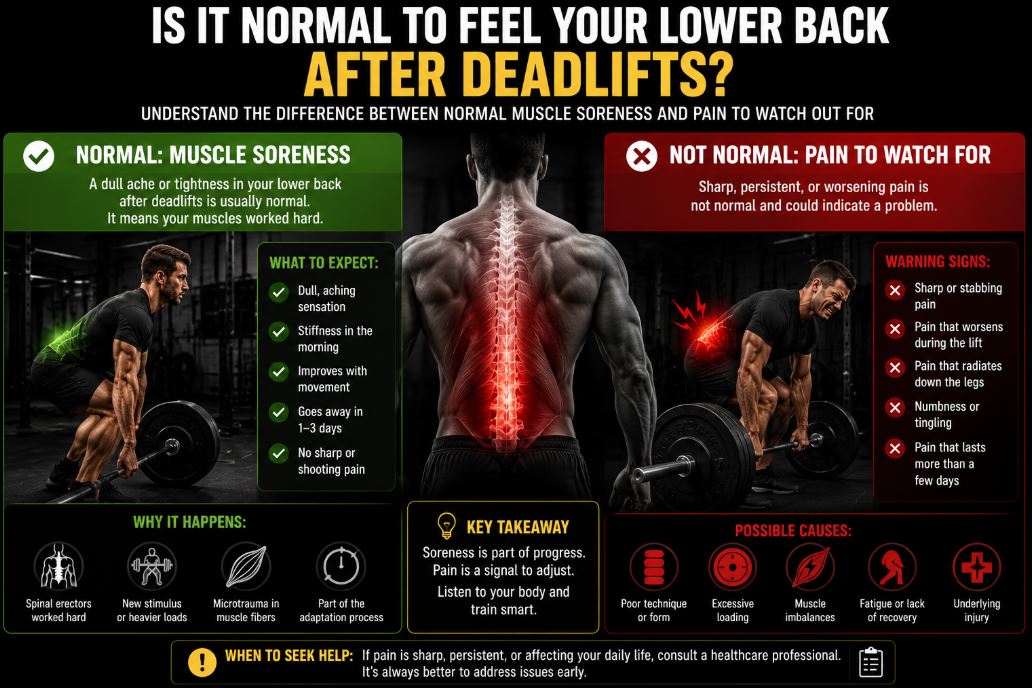
Before assuming something is wrong, it’s important to understand that feeling in your lower back after deadlifts isn’t always a bad sign.
The deadlift places significant demands on the muscles that stabilize and support the spine, particularly the spinal erectors. These muscles work throughout the lift to maintain a strong, neutral position and resist forces that would otherwise cause the spine to flex.

Just like your hamstrings, glutes, or upper back can become sore after a challenging workout, your spinal erectors can also experience normal post-exercise soreness.
This type of soreness is usually characterized by:
- Mild to moderate muscle tenderness
- General stiffness in the lower back
- Discomfort that improves over several days
- Symptoms that are present on both sides of the spine
- No significant impact on normal daily activities
In many cases, this is simply a sign that the muscles worked hard during the exercise.
The situation becomes more concerning when the sensation feels less like soreness and more like pain.
Potential warning signs include:
- Sharp or stabbing pain
- Pain that worsens rather than improves
- Pain radiating into the glutes or legs
- Numbness or tingling sensations
- Significant movement limitations
- Symptoms that persist for an extended period
These signs may indicate that something other than normal muscle soreness is occurring and should not be ignored.
As a coach working with lifters and athletes, I’ve found that many people struggle to distinguish between muscle soreness and injury. Some panic over perfectly normal post-workout soreness, while others ignore symptoms that deserve attention. Learning the difference is one of the most valuable skills a lifter can develop.
The goal is not to eliminate all sensation from the lower back during or after deadlifts.
The goal is to ensure that what you’re feeling is normal muscular fatigue and adaptation rather than pain caused by poor mechanics, excessive loading, or injury.
Now let’s look at the most common reasons lower back pain occurs after deadlifts and how to fix them.
10 Causes & Fixes
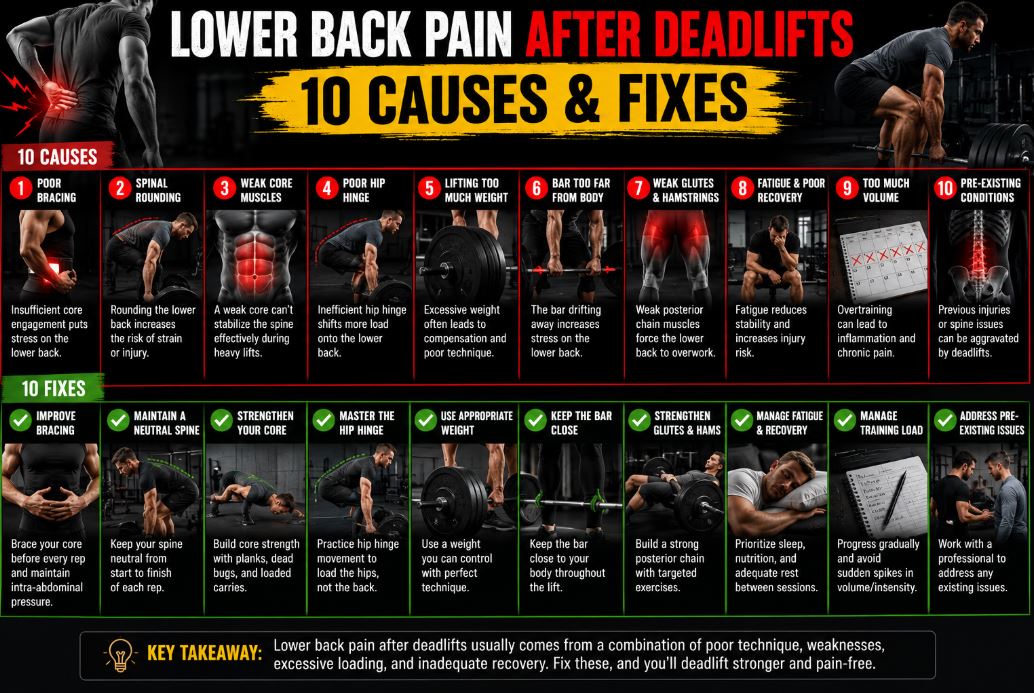
Reason #1: You’re Not Bracing Properly
If there is one mistake responsible for more deadlift-related lower back discomfort than almost any other, it’s poor bracing.
Many lifters focus heavily on grip, stance, and the amount of weight on the bar, yet pay very little attention to how they stabilize their torso before initiating the lift.
Bracing refers to creating tension throughout the core before and during the deadlift. Think of it as building a strong, rigid cylinder around the spine that helps resist unwanted movement under load.
When bracing is performed correctly, the abdominal muscles, obliques, diaphragm, and lower back muscles work together to create stability. This allows force to be transferred efficiently from the legs and hips into the barbell while reducing unnecessary stress on the spine.
The problem occurs when lifters fail to create enough tension before pulling the weight from the floor.
Without adequate bracing, the lower back often becomes the body’s primary stabilizer. As the load increases, the spinal erectors must work much harder to maintain position, increasing fatigue and potentially contributing to discomfort after the workout.
This issue becomes even more noticeable during heavier sets, where small technical errors are magnified by the weight lifted.
As a coach working with lifters and athletes, I’ve frequently seen lower back discomfort improve dramatically without changing the training program at all. Instead, the solution was simply learning how to brace properly before each repetition.
In many cases, the lower back wasn’t weak. It was being forced to do a job that should have been shared by the entire core. The encouraging news is that bracing is a skill that can be learned and improved with practice.
How To Fix It
If poor bracing may be contributing to your lower back pain:
- Take a deep breath into your abdomen before each repetition.
- Expand your midsection in all directions rather than lifting your chest excessively.
- Tighten your abdominal muscles as if bracing for a punch.
- Maintain this tension throughout the lift.
- Reset your brace before every repetition, rather than rushing through sets.
- Practice bracing during lighter loads before applying it to heavier deadlifts.
A stronger brace often leads to a stronger deadlift. More importantly, it can significantly reduce unnecessary stress on your lower back.
Reason #2: Your Lower Back Is Rounding
Few deadlift mistakes receive more attention than a rounded lower back.
While the topic is often oversimplified online, excessive spinal rounding during deadlifts can increase stress on the lower back structures and contribute to post-training discomfort.
The deadlift is designed to be performed with a stable, neutral spine. This doesn’t mean your back must be perfectly straight like a ruler, but it does mean the spine should remain relatively stable throughout the movement.
Problems occur when the lower back loses its position and begins to flex excessively under load.

When this happens, the muscles, ligaments, discs, and connective tissues of the lower back may be exposed to forces they are not well prepared to handle. As the weight increases, these forces can become even more significant.
Several factors can contribute to spinal rounding during deadlifts:
- Poor bracing
- Using too much weight
- Limited hip mobility
- Poor starting position
- Weakness in the core or posterior chain
- Fatigue during later sets
The challenge is that many lifters don’t realize their back is rounding. The movement may feel normal while lifting, but video analysis often reveals technical breakdowns that aren’t obvious in real time.
As a coach working with lifters and athletes, I’ve found that many cases of lower back discomfort improve once lifters learn to maintain a more stable spinal position throughout the lift. In many situations, the issue isn’t deadlifting itself—it’s how the deadlift is being performed.
It’s also important to remember that not every slight deviation from a perfectly neutral spine automatically leads to injury. Human movement is complex, and many experienced lifters can tolerate small amounts of rounding without problems.
However, excessive rounding under heavy loads significantly increases the risk of lower back irritation and discomfort.
How To Fix It
If lower back rounding may be contributing to your pain:
- Reduce the weight until proper positioning can be maintained.
- Improve your bracing technique before each repetition.
- Film your deadlifts to objectively evaluate spinal position.
- Focus on keeping your chest up and your torso tight during the setup.
- Strengthen your core and posterior chain muscles.
- Stop sets when technique begins to deteriorate rather than pushing through fatigue.
The goal is not to achieve a perfectly rigid spine at all costs. The goal is to maintain enough stability that the lower back can safely transfer force throughout the lift without becoming the weak link.
Reason #3: The Bar Is Too Far Away From Your Body
The position of the barbell may seem like a small detail, but it can have a massive impact on how much stress is placed on your lower back during deadlifts.
One of the most common technical mistakes lifters make is allowing the bar to drift too far away from their body.
From a biomechanical standpoint, this creates a problem.
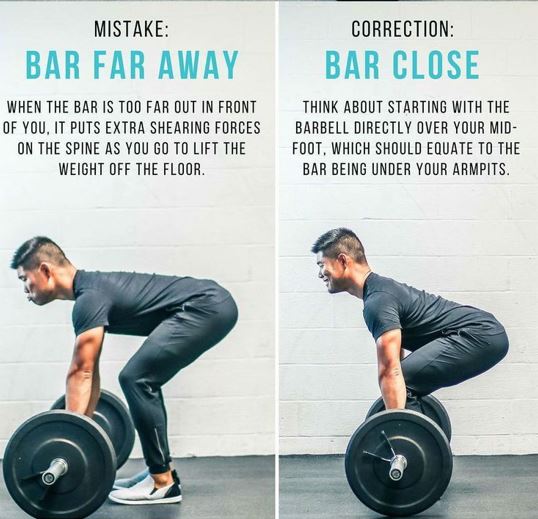
As the distance between the barbell and your body increases, the lever arm acting on the lower back becomes longer. Even a small increase in distance can dramatically increase the amount of force the spinal erectors must generate to keep the torso from collapsing forward.
In simple terms, the farther the bar moves away from you, the harder your lower back has to work.
This often happens for several reasons:
- The bar starts too far from the shins.
- The lifter pulls with the back instead of driving through the legs.
- The lats aren’t engaged properly.
- Fatigue causes technique to deteriorate during later repetitions.
- The lifter loses balance, allowing the bar path to drift forward.
When this occurs repeatedly, the lower back can become overworked and sore after training.
As a coach working with lifters and athletes, I’ve frequently seen lower back discomfort decrease simply by improving bar path. In many cases, the issue wasn’t insufficient strength or mobility—it was that the bar was traveling farther from the body than necessary.
The deadlift becomes much more efficient when the bar stays close throughout the movement.
Not only does this reduce unnecessary stress on the lower back, but it also often improves lifting performance.
A more efficient bar path means less wasted energy and better force transfer into the barbell.
How To Fix It
If the bar is drifting away from your body:
- Start with the bar positioned close to your shins.
- Keep the bar in contact with or very close to your legs throughout the lift.
- Engage your lats before initiating the pull.
- Think about pulling the bar “back toward you” rather than simply lifting it upward.
- Film your deadlifts from the side to evaluate bar path.
- Reduce the load if technique breaks down during heavier sets.
A good deadlift bar path is typically very close to vertical.
The closer the bar stays to your center of mass, the less unnecessary stress your lower back must absorb.
Reason #4: You’re Trying to Lift Too Much Weight
Sometimes the cause of lower back pain after deadlifts is surprisingly simple:
You’re lifting more weight than you’re currently prepared to handle.
Deadlifts are often viewed as the ultimate test of strength. Because of this, many lifters become highly focused on adding weight to the bar as quickly as possible. While progressive overload is an essential part of building strength and muscle, problems arise when the load increases faster than technique and stability can keep up with.
As the weight becomes heavier, even small technical errors become much more costly.
A slight loss of bracing. A small amount of spinal rounding. A minor shift in bar position.
Under lighter loads, these mistakes may not cause any noticeable issues. Under heavier loads, however, they can place significantly more stress on the lower back.
The body will always find a way to complete a lift if possible.
Unfortunately, that doesn’t mean it will complete the lift efficiently.
When the weight exceeds what your current strength and technique can support, compensation patterns often emerge. The lower back is often among the first areas forced to absorb this additional stress.
This is why many lifters report that their lower back only hurts during their heaviest sets.
Their technique may look excellent with moderate loads but begin to deteriorate once the weight approaches their limits.
As a coach working with lifters and athletes, I’ve found that many lower back issues disappear when people temporarily reduce the load and rebuild their technique. In many cases, the problem isn’t the deadlift itself—it’s that the lifter is attempting to perform a technically demanding exercise with a weight they aren’t yet ready to control consistently.
Strength should be earned gradually.
Trying to rush the process rarely ends well.
How To Fix It
If excessive loading may be contributing to your lower back pain:
- Reduce the weight and focus on perfect technique.
- Increase load gradually rather than making large jumps.
- Prioritize movement quality over ego.
- Stop adding weight if technique begins to break down.
- Use video analysis to objectively evaluate heavy sets.
- Build strength patiently and consistently over time.
Remember, the goal isn’t simply to lift the heaviest weight possible.
The goal is to lift the heaviest weight you can control safely and efficiently. Very often, that’s the key difference between productive deadlifting and lower back pain.
Reason #5: Your Core Is Too Weak
Many lifters assume that deadlifts primarily challenge the glutes, hamstrings, and lower back.
While those muscles certainly play a major role, the core is equally important.
In fact, one of the core’s primary functions during a deadlift is to prevent movement rather than create it. The abdominal muscles, obliques, transverse abdominis, and other stabilizing muscles work together to help maintain spinal position while the lower body generates force.
When the core cannot provide sufficient stability, the lower back is often forced to compensate.
This creates a situation where the spinal erectors must work harder than they should, increasing fatigue and potentially contributing to soreness or pain after training.
The challenge is that many people underestimate how demanding deadlifts are on the core.
They may have visible abdominal muscles or do plenty of crunches, yet still lack the stability required to support heavy loads during compound lifts.
A strong deadlift requires more than simply having strong abs.
It requires the ability to create and maintain full-body tension throughout the entire movement.
When that stability is lacking, the body often finds other ways to complete the lift—and the lower back frequently pays the price.
As a coach working with lifters and athletes, I’ve seen many cases where lower back discomfort improved after core strength and stability were addressed. The lifter often assumed their back was the problem when, in reality, their core wasn’t providing enough support to protect it.
This is one reason why strengthening the core can often improve both deadlift performance and lower back comfort.
How To Fix It
If a weak core may be contributing to your lower back pain:
- Focus on improving bracing technique before every deadlift.
- Include core stability exercises in your training program.
- Prioritize exercises that resist movement rather than create it.
- Practice maintaining tension throughout every repetition.
- Avoid letting your torso go loose as the weight increases.
- Progress deadlift loads gradually while core strength improves.
Effective core exercises may include:
Remember, the core acts as the bridge between the upper and lower body. The stronger and more stable that bridge becomes, the less likely your lower back is to absorb forces it was never meant to handle alone.
Reason #6: You’re Using Poor Hip Hinge Mechanics
The deadlift is fundamentally a hip hinge exercise.
Unfortunately, many lifters never learn how to hinge properly.
Instead of loading the hips and allowing the glutes and hamstrings to perform most of the work, they compensate by bending excessively through the lower back or turning the movement into an awkward hybrid between a squat and a deadlift.

This often places unnecessary stress on the lumbar spine.
A proper hip hinge involves pushing the hips backward while maintaining a stable spine and allowing the torso to lean forward naturally. The glutes and hamstrings should be responsible for generating much of the force required to lift the bar.
When the movement pattern breaks down, the lower back frequently becomes overworked.
Some lifters initiate the pull by aggressively extending the lower back instead of driving through the hips.
Others struggle to load their posterior chain effectively and end up relying on spinal movement to complete the lift.
In both situations, the lower back may be exposed to forces that could have been distributed more efficiently throughout the hips and legs.
The problem is that poor hip hinge mechanics often feel normal to the person performing them.
Many lifters have spent years moving this way without realizing it.
As a coach working with lifters and athletes, I’ve found that teaching someone to hinge properly can completely change how a deadlift feels. Once the hips begin doing their share of the work, the lower back often feels less stressed, the lift becomes more powerful, and overall technique improves significantly.
This is one reason why movement quality is often more important than simply adding weight to the bar.
If the movement pattern is flawed, increasing the load usually magnifies the problem.
How To Fix It
If poor hip hinge mechanics may be contributing to your lower back pain:
- Practice pushing your hips backward before initiating the pull.
- Focus on loading the glutes and hamstrings during the setup.
- Maintain a stable spine throughout the movement.
- Avoid initiating the lift by extending the lower back.
- Use lighter loads while refining technique.
- Record your deadlifts to identify movement errors.
Exercises that can help improve hip hinge mechanics include:
- Romanian deadlifts
- Hip hinges with a dowel
- Kettlebell deadlifts
- Pull-throughs
- Glute bridges
- Hip thrusts
Remember, the deadlift is a hip-dominant movement. The more effectively you use your hips, the less likely your lower back is to become the limiting factor.
Reason #7: Your Glutes Aren’t Contributing Enough
The glutes are among the most powerful muscles in the human body.
During a properly executed deadlift, they play a major role in extending the hips and helping drive the body into a strong, upright position at the top of the lift.
When the glutes are doing their job effectively, force is distributed efficiently throughout the posterior chain.
When they’re not, other muscles often have to compensate.
Unfortunately, one of the most common compensation patterns involves the lower back.
If the glutes fail to generate sufficient force, the spinal erectors may have to work harder to complete the lift. Over time, this additional workload can contribute to excessive fatigue, soreness, and lower back discomfort after training.
Several factors can reduce glute contribution during deadlifts:
- Poor hip hinge mechanics
- Weak glute muscles
- Limited hip mobility
- Poor movement awareness
- Excessive sitting outside the gym
- Technical breakdown under heavy loads
The result is often a deadlift that relies too heavily on the lower back and not enough on the hips.
This issue can be difficult to recognize because the lift may still appear successful from the outside. The bar reaches lockout, the repetition is completed, and everything seems fine.
However, the body may be using a less efficient strategy to get there.
As a coach working with lifters and athletes, I’ve frequently seen lower back discomfort improve after addressing glute strength and activation. In many cases, the lower back wasn’t necessarily weak or injured—it was simply doing more work than it should have been because the glutes weren’t contributing enough.
A stronger posterior chain is often a healthier posterior chain.
When the glutes perform their intended role, the lower back no longer has to compensate for their shortcomings.
How To Fix It
If insufficient glute involvement may be contributing to your lower back pain:
- Focus on proper hip hinge mechanics.
- Learn to actively drive through the hips during the lift.
- Strengthen the glutes with targeted exercises.
- Avoid rushing the lockout portion of the deadlift.
- Use lighter weights while improving movement quality.
- Pay attention to where you feel the exercise working.
Exercises that can help improve glute strength and contribution include:
- Hip thrusts
- Glute bridges
- Romanian deadlifts
- Bulgarian split squats
- Reverse lunges
- Cable pull-throughs
Remember, the deadlift is not a lower-back exercise.
It’s a full posterior-chain movement. The more effectively your glutes contribute, the less likely your lower back is to become overloaded and painful after training.
Reason #8: You’re Fatigued Before You Start Deadlifting
Sometimes the problem isn’t your deadlift technique.
The problem is the condition you’re in before you even touch the bar.
Many lifters perform deadlifts after completing several demanding exercises earlier in the workout. Heavy squats, leg presses, lunges, Romanian deadlifts, hamstring curls, and other compound movements can significantly reduce the body’s ability to maintain optimal deadlift mechanics.
By the time the deadlift begins, important stabilizing muscles may already be fatigued.
The core may not brace as effectively. The glutes may not contribute as much force. The spinal erectors may already be working hard.
As fatigue accumulates, maintaining proper technique becomes increasingly difficult.
The challenge is that fatigue often causes subtle changes rather than dramatic technical breakdowns. A lifter may still complete every repetition, but small deviations in bracing, spinal position, bar path, and hip mechanics can gradually increase stress on the lower back.
These small changes may not seem significant during the workout.
However, the lower back often notices them later.
As a coach working with lifters and athletes, I’ve frequently seen lower back discomfort disappear simply by changing exercise order. In some cases, nothing about the deadlift itself needed to change. The lifter simply stopped performing it after exhausting themselves with multiple heavy exercises beforehand.
This doesn’t mean deadlifts must always be performed first.
However, if deadlift performance and lower back comfort are priorities, it’s worth considering how much fatigue has accumulated before the lift begins.
The body generally performs best when complex, technically demanding exercises are performed while energy and concentration are still high.
How To Fix It
If fatigue may be contributing to your lower back pain:
- Consider performing deadlifts earlier in your workout.
- Avoid excessive volume before heavy deadlift sets.
- Monitor technique carefully when fatigue increases.
- Reduce deadlift intensity if performed late in the session.
- Allow adequate recovery between demanding lower-body workouts.
- Focus on quality repetitions rather than simply completing planned volume.
Remember, deadlifts require strength, coordination, stability, and concentration.
If all of those resources are already depleted before your first working set, the lower back often ends up paying the price.
Reason #9: You’re Recovering Poorly
Not all lower back pain after deadlifts is due to poor technique.
Sometimes the problem is that your body simply hasn’t recovered from previous training sessions.
Recovery is the process by which muscles, connective tissues, and the nervous system adapt to training stress. When recovery is insufficient, fatigue accumulates faster than the body can repair itself.
As a result, muscles become less resilient, movement quality declines, and discomfort becomes more likely.
The lower back is often one of the first areas to reflect this problem.
Unlike some muscle groups that may only be trained once or twice per week, the lower back is involved in a wide range of activities. It contributes to deadlifts, squats, rows, carries, athletic movements, and even many daily tasks outside the gym.
If recovery is poor, the lower back may never fully return to baseline before being stressed again.
Several factors can impair recovery:
- Inadequate sleep
- Insufficient calorie intake
- Low protein consumption
- High stress levels
- Excessive training volume
- Too little rest between hard workouts
Individually, each factor may have only a modest effect. Together, however, they can significantly reduce recovery capacity.
As a coach working with lifters and athletes, I’ve often seen people blame deadlift technique when the real issue was accumulated fatigue. Their form looked reasonable, but their recovery habits weren’t supporting the amount of training they were performing.
In many cases, improving recovery reduced lower back discomfort without changing the deadlift itself.
This is why recovery should be viewed as part of the training process, not something separate from it.
You don’t get stronger from workouts alone.
You get stronger from recovering from workouts.
How To Fix It
If poor recovery may be contributing to your lower back pain:
- Aim for consistent, high-quality sleep.
- Consume enough calories to support training demands.
- Prioritize adequate daily protein intake.
- Manage overall training volume.
- Schedule rest days when needed.
- Avoid repeatedly training through excessive fatigue.
Remember, even perfect deadlift technique can become difficult to maintain when recovery is inadequate. The better you recover, the better your body can tolerate and adapt to heavy training.
Reason #10: You’re Confusing Muscle Soreness With Injury
One of the biggest reasons people worry about their lower back after deadlifts is that they assume every uncomfortable sensation means something has gone wrong.
In reality, there is a significant difference between normal muscle soreness and an actual injury.
The lower back contains several muscles that work extremely hard during deadlifts, particularly the spinal erectors. After a challenging training session, these muscles can become fatigued and sore just like the hamstrings, glutes, or upper back.
For many lifters, this soreness feels unfamiliar.
Unlike soreness in the arms or chest, lower back soreness often attracts more attention because of the fear associated with back injuries. As a result, completely normal post-workout muscle soreness may be interpreted as a sign of serious damage.
This can create unnecessary anxiety and lead people to avoid deadlifts altogether.
The key is learning to distinguish between soreness and pain.
Normal muscle soreness is typically:
- Dull and achy
- Spread across a broader area
- Symmetrical on both sides of the spine
- Worse when muscles are pressed or stretched
- Gradually improving over several days
In contrast, injury-related pain is often:
- Sharp or stabbing
- Localized to a specific area
- Associated with sudden onset during a lift
- Accompanied by movement restrictions
- Worsening rather than improving
- Radiating into the glutes or legs
As a coach working with lifters and athletes, I’ve seen many people assume they injured their back when they were actually experiencing normal muscular soreness from training. At the same time, I’ve also seen people ignore genuine warning signs because they assumed it was “just soreness.”
Neither extreme is helpful.
The goal is not to panic every time your lower back feels tired after deadlifts.
The goal is to understand what your body is telling you and respond appropriately.
How To Fix It
If you’re unsure whether you’re dealing with soreness or injury:
- Pay attention to the quality of the sensation.
- Monitor whether symptoms improve over the next few days.
- Consider whether the discomfort feels muscular or structural.
- Avoid immediately assuming the worst.
- Seek professional evaluation if pain is severe, persistent, worsening, or accompanied by neurological symptoms.
Remember, feeling your lower back after deadlifts does not automatically mean you’ve injured yourself.
In many cases, it’s simply evidence that the muscles responsible for stabilizing your spine worked hard and are adapting to the demands of training.
How to Deadlift Without Lower Back Pain
Although we’ve already discussed solutions for each reason your lower back may hurt after deadlifts, it’s helpful to review the most important principles in one place. Lower back pain after deadlifts rarely comes from a single mistake—it is usually the result of several technical, recovery, and programming factors working together.
If your lower back hurts after deadlifting, the solution is rarely to stop deadlifting altogether.
In most cases, the problem can be traced to poor bracing, excessive loading, weak supporting muscles, technical breakdowns, accumulated fatigue, or inadequate recovery. Once these factors are addressed, many lifters discover that deadlifts become both safer and more effective.
As a coach working with lifters and athletes, I’ve found that people often spend too much time searching for a perfect exercise variation and not enough time improving the fundamentals that make every deadlift stronger and safer.
Here are the most important steps.

1. Learn to Brace Properly
A strong brace is one of the most important foundations of a safe deadlift.
Before each repetition, create tension throughout your midsection and maintain it during the lift. Proper bracing helps stabilize the spine and reduces unnecessary stress on the lower back.
2. Maintain a Stable Spine
The goal is not to force an unnatural posture but to maintain a stable spinal position throughout the movement.
Excessive lower back rounding under load often increases stress on spinal structures and can contribute to post-training discomfort.
3. Keep the Bar Close to Your Body
The farther the bar moves away from your body, the harder your lower back must work.
A close, efficient bar path reduces unnecessary strain and improves lifting mechanics.
4. Use a Weight You Can Control
One of the fastest ways to create technical problems is to consistently lift more weight than you can control.
Progressive overload is important, but technique should always take priority over ego.
5. Strengthen Your Core
A strong core helps transfer force efficiently and supports spinal stability throughout the lift.
The more effectively your core performs its job, the less likely your lower back is to become overloaded.
6. Improve Your Hip Hinge Mechanics
Deadlifts should be driven primarily by the hips.
Learning how to properly load the glutes and hamstrings can dramatically reduce unnecessary stress on the lower back.
7. Build Stronger Glutes and Hamstrings
The posterior chain is designed to share the workload.
When the glutes and hamstrings contribute effectively, the lower back no longer has to compensate for their weaknesses.
8. Avoid Deadlifting in a Highly Fatigued State
Heavy deadlifts require strength, coordination, focus, and stability.
Performing them after exhausting yourself with multiple demanding exercises often increases the likelihood of technical breakdown.
9. Prioritize Recovery
Sleep, nutrition, hydration, and stress management all influence how well your body recovers from training.
Even excellent technique can become difficult to maintain when recovery is inadequate.
10. Understand the Difference Between Soreness and Injury
Not every sensation in the lower back is a sign of damage.
Learning to distinguish normal muscular soreness from injury-related pain can help you make better training decisions and avoid unnecessary fear.
The goal is not to eliminate all sensations in the lower back during or after deadlifts.
The goal is to build a strong, resilient body that can perform one of the most effective strength exercises safely, confidently, and consistently for years to come.
How to Relieve Lower Back Pain After Deadlifting
1. Rest and Recovery
Allowing the body to rest is essential for recovery. Avoiding heavy lifting for a few days can give the muscles time to heal.
2. Ice Therapy
Applying ice to the lower back can help reduce inflammation and numb pain. It’s advisable to ice the area for 15-20 minutes every few hours during the first 48 hours post-injury.
3. Gentle Stretching
Gentle stretching can alleviate tension in the lower back. Consider stretches such as:
- Child’s Pose
- Cat-Cow Stretch
- Hamstring Stretch
4. Incorporating Foam Rolling
This can help release muscle tightness and improve circulation. Focus on rolling the lower back, glutes, and hamstrings to address any muscle knots or tension that may be contributing to discomfort.
5. Over-the-Counter Pain Relief
Nonsteroidal anti-inflammatory drugs (NSAIDs) like ibuprofen can help reduce pain and inflammation. Always consult with a healthcare professional before beginning any medication.
6. Physical Therapy
If lower back pain persists, seeking help from a physical therapist can provide targeted relief. A therapist can design a rehabilitation program to strengthen weak areas and improve flexibility.
Coach’s Note — Feeling Your Lower Back Isn’t Always a Bad Thing
As a coach working with lifters and athletes, one of the most common misconceptions I encounter is the belief that you should never feel your lower back after deadlifts.
In reality, the lower back muscles—particularly the spinal erectors—play an important role during the exercise. Their job is to help stabilize the spine and maintain position while the hips and legs generate force. Because these muscles work hard during deadlifts, it’s completely normal for them to feel fatigued or mildly sore afterward.
The problem is that many people automatically assume any sensation in the lower back means they’ve injured themselves. This often creates unnecessary fear and can even cause lifters to avoid one of the most effective strength-building exercises available.
That said, not all discomfort should be ignored. The key is learning to distinguish normal muscular soreness from pain that may indicate a technical problem or injury. Mild stiffness and muscle soreness that gradually improve are usually very different from sharp, localized, or radiating pain.
In my experience, the goal shouldn’t be to eliminate every sensation from the lower back. The goal should be to deadlift with solid technique, recover properly, and ensure that what you’re feeling is normal muscular fatigue rather than unnecessary spinal stress.
A strong lower back is an asset. Deadlifts can help build that strength—but only when they’re performed intelligently and progressively.
Final Thoughts
Lower back pain after deadlifts can be frustrating, especially when you’re putting significant effort into improving your strength and technique.
The good news is that most cases are not caused by a serious injury.
More often, lower back discomfort develops because of factors such as poor bracing, excessive loading, weak supporting muscles, inefficient movement mechanics, accumulated fatigue, or inadequate recovery. In many situations, addressing these factors can dramatically improve both comfort and performance.
It’s also important to remember that feeling in your lower back after deadlifts isn’t automatically a bad sign. The spinal erectors work hard during the exercise and can become sore just like any other muscle group. The key is learning to distinguish normal muscular soreness from pain that may indicate a technical issue or injury.
As a coach working with lifters and athletes, I’ve found that most people make the biggest improvements when they stop searching for a single magic fix and instead focus on mastering the fundamentals. Better bracing, stronger core muscles, improved hip hinge mechanics, appropriate loading, and consistent recovery habits often solve problems that seem much more complicated than they actually are.
The goal is not to avoid challenging exercises.
The goal is to perform them safely, effectively, and consistently.
Deadlifts remain one of the most valuable exercises for building strength, muscle, athleticism, and resilience. When performed with good technique and supported by proper recovery, they can be an incredibly productive part of a long-term training program.
If your lower back hurts after deadlifts, don’t immediately assume you need to abandon the movement. Instead, identify the underlying cause, make the necessary adjustments, and give your body time to adapt.
In many cases, that’s all it takes to turn a frustrating problem into a valuable learning experience—and ultimately become a stronger lifter.
Camara KD, Coburn JW, Dunnick DD, Brown LE, Galpin AJ, Costa PB.
Fischer SC, Calley DQ, Hollman JH.
Kendall KD, Emery CA, Wiley JP, Ferber R.
Ramirez VJ, Bazrgari B, Gao F, Samaan M.
Berglund L, Aasa B, Hellqvist J, Michaelson P, Aasa U.
Escamilla RF, Francisco AC, Kayes AV, Speer KP, Moorman CT 3rd.
Costa LOP, Maher CG, Latimer J, Hodges PW, Herbert RD, Refshauge KM, McAuley JH, Jennings MD.
Luomajoki H, Kool J, de Bruin ED, Airaksinen O.
