


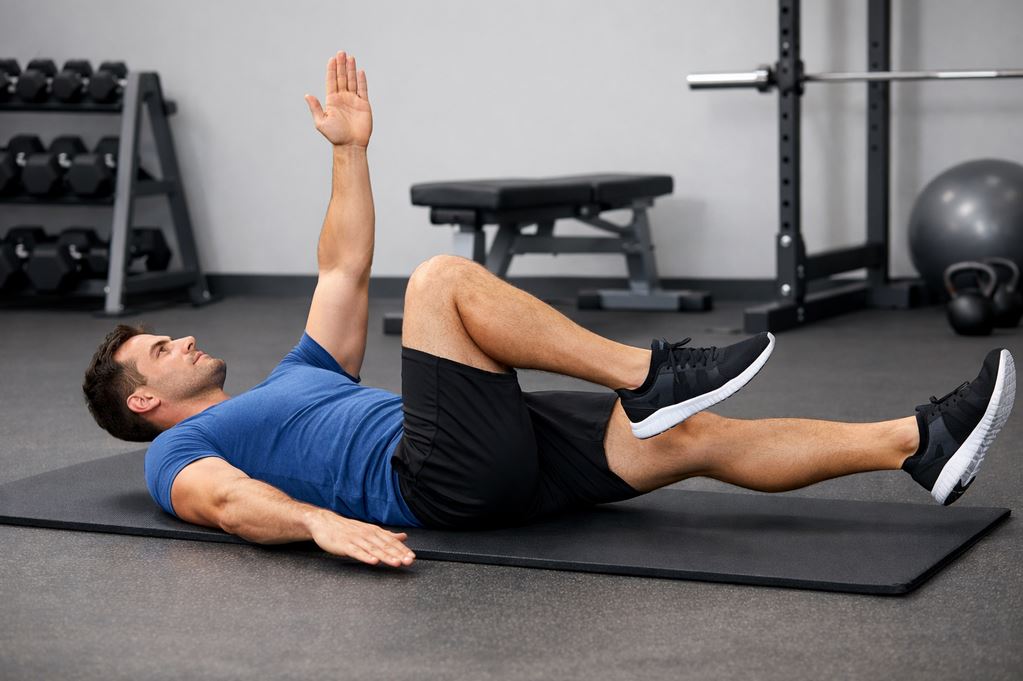
Introduction
The dead bug is one of the most effective exercises for developing deep core stability and spinal control without placing excessive stress on the lower back. Unlike traditional core exercises that emphasize movement or flexion, the dead bug trains resistance to unwanted movement, making it a foundational drill for strength training, rehabilitation, and athletic performance.
This exercise is especially valuable for improving coordination between the core and the limbs while maintaining a neutral spine throughout the movement. Where most ab exercises ask you to create movement, the dead bug asks you to prevent it — the arms and legs move independently while the spine and pelvis stay completely still, which is a fundamentally different and, in many respects, more functionally relevant skill than the flexion-based crunching most people associate with ab training.
The dead bug is not designed to exhaust the abdominal muscles but to improve neuromuscular control. It teaches the core to stabilize the spine while the arms and legs move independently — a skill directly transferable to squats, deadlifts, presses, and athletic movements of nearly every kind.
Exercise Snapshot
Muscles Worked in the Dead Bug
Primary muscles
- Transversus abdominis — provides deep spinal stabilization throughout the entire movement, bracing the trunk before any limb movement begins
- Rectus abdominis — provides anti-extension control, resisting the lower back’s tendency to arch as the limbs extend away from the body
- Internal and external obliques — provide rotational stability, preventing the pelvis or trunk from twisting as the opposite-side limbs move independently
Secondary muscles
- Hip flexors — control the limb movement as the leg extends and returns
- Gluteus muscles — contribute to pelvic stability throughout the movement
- Spinal stabilizers — assist with posture maintenance and overall spinal control
Antagonists
The muscles that would allow the lower back to arch or the pelvis to rotate as the limbs extend — primarily the hip flexors and lower back acting without core control — are the forces that the transversus abdominis, rectus abdominis, and obliques are actively resisting throughout every repetition.
The dead bug is genuinely distinct from most other ab exercises in its underlying purpose. It is not designed to exhaust the abdominal muscles the way a set of crunches might, but to improve neuromuscular control — the brain’s ability to coordinate the core’s stabilizing function with independent limb movement. That coordination skill transfers directly to nearly every compound lift and athletic movement that requires a stable spine while the arms or legs are producing force elsewhere.
How to Do a Dead Bug: Step-by-Step Form Guide
Starting position
- Lie on your back with your arms extended toward the ceiling
- Bend your hips and knees to approximately 90 degrees, creating a tabletop position
- Press your lower back gently into the floor to establish a neutral pelvis
- Engage your core by bracing your abdominal wall, as if you were about to cough
- Keep your ribcage down and your neck relaxed against the mat
At this stage, your body should feel stable and controlled, with no tension in the lower back.
Execution
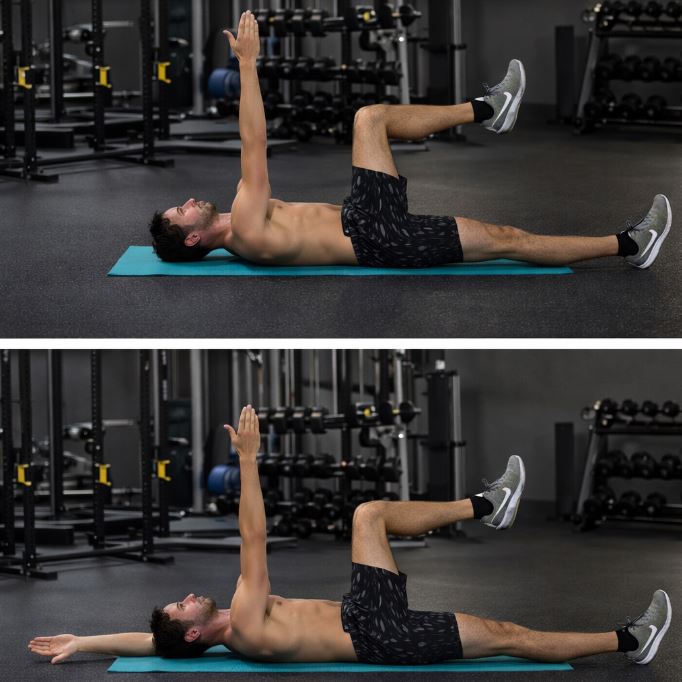
- Slowly extend one arm overhead while simultaneously extending the opposite leg toward the floor
- Maintain constant core tension and keep your lower back in contact with the floor throughout
- Lower the limb pair until just before losing spinal control — not necessarily all the way to the floor
- Pause briefly to reinforce stability at that lowest controlled point
- Return to the starting position with full control
- Alternate sides and repeat for the desired number of repetitions
The key coaching cue: The goal is to move the limbs without allowing the spine or pelvis to shift at all. This is a slow, controlled movement that prioritizes stability over speed. Focus on maintaining tension, not on how far the limbs travel — the moment you feel the lower back lifting off the floor or the pelvis beginning to rock, that is the actual end of your usable range for that rep, regardless of how much further the limb could technically reach.
4 Common Dead Bug Mistakes (And How to Fix Them)
1. Arching the lower back
This is the single most common and most consequence-rich error in the dead bug. As the arm and opposite leg extend farther from the body, the lever arm increases, and the lower back tends to arch off the floor if core bracing is insufficient. The entire purpose of the exercise is lost the moment this happens. Reduce the range of motion — extend the limbs less far — until the lower back can stay genuinely flat throughout the full range of motion.
2. Moving too quickly
Speed defeats the purpose of an exercise designed around deliberate, controlled motor control rather than momentum. Move slowly and deliberately through both the extension and the return, giving the core stabilizers time to actually do their job rather than letting inertia carry the limbs through the range.
3. Losing rib-to-pelvis connection
Allowing the ribcage to flare upward away from the pelvis — rather than staying “stacked” with the ribs down — indicates the deep core bracing has been lost, even if the lower back has not visibly arched yet. Keep the ribs down and the connection between the rib cage and pelvis intact throughout every repetition.
4. Treating the exercise as a flexibility drill
Some trainees perform the dead bug, focusing on how far the arm and leg can reach, treating it more like a stretching exercise than a stability drill. This misses the entire point. Focus on maintaining tension, not range of motion — a shorter range with perfect spinal control delivers far more value than a longer range with the back arching or the pelvis rocking.
Benefits of the Dead Bug
Improves core stability
The dead bug strengthens the deep stabilizing muscles — particularly the transversus abdominis — that many more visible, flexion-based ab exercises do not train as directly.
Protects the spine
By reinforcing neutral spine control under the demand of independent limb movement, the dead bug builds a foundational skill that protects the lower back during far more demanding compound lifts and athletic movements.
Enhances movement quality
The coordination between the core and the limbs that this exercise develops improves overall movement quality, not just isolated muscular strength.
Supports injury prevention
By reducing excessive lumbar motion under load, the dead bug meaningfully contributes to the prevention of lower back injuries.
Transfers directly to compound lifts
The neutral spine control trained by the dead bug improves squat and deadlift mechanics directly, since both lifts demand the same fundamental capacity to maintain spinal stability while force is generated through the limbs.
Suitable for all levels
The dead bug is scalable for beginners and advanced athletes alike, using the same fundamental setup with adjustments to range of motion, tempo, or added resistance.
Who Should Use This Exercise
- Beginners new to core training — the dead bug provides an accessible, low-risk introduction to genuine core stability work
- Anyone returning to training after a back injury — under appropriate guidance, the low spinal loading and the emphasis on control make this a useful rehabilitation tool
- Athletes and lifters who want their core training to directly transfer to squat, deadlift, and pressing mechanics
- Advanced trainees using the dead bug as a warm-up or activation drill before heavier compound lifts
Who Should Be Cautious
- Anyone who cannot maintain a neutral pelvis, even with a reduced range of motion — if the lower back arches even with minimal limb extension, more foundational core awareness work may be needed first
- People with acute lower back pain — while generally low-risk, anyone with active back pain should get clearance from a physiotherapist before introducing this or any new core exercise
- Anyone treating this purely as a flexibility or range-of-motion exercise — the dead bug’s value depends entirely on prioritizing stability over how far the limbs reach
How to Make It Easier or Harder
Easier
- Bent-knee dead bug — shortens the lever arm, making the exercise easier for beginners by reducing the demand on the core to resist the extending limb’s leverage
- Reduced range of motion — extending the limbs only partway, well within the range where spinal control is easily maintained, is itself a valid regression rather than a compromise
Harder
- Straight-leg dead bug — increases the demand on core stability and hip control by lengthening the lever arm of the extending leg
- Banded dead bug — adds external resistance to increase the anti-extension challenge throughout the movement
- Dumbbell dead bug — lying on the back holding dumbbells above the shoulders, bend the knees to 90 degrees, then slowly extend the opposite arm and leg while keeping the core braced and the lower back neutral; return and switch sides
- Landmine dead bug — anchor one end of a barbell and hold the free end straight above the chest; lie on the back with legs raised to 90 degrees, keep the core braced and the lower back flat, and slowly extend one leg before switching sides
- Single-limb dead bug — moves only one limb at a time, which can be used to improve coordination and isolate the stability challenge to one side at a time
Dead Bug vs. Basic Forearm Plank
Although the dead bug and the forearm plank target many of the same core-stabilizing muscles, they differ significantly in how they apply stress to the spine.
The dead bug is often considered a more accessible entry point into core stability training because it allows the athlete to maintain spinal control in a supine position, where lumbar alignment is easier to monitor and correct. This makes it especially useful for beginners or individuals who experience discomfort during plank-based exercises.
The forearm plank increases anti-extension demand by placing the body in a prone position against gravity. While highly effective, it also requires greater awareness and strength to prevent excessive sagging or lifting of the hips. For this reason, many athletes benefit from mastering the dead bug before progressing to plank variations. Once proper core control is established, the plank can be further progressed by lifting or extending one or both limbs while maintaining a rigid torso.
For those who prefer supine-based core work, the dead bug can be progressed similarly by adding light external resistance. Holding small dumbbells or using resistance bands increases the demand for stabilization without changing body position, allowing continued development of core control while minimizing unnecessary spinal strain.
| Feature | Dead Bug | Basic Forearm Plank |
|---|---|---|
| Body position | Supine (lying on the back) | Prone (face down) |
| Primary core demand | Anti-extension with limb movement | Anti-extension against gravity |
| Spinal control | Easier to monitor and correct | Requires greater awareness |
| Lower back stress | Low | Moderate to high if form breaks |
| Suitability for beginners | Very high | Moderate |
| Progression options | Add limb movement or light resistance | Add time, load, or limb lifts |
Table 1: Dead Bug vs. Basic Forearm Plank — Core Stability Comparison
The practical takeaway: The dead bug’s supine position makes spinal alignment easier to monitor and self-correct, which is exactly why it serves as such a useful entry point for beginners or anyone who finds plank-based exercises uncomfortable. The forearm plank, performed against gravity in a prone position, demands more awareness and baseline strength to prevent hip sag or excessive piking. I have most new trainees master the dead bug first, then progress to the forearm plank once that foundational spinal control is established — the two exercises build on each other rather than competing for the same training slot.
Exercise Variations
Dumbbell Dead Bug
Lie on your back holding dumbbells above your shoulders. Bend your knees to 90 degrees. Slowly extend the opposite arm and leg while keeping your core braced and lower back neutral. Return and switch sides. This variation adds a small external load to the arm movement, increasing the demand for stabilization without dramatically changing the fundamental exercise.
Bent-Knee Dead Bug
Shortens the lever arm, making the exercise easier for beginners. This is the standard starting variation for most trainees new to the dead bug pattern.
Straight-Leg Dead Bug
Increases demand on core stability and hip control by fully extending the leg rather than maintaining a bent knee throughout the movement, thereby lengthening the lever arm considerably.
Banded Dead Bug
Adds external resistance to increase the anti-extension challenge, typically by anchoring a band to resist the extending limb.
Landmine Dead Bug
Anchor one end of a barbell and hold the free end straight above your chest. Lie on your back with legs raised to 90 degrees. Keep your core braced and lower back flat as you slowly extend one leg, then switch sides. The landmine’s fixed arc and the added weight create a distinct loading pattern compared to dumbbells.
Single-Limb Dead Bug
Moves only one limb at a time for improved coordination, isolating the stability challenge to one side and making it easier to identify and address any asymmetries between sides.
Coach’s Note — Weight & Progression
The dead bug is typically performed using bodyweight only. While resistance bands or very light external loads can be added as a progression, the priority should always remain on perfect spinal control and coordination.
Adding resistance too early often compromises technique, leads to excessive lumbar movement, and undermines the exercise’s true purpose. The dead bug is designed to develop core stability, motor control, and spinal integrity — not maximal strength or rapid muscle hypertrophy. If you find yourself reaching for heavier dumbbells before the bodyweight version is genuinely mastered, that impulse is worth resisting.
Replacement Exercises (Alternatives)
If the dead bug is not suitable, consider:
- Bird Dog
- Forearm Plank
- Cable Pallof Press
- Hollow Body Hold
- Supine Marching
How To Incorporate the Dead Bug Into Your Workouts
- As a warm-up or activation drill — the dead bug works well before compound lifts like squats and deadlifts, priming the core stabilization pattern those lifts require
- As a foundational core exercise for beginners — an excellent entry point before progressing to plank-based or more dynamic core work
- In rehabilitation contexts — under appropriate guidance, the low spinal loading makes this a useful tool during a return to training
- Rep range: 6–10 reps per side, prioritizing quality and control over volume
- Sets: 2–3 sets
- Frequency: 3–4 times per week, given the low intensity and motor-control focus of the exercise
- Tempo: Slow and deliberate throughout — roughly 3 seconds extending, a brief pause, 3 seconds returning
- Progression trigger: When 3 sets of 10 reps per side with a consistently flat lower back and full control become easy, progress to the straight-leg version, add light resistance, or introduce the single-limb variation for an added coordination challenge
Conclusion
The dead bug is a deceptively simple exercise that plays a crucial role in developing core stability, spinal control, and coordinated limb movement. Unlike many traditional core exercises that emphasize visible muscle activation, the dead bug focuses on maintaining a neutral spine while the arms and legs move independently — a skill that directly transfers to athletic performance and injury prevention.
While it does contribute to core strength, the dead bug is not intended as a primary muscle-building exercise. Its greatest value lies in improving neuromuscular control, reinforcing proper bracing patterns, and teaching the body to resist unwanted spinal movement. For beginners, it serves as an excellent introduction to core training, and for advanced athletes, it remains a valuable tool for warm-ups, rehabilitation, and long-term spinal health.
When performed with strict technique and proper breathing, the dead bug becomes one of the most effective foundational core exercises available — simple in appearance, but highly demanding in execution.
Want to build a complete core training program? Check out our guide to the best core exercises for every level. Check out our guides to upper ab, lower ab, and oblique exercises, too.
Is the dead bug exercise suitable for people with lower back pain?
Yes, when performed correctly, the dead bug is one of the safest core exercises for individuals with lower back discomfort because it emphasizes spinal control without loading the spine.
Why is the dead bug considered an anti-extension exercise?
The dead bug trains the core to resist excessive lumbar extension while the arms and legs move, reinforcing the ability to maintain a neutral spine under dynamic conditions.
Should the lower back stay flat on the floor during the dead bug?
Yes. Maintaining contact between the lower back and the floor helps ensure proper pelvic positioning and prevents excessive spinal arching during the movement.
Is breathing important during the dead bug exercise?
Absolutely. Controlled breathing helps maintain intra-abdominal pressure and reinforces core stability throughout each repetition.
How does the dead bug differ from traditional ab exercises like crunches?
Unlike crunches, the dead bug does not involve spinal flexion. Instead, it focuses on stabilization and motor control, which is more transferable to compound lifts and athletic movements.
Can advanced athletes still benefit from the dead bug?
Yes. Even advanced athletes use the dead bug as a warm-up, activation drill, or rehabilitation tool to reinforce proper core engagement and movement quality.
How fast should the dead bug be performed?
The movement should be slow and controlled. Speed reduces stability demands and often leads to loss of spinal control.
Is it better to alternate limbs or complete all reps on one side?
Both approaches are valid. Alternating limbs improves coordination, while completing all reps on one side can increase focus and stability demands.
Can resistance bands be used with the dead bug?
Yes, light resistance bands can be added once technique is mastered, but only if spinal control is maintained throughout the movement.
How often should the dead bug be included in a training program?
The dead bug can be performed 2–4 times per week, depending on training volume and whether it is used for activation, rehabilitation, or core development.
