



Introduction
The obliques are the most undertrained muscle group in most people’s core programs — and the most consequential gap in their training. Walk into any gym and you will see trainees spending significant time on crunches, cable crunches, and hanging leg raises, while the oblique muscles — the muscles responsible for rotation, lateral flexion, and the anti-movement stability that makes every other core exercise safer and more effective — receive perhaps one or two sets of Russian twists at the end of a session, if they receive any direct training at all.
The result shows up in two places: aesthetically, in a core that looks developed from the front but is undefined at the sides; and functionally, in rotational weakness that limits athletic performance and increases the risk of injury in any movement that involves twisting, throwing, swinging, or changing direction.
This guide covers the 19 best oblique exercises I use in programming — organized not by arbitrary ranking but by function, because the obliques serve multiple distinct roles and a complete oblique program needs to address all of them. Within each functional category, every exercise links to a complete individual guide with full technique breakdown, common mistakes, progressions, and programming recommendations.
Whether you are a beginner learning to feel the obliques working for the first time, or an advanced trainee looking to add landmine 180s and hanging windshield wipers to an already comprehensive core program, the exercises and workout routines in this guide will give you everything you need.
Understanding the Obliques
The oblique muscles consist of two layers on each side of the torso: the external obliques, which are visible running diagonally along the rib cage, and the internal obliques, which lie beneath them running in the opposite direction. Together, they are the primary movers of trunk rotation and lateral flexion, and they play an equally important role as stabilizers that resist those same movements when the task requires keeping the spine still.
The rectus abdominis — the six-pack muscle — runs vertically and is responsible for forward spinal flexion. The transverse abdominis sits deepest and acts as the spine’s internal corset. The obliques bridge these two layers and connect the anterior and lateral core into a functional unit.

What this means practically: you cannot train the obliques adequately with crunches, because crunches do not produce the rotation, lateral flexion, or anti-movement demands that the obliques are designed to meet. Direct oblique training requires exercises that specifically challenge those movement patterns.
How We Classified These Exercises
Rather than listing 19 exercises in arbitrary order, this guide organizes them by the primary function each exercise trains:
- Lateral flexion — exercises where the torso bends sideways, bringing the ribs toward the hip
- Rotation — exercises where the torso or lower body rotates around the spinal axis
- Combined flexion and rotation — exercises that simultaneously train spinal flexion and trunk rotation
- Athletic rotation and advanced variations — dynamic, full-body rotational exercises and advanced hanging movements
A complete oblique program draws from all four categories. Trainees who perform only rotational exercises miss the lateral flexion stimulus; trainees who perform only lateral flexion miss the rotational strength that transfers to sport and daily life.
| Exercise | Category | Difficulty | Equipment |
|---|---|---|---|
| Dumbbell Side Bend | Lateral Flexion | Beginner – Intermediate | Dumbbell |
| Roman Chair Side Bend | Lateral Flexion | Intermediate | Hyperextension bench |
| Lateral Crunch | Lateral Flexion | Beginner | None |
| Heel Touches | Lateral Flexion | Beginner | None |
| Double-Side Jackknife | Lateral Flexion | Intermediate | None |
| Hip Crossover | Rotation | Beginner | None |
| Broomstick Twist | Rotation | Beginner | Bar or broomstick |
| Standing Machine Twist | Rotation | Beginner | Rotating platform machine |
| Russian Twist | Rotation | Beginner – Intermediate | None (or medicine ball) |
| Rotary Torso Machine | Rotation | Beginner – Intermediate | Rotary torso machine |
| Seated Rotary Torso Machine | Rotation | Beginner – Intermediate | Seated rotary torso machine |
| Hanging Windshield Wiper | Rotation | Advanced | Pull-up bar |
| Crossover Crunch | Combined Flexion + Rotation | Intermediate | None |
| Bicycle Crunch | Combined Flexion + Rotation | Intermediate | None |
| Decline Twisting Sit-Up | Combined Flexion + Rotation | Advanced | Decline bench |
| Standing Cable Oblique Crunch | Combined Flexion + Rotation | Beginner – Intermediate | Cable machine |
| Twisting Cable Crunch | Combined Flexion + Rotation | Intermediate | Cable machine |
| Landmine 180s | Athletic Rotation & Advanced | Intermediate – Advanced | Barbell + landmine attachment |
| Hanging Oblique Knee Raise | Athletic Rotation & Advanced | Advanced | Pull-up bar |
The 19 Best Oblique Exercises
Category 1: Lateral Flexion
Lateral flexion exercises train the obliques by bending the torso sideways — bringing the ribs toward the hip on the working side. These exercises directly target the quadratus lumborum alongside the obliques and address a movement pattern that most rotational oblique exercises do not reach.
1. Dumbbell Side Bend

Difficulty: Beginner – Intermediate | Equipment: Dumbbell | Best for: Direct oblique and QL isolation, accessible loading
The dumbbell side bend is the most accessible loaded lateral flexion exercise — a single dumbbell, a standing position, and a pure side-to-side bend that directly targets the obliques and quadratus lumborum. The resistance peaks at the bottom of the bend and diminishes as the torso returns to upright, which is the primary mechanical limitation compared to cable alternatives.
How to do it: Stand holding a dumbbell in one hand, arm straight at the side. Keeping the torso facing directly forward — no rotation, no forward lean — bend laterally until the dumbbell approaches knee level, then contract the opposite oblique to return upright.
Common mistake: Using two dumbbells, one in each hand. The two weights cancel each other out — one lowering assists the other lifting — which dramatically reduces the effective resistance on the obliques.
2. Roman Chair Side Bend
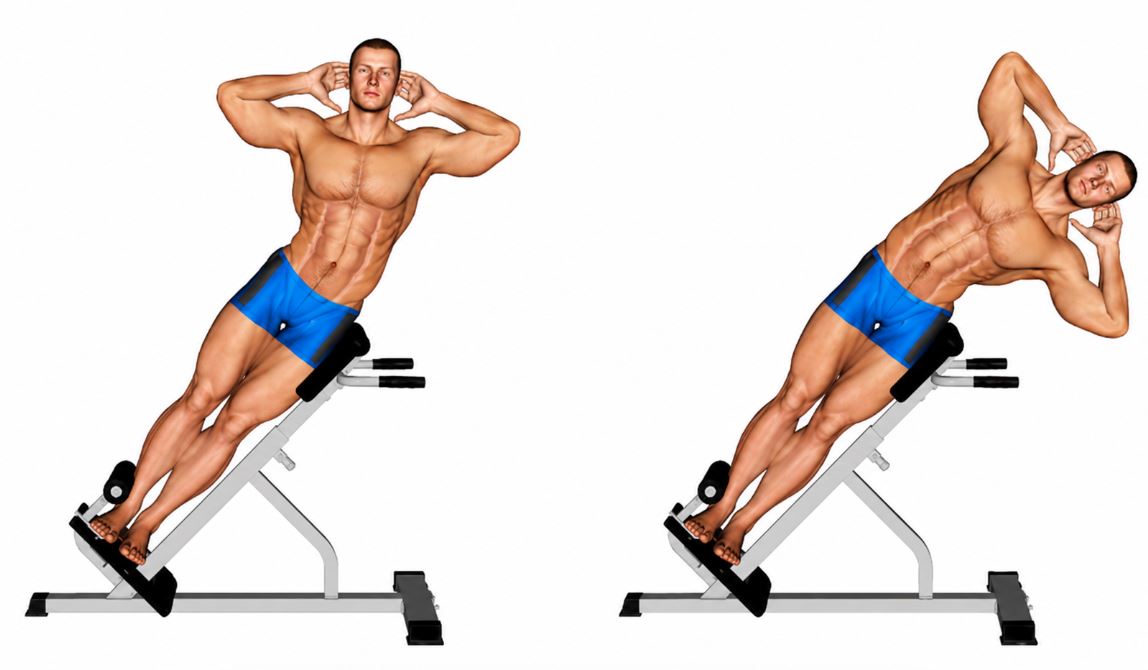
Difficulty: Intermediate | Equipment: Hyperextension bench | Best for: Full-range lateral flexion, maximum oblique stretch
The Roman chair side bend — also called the hyperextension side bend or 45-degree side bend — provides the largest range of lateral flexion available in any gym exercise. The hips and legs are supported on the bench pad while the torso hangs freely, allowing the obliques to work through an arc from below neutral to above it. That extended range produces an oblique and QL stimulus that no standing side bend variation can match.
How to do it: Lie sideways on a 45-degree hyperextension bench with hips on the pad and torso unsupported. Cross the legs and secure the feet, then lower the torso toward the floor before contracting the obliques to raise past the neutral position — 30 to 45 degrees above neutral at the top.
Common mistake: Rotating the trunk instead of bending laterally. Any torso rotation shifts the load to the lumbar spine in a compromised position. The movement is lateral only — face a fixed point throughout and maintain it.
3. Lateral Crunch

Difficulty: Beginner | Equipment: None | Best for: Pure oblique isolation, beginners, low spinal loading
The lateral crunch is the most direct no-equipment lateral flexion exercise available — obliques closing the ribs toward the hip through a small, controlled range with zero cervical or thoracic demand. The ability to place the lower hand directly on the obliques during the movement provides real-time tactile feedback on whether the target muscle is actually contracting.
How to do it: Lie on your side with knees slightly bent, upper hand behind the ear. Lift the head and shoulders two to four inches — thinking of reducing the space between the ribs and the hip, not reaching the head upward.
Common mistake: Moving only the head. The entire shoulder must rise — if only the head nods, the obliques are not generating the movement and the exercise is producing neck strain rather than oblique stimulus.
4. Heel Touches

Difficulty: Beginner | Equipment: None | Best for: Bilateral alternating oblique training, sustained tension
Heel touches — also known as the lying oblique reach or alternate heel touchers — train the obliques through alternating lateral flexion from a supine position. The shoulders and head remain elevated off the floor throughout the set, maintaining sustained isometric tension in the transverse abdominis and rectus abdominis between each reach.
How to do it: Lie on your back, knees bent, shoulders elevated slightly off the floor. Crunch the torso laterally to bring each hand toward the corresponding heel in alternating fashion — the movement is the ribs closing toward the hip, not the arm extending toward the foot.
Common mistake: Reaching with the arm while the torso stays fixed. The obliques are not being trained if the shoulder stays on the floor and only the hand extends. The entire torso must crunch laterally.
5. Double-Side Jackknife

Difficulty: Intermediate | Equipment: None | Best for: More complete oblique contraction than the lateral crunch, home training
The double-side jackknife takes the lateral crunch and adds a simultaneous leg rise — both the torso and both legs close toward each other like a jackknife. That bilateral closing creates a more complete oblique contraction than the one-directional torso rise of the lateral crunch and is the direct bodyweight progression from it.
How to do it: Lie on your side with legs extended and the lower elbow on the floor for support. Simultaneously raise both legs and bring the torso upward — both ends closing toward each other at the same time. Hold briefly at the top before lowering under control.
Common mistake: Moving the torso and legs sequentially rather than simultaneously. The jackknife closing mechanics require both ends to initiate and arrive together — if one end leads, the exercise becomes two separate partial movements.
Category 2: Rotation
Rotational exercises train the obliques through trunk or lower-body rotation about the spinal axis. This category covers the widest range of equipment and difficulty levels and trains the movement pattern most directly relevant to sport performance.
6. Hip Crossover

Difficulty: Beginner | Equipment: None | Best for: Lower-body rotation pattern, athletic carryover, beginners
The hip crossover — also called the hip roll or lower body Russian twist — is the safest and most accessible rotational oblique exercise available. Unlike most rotational exercises where the upper body rotates toward fixed legs, the hip crossover rotates the lower body toward a fixed upper body — the same pattern as athletic hip drive in throwing, swinging, and changing direction.
How to do it: Lie on your back with arms in a T-position, hips and knees bent to 90 degrees. Keeping the shoulders pressed into the floor, slowly rotate both legs together to one side as far as oblique control allows, then return and rotate to the other side.
Common mistake: Allowing the shoulders to lift off the floor. The shoulder staying on the mat is the range-of-motion limiter — when it lifts, the obliques are exceeded, and the lower back compensates.
7. Broomstick Twist

Difficulty: Beginner | Equipment: Bar or broomstick | Best for: Thoracic mobility, warm-up, oblique activation
The broomstick twist is a mobility and activation exercise first, a training exercise second. A bar resting across the shoulders, the torso rotating from side to side through the full range of thoracic rotation — no resistance, just deliberate movement. Its primary value is as a warm-up tool and a thoracic mobility exercise; for oblique strength development, other exercises on this list are more appropriate.
How to do it: Sit on a bench or stand with feet shoulder-width apart, bar resting across the back of the shoulders. Rotate the torso to each side slowly and deliberately — the rotation comes from the thoracic spine and waist, not the shoulders swinging independently or the lumbar spine torquing.
Common mistake: Rotating from the lumbar spine rather than the thoracic spine. The lumbar spine has minimal rotational capacity — forcing rotation through it under load creates disc stress. The movement must come from the mid-back upward.
8. Standing Machine Twist

Difficulty: Beginner | Equipment: Rotating platform machine | Best for: Standing lower-body rotation activation, warm-up
The standing machine twist reverses the typical oblique rotation direction — the feet and hips rotate on a platform while the upper body stays fixed by the handles. That lower-body rotation pattern trains the obliques in the same mechanical context as the hip crossover but in a standing position. Like the broomstick twist, it is most valuable as an activation and warm-up tool rather than a primary oblique strength exercise.
How to do it: Stand on the machine’s rotating platform with feet shoulder-width apart and knees slightly bent. Grip the handles and slowly rotate the hips and pelvis from side to side — initiating the movement with the obliques, not by letting the platform spin under momentum.
Common mistake: Allowing momentum to spin the platform. When the platform rotates faster than the obliques are consciously driving it, the ligaments and smaller spinal muscles absorb the end-range forces. Every degree of rotation must be driven by deliberate oblique contraction.
9. Russian Twist

Difficulty: Beginner – Intermediate | Equipment: None (or medicine ball) | Best for: Upper-body rotation, isometric rectus abdominis, scalable resistance
The Russian twist is one of the most widely programmed oblique exercises — performed in a seated, reclined position, torso at 45 degrees, arms rotating from side to side. What distinguishes it from pure rotational exercises is the simultaneous isometric demand on the rectus abdominis, which works continuously to maintain the reclined torso angle against gravity throughout the set.
How to do it: Sit with knees bent, torso reclined to 45 degrees, arms extended in front. Rotate the torso as far as possible to one side — driving from the waist, not swinging the arms — then continue to the other side in a controlled, continuous motion. Add a medicine ball as strength develops.
Common mistake: Moving too fast. Fast Russian twists are momentum-driven — the obliques contribute minimally. Slow down to two to three seconds per side with a deliberate pause at each end range. That tempo is what separates a productive set from an arm-swinging exercise.
10. Rotary Torso Machine

Difficulty: Beginner – Intermediate | Equipment: Rotary torso machine | Best for: Measurable progressive overload, oblique hypertrophy, beginners
The rotary torso machine offers something most rotational oblique exercises lack: precise, incrementally adjustable resistance through a guided rotational arc. The chest pad and lower-body fixation constrain movement to pure trunk rotation, making the obliques the sole movers and eliminating the compensation patterns that plague free-standing rotational exercises.
How to do it: Adjust the seat height so the chest pad rests at mid-chest. Brace the core, then rotate the upper body against the resistance stack in a slow, controlled arc — initiating with the obliques, not pulling with the arms. Pause at the end range and return under control.
Common mistake: Using too much weight. Heavy loading on this machine almost always produces hip rocking and arm pulling that bypass the obliques entirely. Light-to-moderate weight with full range and a genuine pause at end range produces far more oblique stimulus than heavy compensated reps.
11. Seated Rotary Torso Machine

Difficulty: Beginner – Intermediate | Equipment: Seated rotary torso machine | Best for: Oblique isolation with dual body fixation, asymmetry correction
The seated rotary torso machine is the most common rotary machine configuration in commercial gyms. The chest pad, thigh pads, and foot platforms fix both the upper and lower body simultaneously, leaving pure trunk rotation as the only available movement. That dual fixation creates the most isolated oblique rotation stimulus available on any machine.
How to do it: Adjust the seat so the chest pad rests at mid-chest. Press the chest firmly into the pad throughout the entire movement — chest pad contact is what isolates the rotation to the obliques. Rotate slowly, pause at end range, return under control without letting the weight stack touch down between reps.
Common mistake: Losing chest pad contact during the rotation. When the chest lifts away from the pad, the torso is compensating — typically by leaning forward — to extend the apparent range beyond what the obliques can actually produce.
12. Hanging Windshield Wiper

Difficulty: Advanced | Equipment: Pull-up bar | Best for: Maximum oblique rotational control, serratus development, advanced athletes
The hanging windshield wiper begins where the hanging leg raise ends — at the full V-position with toes at bar height — and adds lateral rotation of the legs from side to side. The obliques control every degree of that rotation against the full weight of the legs and the constant anti-swing demand of the hanging position. The serratus anterior receives exceptional activation throughout.
How to do it: From a dead hang, perform a full hanging leg raise until the toes reach the bar. From that V-position, slowly rotate both legs together to one side by approximately 90 degrees while keeping the torso facing upward, then return to the V and rotate to the other side.
Common mistake: Attempting this exercise without first mastering the hanging toes-to-bar raise. The V-position starting point is a non-negotiable prerequisite. Without it, every rep is a compensated version of the exercise that provides neither the intended stimulus nor adequate control.
Category 3: Combined Flexion and Rotation
These exercises simultaneously train spinal flexion and trunk rotation — the combined movement pattern that the obliques most commonly produce in athletic contexts and that provides the most comprehensive oblique and anterior core stimulus per exercise.
13. Crossover Crunch

Difficulty: Intermediate | Equipment: None | Best for: Learning rotation mechanics, controlled oblique isolation
The crossover crunch — also called the cross-body crunch or twisting crunch — combines a floor crunch with trunk rotation to drive one elbow toward the opposite knee. The crossed-leg position stabilizes the pelvis and focuses the rotation at the waist rather than the hip, making this one of the more oblique-isolated combined flexion-rotation exercises available without equipment.
How to do it: Lie on your back with one leg crossed over the other, hands behind the head. Crunch the torso upward and simultaneously rotate to bring one elbow toward the opposite knee — both flexion and rotation initiating together, not flexion followed by rotation.
Common mistake: Rotating from the elbow rather than the shoulder. If only the elbow reaches across while the shoulder stays back, the obliques are not generating the rotation. Drive the shoulder toward the opposite knee — the elbow follows.
14. Bicycle Crunch

Difficulty: Intermediate | Equipment: None | Best for: Combined rectus abdominis and oblique training, research-validated activation
The bicycle crunch is the most research-validated bodyweight ab exercise — ACE-commissioned EMG research ranked it first for rectus abdominis activation and second for oblique activation among 13 exercises tested. The alternating pedaling leg movement adds hip flexor demand and bilateral oblique training in a single continuous set, making it one of the most comprehensive anterior core exercises available without equipment.
How to do it: Lie on your back, shoulders elevated, hands behind the head. Simultaneously draw one knee toward the chest and rotate the opposite shoulder toward it — legs pedaling and torso rotating continuously in alternating fashion. Maintain the elevated shoulder position throughout.
Common mistake: Moving too fast. Fast bicycle crunches are momentum-driven exercises with minimal oblique activation. Slow down to two seconds per side — at that pace, the obliques must generate and control every rotation rather than being carried by inertia.
15. Decline Twisting Sit-Up

Difficulty: Advanced | Equipment: Decline bench | Best for: Full-range combined flexion-rotation, advanced athletes
The decline twisting sit-up combines the full range of a decline sit-up with trunk rotation — driving one elbow toward the opposite knee as the torso rises from near-horizontal to upright. The decline angle increases the gravitational demand throughout the full sit-up range. The primary limitation is hip flexor involvement: the iliopsoas generates significant force in any anchored-feet sit-up, so conscious technique is required to prevent it from dominating the movement.
How to do it: Set a decline bench to approximately 20 degrees, secure the feet, and place hands behind the head. Rise by curling the torso upward and simultaneously rotating to bring one elbow toward the opposite knee — alternating sides each rep. Stop three-quarters of the way down on the return to maintain tension without releasing the lower back.
Common mistake: Relying on the hip flexors instead of the obliques. If the movement feels like it is coming from the front of the hips rather than the midsection, slow down significantly and focus on the oblique contraction initiating each rep before the torso begins to rise.
16. Standing Cable Oblique Crunch

Difficulty: Beginner – Intermediate | Equipment: Cable machine | Best for: Lateral flexion with constant tension, oblique hypertrophy
The standing cable oblique crunch trains the obliques through lateral spinal flexion — the ribs crunching toward the hip — against constant cable tension throughout the full range. Unlike the dumbbell side bend, where resistance drops off significantly as the torso returns upright, the cable maintains meaningful resistance from the stretched position at the top to the fully contracted position at the bottom.
How to do it: Stand sideways to a high cable pulley, grip the D-handle with the inside hand at head height, elbow pointing downward. Crunch the rib cage laterally toward the hip — keeping the arm fixed relative to the head — then allow a slight hyperextension to the opposite side at the top for a full oblique stretch before the next rep.
Common mistake: Using the arm to pull the cable down rather than the torso crunching laterally. The arm position is fixed throughout — the handle does not move relative to the head. The torso moves; the arm is a passive connector.
17. Twisting Cable Crunch

Difficulty: Intermediate | Equipment: Cable machine | Best for: Combined flexion-rotation with progressive overload, oblique hypertrophy
The twisting cable crunch is the most effectively loaded combined oblique exercise on this list. Kneeling in front of a high cable pulley with a rope attachment, the torso crunches downward through pure flexion and then rotates at the midpoint to drive one elbow toward the opposite knee — the cable providing constant tension throughout the full flexion-rotation arc. The loading potential significantly exceeds that of any bodyweight oblique exercise.
How to do it: Kneel in front of a high pulley with the rope held at forehead height. Initiate with a straight crunch downward, then rotate at the halfway point to drive one elbow toward the opposite knee. Pause at the bottom, then return to the arched starting position before the next rep. Alternate the rotating elbow each rep.
Common mistake: Rotating at the beginning of the rep rather than the midpoint. Starting the rotation immediately bypasses the rectus abdominis contribution, which provides the mechanical foundation for oblique rotation. Crunch straight down first — then rotate.
Category 4: Athletic Rotation and Advanced Variations
These exercises train the obliques through dynamic, full-body movements or in the most demanding hanging positions. They require prerequisites of core strength and technical foundation that the previous categories build.
18. Landmine 180s
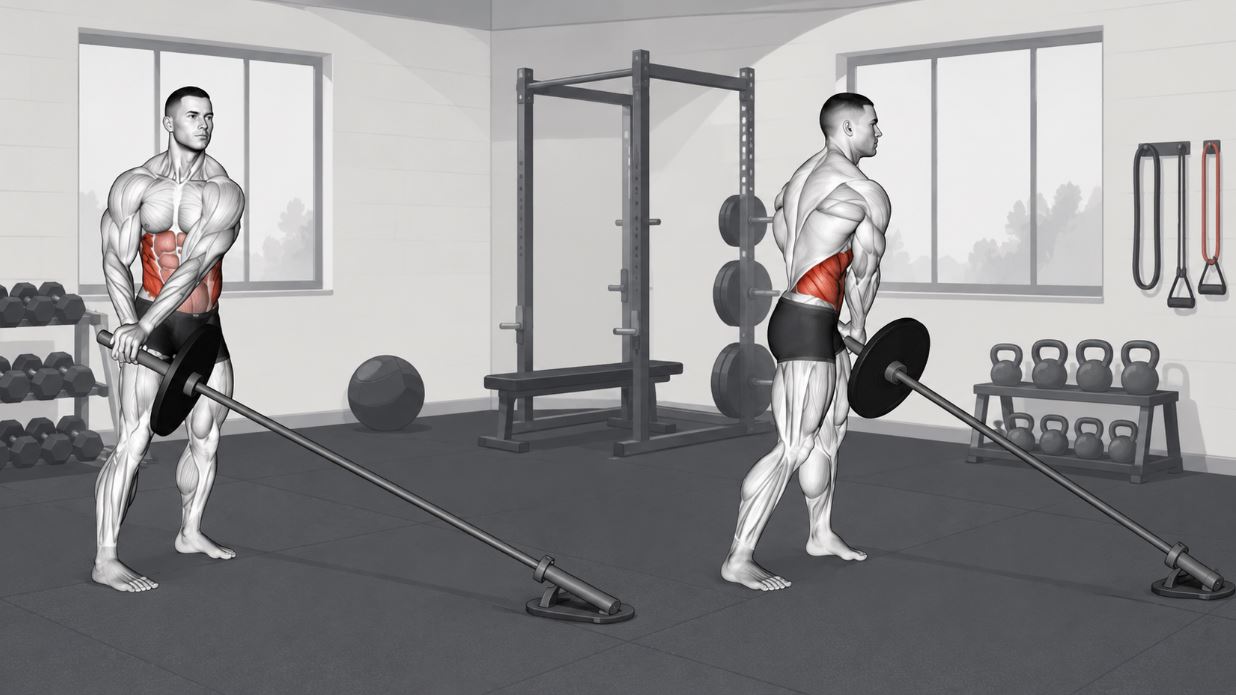
Difficulty: Intermediate – Advanced | Equipment: Barbell + landmine attachment | Best for: Rotational power development, athletic training, full kinetic chain
Landmine 180s train the obliques in a way no floor or machine exercise can replicate — as the primary rotational driver of a standing, full-body power movement. The weighted barbell sweeps through a 180-degree arc from hip height on one side, through an overhead midpoint, and down to hip height on the other. Power comes from the ground up through the legs, transfers through the obliques, and is expressed through the shoulders. The result is rotational power development with direct athletic carryover.
How to do it: Anchor one end of a barbell in a landmine attachment. Stand facing the free end, grip with both hands at chest height. Lower the bar to one side in a controlled arc — torso rotating to follow — then explosively drive it through the overhead midpoint and down to the other side, decelerating under oblique control at each end.
Common mistake: Using the arms to swing the bar rather than the lower body and obliques driving the arc. The arms guide; the legs and obliques generate the force. If the arms do most of the work, the power-development benefit is lost entirely.
19. Hanging Oblique Knee Raise
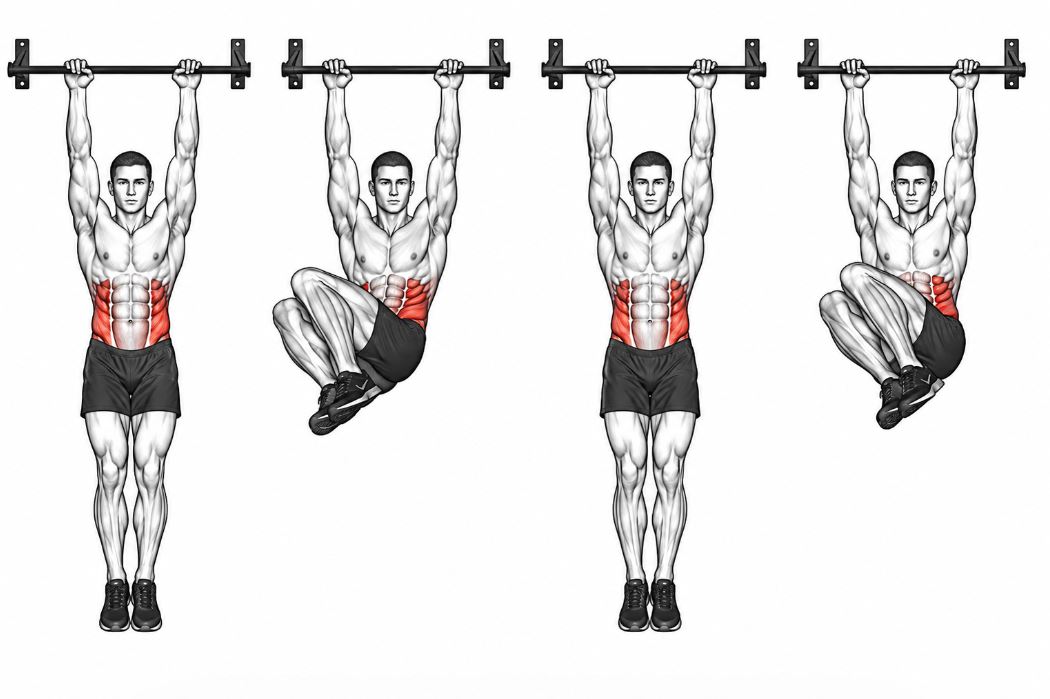
Difficulty: Advanced | Equipment: Pull-up bar | Best for: Oblique training in hanging position, combined hip flexion and rotation
The hanging oblique knee raise — also known as the hanging oblique crunch — takes the standard hanging knee raise and adds trunk rotation at the top, driving the knees toward one shoulder rather than straight up the midline. The rotation component shifts the primary stimulus from the lower abs to the obliques, making this a genuinely distinct oblique exercise rather than a variation of the hanging knee raise.
How to do it: From a dead hang, draw both knees toward the chest while simultaneously rotating the torso to bring the knees toward one shoulder. Pause at the top with the obliques contracted, then lower under control. Alternate sides each rep.
Common mistake: Tilting the shoulders rather than rotating the torso. If only the shoulders lean to one side while the torso stays relatively fixed, the obliques are not producing the rotation. The chest must face the shoulder the knees are pointing toward at the top of each rep.
How To Choose the Right Exercise for Your Level
If you are a complete beginner — start with the lateral crunch, heel touches, and hip crossover. These three exercises cover lateral flexion and rotation without any equipment and teach the fundamental oblique contraction patterns that every other exercise builds on.
If you train at home without equipment — the lateral crunch, heel touches, hip crossover, double-side jackknife, crossover crunch, bicycle crunch, and Russian twist cover beginner through intermediate levels comprehensively with no equipment beyond a mat.
If you have gym access — add the dumbbell side bend, standing cable oblique crunch, twisting cable crunch, and rotary torso machine to achieve progressive overload in both lateral flexion and rotation.
If you have a pull-up bar — the hanging oblique knee raise and hanging windshield wiper add the hanging oblique stimulus that no floor or machine exercise replicates. Master the standard hanging knee raise before attempting either.
If you are training for athletic performance — prioritize the landmine 180s, hanging windshield wiper, and decline twisting sit-up alongside foundational lateral flexion and rotation work.
Sample Workout Routines by Level
Beginner Oblique Workout
For trainees new to direct oblique training, learn the fundamental contraction patterns.
| Exercise | Sets | Reps | Rest |
|---|---|---|---|
| Hip Crossover | 3 | 10 per side | 60 sec |
| Lateral Crunch | 3 | 15–20 per side | 60 sec |
| Heel Touches | 3 | 15 per side | 60 sec |
Focus: Feel the obliques contracting on every rep. If you cannot feel them working, slow the pace down further before adding reps or sets.
Intermediate Oblique Workout
For trainees who have mastered bodyweight oblique exercises and are ready for loaded variations.
| Exercise | Sets | Reps | Rest |
|---|---|---|---|
| Dumbbell Side Bend | 3 | 15–20 per side | 60 sec |
| Russian Twist | 3 | 12–15 per side | 75 sec |
| Standing Cable Oblique Crunch | 3 | 12–15 per side | 75 sec |
| Bicycle Crunch | 3 | 15 per side | 60 sec |
Focus: Controlled tempo throughout. Two seconds per direction minimum — no momentum, no rushing.
Advanced Oblique Workout
For advanced trainees who need maximum oblique stimulus across all functional categories.
| Exercise | Sets | Reps | Rest |
|---|---|---|---|
| Landmine 180s | 4 | 8–10 per side | 90 sec |
| Twisting Cable Crunch | 4 | 10–12 per side | 90 sec |
| Roman Chair Side Bend | 3 | 12–15 per side | 75 sec |
| Hanging Oblique Knee Raise | 3 | 8–10 per side | 90 sec |
Focus: Quality over volume. Every rep of every set should feel controlled and deliberate — when technique breaks down, the set ends.
Common Mistakes in Oblique Training
Training only rotation and neglecting lateral flexion. Most oblique programs consist entirely of rotational exercises — Russian twists, bicycle crunches, cable rotations. Lateral flexion exercises like side bends and Roman chair side bends train a fundamentally different oblique function and should be present in any complete oblique program alongside rotational work.
Using momentum instead of oblique contraction. This applies to every exercise on this list but is most damaging in rotational exercises. Fast reps mean the obliques switch off and momentum, hip flexors, or arm swing carry the movement. Slow every oblique exercise down until you can feel the target muscles generating the work on every rep.
Programming obliques at the beginning of a session: The obliques are involved as stabilizers in virtually every compound movement — squats, deadlifts, overhead pressing, and rows all require lateral core stability. Pre-fatiguing the obliques before compound work compromises both the oblique stimulus and the safety of those movements. Always train obliques at the end of a session, after compound work is complete.
Expecting oblique training to reduce love handles: Fat loss is systemic — the body does not selectively burn fat from the area being exercised. Spot reduction does not work. Oblique training builds the muscles beneath the love handle area; what reveals them is a sustained caloric deficit. Train the obliques for strength and development — manage nutrition for fat loss.
Never progressing beyond beginner exercises. Once 4 sets of 20 controlled reps of a bodyweight oblique exercise are consistently achievable, that exercise has largely delivered its adaptation. The correct response is to progress — add resistance, increase difficulty, or move to a more demanding variation. Staying with easy exercises indefinitely produces maintenance, not development.
Conclusion
The obliques are not a finishing muscle group — something to hit with a few sets of Russian twists after the real training is done. They are a core muscle group that controls rotation, lateral flexion, and anti-movement stability, making every other exercise safer and more powerful. Treating them that way, with a structured program that covers all four functional categories and progressively overloads over time, produces core development that is both visible and genuinely functional.
The 19 exercises in this guide cover every training level and every functional demand from beginner bodyweight lateral flexion to advanced hanging rotational control. Each one links to a complete individual guide with full technique breakdown, coaching cues, and programming recommendations.
Start with the exercises that match your current level. Master the oblique contraction in each one before adding complexity or load. Progress systematically. That approach will produce more oblique development in six months than years of haphazard Russian twists and side bends ever could.
For complete upper ab and lower ab exercise guides, see our companion pillar articles: The 10 Best Upper Ab Exercises and The 11 Best Lower Ab Exercises.
Frequently Asked Questions
How often should I train my obliques?
Two to three times per week with at least 48 hours between sessions is the productive range. The obliques are skeletal muscles that require recovery time to adapt. Daily high-volume oblique training accumulates fatigue faster than it drives development.
Will oblique exercises make my waist wider?
This is the most common concern about direct oblique training. High-rep training with moderate weight — which is the recommended approach for most exercises on this list — is unlikely to produce significant muscle bulk. The obliques respond to training like any muscle: they develop with progressive overload over time. For trainees concerned about waist width, keeping loads moderate and rep ranges high minimizes hypertrophy while maintaining the functional and stability benefits of direct oblique training.
What is the difference between the external and internal obliques?
The external obliques run diagonally downward from the ribs toward the pelvis and are visible on the surface. The internal obliques lie beneath them, running in the opposite diagonal direction. Both contribute to rotation and lateral flexion, but their fiber orientations mean they contribute differently to each direction of rotation: the external oblique on one side and the internal oblique on the opposite side work together to rotate the torso in each direction.
Can I train obliques every day?
Not productively for strength development — the muscles need recovery time between sessions. For mobility purposes, light broomstick twists or gentle hip crossovers can be performed daily without meaningful recovery cost. Direct loaded oblique training belongs on two to three days per week, not every day.
Where in my workout should oblique training go?
Always at the end of the session, after compound movements. The obliques stabilize the spine during squats, deadlifts, and overhead pressing — pre-fatiguing them before those movements compromises both performance and safety. Within the core training block, train the rectus abdominis first and finish with oblique work.
Expert Review: This article was reviewed by multiple subject-matter experts to ensure accuracy, practical applicability, and evidence-based recommendations.
Anatomy & Biomechanics Review: Dr. Alex Novak, MD reviewed the anatomical and biomechanical information related to the oblique muscles and trunk function.
Exercise Technique Review: Tomislav G., Certified Fitness Instructor reviewed exercise execution, coaching cues, and training recommendations.
Strength Training Review: Kelley V., MPH, MS, CSCS, ACE Health Coach reviewed the workout programming and strength-training guidance presented throughout this article.
References
-
1
Francis, P., & Davis, J. (2001). New Study Puts the Crunch on Ineffective Ab Exercises. ACE FitnessMatters, American Council on Exercise, San Diego State University Biomechanics Lab. acefitness.org
-
2
Nakai, Y., Kawada, M., Miyazaki, T., Araki, S., Takeshita, Y., & Kiyama, R. (2021). A self-oblique exercise that activates the coordinated activity of abdominal and hip muscles–A pilot study. PLoS One, 16(8), e0255035. doi.org/10.1371/journal.pone.0255035
-
3
Saeterbakken, A. H., Chaudhari, A., van den Tillaar, R., & Andersen, V. (2019). The effects of performing integrated compared to isolated core exercises. PLoS One, 14(2), e0212216. pubmed.ncbi.nlm.nih.gov
-
4
Bergmark, A. (1989). Stability of the lumbar spine. A study in mechanical engineering. Acta Orthopaedica Scandinavica Supplementum, 230, 1–54. pubmed.ncbi.nlm.nih.gov
-
5
Park, D.-J., & Park, S.-Y. (2019). Which trunk exercise most effectively activates abdominal muscles? A comparative study of plank and isometric bilateral leg raise exercises. Journal of Back and Musculoskeletal Rehabilitation, 32(5), 797–802. pubmed.ncbi.nlm.nih.gov
-
6
Dong, K., Yu, T., & Chun, B. (2023). Effects of core training on sport-specific performance of athletes: A meta-analysis of randomized controlled trials. Behavioral Sciences, 13(2), 148. pmc.ncbi.nlm.nih.gov
