


Introduction
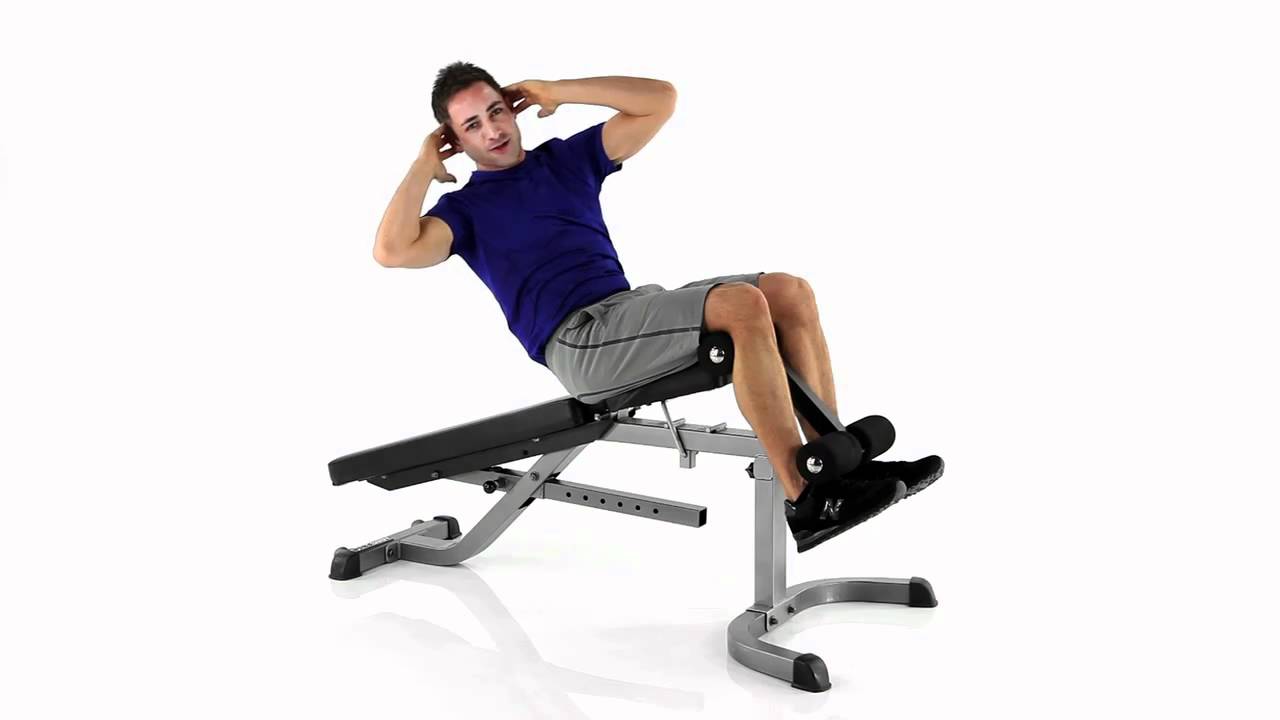
The decline twisting sit-up is an advanced oblique exercise that combines the full range of motion of a decline sit-up with trunk rotation — driving each elbow toward the opposite knee as the torso rises on alternating reps. The decline bench angle increases the gravitational demand throughout the range of motion compared to the floor version, and the rotation component shifts a significant portion of the stimulus from the rectus abdominis to the obliques.
Also called the oblique sit-up or decline bench twisting sit-up, this exercise sits at the more demanding end of the oblique exercise spectrum. It requires a solid foundation of core strength before attempting — if the standard decline sit-up cannot be performed with proper pelvic control and no lower back arching, the twisting variation will amplify those technique deficiencies rather than correct them.
I want to be direct about one thing before we go further. The decline twisting sit-up has a legitimate limitation that most exercise descriptions gloss over: the iliopsoas — the primary hip flexor — often dominates the movement, particularly when the feet are anchored and the reps are performed quickly. That hip-flexor dominance pulls on the lower back with every rep, considerably reducing the oblique stimulus. I program this exercise with that limitation in mind — slower tempo, controlled range, and attention to whether the obliques or the hip flexors are generating the movement. Done correctly, it is an effective advanced oblique exercise. Done carelessly, it is an expensive way to stress the lumbar spine while the obliques watch.
Exercise Snapshot
Muscles Worked in the Decline Twisting Sit-Up
Primary muscles
- Rectus abdominis — drives the spinal flexion component throughout the full range of motion from the declined starting position to upright
- External obliques — on the side rotating toward the opposite knee, the external obliques work concentrically to produce the rotation; the external oblique on the right side and the internal oblique on the left side work together to rotate the torso to the left, and vice versa
- Internal obliques — work alongside the external obliques; only the internal oblique on the same side as the direction of movement and the external oblique on the opposite side can assist with the rotation — the remaining obliques become antagonists to the movement, which is an important distinction unique to rotational exercises
Secondary muscles
- Serratus anterior — assists with the rotational component of the movement
- Hip flexors (iliopsoas, sartorius, rectus femoris) — significantly involved throughout the full sit-up range of motion, particularly when the feet are anchored; this hip flexor involvement is the primary limitation of the exercise, and the reason technique discipline is essential
Antagonists
Spinal erectors and surrounding lumbar musculature lengthen under control during the flexion-rotation phase and drive the controlled return to the starting position.
The mechanical note about oblique function here is worth understanding: when rotation is added to a sit-up, some of the obliques actually become antagonists to the movement rather than assistors. Only the internal oblique on the side of the rotation direction and the external oblique on the opposite side contribute to the movement — the remaining obliques resist it. That selective recruitment is what makes the rotational component of the obliques genuinely more challenging than a standard sit-up.
How to Do a Decline Twisting Sit-Up: Step-by-Step Form Guide
Starting position
- Set the decline bench to an angle of approximately 20 degrees — start at a shallow incline if new to the exercise; steeper angles increase difficulty significantly
- Sit on the bench and position the feet securely under the roller pad, backs of the knees on the knee pad
- Place both hands behind the head with fingers interlocking, elbows pointing outward and wide
- Lower the torso to approximately three-quarters of the way down toward the bench — not fully parallel to the floor; stopping three-quarters down maintains abdominal tension and avoids the excessive lumbar stress that comes with leaning all the way back

Execution
- Exhale and contract the core, rising by bringing the head up first, then the chest off the bench
- As the torso rises, rotate to bring the right elbow toward the left knee — the torso should be vertically upright at the top with the elbow as close to the opposite knee as possible
- Hold the top position for one second, feeling the oblique contracted on the rotating side
- Lower the torso back toward the starting position under control — stop at three-quarters of the way down, not fully parallel
- On the next rep, rotate to the left, driving the left elbow toward the right knee
- Continue alternating sides throughout the set

The key coaching cue: The torso should be upright in the top position — neither leaning forward nor stopping halfway. Full upright position at the top, three-quarters down at the bottom. That range — from three-quarters down to fully upright — is where the oblique and rectus abdominis stimulus is maximized and where the lower back stress is minimized.
5 Common Decline Twisting Sit-Up Mistakes (And How to Fix Them)
1. Relying on the hip flexors instead of the obliques
This is the defining limitation of any anchored-feet sit-up exercise. When the feet are fixed, and the movement is performed quickly, the iliopsoas generates most of the force to raise the torso and the obliques contribute far less than they appear to. The fix requires conscious technique: slow the movement significantly, focus on initiating each rep with a deliberate abdominal contraction before the torso begins to rise, and feel whether the effort comes from the front of the hips or the midsection. If the hip flexors are consistently dominating, resting the legs on a flat bench or other elevated platform reduces their mechanical advantage and shifts more demand to the obliques.
2. Leaning too far back at the bottom
Lowering the torso all the way to parallel — or beyond — releases tension from the abdominals and places the lower back in a vulnerable extended position under the load of the raised torso. Stop at approximately three-quarters of the way down. The abdominals stay engaged, the lumbar spine stays in a safer position, and the next rep begins with maintained tension rather than full relaxation.
3. Using momentum to generate the rotation
Jerking the torso up and swinging the elbow across does not constitute a twisting sit-up — it constitutes a momentum-driven hip flexor exercise with an arm swing attached. The rotation must come from deliberate trunk rotation driven by the obliques, not from the elbow swinging independently of the torso. Think of it the same way as every other rotational oblique exercise: drive with the shoulder, not the elbow.
4. Bringing the elbows too close together
Allowing the elbows to come forward and toward each other reduces the rotation component and converts the exercise into a partial forward crunch. Keep the elbows wide and pointing laterally throughout — at the top of the movement, one elbow approaches the opposite knee while the other elbow stays wide and pointing away.
5. Starting too steep an incline
A steep decline angle before the core strength is adequate to control the movement leads to momentum-dependent reps and compensated technique from the first rep. Start at 20 degrees — a shallow incline that is noticeably harder than the floor but manageable with good technique — and increase the angle only once 4 clean sets of 15 reps are consistently achievable.
Benefits of the Decline Twisting Sit-Up
Greater range of motion than floor variations
The decline bench allows the torso to travel through a greater range of motion than any floor-based twisting crunch — from near-horizontal to fully upright — thereby loading the rectus abdominis and obliques over a longer arc per rep. That extended range translates to a more complete muscle contraction and stretch per repetition.
Progressive overload through bench angle
Like the incline reverse crunch, the decline twisting sit-up has a built-in progressive overload variable — the bench angle. Increasing from 20 to 30 to 45 degrees adds meaningful resistance without changing the movement pattern or requiring external weights. That scalability makes it useful across a wide range of training levels once the basic technique is established.
Combined flexion and rotation stimulus
The simultaneous spinal flexion and trunk rotation trains the obliques in a combined movement pattern that more closely mirrors athletic demands than isolated flexion or rotation exercises. For athletes in sports requiring simultaneous core flexion and rotation — combat sports, throwing sports, racket sports — this combined pattern has direct functional carryover.
Develops oblique strength across a large range
The full sit-up range of motion — from near-horizontal to upright — means the obliques are working eccentrically on the way down and concentrically on the way up across a larger arc than crunch-based exercises. That full-range eccentric loading is valuable for oblique strength development in a way that partial-range crunch variations cannot replicate.
Who Should Use This Exercise
- Advanced trainees who have mastered the standard decline sit-up and the crossover crunch and are ready for a more demanding combined flexion-rotation exercise
- Athletes in rotational sports — combat sports, baseball, tennis, golf — who need combined flexion-rotation oblique strength with a full range of motion
- Trainees who have plateaued on floor-based twisting exercises and need the increased resistance of the decline angle to continue oblique development
Who Should Be Cautious
- Beginners and intermediate trainees who have not yet mastered the basic decline sit-up — the twisting variation amplifies every technique deficiency of the flat version; master the foundation first
- People with lower back pain or lumbar disc issues — the combination of hip flexor pull on the lumbar spine and the full sit-up range of motion creates significant lumbar demand; physiotherapy clearance is strongly recommended
- Anyone who cannot maintain posterior pelvic tilt throughout the movement — if the lower back arches at any point during the range, the exercise is beyond the current strength level; regress to the crossover crunch until the pelvic control is established
- People with hip flexor dominance who cannot feel the obliques working during simpler rotational exercises — address that motor control deficiency with less complex exercises before programming the decline twisting sit-up
How to Make It Easier or Harder
Easier
- Shallower bench angle — reducing to 15 to 20 degrees decreases the gravitational demand throughout the range of motion
- Resting legs on a bench — placing the lower legs on a flat bench at the foot of the decline reduces the hip flexor mechanical advantage and shifts more demand to the obliques; recommended for trainees who consistently feel this exercise in the hip flexors rather than the obliques
- Floor twisting sit-up — the same movement without the bench; reduced range of motion and reduced gravitational resistance; the appropriate starting point before progressing to the decline version
Harder
- Steeper bench angle — increasing from 20 to 30 to 45 degrees progressively increases the resistance throughout the range
- Added resistance — holding a weight plate behind the head or a medicine ball at the chest significantly increases the demand; only appropriate once the bodyweight version is consistently controlled with full range and no lumbar arching
- Medicine ball pass variation — with a partner standing at the feet, catching and throwing a medicine ball at the top of each rep adds both resistance and coordination demand
Decline Twisting Sit-Up vs. Crossover Crunch
Both exercises drive one elbow toward the opposite knee to train the obliques through combined flexion and rotation, but the range of motion, the equipment, and the difficulty differ significantly.
| Decline Twisting Sit-Up | Crossover Crunch | |
|---|---|---|
| Range of motion | Full — near-horizontal to upright | Partial — small crunch range |
| Equipment | Decline bench | None |
| Hip flexor involvement | High — full sit-up range | Low — partial crunch range |
| Lumbar demand | High | Low |
| Oblique isolation | Lower — hip flexors assist heavily | Higher — less hip flexor compensation |
| Difficulty | Advanced | Intermediate |
| Best for | Full-range combined flexion-rotation | Controlled oblique isolation |
The practical takeaway: The crossover crunch is the more oblique-isolated exercise — the partial crunch range limits hip flexor involvement and keeps the focus on the rotational oblique contraction. The decline twisting sit-up is the more demanding exercise overall — the full sit-up range trains the rectus abdominis and obliques through a larger arc but introduces significant hip flexor involvement that requires deliberate technique to manage. I program the crossover crunch for oblique isolation and the decline twisting sit-up as a general, advanced core exercise, with the combined stimulus of flexion, rotation, and hip flexion as the goal rather than pure oblique isolation.
Exercise Variations
Twisting Sit-Up on the Floor
The same elbow-to-opposite-knee movement performed lying flat on the floor — knees bent at 90 degrees, feet flat, hands behind the head. Rising by contracting the abdominals and rotating to bring one elbow toward the opposite knee. The floor version reduces both the range of motion and the gravitational resistance compared to the decline bench, making it the appropriate starting point before progressing to the decline variation. The technique cues are identical: full upright position at the top, controlled return, alternating sides each rep.

Medicine Ball Twisting Sit-Up
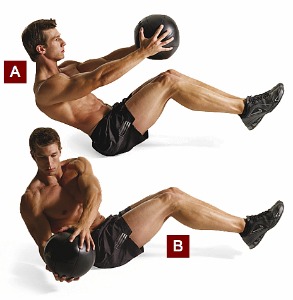
Perform the decline twisting sit-up (or on the floor without the decline) while holding a medicine ball at the chest level. At the top of each rep, rotate the medicine ball toward the opposite knee rather than driving the elbow. The medicine ball adds external resistance and slightly alters leverage, increasing the demand on the obliques and the rectus abdominis. A useful loaded progression once the bodyweight decline version is consistently controlled.
Medicine Ball Partner Throw
With a training partner standing at the foot of the decline bench, perform the twisting sit-up and pass the medicine ball to the partner at the top of each rep. The partner passes it back, requiring the torso to absorb the catch and stabilize before the next lowering phase. The reactive catch-and-stabilize demand adds an element of core control that purely predictable resistance exercises do not replicate.
Replacement Exercises (Alternatives)
If the decline twisting sit-up is not the right fit or a decline bench is unavailable, these exercises target the same primary muscle group:
- Crossover Crunch
- Hanging Oblique Knee Raise (Hanging Oblique Crunch)
- Bicycle Crunch
- Twisting Cable Crunch
- Standing Cable Oblique Crunch
- Russian Twist – Oblique Trunk Rotation
- Heel Touches
- Hip Crossover
- Lateral Crunch
- Dumbbell Side Bend
- Broomstick Twist
- Rotary Torso Machine
- Seated Rotary Torso Machine
- Roman Chair Side Bend
- Hanging Windshield Wiper
- Side Jackknife: Double Leg Double Side Jackknife
- Landmine 180s
How To Incorporate the Decline Twisting Sit-Up Into Your Workouts
- As a primary oblique and core exercise — the full range of motion and the combined stimulus make it appropriate as the main loaded core movement in an advanced session when the abs and obliques are fresh
- After compound lower body or upper body work — the decline bench setup means this exercise is often performed toward the end of a session; ensure adequate core freshness remains for quality reps
- Paired with a lateral flexion exercise — superset with a dumbbell side bend or Roman chair side bend for complete oblique coverage — rotation and lateral flexion back to back
- Rep range: 10–15 reps per side — the advanced difficulty and the hip flexor demand make moderate rep ranges most appropriate; high-rep sets almost always produce technique breakdown
- Sets: 3–4 working sets
- Frequency: 2–3 times per week alongside other core training
- Bench angle progression: Start at 20 degrees, increase to 30 degrees when 4 sets of 15 clean reps are consistently achievable, then to 45 degrees — do not rush this progression
- Progression trigger: When 4 sets of 15 controlled reps at the current bench angle with full upright top position, three-quarter bottom position, and no hip flexor dominance become consistent — increase the bench angle by one notch
Conclusion
The decline twisting sit-up is an advanced exercise that demands both physical strength and technical discipline. The hip flexor limitation is real — it is not a reason to avoid the exercise, but it is a reason to approach it with more attention to what is actually working than most trainees bring.
Slow the movement down. Feel whether the obliques or the hip flexors are initiating each rep. Keep the elbows wide. Stop three-quarters of the way down. If those conditions are consistently met, the decline twisting sit-up delivers a combined stimulus to the obliques and the rectus abdominis across a full range of motion that few exercises can match.
If they are not met — if the hip flexors are dominating, the elbows are swinging rather than the torso rotating, and the lower back is coming off the bench — do the crossover crunch instead and build the foundation that this exercise requires before returning to it.
Looking for more advanced oblique training options? See our guide to the best exercises for the oblique muscles. For more ways to train your midsection, check out our guides to upper ab, lower ab, and core exercises.
Reviewed by a Women’s Strength Specialist: The training recommendations and educational content presented in this article were reviewed by Kelley V., MPH, MS, CSCS, ACE Health Coach , whose expertise includes women’s strength training, hormonal health, and long-term athletic development.
