


Introduction
Most oblique exercises train the obliques in isolation — lying on the floor, sitting on a bench, or hanging from a bar, with the rest of the body fixed and passive. The landmine 180 does something entirely different. It trains the obliques as part of a dynamic, full-body rotational movement performed on your feet, with a loaded barbell arc that simultaneously challenges the entire anterior and lateral chain.
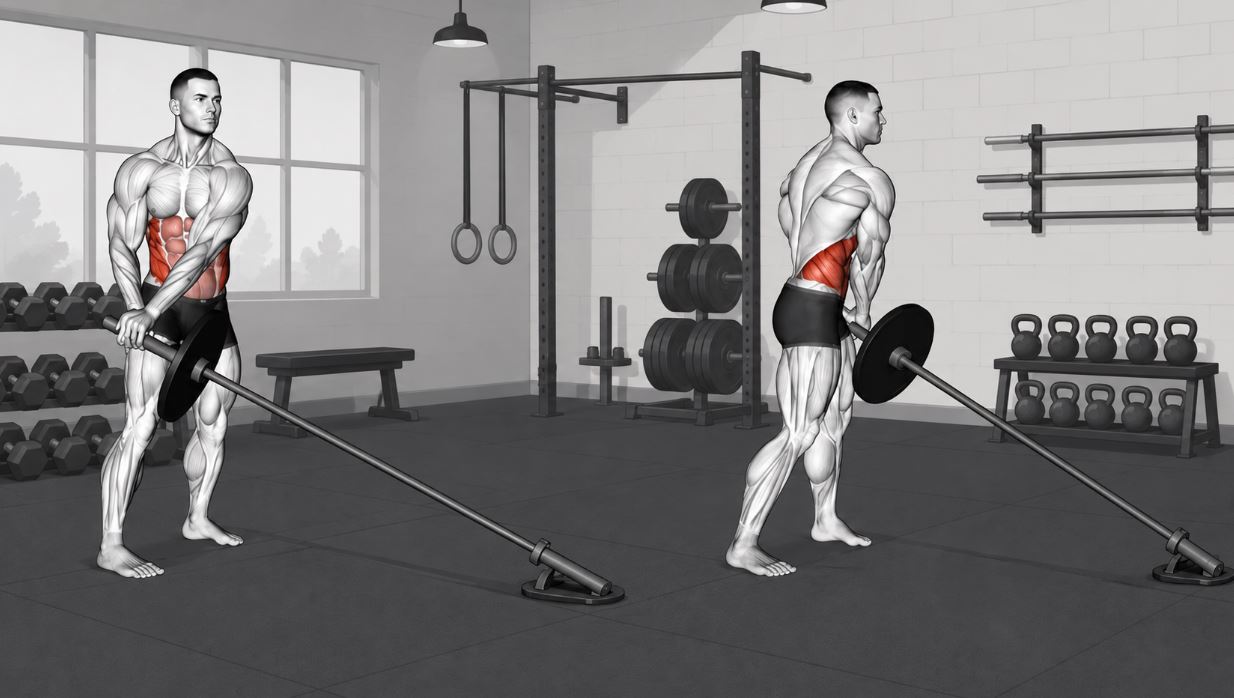
The exercise involves anchoring one end of a barbell in a landmine attachment — or in the corner of a wall or a plate on the floor — and sweeping the free end in a 180-degree arc from one side of the body to the other. The obliques drive and control the rotation; the quadriceps, glutes, hamstrings, shoulders, and upper back all contribute to generating and managing the arc. The result is a rotational power exercise that has more in common with athletic movement than with conventional ab training.
This is not a replacement for direct oblique isolation work. The lateral crunch, the Russian twist, and the twisting cable crunch all have their place. But if you want a strong and functional core that works as it does in sport and daily life — on your feet, through a full rotational arc, against meaningful resistance — then landmine 180s belong in your program alongside those isolation exercises, not instead of them.
Exercise ID Card
Muscles Worked in Landmine 180s
Primary muscles
- External and internal obliques — the primary rotational movers; they drive the arc of the bar from one side to the other and eccentrically control the deceleration at each end of the movement
- Quadriceps — provide the power base for the lower body drive that initiates each arc; the slight squat position at the bottom of each sweep loads the quads significantly
- Glutes and hamstrings — work alongside the quadriceps to generate lower body power through the rotational drive
- Shoulders (deltoids) — control the bar through the overhead arc and stabilize the upper extremities throughout the movement
Secondary muscles
- Rectus abdominis — works isometrically throughout to maintain trunk stability against the rotational and overhead forces
- Transverse abdominis — braces the spine and maintains intra-abdominal pressure throughout
- Latissimus dorsi — assists with controlling the bar through the arc
- Trapezius — stabilizes the shoulder girdle throughout the movement
- Calves — assist with foot stability and the drive through the arc
Antagonists
The opposing obliques, spinal stabilizers, and shoulder muscles on the opposite side work eccentrically to control the deceleration at each end of the 180-degree arc.
The serratus anterior is also meaningfully engaged during the overhead portion of the arc — as the bar sweeps through the top position, the serratus works to maintain scapular stability against the combined rotational and overhead forces.
How to Do Landmine 180s: Step-by-Step Form Guide
Starting position
- Insert one end of a barbell into a landmine attachment, or secure it in a corner or against a heavy plate on the floor
- Load the desired weight onto the free end — start with just the bar; even an unloaded barbell creates meaningful resistance through this arc
- Stand facing the free end of the bar with feet shoulder-width apart, toes turned slightly outward
- Bend down and grip the free end of the bar with both hands — one hand on top of the other or both hands cupped around the end
- Stand and extend the arms forward, holding the bar at approximately chest height — this is the starting position at the midpoint of the arc
- Brace the core firmly before beginning
Execution
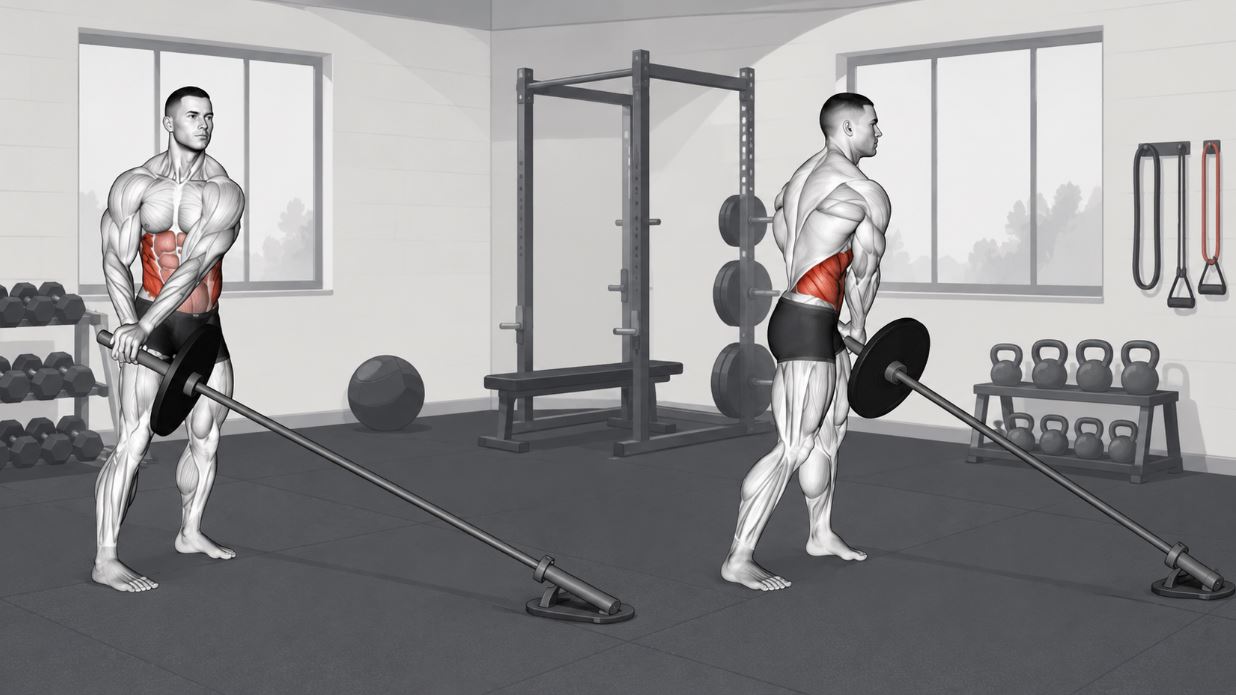
- Lower the bar to one side in a controlled arc — as the bar descends, the top arm stays extended while the bottom arm bends to guide the bar toward hip height; simultaneously rotate the torso slightly in the direction the bar is moving
- At the bottom of the arc on one side, the bar is at approximately hip height with the torso rotated to that side
- Explosively drive the bar upward and across the body through the overhead midpoint — the lower body generates power through a slight leg drive, the obliques drive the rotation, and the shoulders guide the arc
- Continue the arc to the other side, decelerating as the bar reaches hip height on the opposite side — the arm positions reverse: the arm that was extended is now bent, and the previously bent arm is now extended
- Without pausing longer than necessary to control the movement, drive the bar back through the arc to the other side
- Continue alternating for the prescribed reps — each full side-to-side arc counts as one rep

The key coaching cue: The power comes from the lower body and transfers through the obliques — not from the arms pulling or pushing. Think of the arms as connectors transmitting force generated by the legs and core, not as the primary movers. If the arms are doing most of the work, the lower-body and oblique contributions are lost, and the exercise is far less effective than it should be.
5 Common Landmine 180s Mistakes (And How to Fix Them)
1. Using only the arms to swing the bar
The most common and most limiting mistake. When the arms generate most of the force to swing the bar rather than the lower body and obliques, the weight that can be used is severely limited, the rotational power benefit is lost, and the obliques barely contribute to the movement. Drive through the floor with the legs, rotate through the obliques, and let the arms guide the arc. The feeling should be similar to throwing a ball — the power comes from the ground up, not from the hands.
2. Using too much weight too soon
Even a small amount of additional weight on a landmine bar changes the exercise significantly because the lever arm of the bar amplifies any added load at the free end. Start with just the bar and feel the arc before adding weight. Most trainees are surprised by how demanding the unloaded bar is through a full 180-degree arc. Progressive overload applies here as it does anywhere — but the increments need to be smaller than you might expect.
3. Not rotating the torso sufficiently
A common error is keeping the torso relatively fixed while the bar swings — essentially treating the exercise as a lateral raise rather than a rotational movement. The torso must rotate to follow the bar’s arc: as the bar descends to the right, the torso rotates to the right; as it sweeps left, the torso rotates to the left. Without that torso rotation, the obliques are barely involved, and the movement loses its primary purpose.
4. Losing foot position and stability
As the bar sweeps through the arc, there is a tendency for the feet to shift or pivot. Both feet should stay planted throughout the movement — the rotation comes from the torso above a stable base, not from the feet stepping or pivoting. If foot stability cannot be maintained, the weight is too heavy, or the range of rotation needs to be reduced.
5. Rushing through the deceleration phase
The deceleration at each end of the arc — where the obliques are working eccentrically to control the downswing — is one of the most valuable parts of the exercise for oblique development. Allowing the bar to crash to the end of the arc under gravity wastes that eccentric stimulus and can also stress the shoulder joint at end range. Control the descent on each side. The explosive phase is the drive through the arc; the controlled phase is the deceleration at each end.
Benefits of Landmine 180s
Trains rotational power in a functional standing position
Most oblique exercises train rotation or lateral flexion in a lying, seated, or kneeling position. Landmine 180s train rotational power on your feet — the position in which rotational strength actually matters in sport and daily life. Throwing, swinging, striking, and changing direction all involve standing rotational power through the full kinetic chain. This exercise develops that capacity more directly than any floor-based alternative.
Full kinetic chain engagement
The power generated in landmine 180s travels from the floor through the feet, up through the legs and hips, through the obliques and core, and out through the shoulders to the bar. That full kinetic chain engagement — identical to the chain involved in athletic rotational movements — makes this exercise genuinely functional in a way that isolated compound and isolation exercises cannot replicate.
Progressive overload with precise control
The landmine setup allows small, precise weight additions. Because the bar’s lever arm amplifies any added weight at the free end, progression is achievable in very small increments, which is particularly useful for developing rotational power where technique must be maintained as load increases.
Develops eccentric oblique strength
The deceleration phase at each end of the arc — the obliques working eccentrically to control the downswing — develops eccentric oblique strength that pure concentric rotational exercises do not address. That eccentric strength is directly relevant to injury prevention in rotational sports.
Versatile loading and rep range
Landmine 180s can be programmed for strength (lower reps, heavier load), hypertrophy (moderate reps, moderate load), or power (explosive reps, light-to-moderate load). That versatility makes them appropriate for a range of training goals without requiring a different exercise.
Who Should Use This Exercise
- Intermediate and advanced trainees who have already developed solid oblique strength through isolation exercises and want to train rotational power in a standing, functional context
- Athletes in rotational sports — baseball, golf, tennis, combat sports, hockey, swimming — who need to develop rotational power through the full kinetic chain rather than isolated oblique strength
- Trainees who want to add functional core training alongside conventional oblique isolation work
- Anyone with access to a landmine attachment or a barbell that can be safely anchored — the setup is accessible in most commercial gyms
Who Should Be Cautious
- Beginners who have not yet developed baseline oblique and core strength — the full-body demands of landmine 180s require a foundation of core stability that floor-based isolation exercises build first; master exercises like the lateral crunch, hip crossover, and Russian twist before attempting this movement
- People with lumbar disc issues — the combination of rotation and load creates significant lumbar demand; physiotherapy clearance is recommended before programming this exercise
- People with shoulder impingement or rotator cuff issues — the overhead portion of the arc places meaningful demand on the shoulder joint; rotator cuff pathology can be aggravated
- People with knee issues — the slight squat position and the rotational lower body drive load the knees; consult a physiotherapist if knee pain occurs
How to Make It Easier or Harder
Easier
- Reduce the arc — instead of a full 180-degree sweep, work through a shorter arc of 90 to 120 degrees; this reduces the rotational demand and the shoulder overhead exposure while preserving the rotational oblique stimulus
- Use just the bar — an unloaded barbell through a full arc is a meaningful challenge; do not add weight until the arc, the lower body drive, and the torso rotation are all consistently controlled
- Slow the tempo — performing the movement slowly removes the power component and focuses the stimulus on controlled rotational strength rather than explosive rotational power
Harder
- Add weight — small plate increments on the free end of the bar; even 5 kilograms changes the exercise noticeably, given the lever arm
- Increase the arc speed — performing the arc explosively develops rotational power rather than controlled strength; appropriate for athletic training contexts
- Single-arm variation — gripping the bar with one hand rather than two dramatically increases the rotational demand and the anti-rotation stability requirement; an advanced variation for experienced users of this movement
Landmine 180s vs. Cable Wood Chop
Both exercises train the obliques through standing rotational movement against external resistance, but the movement pattern, the loading profile, and the muscle recruitment differ meaningfully.
| Landmine 180s | Cable Wood Chop | |
|---|---|---|
| Movement pattern | 180° bilateral arc — side to side | Diagonal chop — high to low or low to high |
| Lower body involvement | High — leg drive integral to movement | Low to moderate — primarily upper body |
| Rotational arc | Full 180° — both sides in one continuous movement | Single direction per set |
| Equipment | Landmine attachment + barbell | Cable machine |
| Loading profile | Lever arm amplifies end weight | Consistent cable resistance |
| Power development | High — explosive rotational power | Moderate — controlled rotation |
| Oblique isolation | Lower — full body movement | Higher — more isolated rotation |
| Best for | Athletic rotational power, functional training | Oblique strength and hypertrophy |
The practical takeaway: The cable wood chop is the more oblique-isolated exercise — the cable provides consistent resistance through a controlled rotational arc with less lower body involvement, making it a better tool for targeted oblique development. Landmine 180s are the more athletically functional exercise — the full kinetic chain engagement, the bilateral 180-degree arc, and the power development component make them more relevant to sport performance. I program both: the standing cable oblique crunch and cable variations for oblique isolation and hypertrophy, and landmine 180s for rotational power development in athletic training contexts.
Exercise Variations
Half Landmine 180 (Single Side)
Rather than sweeping the full 180-degree arc from side to side, work one side at a time — starting at center and lowering to one side, returning to center, and repeating for all reps before switching. This allows more focus on the rotational mechanics of each side independently and is useful for identifying and addressing left-right rotational strength asymmetries. A good starting point for trainees new to the landmine 180 who want to master one side before combining both into the full arc.
Slow Landmine 180
Perform the full arc at a deliberate, controlled tempo — three to four seconds per side with no explosive drive. The slow version removes the power component and focuses the stimulus entirely on controlled rotational strength and eccentric oblique loading. It is significantly harder than it sounds — controlling the weight through the arc without momentum requires genuine rotational strength. A useful variation for building the oblique and shoulder strength needed before adding speed.
Landmine 180 with Squat
Add a squat at the bottom of each arc — as the bar reaches hip height on each side, drop into a partial squat before driving back up through the arc. The added squat dramatically increases the lower-body demand and the total metabolic cost of the exercise. A genuine full-body variation that is appropriate for conditioning work and athletic training.
Replacement Exercises (Alternatives)
If a landmine setup is unavailable or this exercise is not the right fit, these exercises target the same primary muscle group:
- Standing Cable Oblique Crunch
- Twisting Cable Crunch
- Russian Twist – Oblique Trunk Rotation
- Hip Crossover
- Decline Twisting Sit-Up
- Bicycle Crunch
- Broomstick Twist
- Rotary Torso Machine
- Seated Rotary Torso Machine
- Dumbbell Side Bend
- Lateral Crunch
- Roman Chair Side Bend
- Hanging Windshield Wiper
- Heel Touches
- Side Jackknife: Double Leg Double Side Jackknife
- Hanging Oblique Knee Raise
For more ways to train your obliques across every functional category, see our guide to the best exercises for the oblique muscles.
How To Incorporate Landmine 180s Into Your Workouts
- As a power development exercise — program early in the session when the nervous system is fresh; rotational power exercises lose their effectiveness under fatigue
- In an athletic training context — pair with other rotational power movements such as medicine ball throws and cable rotations for a complete rotational power training block
- Not as a primary oblique isolation exercise — landmine 180s complement isolation oblique work; they do not replace it; program alongside lateral crunches, cable oblique crunches, and side bends for complete oblique development
- Rep range:
- Power: 3–6 reps per side — explosive, maximal intent
- Strength: 6–8 reps per side — controlled but forceful
- Hypertrophy: 8–12 reps per side — moderate load, controlled tempo
- Endurance/conditioning: 12–20 reps per side — lighter load, continuous movement
- Sets: 3–4 working sets
- Frequency: 2–3 times per week — the full-body demand requires adequate recovery between sessions
- Tempo for power: Explosive through the arc, controlled deceleration at each end
- Tempo for hypertrophy: Two seconds per side up, two seconds deceleration — no explosive drive
- Progression trigger: When the current weight and rep range are consistently controlled with full arc, lower body drive, and torso rotation — add the smallest available weight increment to the free end of the bar
Conclusion
Landmine 180s occupy a specific niche in oblique and core training that no floor-based exercise can fill — standing rotational power development through a full bilateral arc against meaningful resistance. They are not the best oblique isolation exercise; that distinction belongs to exercises like the twisting cable crunch or the standing cable oblique crunch. What they are is the best way to train the obliques as part of a complete athletic rotational movement, which is a different and equally important goal.
The arms guide; the legs drive; the obliques rotate. Get those three elements working together through a controlled arc with appropriate loading, and the landmine 180 delivers a training stimulus that is genuinely difficult to replicate with conventional gym equipment.
If your oblique training has been confined to the floor and cable machines, adding landmine 180s will likely feel like a revelation — not because the obliques are working harder than they do in isolation exercises, but because they are finally working the way they were designed to work: as part of a complete, coordinated, powerful human movement.
For more athletic, full-body core training options, check out our complete core exercises guide. See our guides to upper ab, lower ab, and oblique exercises to round out your training.
Frequently Asked Questions
Do I need a landmine attachment to do landmine 180s?
No — a landmine attachment is the ideal setup but not the only option. The most common alternative is wedging one end of the barbell into the corner where two walls meet, which creates a stable pivot point without any additional equipment. A second option is placing the end of the bar inside a folded towel or rubber mat against a wall to prevent slipping. A third is using a heavy dumbbell or weight plate to anchor the end of the bar on the floor. All three alternatives work for light to moderate loads, though a proper landmine attachment is safer and more stable for heavier loading.
Are landmine 180s good for building oblique muscle mass?
They contribute to oblique development but are not the most efficient tool for pure oblique hypertrophy. Because landmine 180s distribute the load across the entire kinetic chain — legs, hips, core, shoulders — the obliques are one of several muscles sharing the stimulus rather than the exclusive target. For maximum oblique hypertrophy, exercises that isolate the obliques more directly — the twisting cable crunch, the standing cable oblique crunch, or the roman chair side bend — are more effective. Landmine 180s are best programmed alongside those isolation exercises for rotational power development, not as a substitute for them.
How is a landmine 180 different from a landmine twist?
The terms are often used interchangeably but describe slightly different movement patterns. The landmine twist typically involves a shorter rotational arc — rotating the bar from one side to the other without necessarily sweeping through overhead — with more emphasis on pure rotational oblique control. The landmine 180 specifically refers to the full 180-degree arc that takes the bar from hip height on one side, through an overhead midpoint, and down to hip height on the other side. The 180 version has greater overhead shoulder involvement and a more pronounced lower body drive component due to the larger arc.
What grip should I use for landmine 180s — interlaced fingers or cupped hands?
Both work. Interlaced fingers — one hand gripping the other — provides a more secure connection to the bar and is generally more comfortable for heavier loads. Cupped hands — both palms cupping the end of the bar from below — allows a slightly more natural wrist position through the arc and works well for lighter, more explosive sets. The arm mechanics change at each end of the arc regardless of grip style: the top arm stays extended while the bottom arm bends as the bar descends, and these positions reverse as the bar sweeps to the other side. Choose whichever grip feels most controlled through that transition.
Should landmine 180s be trained for power or hypertrophy?
Both — but with different programming. For rotational power, use lighter loads, 3 to 6 explosive reps per side, with maximum intent on each arc and complete recovery between sets. For hypertrophy and oblique development, use moderate loads, 8 to 12 controlled reps per side, with a deliberate two-second tempo through the arc and no explosive drive. The power version is appropriate for athletes in rotational sports during the performance phase of training; the hypertrophy version is appropriate for trainees whose primary goal is core and oblique development. Mixing both in the same program — power-focused early in a training block, hypertrophy-focused later — is a valid and effective approach.
Reviewed by a Women’s Strength Specialist: The training recommendations and educational content presented in this article were reviewed by Kelley V., MPH, MS, CSCS, ACE Health Coach , whose expertise includes women’s strength training, hormonal health, and long-term athletic development.
