


Introduction
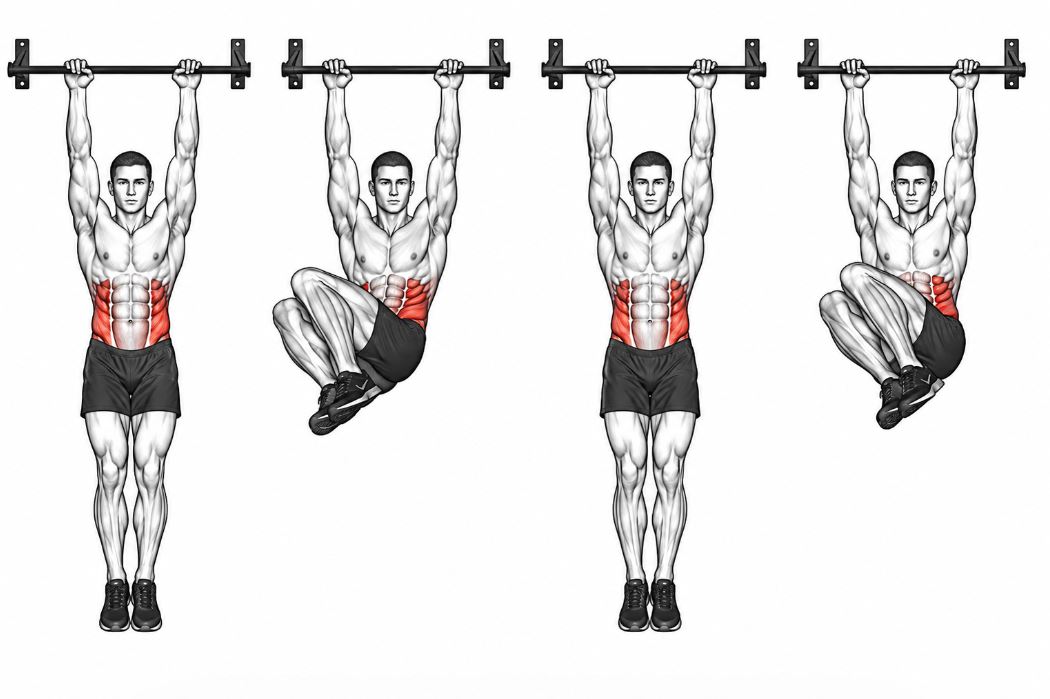
The hanging oblique knee raise — also called the hanging oblique crunch — takes the standard hanging knee raise and adds a rotational component that shifts a significant portion of the stimulus from the lower abs to the obliques. The setup is identical: grip a pull-up bar, hang freely, and draw the knees toward the chest. The difference is that, as the knees rise, the torso rotates to bring them toward one shoulder rather than straight up the midline. That rotation is what makes this a fundamentally different exercise — not a variation of the hanging knee raise, but a separate oblique-focused movement that happens to share the same apparatus and starting position.
The exercise requires the same prerequisites as any hanging ab variation: adequate grip strength to sustain multiple sets without grip failure becoming the limiting factor, shoulder stability to maintain a controlled hanging position, and enough lower ab and hip flexor strength to raise the knees without excessive swinging. What it adds on top of those requirements is the oblique strength and trunk rotation control to produce a deliberate, meaningful rotation at the top of each rep — not a shoulder twitch, but a genuine torso twist that drives the knees toward the opposite shoulder.
Done correctly, this is one of the most effective hanging oblique exercises available. Done incorrectly — which usually means a small elbow swing substituting for actual trunk rotation — it is just a hanging knee raise with an arm movement attached.
Exercise ID Card
Muscles Worked in the Hanging Oblique Knee Raise
Primary muscles
- External obliques — on the side toward which the torso rotates, the external obliques drive the rotational component of the movement; together with the internal oblique on the opposite side, they produce the trunk rotation that directs the knees toward the shoulder
- Internal obliques — work in concert with the external obliques; the internal oblique on one side and the external oblique on the opposite side coordinate to produce rotation in each direction
Secondary muscles
- Rectus abdominis (lower portion) — drives the hip flexion component that raises the knees; the lower abs are actively involved throughout, but the rotation component shifts the primary emphasis toward the obliques
- Hip flexors (iliopsoas, rectus femoris) — actively involved in raising the knees throughout the movement
- Latissimus dorsi and shoulder girdle — work continuously to maintain the hanging position throughout the set
- Forearm flexors — sustain the grip throughout; grip endurance is a genuine limiting factor
- Serratus anterior — engaged during the rotational component at the top of each rep
Antagonists
Spinal erectors and surrounding lumbar musculature lengthen under control during the combined flexion-and-rotation phase and drive the controlled return to the starting position.
The key mechanical distinction from the standard hanging knee raise is worth understanding clearly: in the standard version, the posterior pelvic tilt at the top drives the lower ab contraction. In the oblique version, the top-of-the-torso rotation engages the obliques. Both movements should still involve a posterior pelvic tilt — but the rotation is the additional element that changes which muscles bear the primary load at the peak of the movement.
How to Do a Hanging Oblique Knee Raise: Step-by-Step Form Guide
Starting position
- Grip a pull-up bar with an overhand grip, hands approximately shoulder-width apart
- Hang freely with arms fully extended and legs straight — allow the body to settle into a dead hang before beginning
- Depress the shoulder blades slightly to engage the lats and stabilize the shoulder girdle
- Brace the core before initiating the first rep

Execution
- Exhale and engage the core, lifting both knees simultaneously toward the chest
- As the knees rise, rotate the torso to one side — the knees travel toward the shoulder on that side rather than straight up the midline
- At the top of the movement, pause briefly with the obliques maximally contracted — knees as close to the shoulder as the range allows
- Lower the legs back to the starting position under control — resist the temptation to drop them quickly
- On the next rep, rotate to the opposite side — alternating sides with each rep throughout the set
- Maintain a controlled, anti-swing position throughout — do not allow the body to swing between reps
The key coaching cue: The rotation comes from the torso, not from the arms or shoulders tilting. Think of the lower ribs on the working side driving toward the opposite hip — that cue produces genuine trunk rotation from the obliques rather than a shoulder-tilt that bypasses them. If the knees move to the side while the torso stays vertical, the obliques are not producing the rotation.

5 Common Hanging Oblique Knee Raise Mistakes (And How to Fix Them)
1. Rotating with the shoulders rather than the torso
This is the most common and most consequence-rich mistake in this exercise. When the shoulders tilt rather than the torso rotating, the movement looks like a side-to-side lean rather than a trunk rotation — and the obliques contribute almost nothing. The rotation must come from the waist: the ribs on one side driving toward the opposite hip, the entire torso from hips to shoulders rotating as a unit. A useful check: at the top of the rotation, the chest should be facing the shoulder the knees are pointing toward. If the chest is still facing forward, the rotation is insufficient.
2. Swinging the body for momentum
Without a backrest or forearm support, the body naturally wants to swing — and swinging undermines the oblique rotation by turning the exercise into a momentum-driven pendulum. Every rep must begin from a controlled, relatively still position. If swinging is unavoidable, use the captain’s chair oblique knee raise — the forearm support and backrest of the captain’s chair eliminate swinging and allow full focus on the rotational oblique contraction.
3. Substituting a knee-lean for genuine rotation
Some trainees allow the knees to drift to one side while the torso stays relatively fixed — a lateral knee drift rather than a genuine torso rotation. The knees may appear to be going toward the shoulder, but the obliques are not generating that movement. The rotation must come from the torso driving the knees to the side, not from the knees drifting independently. If in doubt, place a hand on the oblique on the working side and feel whether it hardens at the top of the rep.
4. Not pausing at the top
Bouncing through the top position — knees reaching peak height and immediately dropping — removes the isometric oblique contraction that makes the top of the rep most productive. Pause for one to two seconds at the top with the obliques contracted. That pause confirms the full rotation has been achieved and maximizes the oblique stimulus per rep.
5. Grip failure ending the set before the obliques are adequately stimulated
Grip fatigue is a genuine and frequent limiting factor in all hanging exercises. Use chalk for later sets, or wrist straps if grip failure consistently ends sets before the obliques have been adequately worked. The obliques should be the limiting factor — not the hands.
Benefits of the Hanging Oblique Knee Raise
Oblique training in the hanging position
Most hanging ab exercises primarily target the lower abs and hip flexors — the hanging knee raise, the hanging leg raise, and the captain’s chair variations are all lower-ab-dominant. The hanging oblique knee raise addresses the obliques specifically in the hanging position, adding a rotational stimulus that complements the lower ab focus of other hanging exercises.
Combined hip flexion and trunk rotation
The simultaneous knee rise and trunk rotation trains the obliques in the combined flexion-rotation pattern that mirrors athletic demands — throwing, striking, and rotational power movements all involve simultaneous hip flexion and trunk rotation. That functional pattern has direct carryover to rotational sports performance.
No equipment beyond a pull-up bar
A pull-up bar is the only requirement. The hanging oblique knee raise adds meaningful oblique training to any program that already includes pull-up bar work without requiring any additional equipment.
Grip and shoulder endurance alongside oblique training
Like all hanging exercises, grip strength and shoulder girdle stability are trained as concurrent demands. For athletes who need that combination alongside oblique development, the hanging position is more efficient than floor or cable alternatives.
Who Should Use This Exercise
- Advanced trainees who have mastered the standard hanging knee raise with consistent posterior pelvic tilt and no swinging, and are specifically seeking oblique development from the hanging position
- Athletes in rotational sports — martial artists, baseball players, tennis players, golfers, swimmers — who need combined hip flexion and trunk rotation strength with a hanging position challenge
- Trainees building toward the hanging windshield wiper — the hanging oblique knee raise develops the rotational control and hanging oblique strength that the windshield wiper requires
Who Should Be Cautious
- Trainees who cannot yet perform multiple clean hanging knee raises — the oblique rotation adds demand on top of the standard hanging knee raise requirements; the standard version must be mastered first
- People with shoulder impingement or rotator cuff issues — the sustained hanging position combined with the rotational demand places significant stress on the shoulder joint
- People with grip injuries or forearm tendinopathy — grip failure during hanging exercises is a fall risk
- People with lumbar disc issues — combined hip flexion and trunk rotation creates lumbar demand; physiotherapy clearance is recommended
How to Make It Easier or Harder
Easier
- Captain’s chair oblique knee raise — the same combined knee rise and rotation performed in a captain’s chair with forearm support and a backrest; eliminates swinging and reduces grip demand while preserving the oblique rotation pattern
- Crossover crunch — a floor-based elbow-to-opposite-knee movement that teaches the rotation mechanics without any hanging demands
- Reduced rotation range — rotating the knees only partway toward the shoulder rather than full rotation; useful when learning the movement before progressing to the full range
Harder
- Straight leg hanging oblique raise — extending the legs rather than bending the knees dramatically increases the lever arm and the oblique and hip flexor demand; an advanced progression from the knee version
- Extended hold at top — holding the peak rotation for three to five seconds significantly increases time under tension on the obliques
- Hanging windshield wiper — the ultimate hanging oblique exercise; starts where the hanging leg raise to the bar ends and adds lateral rotation from the full V-position
Hanging Oblique Knee Raise vs. Hanging Knee Raise
Both exercises are performed from the same pull-up bar grip and hanging position, but the rotation component changes the primary target muscle and the nature of the stimulus.
| Hanging Oblique Knee Raise | Hanging Knee Raise | |
|---|---|---|
| Movement pattern | Hip flexion + trunk rotation | Hip flexion only |
| Primary target | Obliques | Lower abs (rectus abdominis) |
| Rotation at top | Yes — knees toward shoulder | No — knees straight up |
| Posterior pelvic tilt | Yes — still important | Yes — primary stimulus |
| Difficulty | Advanced | Intermediate |
| Anti-swing demand | High | High |
| Best for | Oblique development from bar | Lower ab development from bar |
The practical takeaway: The hanging knee raise and the hanging oblique knee raise are complementary exercises that train different primary muscles from the same apparatus. The knee raise targets the lower abs through pure hip flexion and posterior pelvic tilt. The oblique knee raise targets the obliques by adding trunk rotation to the same hip-flexion pattern. I program both in advanced hanging core sessions — the standard version for lower ab stimulus and the oblique version for rotational oblique development — treating them as a hanging core pairing rather than as substitutes.
Exercise Variations
Captain’s Chair Oblique Knee Raise
The same combined knee rise and trunk rotation performed in a captain’s chair — forearms on padded bars, back against the backrest. The backrest eliminates swinging and allows full focus on the rotational oblique contraction without grip or anti-swing variables interfering. This is the primary regression for trainees who want to learn the oblique rotation pattern before taking it to the free-hanging pull-up bar. The captain’s chair version is also a genuinely effective oblique exercise in its own right — not merely a stepping stone.
Hanging Straight Leg Oblique Raise
From the same hanging position, keep the legs straight throughout the movement rather than bending the knees. Raise straight legs toward one side — directing them toward the shoulder on the rotating side — rather than drawing bent knees toward the chest. The straight-leg position dramatically increases the lever arm and the demands on the oblique and hip flexors, making this an advanced progression from the knee version. Only attempt once the bent-knee version is consistently controlled through a full range of rotation.
Single-Side Hanging Oblique Knee Raise
Rather than alternating sides each rep, complete all reps rotating to one side before switching. This approach maintains focused oblique tension on one side for the full set duration, which increases the sustained stimulus per side and makes any left-right oblique strength asymmetry immediately apparent. Useful when specifically addressing an oblique strength imbalance.
Replacement Exercises (Alternatives)
If the hanging oblique knee raise is too advanced or a pull-up bar is unavailable, these exercises target the same primary muscle group:
- Twisting Cable Crunch
- Standing Cable Oblique Crunch
- Hip Crossover
- Russian Twist – Oblique Trunk Rotation
- Bicycle Crunch
- Decline Twisting Sit-Up
- Cross-Over Crunch
- Dumbbell Side Bend
- Lateral Crunch
- Rotary Torso Machine
- Seated Rotary Torso Machine
- Roman Chair Side Bend
- Broomstick Twist
- Landmine 180s
- Hanging Windshield Wiper
- Side Jackknife: Double Leg Double Side Jackknife
How To Incorporate the Hanging Oblique Knee Raise Into Your Workouts
- As a primary hanging oblique exercise — program at the beginning of a hanging core session when grip and shoulders are completely fresh; grip and shoulder fatigue from other pulling movements significantly compromises the quality of hanging oblique work
- Paired with standard hanging knee raise — superset for complete hanging core coverage — lower abs through straight knee raise, obliques through the rotational version; both movements, same bar, efficient pairing
- Not on the same day as heavy pulling — deadlifts, pull-ups, and rows create grip and shoulder fatigue that limits the quality of hanging ab work; program on separate days or ensure hanging core work comes first in the session
- Rep range: 8–12 reps per side — count each side separately; at controlled tempo with a genuine pause at each rotation, 10 reps per side is a demanding set
- Sets: 3–4 working sets
- Frequency: 2–3 times per week maximum — the grip and shoulder demands require adequate recovery between sessions
- Tempo: Two seconds raising with simultaneous rotation, one to two second pause at the top, two to three seconds lowering — never drop the legs
- Progression trigger: When 4 sets of 12 controlled reps per side with genuine trunk rotation, no swinging, and a deliberate pause at the top become consistently achievable — progress to the straight-leg version or extend the hold at the top
Conclusion
The hanging oblique knee raise fills a specific gap in oblique training that floor and cable exercises cannot address — the hanging position demands grip, shoulder stability, and anti-swing control alongside the oblique rotational stimulus, creating a more complete training challenge than any supported alternative.
The rotation is everything in this exercise. A hanging knee raise with a slight shoulder lean is not a hanging oblique knee raise — it is a hanging knee raise with poor alignment. The chest must face the shoulder the knees are directed toward. The ribs on one side must drive toward the opposite hip. The obliques must be the muscle generating that rotation.
Get the rotation right, and this exercise delivers oblique development from the hanging position, with no direct equivalent among floor or machine exercises. That is a narrow but genuine niche — and for advanced trainees who have built the prerequisites, it is worth filling.
Looking for more oblique training options? See our guide to the best oblique exercises. To train your entire core, check out our guides to upper ab exercises, lower ab exercises, and core exercises.
Reviewed by a Women’s Strength Specialist: The training recommendations and educational content presented in this article were reviewed by Kelley V., MPH, MS, CSCS, ACE Health Coach , whose expertise includes women’s strength training, hormonal health, and long-term athletic development.
