



Do you want to level up your tennis game with strength training? You’re in the right place! Strength training plays a precious role in the sport of tennis, enhancing performance while fortifying the body against potential injuries. With the right guidance, pro tips, and exercises, you can craft a tailor-made workout plan that integrates strength training into your routine. In our Ultimate Guide to Strength Training for Tennis Players, we will cover all these components and more.
Whether you’re a newbie or a seasoned pro, strength training can help you take your tennis game to new heights. The key is to understand the strokes, the muscles that play the most crucial role in the game, and the training specifics to develop these muscles effectively.
The key components of a tennis player’s workout routine
A tennis player’s training routine should be comprehensive and multifaceted, focusing on several key components. First and foremost, it should target the muscle groups that are most used in tennis. This includes the core, legs, and upper body, particularly the shoulders and arms.
- Functional strength training. This involves exercises that mimic the movements a player makes during a tennis match. It helps to improve the player’s agility, speed, and power on the court and reduces the risk of injury.
- Balance and stability training. Tennis requires a lot of lateral movement and quick changes in direction, so exercises that improve balance and stability can greatly enhance a player’s performance.
- Explosive power training (often through plyometric exercises). This type of training helps players to increase their speed and power, which is particularly beneficial for serving and returning shots.
- Endurance and cardiovascular training. Tennis matches can last for several hours, so players need to have good stamina. This type of training can also help to improve recovery times.
- Flexibility and mobility exercises. They help to improve a player’s range of motion, which can enhance their ability to reach and return shots. They also help to prevent injuries.
Each of these components should be incorporated into a tennis player’s training routine in a balanced and structured way. The specific exercises and the intensity and frequency of the workouts should be tailored to the individual player’s needs and goals.
The most important muscles for a tennis player
As a tennis player, developing strength in specific muscles isn’t just beneficial – it’s essential. When you’re positioned at the baseline preparing to serve or poised ready to return a fast shot, the power behind your moves comes from a combination of various muscles. Here’s an overview of the key muscles a tennis player needs to condition:
- Forearms: Your forearms are essential for gripping the racquet and controlling your shots.
- Biceps: Biceps assist in the movements of your elbows and shoulders, playing a vital part in serving and volleying.
- Triceps: Your triceps help stabilize your elbow while making groundstrokes, ensuring you can make even forceful shot returns with excellent control.
- Rhomboids: These muscles, situated in the upper back, are leaned on in nearly all racquet strokes, giving power to your movements.
- Rotator Cuff: The rotator cuff, a group of muscles and tendons that surround the shoulder joint, allows a full range of motion in your shoulder. This allows for powerful serves and returns.
- Core Muscles: Your abdominal muscles, obliques, and lower back are responsible for stabilizing your body and providing a strong base for all your other muscles’ movements.
- Glutes: Your buttocks muscles propel you as you sprint on the court, change direction swiftly, or make jumps for overhead shots.
- Quadriceps and Hamstrings: These significant thigh muscles play an essential role in your ability to sprint, jump, and maintain a ready stance. They’re at work in virtually every movement you make as a tennis player.
- Calves: From bouncing on your toes before a serve to sprinting for your next shot, your calves provide crucial support and power for lower body movement.
Understanding these muscles’ roles and the activities that strengthen them is a fundamental step toward creating an effective and sport-specific strength training plan. In conclusion, a combination of upper body, lower body, and core strength is crucial for improving tennis strokes. Each set of muscles contributes to different aspects of the stroke, from power generation to control and stability.
The benefits of strength training for a tennis player’s performance
Strength training is essential for a tennis player’s performance. It brings a myriad of benefits including:
- Improved Swing Speed: By working on your upper body, particularly the shoulders, forearms, and wrists, you can significantly enhance your swing speed. This means faster serves and returns, providing you with an edge over your opponents.
- Increased Stamina: Strength training can help to develop overall stamina, enabling you to maintain high energy levels throughout the game. This assists in preventing fatigue and supports sustained concentration levels.
- Reduced Injuries: Strength training fortifies your muscles, reducing the risk of injury. It also enhances joint flexibility and stability, which can further protect you from injury on the court.
- Better Balance and Coordination: Strength training exercises that target the core and lower body improve your balance and coordination – key attributes required for swift movement on the tennis court.
- Increased Power: By boosting your muscle power through strength training, you can hit the ball harder, making it more challenging for your opponents to return your shots.
In conclusion, integrating strength training into your routine can considerably elevate your tennis game, giving you a competitive advantage on the court. Strength training helps build the necessary muscle mass that allows players to hit harder, serve faster, and maintain a high level of play for longer periods.
The most effective strength training exercises for tennis

Regardless of your current skill level, incorporating strength training exercises into your routine can significantly improve your tennis game. Here are some of the most effective exercises that are specifically beneficial for tennis players:
- Forearm Planks: Core strength is vital for tennis players, as it provides stability and balance during rigorous movements. Performing forearm planks can help in building a strong core while also enhancing shoulder stability, which is particularly useful for serving and volleying.
- Lunges: Lunges target multiple muscle groups including glutes, hamstrings, and quads. These are crucial muscles used in tennis for powerful shots and fast footwork. Performing lunges also helps improve your mobility and balance.
- Bent-Over Rows: Bent-over rows are excellent for strengthening your back, shoulder, and arm muscles — the primary muscles involved while swinging your racket.
- Push-ups: Push-ups not only strengthen your chest, shoulder, and triceps but also engage your abdominal muscles. Having a strong upper body can help improve your serving and swinging speed.
- Medicine Ball Slams: This exercise mimics the overhead serving motion, improving total body power, and coordination.
- Rotational Exercises: Given the rotational nature of many tennis strokes, exercises that strengthen your oblique muscles and promote rotational power are crucial. Including Russian twists or medicine ball rotations in your workout can pay big dividends on the court.
- Plank Rows (also known as Renegade Rows). Renegade row strengthens the core, back, and arms, all of which are important for maintaining balance and control during tennis strokes. The rowing motion also helps to improve upper body strength, which can enhance the power of your strokes.
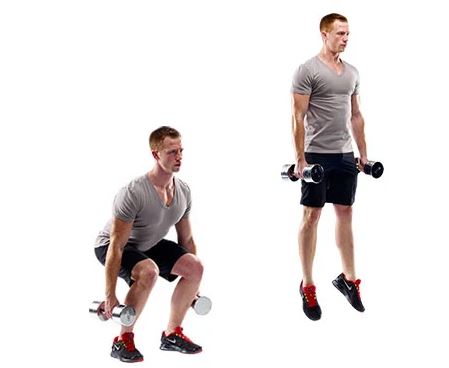
- Squat Jumps. These squats are a plyometric exercise that can help to improve lower body strength and power, both of which are crucial for quick, explosive movements on the tennis court. This exercise targets the quads, hamstrings, glutes, and calves, and can help to improve your speed and agility.

The recommended frequency and intensity of strength training for tennis players
The recommended frequency and intensity of strength training for tennis players can vary depending on their level of play, current physical condition, and specific goals. However, a general guideline is to engage in strength training two to three times per week. This allows for adequate recovery time between sessions, which is crucial for muscle growth and injury prevention.
Each strength training session should last between 45 minutes to an hour. The intensity of the workout should be moderate to high, depending on the player’s fitness level and the phase of their training cycle. During the off-season or pre-season, when players are building their base strength, workouts may be more intense. During the competitive season, the intensity may be reduced to maintain strength and prevent injury.
A typical strength training session might involve two to three sets of 8-12 repetitions for each exercise, using a weight that challenges the player without compromising form. The aim of each training session should be to work up to about 70-85% of your one-repetition maximum (1RM), which is the most weight you can lift in one go. However, this doesn’t mean lifting your heaviest in every session. It’s about progressive increments and respecting your body’s limits. Start with light weights and gradually increase the weight as your strength improves.
Remember, your muscles need time to recover, so ensure you’re not neglecting the crucial aspect of rest. Aim to take a rest day in between your strength training days to allow your muscles to repair and grow.
Finally, it’s important to note that the intensity and frequency of strength training should be balanced with other components of a tennis player’s training program, such as on-court practice, cardiovascular training, flexibility exercises, and rest. A well-rounded program will ensure optimal performance and longevity in the sport.
Expert tips for improving a tennis player’s strength training routine
Here are some expert guidelines to further enhance your tennis strength training regimen:
- Individualize your program: Each player has unique strengths, weaknesses, and objectives. Consequently, your strength training program should be tailored to you. Get guidance from a fitness professional who knows your game well.
- Maintain consistency: Nothing beats consistency in training. Regular workouts are more effective than sporadic, high-intensity sessions. Stick to your game plan and see noticeable improvements.
- Incorporate multi-joint exercises: These are exercises that work multiple muscle groups at once. They stimulate more muscle activity and can be beneficial for the dynamic movements required in tennis.
- Proper form is key: As you add weight or reps to your workout, form tends to suffer. Always prioritize maintaining correct form over lifting heavier weights.
- Periodization is a crucial aspect of a successful strength training routine: This involves varying your training program at regular intervals to prevent plateaus and continue challenging your body. For instance, you might focus on building strength during the off-season, and then switch to maintenance mode during the competitive season.
- Incorporate both unilateral and bilateral exercises: Unilateral exercises, which work one side of the body at a time, can help improve balance and coordination, while bilateral exercises, which work both sides of the body at the same time, can help build power and strength.
- Add variety: To prevent workout plateauing, make sure to alter aspects of your workout plan every few weeks. This can be modified by changing the number of sets, reps, weights, or even the type of exercise.
- Recovery is important: Along with diligent training, your body needs time to recover. Adequate sleep, proper nutrition, and restoration techniques can aid in muscle repair and improve performance.
By implementing these pro tips, you’ll be on your way to maximizing your potential on the tennis court. Remember, strength training for tennis is a marathon, not a sprint. So keep pushing, and stay disciplined, and you’ll see your game elevate before you know it.
Understanding the Phases of Periodized Programs
Tennis is a game you can engage in any time of the year, whether you’re playing indoors or outdoors.
Here is a representation of how a strength training program would appear if you have an ‘off’ season following your tennis playing season, enabling you to build your strength and also take some downtime.
Early Pre-Season Training
The objective of this phase is to build a solid base on which you build more intense, more tennis-specific fitness later.
- No. sessions: 2x week
- Circuits: 2-3
- Resistance: 40-50% 1 Rep Max
- Repetitions: 12-15
- Rest between stations: 20-30 secs
- Rest between circuits: 2-3 mins
- Speed of lifts: Smooth and controlled
Mid-Pre-Season
The primary objectives during mid-pre-season training are to build up functional strength and muscle mass (hypertrophy).
Developing hypertrophy or muscle size doesn’t always translate to increased strength. However, in this preparatory phase, accumulating some muscle mass can provide a solid base for the next stage – developing power. Power refers to the capacity to move the heaviest weights in the shortest span. Essentially, it equates to the product of strength and speed.
- No. sessions: 2x week
- Resistance: Adjust the weight so that the final few repetitions in each set are taxing but don’t cause you to “fail” completely
- Sets & Repetitions: 3 sets; 8-12 reps per set
- Rest between sets and exercises: 1 minute / 2 minutes
- Speed of lifts: Smooth and controlled
| WORKOUT ROUTINE, EXAMPLE 1 | WORKOUT ROUTINE, EXAMPLE 2 |
|---|---|
| Barbell squat 12,12,12 | Goblet squat 12,12,12 |
| Incline barbell bench press 12,12,12 | Flat bench dumbbell press 12,12,12 |
| Arnold dumbbell press 10,10,10 | One-arm bent-over cable lateral raise 10,10,10 |
| Trap bar or hex bar deadlift 12,12,10 | Romanian deadlift 12,12,12 |
| Inverted row 12,12,10 | Wide-grip pull-up 10,10,10 |
| Side plank 4x 60 sec | Swiss-ball pike 12,12,12 |
| Hanging windshield wiper 12,12,12 | Lying oblique reach 12,12,12 |

**A key area that requires your undivided attention is none other than your rotator cuff muscles. This group of muscles and tendons spiral around your shoulder joint, working in unison to keep your arm stable in the socket while you command your swings and serves. Strengthening the rotator cuff muscles can be done in the comfort of your own home, regardless of your gym workout. Pick 2-3 rotator cuff exercises and perform them at least once a week.
Late Pre-Season Training
Late pre-season training is about gearing up for the start of the season. The focus at this phase is on enhancing maximum power. Don’t forget that power is a synergy of strength and speed. Power training necessitates explosive, high-velocity weight lifting.
Ensure you take enough rest between repetitions and sets for peak speed in each action. Consider reducing the number of sets compared to phase 1, as training at such high intensity when fatigued isn’t beneficial.
- Sets per exercise: 2-3
- Repetitions per set: 8-10
- Load: Bodyweight/ Medicine ball/ Dumbbells
- Rest Interval: 3-4 minutes
- Way of execution: Explosive, high-velocity
| WORKOUT ROUTINE, EXAMPLE 1 | WORKOUT ROUTINE, EXAMPLE 2 |
|---|---|
| Dumbbell jump squat 10,10,10 | Power clean 10,10,10 |
| Medicine ball slams 10,10,10 | Medicine ball push press 10,10,10 |
| Hurdle jumps to sprint 3x 30 sec | Backward medicine ball throw 8,8,8 |
| Dumbbell hang clean 10,10,10 | Split squat jump 10,10,10 |
| Burpee 8,8,8 | Burpee 8,8,8 |
| Lateral medicine ball throw 10,10,10 | Lying overhead medicine ball throw 10,10,10 |
| Squat-push-throw 8,8,8 | Squat-push-throw 8,8,8 |

In-Season Training
By the time the season rolls around, you should be involved in competitive or routine recreational tennis and should be in your best shape. The accent here is on maintaining the strength and power you’ve built. Alternate strength and hypertrophy workouts with power training. Every third week, skip weight training to assist recovery.
It’s advisable not to mix up your strength training routine with your on-court sessions. However, if your schedule compels you to fit them both into one day, ensure you have them at different times, preferably one in the morning and the other in the afternoon.
Break Season Training
It’s time to slow down and take a breather. However, it’s important to remain active to maintain a certain level of fitness for the next season. The focus during this phase should be on rest and recovery while incorporating light activities like cross-training and easy gym routines.
Conclusion
In conclusion, strength training is integral to any tennis player’s routine, aiming to enhance performance, endurance, and stamina. By focusing on key muscles involved in critical tennis strokes and maintaining the recommended frequency and intensity, players can drastically improve their game. A well-structured, periodized program that evolves with the player’s needs further underpins success. With persistence, dedication, and strategic strength training, you can keep raising the bar, one swing at a time.
