
What is the hanging leg raise?
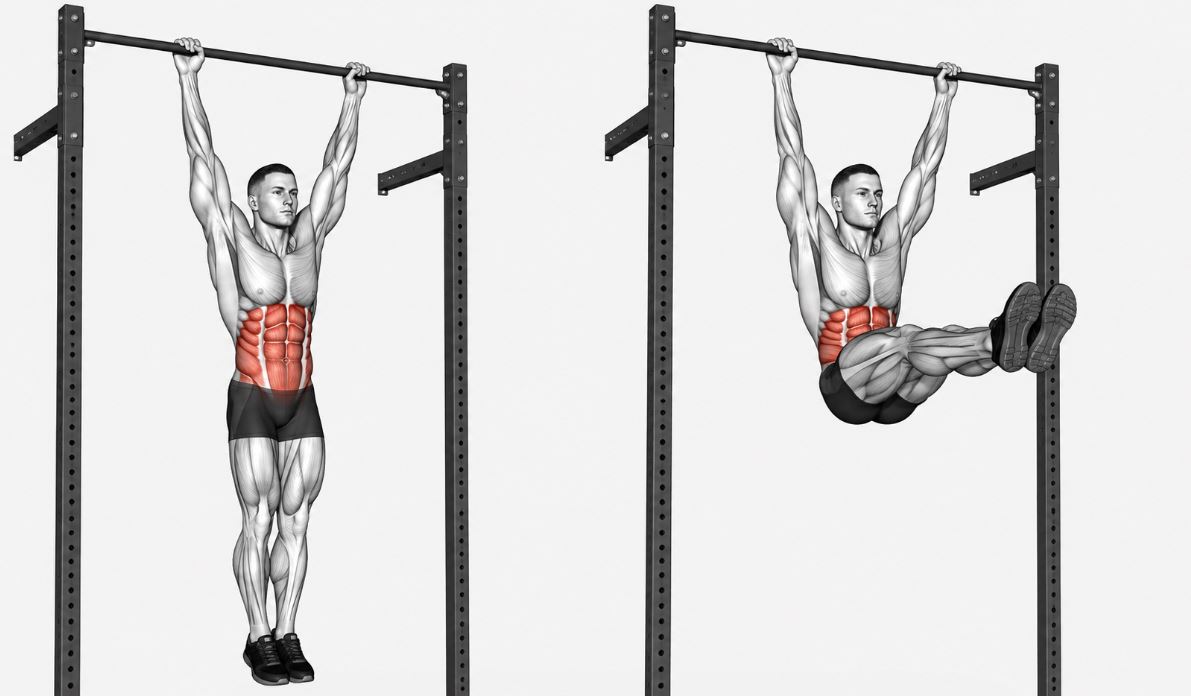
The hanging leg raise is an advanced lower ab exercise performed hanging from a pull-up bar in which straight legs are raised to parallel or beyond through lower ab and hip flexor contraction. Unlike the captain’s chair version, there is no back support or forearm rest — the body hangs freely, requiring grip strength, shoulder stability, and active anti-swing control alongside the lower ab stimulus.
Introduction
The hanging leg raise is one of the most demanding lower ab exercises available — and one of the most honest. There is nowhere to hide on a pull-up bar. No backrest, no forearm support, no floor to generate momentum from. Just grip, hang, and raise your legs straight against gravity while keeping your body from swinging. That combination of demands is exactly what makes it effective and exactly what makes it so commonly performed with poor technique.
Also known as the hanging straight-leg raise or hanging leg lift, this exercise is an advanced progression of the captain’s chair leg raise. The movement pattern is identical — raise the legs, achieve posterior pelvic tilt at the top, lower under control — but the absence of support transforms every variable: grip strength becomes a limiting factor, the body must be actively stabilized against swinging, and the lat and shoulder girdle work continuously just to maintain the hanging position throughout the set.
The bent-knee version of this exercise — the hanging knee raise — is covered in a separate guide. This article covers only the straight-leg variation.
Muscles Worked in the Hanging Leg Raise
Primary muscle
Rectus abdominis (lower portion) — the movement is driven by posterior pelvic tilt and hip flexion from the hanging position. The straight-leg position creates a long lever that maximizes the gravitational load on the lower abs and hip flexors throughout the range of motion. The posterior pelvic tilt at the top of each rep — where the lower back rounds and the pelvis drives upward — is where the lower rectus abdominis reaches maximum contraction.
Secondary muscles
- Hip flexors (iliopsoas, rectus femoris) — drive the leg raise and control the lowering phase; significantly more active than in bent-knee variations due to the straight-leg lever
- External and internal obliques — stabilize the torso and prevent rotation throughout the set
- Transverse abdominis — braces the spine and maintains intra-abdominal pressure
- Latissimus dorsi and shoulder girdle — work continuously to maintain the hanging position and resist the tendency to shrug or lose grip under fatigue
- Forearm flexors — sustain the grip throughout the set; grip failure is a genuine limiting factor on this exercise
- Front quadriceps — maintain leg extension throughout
- Pyramidalis (where present) — assists the lower rectus abdominis
Antagonists
Spinal erectors and surrounding lumbar musculature lengthen under control during the lift and drive the controlled return to the starting position.
How To Perform the Hanging Leg Raise
Starting position
- Grip an overhead pull-up bar with an overhand grip, hands slightly wider than shoulder-width apart.
- Let the body hang fully extended — arms straight, body vertical, feet together and lightly touching the floor or hanging just above it.
- Before initiating the first rep, engage the lats by depressing the shoulder blades slightly — this stabilizes the shoulder girdle and reduces the tendency to shrug under load.
- Brace the core and tilt the pelvis slightly posteriorly to pre-activate the lower abs.
Execution
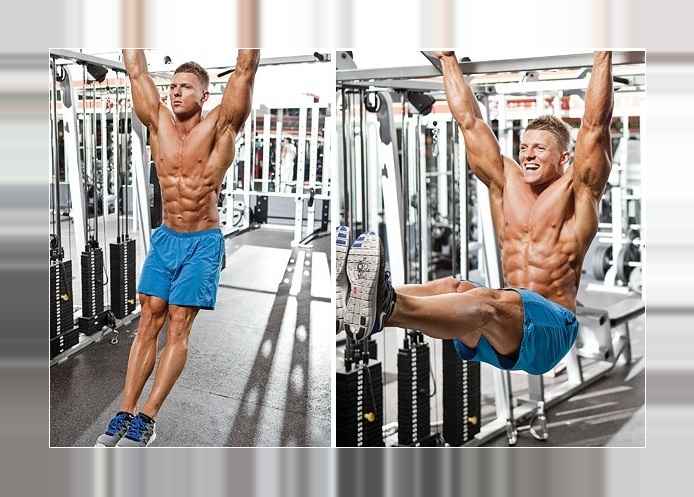
- Exhale and initiate the movement with a posterior pelvic tilt — the pelvis tilts before the legs begin to rise
- Keeping the legs straight and feet together, raise both legs simultaneously
- Continue until the legs are parallel to the floor — the minimum effective range
- Push through to beyond parallel if lower ab strength allows — the legs continuing toward vertical increases the stimulus significantly
- At the top, deliberately round the lower back and drive the pelvis upward — this posterior pelvic tilt at the top maximally contracts the lower abs and is the defining technical element of the exercise
- Hold the top position for one to two seconds
- Slowly lower the legs back to the starting position — two to three seconds minimum on the descent
- Stop just short of full extension at the bottom and begin the next rep without allowing the body to swing
The key coaching cue: Keep the lower legs slightly in front of the body at the end of each rep rather than letting them drop directly below the hips. This forward position prevents the backward rock that puts stress on the lower back and sets up momentum for the next rep. Think of finishing each rep with the body in a slight hollow position — not a straight vertical line from hands to feet.
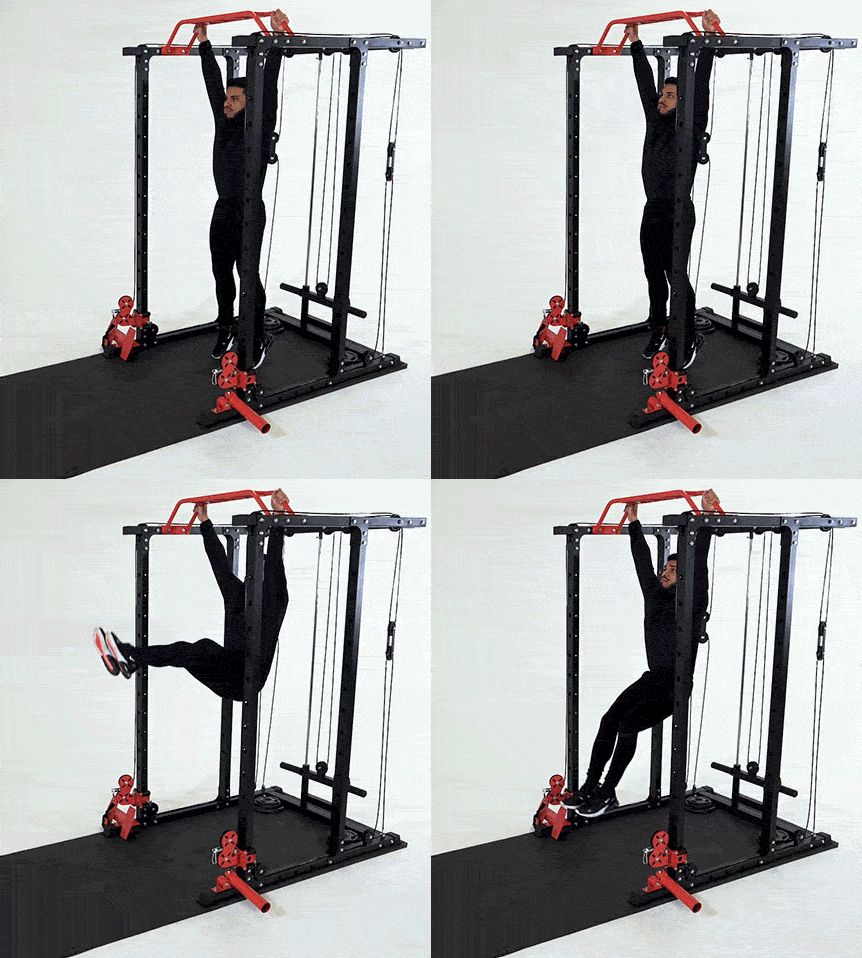
Common Mistakes in the Hanging Leg Raise
1. Swinging the body for momentum
The most common and most damaging mistake on the hanging leg raise. Without a backrest to prevent it, the body naturally wants to swing — legs back on the lowering phase, then forward momentum carrying them up on the next rep. This removes the lower ab stimulus entirely and turns the exercise into a pendulum. Every rep must begin from a controlled dead stop position. If swinging is unavoidable, use the captain’s chair version until core stability and grip strength have developed sufficiently.
2. Not achieving posterior pelvic tilt at the top
Raising the legs to parallel without the accompanying posterior pelvic tilt is the most common technical error that goes unnoticed — it feels like the exercise is being performed correctly because something is clearly working hard. But if the lower back stays flat and the pelvis does not tilt at the top, the hip flexors have generated most of the force. The lower abs only reach maximum contraction when the lower back rounds and the pelvis drives upward at the top of the rep. That rounding is not a mistake — it is the point.
3. Bending the knees during the movement
The moment the knees bend, the exercise becomes the hanging knee raise — a different, easier exercise. Straight legs throughout the entire range of motion define this variation, making it significantly more demanding. If the knees consistently bend before reaching parallel, the hip flexor and lower ab strength is not yet sufficient for the straight-leg version. Use the hanging knee raise until the prerequisite strength develops.
4. Losing lat engagement and shrugging
Under fatigue, the shoulder girdle tends to elevate — the traps take over from the lats and the body begins to hang from the upper traps rather than the lats and shoulder stabilizers. This position is both less stable and harder on the shoulder joints. Keep the shoulder blades depressed throughout the set — think of actively pulling the shoulders away from the ears. If shrugging becomes unavoidable, the set is over.
5. Rushing the lowering phase
Dropping the legs quickly eliminates the eccentric stimulus, generates the backward swing that builds momentum for the next rep, and places unnecessary stress on the lower back at the bottom of the movement. Two to three seconds on the lowering phase is the minimum. The abs should be working throughout the descent, not just at the top.
Benefits of the Hanging Leg Raise
Maximum lower ab stimulus
The combination of straight legs, full gravitational load, and the absence of any support creates one of the highest lower ab demands available in bodyweight training. There is no surface to push against, no backrest to stabilize against — just the lower abs and hip flexors working against the full weight of the straight legs.
Full range of motion
The hanging position allows the legs to travel from fully extended below the hips to vertical and beyond — a range of motion that neither the floor nor the captain’s chair can fully replicate. That extended range means the lower abs are loaded through a longer arc per rep.
Multi-system training stimulus
Unlike floor-based lower ab exercises, the hanging leg raise simultaneously trains grip strength, shoulder girdle stability, lat endurance, and core anti-rotation alongside the primary lower ab stimulus. That combination of demands makes it one of the most efficient exercises available for developing overall core and upper-body endurance.
Direct carryover to athletic performance
The combination of grip, hanging stability, and lower ab strength trained by this exercise has direct carryover to gymnastics, martial arts, climbing, swimming, and any sport that demands trunk control in a suspended or overhead position.
No equipment beyond a pull-up bar
A pull-up bar is the only requirement — one of the most accessible pieces of equipment in any gym and increasingly common in home training setups.
Who Should Use This Exercise
- Advanced trainees who have already mastered the captain’s chair leg raise and can demonstrate 4 clean sets of 12 straight-leg reps with consistent pelvic tilt and controlled eccentric. Attempting this exercise before that foundation is in place almost always results in a swing-and-momentum pattern that provides minimal ab stimulus.
- Athletes who need grip strength alongside lower ab development — climbers, gymnasts, martial artists, and wrestlers all benefit from the combined stimulus this exercise provides.
- Trainees who have plateaued on captain’s chair work and need a harder variation that adds grip and stability demands to the lower ab pattern.
Who Should Be Cautious
- People with lower back pain or lumbar disc issues. The straight-leg lever and the posterior pelvic tilt at the top of the movement place significant demand on the lumbar region. Anyone with an active disc herniation or chronic lower back pain should use the captain’s chair or floor-based alternatives with medical clearance.
- People with shoulder impingement or rotator cuff issues. The sustained hanging position under load places continuous stress on the shoulder joint and rotator cuff. Existing shoulder pathology can be significantly aggravated by the prolonged overhead grip, particularly in high-volume sets.
- People with grip weakness or forearm tendinopathy. Grip failure ends the set before the abs have received adequate stimulus — and the sudden drop that follows grip failure can stress the shoulder joint. Build grip strength through dead hangs and farmer carries before attempting this exercise.
- Beginners and intermediate trainees. The hanging leg raise is genuinely advanced. The prerequisites — posterior pelvic tilt mastery, adequate hip flexor strength, sufficient grip endurance, and shoulder stability — take time to develop. Rushing this exercise before the foundation is in place leads to poor technique and minimal results.
Progressions and Regressions
Regressions (easier)
Captain’s chair leg raise — the same movement with forearm support and a backrest. Eliminates the grip and anti-swing demands while preserving the lower ab stimulus. The appropriate stepping stone before the hanging version.
Hanging knee raise — the bent-knee version on the same bar. Shorter lever, reduced hip flexor demand, easier to control swinging. The right starting point for anyone new to hanging ab exercises.
Dead hang — simply hanging from the bar without any leg movement. Builds the grip strength, shoulder stability, and lat endurance needed to support the hanging leg raise before adding any movement.
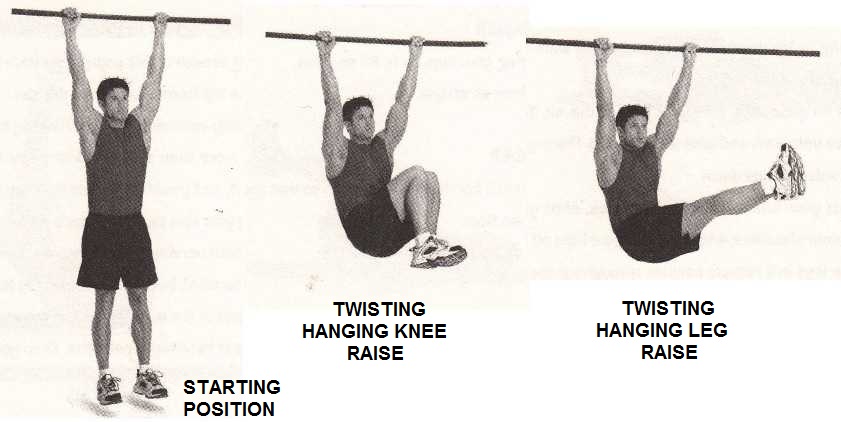
Progressions (harder)
Hanging leg raise beyond parallel — raising the legs past parallel toward the ceiling increases the range of motion and the lower ab demand significantly. Only attempt once the parallel version is consistently controlled with proper pelvic tilt.
Weighted hanging leg raise — holding a light dumbbell between the feet or wearing ankle weights. Even a small change in weight can dramatically alter the exercise, given the length of the straight-leg lever.
Toes to bar — raising the straight legs all the way to touch the bar overhead. A gymnastic-level movement that requires exceptional lower ab strength, hip flexor power, and hamstring flexibility.
Hanging Leg Raise vs. Captain’s Chair Leg Raise
Both exercises perform the same fundamental movement — raising straight legs from a hanging or supported position — but the support structure changes the difficulty, the limiting factors, and who each exercise is appropriate for.
| Hanging Leg Raise | Captain’s Chair Leg Raise | |
|---|---|---|
| Support | None — hanging from bar | Forearms on pads, back on rest |
| Grip demand | High — grip failure ends the set | None |
| Anti-swing demand | High | Low — backrest prevents swinging |
| Shoulder demand | High | Low |
| Lower ab stimulus | Higher — no support to assist | High |
| Difficulty | Advanced | Intermediate |
| Equipment needed | Pull-up bar | Captain’s chair |
| Best for | Advanced trainees, athletes | Intermediate trainees, learning the pattern |
The practical takeaway: The captain’s chair is the better starting point — the backrest eliminates swinging and allows full focus on the lower ab contraction without grip or stability variables interfering. The hanging leg raise is harder in every dimension and provides a greater overall training stimulus, but requires prerequisite strength in grip, shoulders, and lower abs that takes time to build. I never skip the captain’s chair phase — it is where the technique is learned. The hanging bar is where it is tested.
Exercise Variations
Hanging Knee Raise
The bent-knee version of the same exercise — knees draw toward the chest rather than straight legs raising to parallel. The shorter lever reduces the hip flexor demand and makes the posterior pelvic tilt pattern more accessible. This is the appropriate starting point for anyone new to hanging ab exercises and is covered in detail in its own exercise guide.
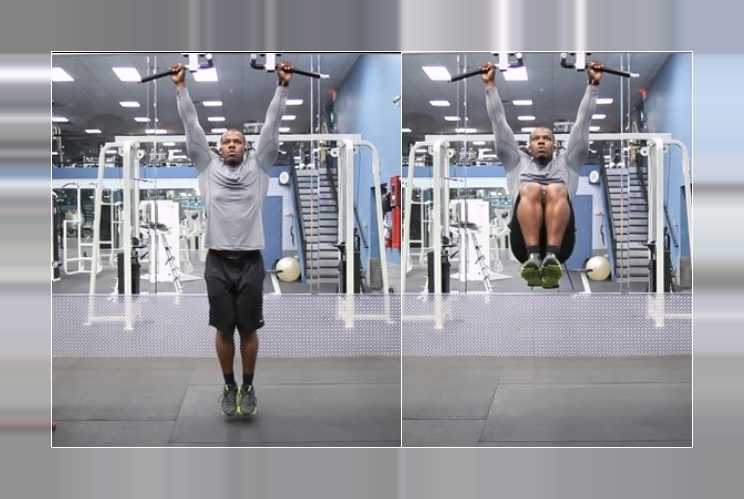
Twisting Hanging Knee Raise
At the top of each rep, rotate the knees toward one shoulder before lowering — alternating sides each rep. The obliques become primary movers alongside the lower abs, adding a rotational strength component to the basic pattern. Use the bent-knee position for this variation to allow the rotation to occur naturally without hamstring tightness limiting the range.
Twisting Hanging Leg Raise
The straight-leg version of the rotation — raise the straight legs toward one shoulder rather than directly in front. Requires more hip flexor strength and oblique activation than the knee version and demands significant hamstring flexibility at the top of the rotated position. Only attempt once the standard hanging leg raise is consistently controlled.
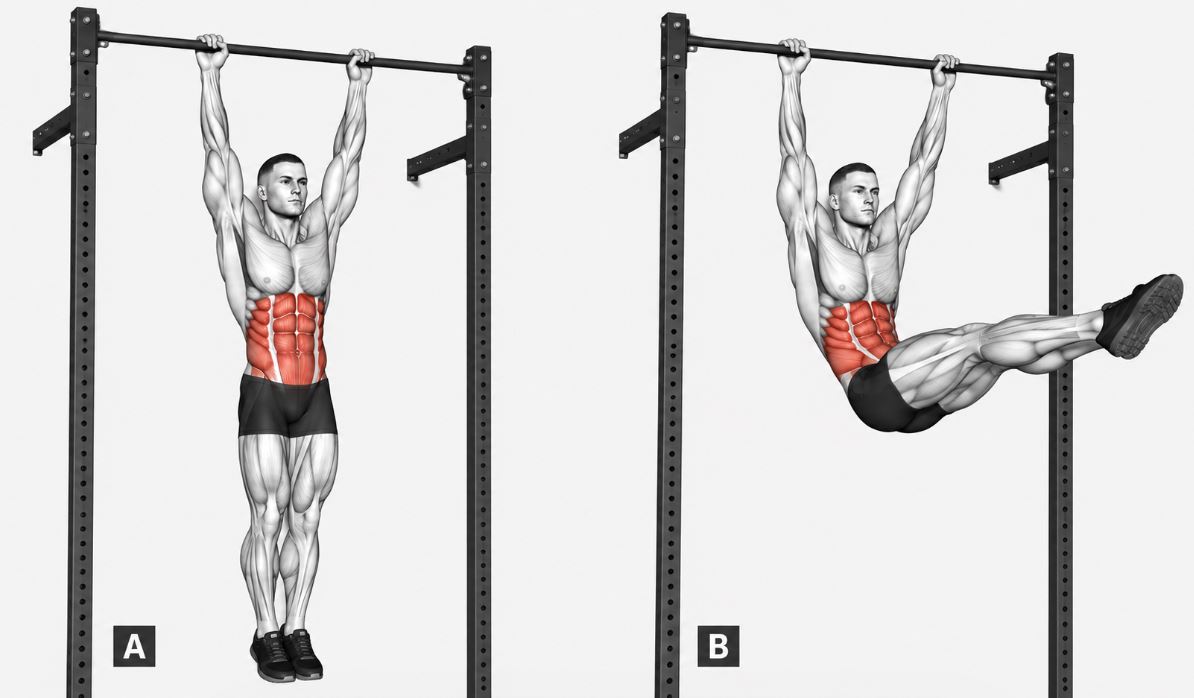
Wall Ladder Hanging Leg Raise
Hang from a wall ladder or similar apparatus with the back against the rungs. The ladder stops the body from swinging — providing a support reference similar to the captain’s chair backrest but in a hanging position. A useful intermediate step between the captain’s chair and the free-hanging version for trainees who struggle with swinging.

Replacement Exercises (Alternatives)
If the hanging leg raise is too advanced or a pull-up bar is unavailable, these exercises target the same primary muscle group:
- Reverse Crunch
- Hanging Knee Raise
- Captain’s Chair Leg Raise
- Captain’s Chair Knee Raise
- Hip Raise
- Lying Leg Raise
- V-Leg Raise (Seated Knee-Up)
- Incline Reverse Crunch
- Swiss-Ball Reverse Crunch
- Full V-Sit (Jackknife Sit-Up)
Programming Tips
- Rep range: 8–12 reps per set. The hanging leg raise is a demanding, technically complex movement — grinding out high reps with deteriorating technique is counterproductive. When the knees begin to bend, the body begins to swing, or the grip begins to fail, the set is over.
- Sets: 3–4 working sets. Sufficient volume without the cumulative fatigue that consistently leads to compensated reps.
- Tempo: Two seconds up, one to two second hold at the top with deliberate pelvic tilt, three seconds down. That tempo eliminates momentum and ensures the lower abs are working throughout the full range.
- Frequency: 2–3 times per week with at least one rest day between sessions.
- Where in the session: At the end of the workout after compound movements — but earlier in the ab training block than simpler exercises, because the grip and stability demands require more neuromuscular freshness than a floor crunch. If pairing with other ab exercises, do the hanging leg raise first.
- Grip management: Use chalk if available — grip failure before the abs are adequately stimulated is a genuine limiting factor for most trainees. Alternatively, use wrist straps for later sets when grip fatigue is accumulating.
- Progression trigger: When you can complete 4 clean sets of 12 straight-leg reps with consistent pelvic tilt at the top, three-second eccentric, and no swinging — add a small weight between the feet or progress toward toes to bar.
Conclusion
The hanging leg raise is the exercise that separates trainees who have built genuine lower-ab strength from those who have been managing hip flexor compensation for years. There is no backrest to lean into, no forearm pad to push against, no floor to generate momentum from. Just a bar, a hanging body, and the lower abs working against the full weight of straight legs.
That honesty is what makes it valuable — and what makes it so commonly performed badly. I have seen more sets of hanging leg raises that were essentially controlled swings than I care to count. Legs moving, body rocking, hip flexors working hard, lower abs doing very little.
The fix is always the same: master the posterior pelvic tilt at the top of every rep. Round the lower back, drive the pelvis upward, feel the lower abs contract maximally. Everything else — grip strength, anti-swing control, straight legs — supports that moment. Get that right consistently, and the hanging leg raise will deliver a lower ab stimulus that no floor or machine exercise can replicate.
Want to know where the hanging leg raise stands among the top lower ab exercises? See how it compares to ten other movements and where it fits in a progressive training plan. Round out your program with our guides to upper ab, oblique, and core exercises.
