


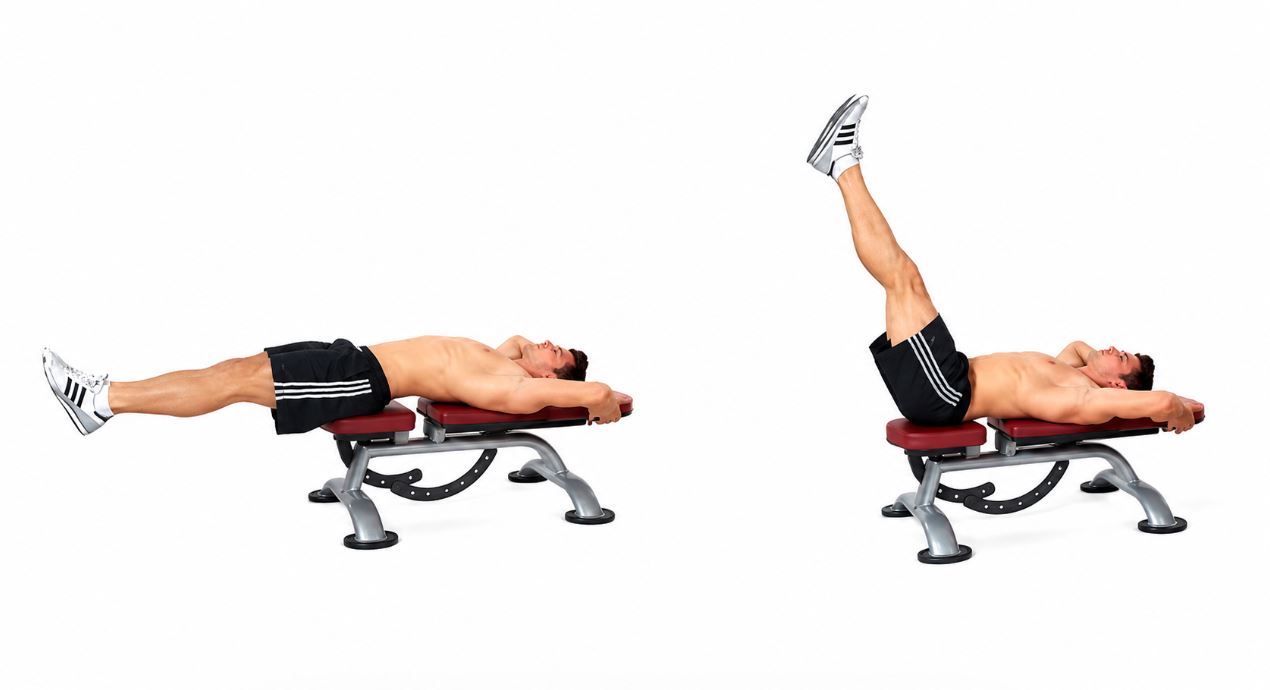
What is the lying leg raise?
The lying leg raise is a lower ab exercise performed lying on the back in which straight legs are raised from a horizontal position to vertical and then lowered under control. It targets the lower portion of the rectus abdominis alongside the hip flexors and is suitable for beginner through intermediate trainees depending on the variation used.
Introduction
The lying leg raise is one of the most fundamental lower ab exercises — and one of the most frequently performed incorrectly. The premise is straightforward: lie on your back, raise straight legs from horizontal to vertical, lower under control. What makes it harder than it looks is the combination of hip flexor demand, lower back stress at the bottom of the movement, and the tendency to lose lower ab involvement the moment momentum takes over.
Also known as the lying straight leg raise or supine leg raise, this exercise can be performed on the floor, on a flat bench, or on an incline bench — each variation progressively harder than the last. The floor version is the most accessible starting point; the incline bench version is one of the more demanding lower ab exercises available without hanging equipment.
The lying leg raise differs from the lying hip raise — which uses a pre-set vertical leg position and focuses on a small hip lift — in that it takes the legs through a full range of motion from horizontal to vertical. That larger range of motion increases both the hip flexor demand and the lower ab stimulus per rep.
Muscles Worked in the Lying Leg Raise
Primary muscles
- Rectus abdominis (lower portion) — the posterior pelvic tilt at the top of the movement is where the lower abs contract most forcefully; the lower portion of the rectus abdominis works throughout the range but peaks as the legs approach vertical
- Hip flexors (psoas major, rectus femoris) — heavily involved throughout the full range of motion, particularly during the lifting phase from horizontal to parallel; the lying leg raise has significantly more hip flexor involvement than the reverse crunch or lying hip raise due to the straight-leg lever and the full range of motion
Secondary muscles
- Upper rectus abdominis — assists with stabilization throughout the movement
- External and internal obliques — stabilize the torso and prevent rotation
- Transverse abdominis — braces the spine and maintains intra-abdominal pressure throughout
Antagonists
- Spinal erectors and surrounding lumbar musculature lengthen under control during the lift and work eccentrically to control the lowering phase — this is the phase where lower back stress is highest and where technique matters most.
How To Perform the Lying Leg Raise
Starting position
- Lie face-up on a flat bench or mat with your legs extended straight, toes pointing toward the ceiling
- If using a bench, position your hips near the end of the bench with legs extending off the edge
- Grip the sides of the bench next to your hips or grip behind your head — both provide upper body stability; behind the head gives more leverage
- Press the lower back into the surface and brace the core before initiating the first rep

Execution
- Keeping the legs straight and together with knees soft but not bent, exhale and raise both legs simultaneously
- Continue raising until the legs are just short of perpendicular to the floor — stopping slightly before vertical prevents the abs from relaxing at the top
- Hold briefly at the top, feeling the lower abs contract
- Inhale and slowly lower the legs back toward the starting position — take at least two to three seconds on the descent
- Stop before the legs drop below the level of the bench or before the lower back arches off the floor — do not lower all the way to horizontal if that position causes the lower back to lift
- Begin the next rep from that controlled position without bouncing
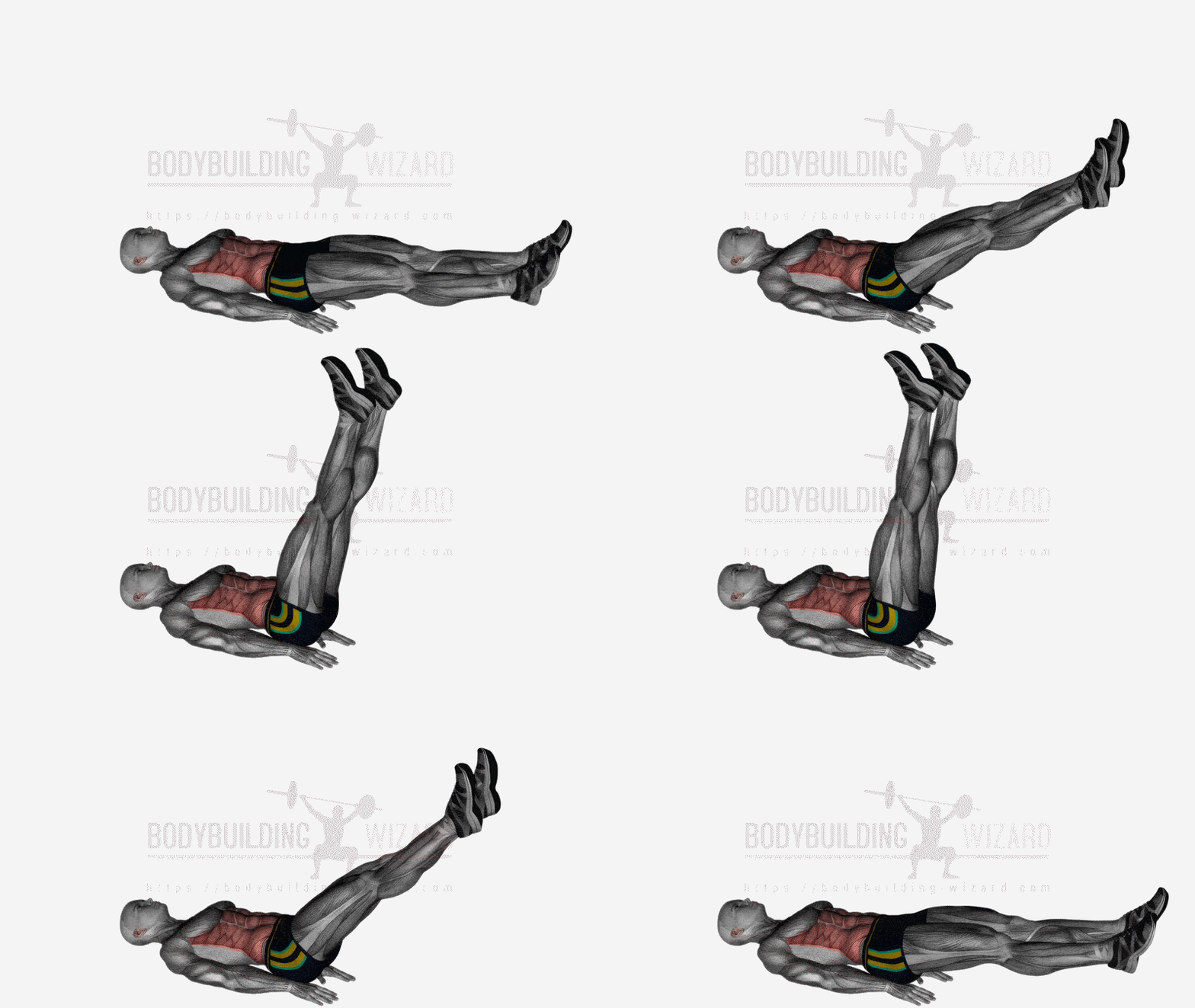
The key coaching cue: Do not raise the legs past vertical — once the legs go past perpendicular, the abs actually relax, and the movement loses its stimulus. Stop just short of vertical, hold the contraction, and begin the controlled descent. The productive range of motion is from horizontal to just below vertical, not beyond it.
Common Mistakes in the Lying Leg Raise
1. Lowering the legs too far
Allowing the legs to drop below the level of the bench — or allowing the lower back to arch off the floor — places excessive strain on the lumbar spine and hip flexors at the bottom of the movement. This is where lower back injuries most commonly occur with this exercise. Keep the lower back in contact with the surface at all times. If the lower back arches before the legs reach the surface, that is the end of the range of motion for that trainee at that point in their development.
2. Using momentum
Swinging the legs up with momentum, rather than with a controlled muscular contraction, removes the lower ab stimulus and increases lumbar stress during the return phase. Every rep should be deliberate and controlled from start to finish. If momentum is unavoidable, bend the knees slightly to shorten the lever and reduce the demand until the lower ab and hip flexor strength develops.
3. Raising the legs too high
Going past vertical — legs swinging over the torso — causes the abs to relax and shifts the load entirely to the hip flexors and lower back. Stop just short of perpendicular to the floor. That is the position where the lower abs are maximally loaded. Beyond it, the stimulus drops off rapidly.
4. Allowing the legs to separate
Keeping the feet together and the legs parallel throughout the movement is not incidental — it maintains the bilateral load and prevents one hip flexor from compensating for the other. If the legs drift apart, tighten the inner thighs consciously or place a folded towel between the knees as a tactile cue.
5. Rushing the lowering phase
The eccentric phase — lowering the legs — is where the most lower back stress occurs and where the most lower ab stimulus is available. Dropping the legs quickly wastes the eccentric stimulus and sets up the lower back for stress at the bottom. Two to three seconds minimum on the way down, every rep.
Benefits of the Lying Leg Raise
Full range of motion lower ab training
The lying leg raise takes the legs through a complete arc from horizontal to vertical — a range of motion that floor-based hip raise exercises cannot replicate. That extended range means the lower abs and hip flexors are loaded through a longer arc per rep, providing a more complete stimulus than short-range alternatives.
Scalable difficulty through surface and angle
The same fundamental movement pattern can be performed on the floor, on a flat bench, or on an incline bench — each progressively harder. That scalability makes the lying leg raise useful from beginner through intermediate training levels without requiring any change in the movement pattern itself.
No specialized equipment for the basic version
A mat is all that is needed for the floor version. The bench versions require only a flat or adjustable bench — standard equipment in any gym. No cables, no machines, no pull-up bar required.
Direct hip flexor conditioning alongside lower ab work
The hip flexors are heavily involved throughout the lying leg raise — more so than in the reverse crunch or lying hip raise. For athletes who need strong hip flexors alongside lower ab strength, the lying leg raise provides both in a single exercise.
Foundational pattern for hanging variations
The straight-leg raise pattern learned in the lying position transfers directly to the captain’s chair and hanging leg raise variations. Mastering the lying version — particularly the controlled lowering phase and the lower back management — builds the movement quality needed before progressing to vertical hanging exercises.
Who Should Use This Exercise
- Beginners building foundational lower ab and hip flexor strength before progressing to hanging or incline variations
- Trainees at home who want an effective lower ab exercise without gym equipment
- Athletes who need hip flexor strength alongside lower ab development — sprinters, swimmers, gymnasts, and martial artists all benefit from the combined stimulus
- Anyone building toward the captain’s chair or hanging leg raise — the lying leg raise is the direct prerequisite movement pattern
Who Should Be Cautious
- People with lower back pain or lumbar disc issues — the bottom of the lowering phase places the highest stress on the lumbar spine; anyone with existing lower back pathology should keep the range of motion short, use the bent-knee variation, or choose the reverse crunch instead
- People with hip flexor tightness — tight hip flexors increase anterior pelvic tilt under load, which amplifies lumbar stress throughout the movement; address the flexibility issue alongside training
- Beginners who cannot maintain lower back contact with the floor — if the lower back arches before the legs reach horizontal, the exercise is beyond the current strength level; use the reverse crunch or lying hip raise until the lower ab and hip flexor strength develops
- People with shoulder or wrist issues — gripping the bench behind the head or at the sides requires sustained upper body tension; adjust the grip position if discomfort occurs
Progressions and Regressions
Regressions (easier)
- Bent-knee lying leg raise — bending the knees shortens the lever arm, reducing both the hip flexor demand and the lower back stress at the bottom of the movement; a useful modification for beginners or those with lower back sensitivity
- Lying hip raise — a shorter, simpler movement that uses the vertical leg position without the full range of the leg raise; teaches posterior pelvic tilt before adding the full arc of the leg raise
- Reverse crunch — bent knees, smaller range, lower hip flexor demand; the most accessible floor-based lower ab exercise before the lying leg raise
Progressions (harder)
- Weighted lying leg raise — ankle weights or a dumbbell held between the feet add external resistance; even a small weight changes the exercise significantly given the length of the straight-leg lever
- Incline bench leg raise — performing the movement on an incline bench with the head at the higher end increases the gravitational load throughout the range of motion
- Captain’s chair leg raise — the same straight-leg pattern in a vertical hanging position; significantly harder due to the absence of surface support
Lying Leg Raise vs. Reverse Crunch
Both exercises target the lower rectus abdominis from the floor without equipment, but they differ in range of motion, hip flexor involvement, and who they are appropriate for.
| Lying Leg Raise | Reverse Crunch | |
|---|---|---|
| Leg position | Straight throughout | Knees bent at 90° |
| Range of motion | Full — horizontal to vertical | Moderate — hips lift off floor |
| Hip flexor involvement | High | Moderate |
| Lower back stress | Moderate to high at bottom | Low |
| Lower ab isolation | Good — but hip flexors share the load | Better — less hip flexor compensation |
| Difficulty | Beginner – Intermediate | Beginner |
| Best for | Hip flexor + lower ab combined | Pure lower ab isolation |
The practical takeaway: The reverse crunch is the cleaner lower ab isolation exercise — the bent knees reduce hip flexor involvement, and the shorter range of motion keeps the lower back safer. The lying leg raise is more demanding, trains the hip flexors more heavily, and builds the movement pattern needed for hanging variations. I use the reverse crunch as the primary lower ab exercise for beginners and introduce the lying leg raise once the lower ab and hip flexor strength is sufficient to control the full range without lower back compensation.
Exercise Variations
Incline Bench Leg Raise
Place the head at the higher end of an incline bench and grip the top of the bench behind your head for support. Raise the legs together until they are parallel to the floor — this is the starting position for this variation. From parallel, raise the legs to approximately 45 degrees above the bench surface, pause, then lower back to parallel. The incline means the abs stop benefiting above 45 degrees, so there is no value in going higher. Reduce resistance by lowering the bench angle; increase it by steepening the incline.

Incline Bench Leg Raise with Bent Knees
Same incline setup and starting position, but from the parallel position, bend the knees and draw the thighs toward the chest as far as possible. Hold at the top, feeling the lower abs contract, then extend the legs back to the parallel starting position. The bent-knee movement at the top adds a posterior pelvic tilt component similar to the reverse crunch. Do not raise the legs overhead — the productive range ends when the thighs reach the chest.

Weighted Lying Leg Raise
Fasten ankle weights snugly around each ankle, or hold a light dumbbell or medicine ball between the feet. Follow the standard lying leg raise instructions. Even a modest weight — 2 to 5 kilograms — significantly increases the difficulty because the added resistance acts at the end of the straight-leg lever. Start conservatively and build incrementally. Only add weight once the bodyweight version is consistently controlled with a two to three-second eccentric and no lower back arching.

Double-Leg Lowering with Bent Knees
Lie supine with palms down and neck neutral, hips and knees both flexed to 90 degrees. From that position, slowly lower both feet toward the floor through eccentric hip extension — keeping the knees bent throughout. Do not let the lower back flatten completely or arch; maintain a neutral lumbar curve throughout the descent. Reverse the movement to return to the starting position. This variation emphasizes the eccentric phase and the lower-ab control needed to resist the hip-flexor pull during the lowering phase.

Lying Leg Raise with Hip Thrust
Raise the legs from horizontal to vertical as in the standard version, then continue into a hip thrust — lifting the pelvis off the floor and pushing the legs straight up toward the ceiling. This combines the lying leg raise with the lying hip raise into a single continuous movement, targeting both the hip-flexor-dominant lifting phase and the lower-ab-dominant hip-thrust phase. The combined movement provides complete lower-ab stimulus throughout both the leg-raise and hip-lift phases.

Replacement Exercises (Alternatives)
If the lying leg raise is not the right fit for your current training level or equipment situation, these exercises target the same primary muscle group:
- Reverse Crunch
- Captain’s Chair Leg Raise
- Captain’s Chair Knee Raise
- Hanging Leg Raise
- Lying Hip Raise
- V-Leg Raise (Seated Knee-Up)
- Incline Reverse Crunch
- Swiss-Ball Reverse Crunch
- Full V-Sit (Jackknife Sit-Up)
Looking to build a smarter lower ab program? The lying leg raise is featured in our complete guide to the best lower abdominal exercises, with difficulty ratings and programming recommendations for every level. For a complete picture of midsection training, see our guides to upper ab, oblique, and core exercises.
Programming Tips
- Rep range: 12–15 reps per set for bodyweight, 10–12 reps with ankle weights — the lying leg raise responds well to moderate rep ranges where technique can be maintained throughout
- Sets: 3–4 working sets
- Tempo: Two seconds up, one second hold at the top, three seconds down — the slow eccentric is critical for lower back safety and lower ab stimulus
- Frequency: 2–3 times per week with at least one rest day between sessions
- Where in the session: At the end of the workout after compound movements; pairs well with an upper ab exercise as a superset
- Lower back management: Never let the lower back arch off the floor or bench on the lowering phase — that is the non-negotiable limit of the range of motion regardless of strength level
- Progression trigger: When you can complete 4 clean sets of 15 reps with full range of motion, consistent lower back contact throughout, and a three-second eccentric on every rep — add ankle weights or progress to the incline bench version
Conclusion
The lying leg raise is a straightforward exercise that demands more technical discipline than most trainees give it. The range of motion is large, the hip flexors are heavily involved, and the bottom of the lowering phase puts the lower back in its most vulnerable position. All of that means the margin for error is smaller than with shorter-range, lower-ab exercises like the reverse crunch.
Done correctly — controlled pace, lower back pressed into the surface throughout, legs stopping just short of vertical at the top — it is one of the most effective floor-based lower-ab exercises available and a natural bridge between beginner floor work and the more demanding vertical-hanging variations.
The eccentric phase is where I see the most technique breakdown in practice. Trainees work hard on the way up and drop their legs on the way down. That drop is where the lower back gets stressed and where the lower ab stimulus is lost. Control the descent on every rep, without exception, and the lying leg raise will deliver exactly what it promises.
