



The full V-sit — also known as the jackknife sit-up or V-ups — is one of the most demanding bodyweight ab exercises you can do with no equipment. It requires lifting both the torso and the legs simultaneously until they meet above the floor, forming a V-shape with the body. That sounds straightforward until you actually attempt it and realize how much coordinated strength, hip flexor power, and core stability the movement demands.
What makes the full V-sit genuinely valuable — and different from most other ab exercises — is that it targets both the upper and lower portions of the rectus abdominis at the same time. Most ab exercises work one end or the other: crunches pull the sternum toward the pelvis (upper abs), leg raises pull the pelvis toward the sternum (lower abs). The V-sit does both simultaneously, making it one of the most complete single-ab exercises available. That efficiency comes with a cost, though — this is an advanced movement, and performing it with poor form is an effective way to stress the lower back and hip flexors without actually training the abs.
Muscles Worked in the Full V-Sit
Primary muscles
- Rectus abdominis (upper and lower portions) — both ends of the muscle contract simultaneously: the upper portion drives the torso lift, the lower portion drives the leg raise. This is the defining mechanical feature of the V-sit and what separates it from single-end crunch variations
- Hip flexors (iliopsoas, rectus femoris, tensor fasciae latae) — heavily involved in raising and controlling the straight legs throughout the movement
Secondary muscles
- External and internal obliques — stabilize the torso and maintain the V position at the top
- Transverse abdominis — braces the spine throughout, particularly critical during the straight-leg hold at the top
- Middle and upper back — engage to keep the torso lifted and prevent spinal collapse
- Quadriceps — maintain knee extension throughout the movement — unlike the modified V-sit, the knees stay straight the entire time
- Hamstrings — lengthen under load as the straight legs are lowered back to the floor
How To Perform the Full V-Sit
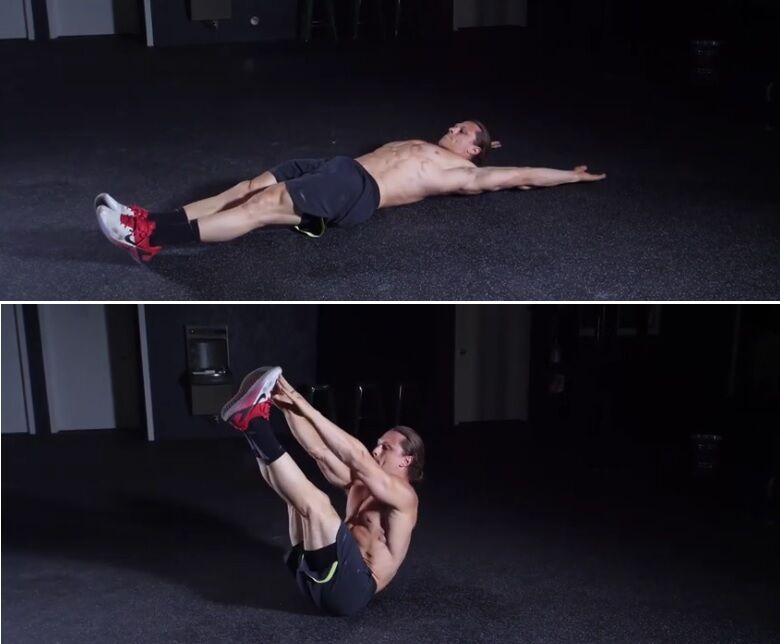
Starting position
- Lie flat on your back with legs fully extended, knees unlocked but not bent, heels resting lightly on the floor
- Arms extended straight overhead, lengthening as much as possible through the fingertips
- Before initiating the movement, get into a hollow body position — lower back pressed gently toward the floor, core braced, body long
Execution
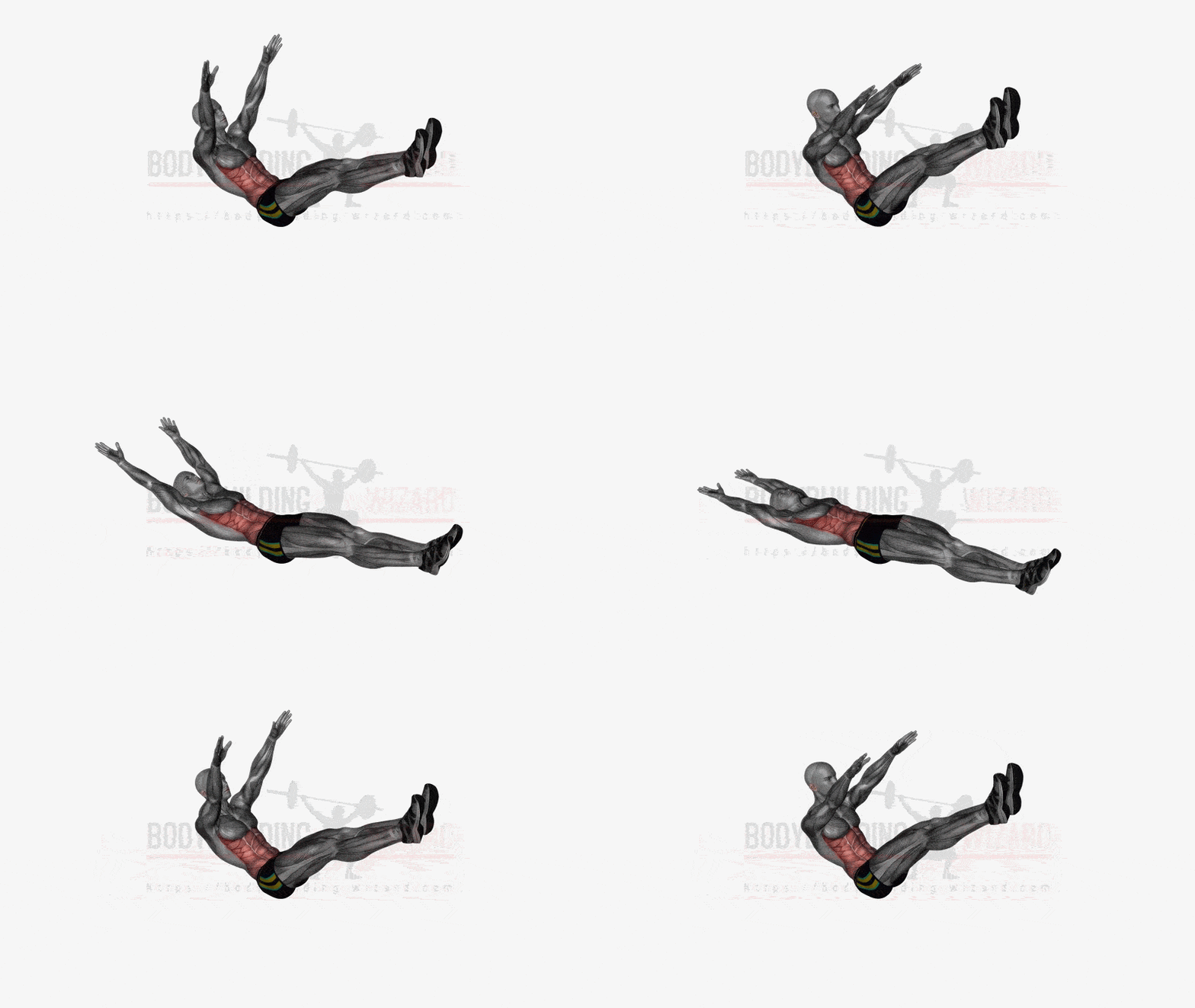
- Simultaneously raise your torso and your straight legs off the floor, using your abs to drive both ends of the movement
- Reach your arms forward toward your feet as both rise — the goal is for hands and feet to meet at the top, with legs and arms pointing upward in a closed V shape
- Touch your toes if your flexibility allows — if not, reach as close as you can without sacrificing straight legs or a controlled torso
- Hold the top position for a count of two, maintaining the full contraction
- Lower both your torso and legs back to the starting position in a slow, controlled motion — do not drop
- Stop just before your heels and upper back touch the floor and begin the next rep — keep the tension on, eliminate the bounce
The key coaching cue: Both ends of the body must leave the floor and arrive at the top at exactly the same time. If your legs shoot up first, your hip flexors are leading. If your torso rises first, your arms are swinging you up. The V-sit is a simultaneous movement — train it that way from the first rep.
Common Mistakes in the Full V-Sit
1. Bending the knees
The moment the knees bend, the exercise becomes the modified V-sit — which is a perfectly good exercise, but a different one. Straight legs throughout the entire range of motion define the full V-sit and make it significantly more demanding. If you cannot keep the knees straight, you are not yet ready for this variation. Regress to the modified version and build the strength first.
2. Using arm swing for momentum
Swinging the arms aggressively from overhead to create momentum through the bottom of the movement is one of the most common cheats I see on this exercise. It gets the body off the floor, but it does so by shifting the work from the abs to the shoulders and lats. The arms should move toward the feet as the torso rises — not the other way around.
3. Asynchronous movement
Legs arriving at the top before the torso, or vice versa, indicates that one end of the movement is weaker than the other. Most commonly, the legs lag behind because the lower abs and hip flexors are not yet strong enough to lift straight legs at the same speed as the torso rises. This is something I see constantly, and it is a clear signal to either regress to the modified V-sit or to add some dedicated leg-raise work before returning to the full version.
4. Dropping back to the floor
Letting gravity take over on the way down eliminates the eccentric stimulus entirely and sets up a momentum-driven bounce at the start of the next rep. The lowering phase should be slow and controlled — at least two to three seconds. That is where a significant portion of the work happens.
5. Not fully extending at the start
Starting with a partially curled body, rather than fully lengthening the arms and legs, reduces the range of motion and removes the stretch on the rectus abdominis before the contraction begins. Get long before you fold. The longer the lever at the start, the more demanding — and more effective — the movement.
Benefits of the Full V-Sit (Jackknife Sit-Up)
Complete rectus abdominis recruitment: The V-sit is one of the only bodyweight exercises that meaningfully loads both the upper and lower portions of the rectus abdominis in a single movement. For trainees who want to develop the entire length of the muscle without using two separate exercises, the efficiency of the V-sit is genuinely difficult to replicate.
No equipment required. One of the most demanding ab exercises available, achievable with nothing but floor space. That makes it a genuinely useful tool for home training, travel workouts, or any situation where gym equipment is unavailable.
High hip flexor and core strength demand: The straight-leg version requires significantly more hip flexor strength and core stability than any crunch variation. For athletes who need strong trunk flexion and hip flexor power — gymnasts, martial artists, swimmers, sprinters — the V-sit builds a strength quality that crunch-based training simply does not.
Builds coordination alongside strength. The simultaneous bilateral movement pattern demands a level of neuromuscular coordination that single-end exercises do not. That coordination carries over to athletic movements that require the body to generate force simultaneously from both ends.
Who Should Use This Exercise
Advanced trainees who have already mastered the modified V-sit and can demonstrate 3 sets of 15 clean reps with full control and no compensation patterns.
Athletes who need full-length core strength — gymnasts, martial artists, swimmers, and sprinters in particular. The V-sit trains the trunk flexion and hip flexor strength that is directly relevant to those movement demands.
Trainees looking for a demanding bodyweight ab exercise that progresses beyond what any crunch variation can offer without requiring additional equipment or resistance.
Anyone training toward the hollow body hold or L-sit — the V-sit is both a strength builder and a movement pattern prerequisite for those more advanced skills.
Who Should Be Cautious
Anyone with lower back pain or lumbar disc issues. The combination of straight-leg hip flexor load and spinal flexion under bodyweight creates significant compressive and shear force on the lumbar spine. This is not an exercise to push through back discomfort. If there is any existing lower back issue, stay with supported variations until cleared by a physiotherapist.
People with tight hamstrings. Straight-leg V-sits require meaningful hamstring flexibility to reach full range of motion at the top. If hamstring tightness forces the pelvis into a posterior tuck under load, the lumbar spine ends up in a compromised position. Work on hamstring flexibility as a parallel goal before making the full V-sit a regular training tool.
Beginners and early intermediate trainees. If someone cannot control a basic floor crunch or hold a dead bug position with their lower back pressed, the full V-sit will immediately expose every weakness in their core — and not in a productive way. The progression exists for a reason: dead bug → floor crunch → modified V-sit → full V-sit. Skip steps at your own risk.
People with hip flexor issues. The hip flexors are working hard throughout this movement, particularly during the straight-leg lowering phase. Anyone managing hip flexor tendinopathy or anterior hip impingement should choose a crunch variation that keeps the legs stationary.
Progressions and Regressions
Regressions (easier)
Modified V-sit — the bent-knee version of the same movement. Reduces the hip flexor demand, eliminates the hamstring flexibility requirement, and makes the simultaneous lift significantly more manageable. The right place to build strength before attempting the straight-leg version.
Hollow body hold — lying on your back with arms overhead and legs extended, pressing the lower back into the floor and lifting the legs and shoulders slightly. A pure isometric exercise that builds the foundational tension and body position the V-sit requires.
Hanging or lying leg raise — isolated lower ab and hip flexor work that directly strengthens the weakest link in most trainees’ V-sit attempts.
Progressions (harder)
Full V-sit with weight — holding a light weight plate overhead as you perform the movement increases the lever arm and the demand on the upper abs and core stabilizers significantly. Even a small change in weight can alter the exercise considerably.
Full V-sit on unstable surface — performing the exercise on a balance disk or BOSU trainer adds a proprioceptive challenge that demands greater stabilizer activation throughout the movement.
Tuck to V-sit to L-sit — combining the V-sit with gymnastic hold positions for trainees working toward advanced calisthenics skills.
Full V-Sit vs. Modified V-Sit
The two exercises share the same movement pattern but differ significantly in execution, demand, and who they are appropriate for.
| Full V-Sit | Modified V-Sit | |
|---|---|---|
| Leg position | Straight throughout | Knees bent |
| Hamstring flexibility required | High | Low to moderate |
| Hip flexor demand | High | Moderate |
| Lower back stress | Higher | Moderate |
| Difficulty | Advanced | Intermediate |
| Ab recruitment | Upper and lower | Upper and lower |
| Best for | Advanced trainees, athletes | Intermediate trainees |
The practical takeaway: Both versions recruit the full length of the rectus abdominis — the difference is in the difficulty and the demands placed on surrounding structures. Master the modified version first. The full V-sit is not a better exercise; it is a harder one — and harder only becomes better when the foundation is solid enough to support it.
Exercise Variations
Bent-knee V-sit (Modified V-Sit)
The same starting position and movement pattern, but the knees remain bent throughout the entire range of motion. Significantly easier than the straight-leg version because the bent knee shortens the lever of the legs, reducing the hip flexor demand and eliminating the hamstring flexibility requirement. This is the appropriate starting point for most trainees before attempting the full straight-leg version.

Oblique V-Sit (V-Sit with Cross)
As you raise your torso and legs simultaneously, cross your right shoulder toward your left knee and your left knee toward your right shoulder. Lower and repeat to the other side, alternating each rep. This rotational component brings the obliques in as active contributors rather than just stabilizers, adding a rotational strength demand to the basic V-sit pattern. A useful variation once the standard version is consistently controlled.

Seated Knee-Up
Sit on a flat bench and lean your torso back until it forms a 45–60-degree angle with the bench surface. From this position, draw your knees toward your chest, then extend them back out. The bench support reduces the balance demand significantly compared to the floor version, but the reclined torso position keeps the rectus abdominis under tension throughout. A good bridge exercise for trainees working toward the floor V-sit.

Alternating Leg V-Sit
Instead of raising both legs simultaneously, raise one leg at a time while lifting the torso toward it with both hands. Alternate legs each rep. This unilateral version reduces the total hip flexor and lower ab demand compared to the bilateral version, making it a useful intermediate step — or a way to address left-right asymmetries in hip flexor and lower ab strength.

Replacement Exercises (Alternatives)
If the full V-sit is too advanced, unavailable, or not the right fit for a given training phase, these exercises target the same primary muscle group:
- Kneeling Cable Crunch
- Machine Crunch
- Decline Bench Sit-Ups
- Basic Abdominal Crunch
- Classic Floor Sit-Up
- Decline Crunch
- Vertical Leg Crunch
- Modified V-Sit
- Exercise Ball Crunch
The full V-sit represents the advanced end of the spectrum in our roundup of the most effective lower abdominal exercises — the only bodyweight movement on the list that simultaneously recruits both the upper and lower abs.
Programming Tips
Rep range: 8–12 reps per set. The full V-sit is a demanding, technically complex movement — it is not suited to high-rep grinding. Quality of movement deteriorates quickly as fatigue sets in, and a sloppy V-sit is not worth doing. When you can no longer maintain straight legs and synchronized movement, the set is over.
Sets: 3–4 working sets. More than that rarely adds productive stimulus and almost always results in compensated reps that reinforce poor movement patterns.
Frequency: 2–3 times per week with at least one full rest day between sessions.
Where in the session: Early in the ab training block, before fatigue compromises the coordination and hip flexor strength the exercise demands. This is not a burnout exercise — it is a skill movement that requires a degree of neuromuscular freshness to execute correctly.
Progression trigger: When you can complete 4 clean sets of 12 reps with straight legs, synchronized movement, and controlled lowering on every rep, it is time to add a light overhead weight or progress to an unstable-surface variation.
A note on hamstring flexibility: If you consistently cannot touch your toes at the top of the movement, do not force it by bending the knees or rounding aggressively through the lumbar spine. Work on hamstring flexibility as a separate goal — a few minutes of dedicated hamstring stretching after each session will pay dividends here within a few weeks.
Conclusion
The full V-sit earns its reputation as one of the most complete bodyweight ab exercises available. The simultaneous recruitment of the upper and lower rectus abdominis, combined with the hip-flexor demand and the coordination required to synchronize both ends of the movement, makes it a genuinely different stimulus from anything crunch-based training can offer.
That said, I want to be direct about something: this exercise is regularly butchered in gyms. Bent knees, arm swinging, asynchronous movement, and dropping back to the floor — these are not minor form breaks; they are signs that the trainee has not yet built the foundation to perform this exercise productively. And there is absolutely nothing wrong with that. The modified V-sit exists precisely for that reason.
Respect the progression. Build the strength. When the full V-sit clicks — when both ends rise together, the body folds cleanly, and you feel the entire length of your abs working simultaneously — it is one of the most satisfying movements in bodyweight training. It is worth doing right.
V-ups represent the advanced end of the spectrum in our complete roundup of the best upper ab exercises — ideal if you are looking to understand where this movement fits in a progressive training plan. Want to train every part of your midsection? Explore our guides to upper ab exercises, oblique exercises, and core exercises.
Frequently Asked Questions
What is the difference between V-ups and the jackknife sit-up?
They are the same exercise described with different names. V-ups, full V-sit, and jackknife sit-up all refer to the movement where both straight legs and the torso are raised simultaneously from the floor until hands and feet meet above the body in a V position. The jackknife name describes the folding action of the body, similar to a closing jackknife blade. In some contexts, jackknife sit-up specifically refers to versions performed on a decline bench or with a cable attachment, but in bodyweight training the terms are used interchangeably.
Why can I not touch my toes during the full V-sit even though my abs feel strong?
Hamstring flexibility is almost always the limiting factor, not ab strength. Reaching full toe-touch at the top of the V-sit requires significant hamstring extensibility — the posterior chain must lengthen enough to allow straight legs and a forward-reaching torso to meet above the floor. If the hamstrings are tight, the legs bend at the knees automatically as a compensation. Dedicated post-session hamstring stretching — particularly straight-leg and seated forward fold variations — will resolve this over four to eight weeks of consistent work.
Is the full V-sit appropriate for someone with a history of lower back pain?
Generally no, without specific medical clearance. The full V-sit generates significant hip flexor tension and lumbar compressive load — particularly during the lowering phase when the straight legs act as a long lever pulling on the lumbar spine. For trainees with a history of disc herniation, lumbar stenosis, or chronic lower back pain, the risk-to-reward ratio of this exercise is unfavorable. Machine crunches, cable crunches, and supported crunch variations provide effective upper and lower ab stimulus with considerably less lumbar stress.
How do I build up to the full V-sit if I cannot do it yet?
The most systematic approach combines three parallel training streams. First, build upper ab strength through kneeling cable crunches and decline crunches. Second, build lower ab and hip flexor strength through hanging knee raises and lying leg raises. Third, address hamstring flexibility with daily stretching. The modified V-sit — the bent-knee version — bridges the gap between these strength foundations and the full straight-leg movement. When you can complete 4 clean sets of 15 modified V-sits with fully controlled movement, begin gradually extending the legs with each session.
Should the arms swing during the full V-sit or stay controlled?
Controlled throughout — the arms should travel toward the feet because the torso is rising, not because they are being swung for momentum. Arm swinging is one of the most common cheats on this exercise and it significantly reduces the ab stimulus by using shoulder and lat momentum to initiate the upward phase. Think of the arms as reaching toward the feet rather than swinging toward them. If controlled arm movement is not sufficient to reach the top position, the core and hip flexor strength is not yet adequate for the full version.
Why do my legs drop faster than my torso on the way down?
Because the legs are a heavier lever and gravity acts on them more forcefully than on the lighter torso. Controlling straight legs on the eccentric phase requires significant lower ab and hip flexor eccentric strength that most trainees have not specifically developed. Focus on slowing the lowering phase deliberately — aim for three seconds from top to bottom. If the legs consistently drop uncontrollably, add isolated eccentric leg lower exercises to your program: from a vertical leg position, lower both straight legs slowly toward the floor over five seconds.
Can the full V-sit be made easier without switching to the modified version?
Yes — two useful intermediate adjustments exist. First, reduce the range of motion: instead of reaching full toe-touch at the top, only raise the torso and legs to 60 or 70 percent of the full range. This preserves the straight-leg pattern while reducing the peak demand. Second, slow the movement significantly — a slow, controlled partial V-sit is more productive than a fast, compensated full version. These adjustments bridge the gap between the modified bent-knee version and the complete straight-leg movement without abandoning the straight-leg pattern entirely.
How does the full V-sit compare to hanging leg raises for lower ab development?
Both target the lower rectus abdominis through hip flexion with a fixed or rising torso, but they differ in several important ways. The V-sit also heavily recruits the upper abs simultaneously, making it a more complete exercise. Hanging leg raises isolate the lower ab and hip flexor pattern more purely and allow greater load progression through ankle weights or a dumbbell held between the feet. For pure lower ab isolation, hanging leg raises are more specific. For overall rectus abdominis development in a single movement, the V-sit covers more ground.
Is it normal to feel the full V-sit primarily in the hip flexors rather than the abs?
In the early stages of learning the movement, yes — particularly during the leg raise component. The hip flexors are the primary movers for raising and lowering the straight legs, and they will fatigue first until the lower ab strength develops sufficiently to share the load. As technique improves and the movement becomes more coordinated, the abdominal contribution becomes more perceptible. If hip flexor dominance persists after several weeks of practice, add isolated lower ab work — reverse crunches and lying leg raises — to bring that portion of the rectus abdominis up to the strength level needed.
How many full V-sits should I be able to do before considering myself proficient?
Three sets of 10 to 12 clean reps — with straight legs throughout, synchronized movement on both the up and down phases, controlled lowering, and no arm swinging — is a reasonable proficiency benchmark. At that point the exercise can be progressively loaded by holding a light weight plate overhead or performed on an unstable surface. Reaching this benchmark typically takes four to twelve weeks depending on starting strength levels, with the timeline extending significantly if hamstring flexibility is a limiting factor alongside strength.
