
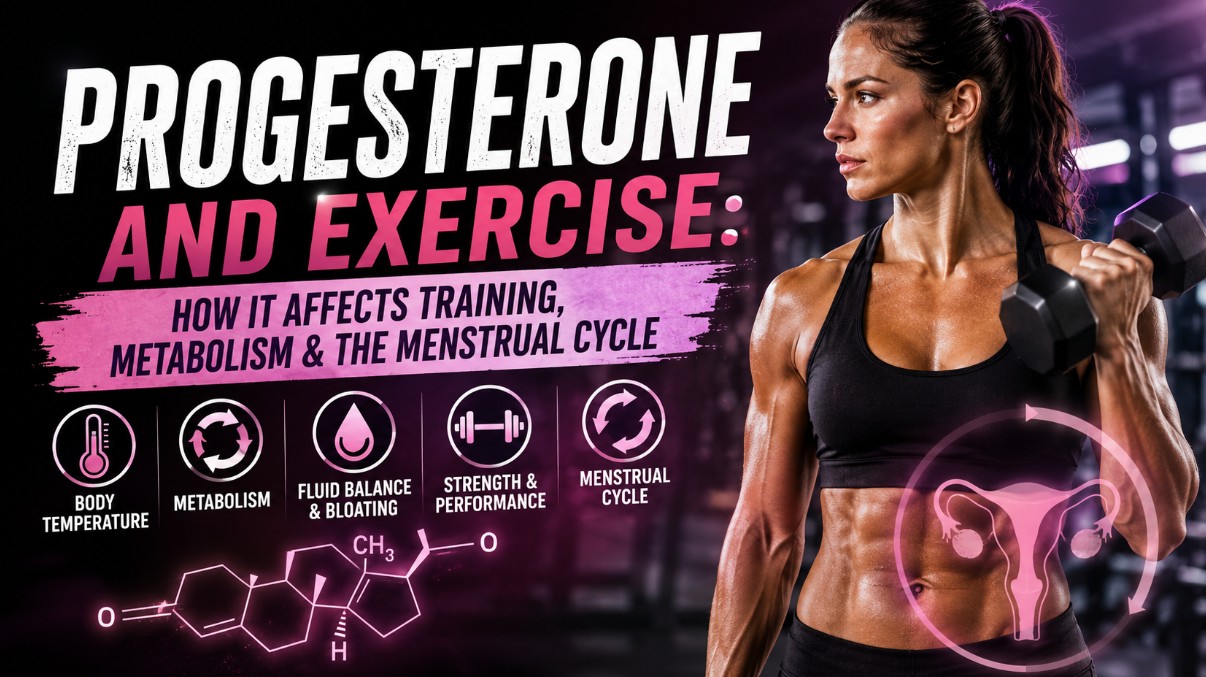
Progesterone usually gets mentioned only as a pregnancy hormone — but its cyclical rise and fall have physiological consequences relevant to exercise, whether or not pregnancy is anywhere in the picture. It’s also the hormone most often left out of fitness content entirely, overshadowed by estrogen and testosterone, despite genuinely shaping thermoregulation, metabolism, and how a training session feels at different points in the cycle.
Here’s the boundary this article holds throughout: progesterone affects exercise physiology, but your progesterone level is not a score for strength, recovery, or muscle growth.
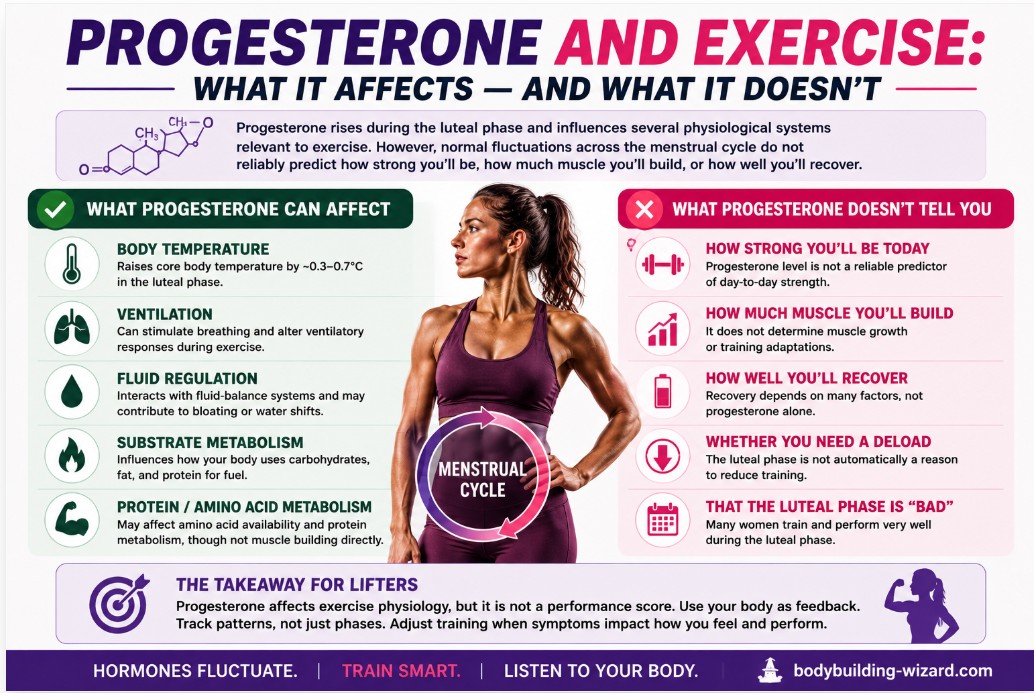
QUICK ANSWER: Progesterone rises predominantly during the luteal phase of the menstrual cycle, where it affects thermoregulation, ventilation, fluid regulation, and substrate/protein metabolism, and interacts closely with estrogen. These are genuine physiological effects — but normal cycle fluctuations do not reliably predict an individual’s gym performance, strength, or muscle growth.
What Is Progesterone?
Where Is Progesterone Produced?
Mainly by the ovaries — specifically the corpus luteum after ovulation — with the placenta taking over as the dominant source during pregnancy, and smaller amounts produced by the adrenal glands. Men also produce progesterone, though at much lower concentrations, primarily as a steroidogenic intermediate on the way to other hormones.
What Does Progesterone Do?
Its best-known roles involve reproductive physiology—preparing and maintaining the endometrium, supporting early pregnancy, and so on. This article isn’t about that. For lifters, the most relevant effects involve how progesterone interacts with estrogen and influences thermoregulation, metabolism, and other physiological responses to exercise — which is exactly what the rest of this article covers.
Progesterone Across the Menstrual Cycle
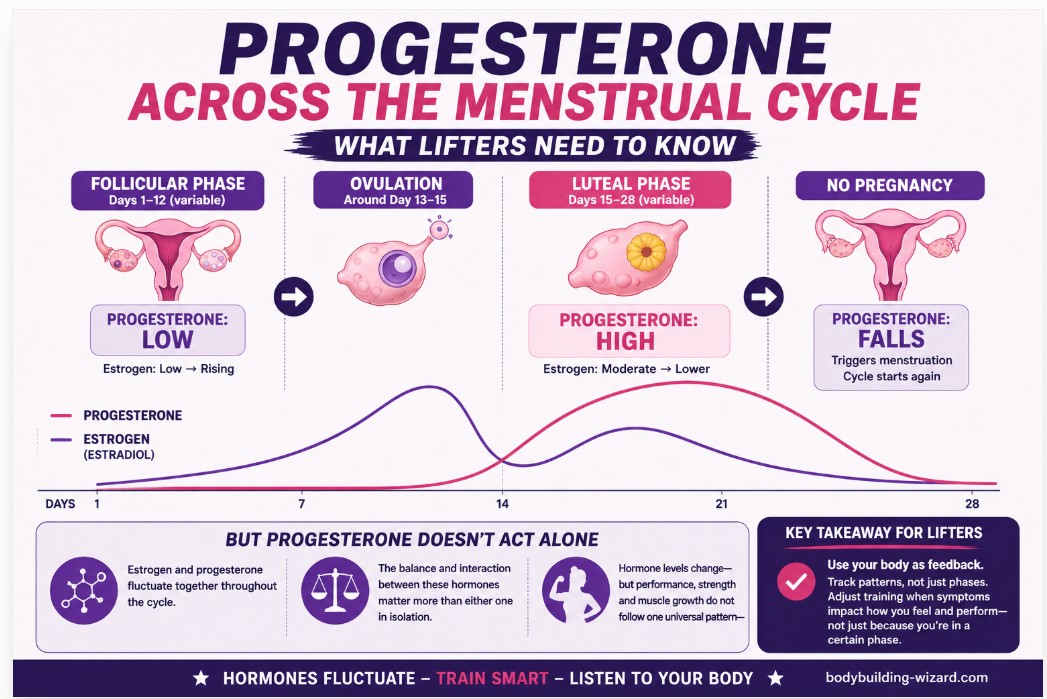
Simply: progesterone stays low through the follicular phase, then rises substantially after ovulation during the luteal phase. If pregnancy doesn’t occur, progesterone falls again, triggering menstruation.
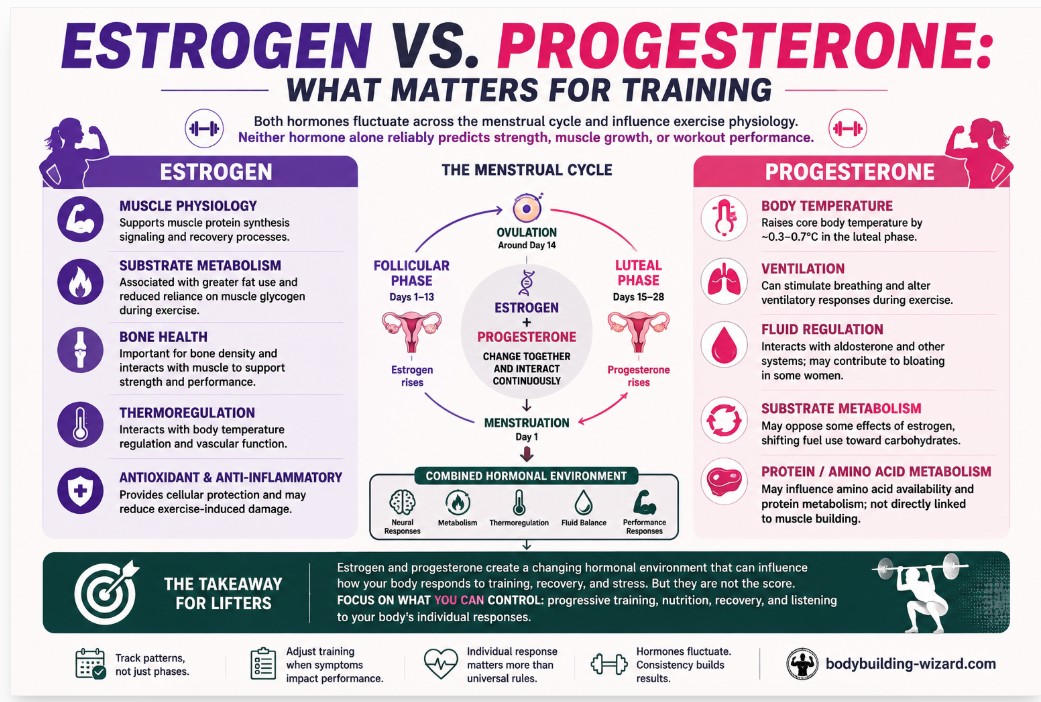
Here’s the detail that matters more than the chart above: progesterone rarely acts alone. Estrogen varies at the same time, often in the opposite direction or at a different rate. This is exactly why you can’t observe a performance difference between two cycle phases and simply conclude “progesterone caused it” — both older and newer exercise literature keep circling back to how much the relationship between these two ovarian hormones matters, not either one in isolation. Keep this point in mind throughout every section below.
Progesterone and Exercise Performance
Does High Progesterone Reduce Exercise Performance?
Not reliably. Some studies find phase-related differences; others don’t. A 2025 systematic review evaluating hormonal fluctuations and female athlete performance — 13 studies, 152 athletes total — found genuinely mixed results: some evidence of enhanced aerobic and anaerobic capacity during the luteal phase, alongside other findings of reduced aerobic capacity in the late luteal phase and performance declines tied to premenstrual symptoms specifically, rather than progesterone itself. The review’s conclusion is the important part: further research is needed given inconsistent results driven by variable cycle-phase definitions, a lack of standardized methodology, small sample sizes, and short observation periods—the same methodological pattern that shows up across nearly every menstrual-cycle-and-performance study currently available.
This same body of research also keeps finding that premenstrual symptoms (cramping, mood changes, disrupted sleep) tend to have a more consistent, better-documented negative effect on perceived and reported performance than progesterone concentration itself does on any objectively measured outcome. That distinction matters practically — the thing actually worth addressing for a struggling lifter might be symptom management, not “fixing” a hormone level.
The takeaway isn’t “luteal phase = bad performance.” It’s this: individual response matters more than assuming every woman performs worse when progesterone is high.
Progesterone and Strength Training
This is the most important section for a bodybuilding audience specifically.
Does Progesterone Affect Strength?
Mechanistically, there’s a case to be made — neural factors, metabolic substrate availability, and the thermoregulatory shifts covered later in this article could all plausibly influence a training session at the margins. But practically: progesterone concentration is not a strength score. Nothing in the current literature supports predicting an individual’s strength output for a given session from where she sits in her cycle, and treating it as though it does risks talking a lifter out of a session she was perfectly capable of having a great day in.
Does Progesterone Affect Resistance-Training Adaptations?
Be especially careful here, because this is where a lot of popular fitness content overreaches furthest. Some literature has proposed an advantage to structuring resistance training around the follicular phase specifically — the theory being that lower progesterone and a more favorable estrogen-dominant hormonal environment might support better training adaptations. But an umbrella review of existing meta-analyses and systematic reviews concluded there currently isn’t good enough evidence that menstrual cycle phase meaningfully determines acute strength performance or chronic resistance-training adaptations. An umbrella review sits above individual systematic reviews and meta-analyses in the evidence hierarchy because it synthesizes across them—when a review at that level says the evidence isn’t there yet, that carries real weight against building training programs around cycle phase. That’s this article’s position, too.
Does Progesterone Affect Muscle Growth?
There is no good basis for treating progesterone as a direct muscle-building hormone. Progesterone may participate in protein metabolism and the broader hormonal environment of skeletal muscle — genuine physiology, covered in more depth below — but there’s no simple progesterone rises → muscle protein synthesis rises → hypertrophy follows model that the evidence supports.
Progressive resistance training, adequate protein, energy availability, and recovery remain vastly more useful predictors of muscle growth than normal progesterone fluctuations.
Progesterone and Protein Metabolism
Worth its own short section because the underlying physiology is genuinely interesting. Progesterone has been linked to increased amino acid catabolism during the luteal phase — several studies have found lower circulating essential amino acid concentrations and higher amino acid oxidation when progesterone is elevated, with some tracer studies even showing increased leucine oxidation and lysine requirements during this phase compared to the follicular phase.
But here’s the crucial follow-up most fitness content skips: a 2025 randomized crossover study specifically tested whether this decreased amino acid availability across the menstrual cycle actually affects whole-body or muscle protein synthesis — and found that it does not. Circulating amino acids shift with the cycle; the actual protein-building process measured directly didn’t show a corresponding impairment. Separately, sports nutrition reviews focused on female athletes have pointed out that even where a luteal-phase increase in protein oxidation is measurable, the actual extra amount involved tends to be trivial — on the order of a few grams — and any shortfall is often naturally offset by the modest increase in appetite many women experience during the same phase.
This does not mean “women lose muscle during the luteal phase.” That would be a significant overreach based on the data — if anything, the most recent, most direct evidence argues against it.
Coach’s Note: Don’t program from a hormone chart before you program from the athlete in front of you. If a lifter consistently feels and performs well throughout her cycle, there’s no reason to force artificial phase-based changes. If recurring symptoms clearly affect training, adjust volume, intensity, or exercise selection when needed. Individual patterns are more useful than universal cycle rules.
Progesterone and Exercise Metabolism
This is a genuinely science-heavy section, and you need to consider estrogen and progesterone together, not progesterone alone. Both hormones influence carbohydrate utilization, fat oxidation, and protein metabolism during exercise, and their effects can differ or modify one another depending on their ratio at a given point in the cycle. For example, estrogen has been linked to reduced reliance on muscle glycogen and increased free fatty acid availability during exercise, favoring endurance performance — while progesterone appears to work in the opposite direction on some of these same pathways, and both hormones together suppress gluconeogenic output during exercise, which could matter for very long training sessions if energy replacement isn’t adequate.
Controlled experiments that have deliberately manipulated estrogen and progesterone levels — rather than simply observing natural cycle variation — have been used specifically to try to separate out each hormone’s individual contribution to carbohydrate metabolism during exercise, precisely because natural-cycle observational studies can’t cleanly attribute an effect to one hormone versus the other when both are moving simultaneously.
Modern reviews on this topic are consistent on one point: menstrual-cycle effects on whole-body substrate oxidation are nowhere near as simple as fitness content on the internet often claims. Treat any confident, specific claim about “carb needs in your luteal phase” with real skepticism unless it’s citing controlled, hormone-verified research rather than a generic cycle-phase assumption.
Progesterone and Body Temperature
This is one of the strongest, most well-documented exercise-relevant effects of progesterone in this entire article, and it deserves attention.
After ovulation, rising progesterone shifts the thermoregulatory set point upward, and resting/core body temperature rises accordingly — a well-documented effect on the order of roughly 0.3-0.7°C higher in the luteal phase compared to the follicular phase, most evident during sleep or immediately upon waking. This shift is well documented enough that many women use it as a retrospective marker of ovulation when tracking their cycles, and the physiology literature has recognized it for over a century.
The proposed mechanism is centrally mediated—progesterone appears to act on the hypothalamic thermoregulatory center rather than producing peripheral heat directly, and research shows this thermogenic effect doesn’t occur without normal pituitary function, suggesting it depends on broader brain-hormone communication rather than progesterone acting alone at the tissue level. Interestingly, estrogen appears to reverse this effect: research directly comparing progestin alone with progestin combined with estrogen found the temperature-raising effect was blunted when estrogen was present —another good example of why these two hormones need to be considered together rather than separately.
Does This Hurt Gym Performance?
For a typical 60-minute resistance training session in a climate-controlled gym? This article isn’t going to dramatize it — the practical impact is minimal for most lifters in that context. For prolonged exercise in heat specifically, it can be more relevant, since an elevated thermoregulatory baseline gives you a smaller buffer before you hit uncomfortable or performance-limiting core temperatures. See our guides to thermoregulation during exercise and exercising in hot weather for the broader picture beyond just this hormonal piece.
Progesterone, Breathing and Ventilation
A genuinely interesting piece of physiology that doesn’t come up in most estrogen-focused content. Progesterone can stimulate ventilation — it’s a known respiratory stimulant, and during the luteal phase some women experience changes in ventilatory response during exercise. But different breathing physiology does not automatically mean worse performance. It’s a documented shift, not a documented impairment — worth knowing, not worth worrying about.
Progesterone, Fluid Balance and Bloating
A genuinely useful section for your audience specifically. Menstrual-cycle hormonal changes can affect fluid regulation, and subjective bloating around the luteal phase and menstruation is real and common — progesterone and its interaction with the renin-angiotensin-aldosterone system are part of the mechanism behind this shift. But here’s the distinction that matters: a temporary increase on the scale around the menstrual cycle is not automatically body-fat gain. Conflating short-term fluid shifts with actual fat gain is a common, avoidable source of unnecessary stress for lifters tracking their weight closely — a two- or three-pound jump on the scale right before or during menstruation is overwhelmingly more likely to be water than tissue. If you’re dealing with water retention concerns more broadly, our guide to water retention covers the underlying fluid-regulation mechanisms in more depth, even though that piece focuses on a different specific cause.
Progesterone and Recovery
Approach this carefully. There’s mechanistic data on estrogen/progesterone signaling, oxidative stress, and exercise-induced muscle damage — genuine, published physiology exploring whether ovarian hormones modulate the inflammatory and repair response to hard training. But that’s a different claim than “high progesterone means better or worse recovery” as a practical, actionable rule that should change how a lifter plans her week. Recovery is multifactorial, and normal progesterone fluctuations should not be used as a standalone recovery predictor. Sleep, training load management, nutrition, and stress remain far bigger levers — and unlike progesterone, they’re levers you can actually pull.
Should Women Train Differently During the Luteal Phase?
Not automatically. There’s no universal “high progesterone → deload” program that the evidence supports, for the same reasons covered in the resistance-training adaptations section above. But if a woman individually experiences bloating, cramps, fatigue, sleep changes, greater thermal discomfort, or reduced training readiness tied consistently to her luteal phase, then adjusting volume, intensity, or exercise selection when useful is entirely reasonable.
That’s coaching, not hormone hacking — responding to a real, reported pattern in front of you, not applying a generic rule to every woman regardless of her actual experience. The practical version of this looks less like a rigid calendar-based program and more like normal training autoregulation: paying attention to how a session actually feels and adjusting load or volume within a session or week accordingly, the same way you’d respond to poor sleep, high life stress, or any other factor that affects a given day’s readiness.
Progesterone vs. Estrogen: What Matters for Lifters?
| Estrogen | Progesterone | |
|---|---|---|
| Follicular phase | Rises | Low |
| Luteal phase | Moderate/high | High |
| Muscle physiology | Important | Possible modulatory role |
| Thermoregulation | Interacts | Stronger relevance |
| Substrate metabolism | Important | Modifies estrogen’s effects |
| Performance prediction | Poor alone | Poor alone |
The estrogen-to-progesterone environment may sometimes be more physiologically informative than looking at either hormone in isolation — which is really the throughline of both this article and our companion piece on estrogen and exercise.
What About Hormonal Birth Control?
Worth including, briefly, because it’s a genuinely common and relevant question — but this article isn’t going to become an oral contraceptive guide. The critical distinction: progesterone is not the same thing as progestin. Hormonal contraceptives use synthetic progestins, which can behave differently from endogenous progesterone and which alter or suppress the natural ovarian hormone fluctuations described throughout this article. If you’re specifically weighing birth control and training considerations, see our dedicated guide to oral contraceptives and muscle gains for that fuller picture.
Progesterone in Men
Briefly. Progesterone exists in men too, functioning as a steroidogenic precursor to other hormones and carrying other physiological roles beyond that. Unlike estrogen — which male lifters genuinely need to understand given the aromatization pathway from testosterone covered in our estrogen article — progesterone doesn’t have comparable bodybuilding-specific relevance worth inventing content around. This isn’t a major section of this article by design.
Low Energy Availability and Progesterone
Genuinely important for the female athlete audience. Low energy availability can disrupt the hypothalamic-pituitary-ovarian axis, which can suppress ovulation, impair luteal function, and reduce progesterone exposure—connecting directly to the broader menstrual irregularity, RED-S, and bone health concerns covered in our estrogen and exercise article. This isn’t a rare edge case in serious athletic populations; it’s a well-documented, common consequence of chronic under-fueling relative to training demand, particularly in sports or training approaches that emphasize leanness.
One caution worth stating plainly: progesterone is not a “RED-S test.” A single low reading doesn’t diagnose anything on its own — persistent menstrual irregularity alongside inadequate fueling is the pattern worth taking seriously, not an isolated hormone number pulled from one blood draw at an unspecified point in an already-irregular cycle.
Can Exercise Increase or Decrease Progesterone?
It depends — on exercise context, menstrual cycle phase, training status, and energy availability, among other factors. And as with every other hormone covered across this site, an acute hormonal response to a single session shouldn’t be interpreted as evidence of a lasting adaptation. A post-workout hormone change does not tell you whether a workout will build more muscle — the same principle that’s run through testosterone, growth hormone, and every other hormone in this category applies here too.
Can You “Balance” Progesterone Naturally?
This won’t be a “5 foods that boost progesterone” list. What lifters can actually control: sufficient energy availability, adequate nutrition, sensible training load, recovery, sleep, and avoiding prolonged extreme dieting. These support normal reproductive and endocrine physiology — they do not allow you to manually “optimize” progesterone. Same philosophy as every hormone covered across this site: support the system, don’t try to engineer a specific number.
Common Progesterone Myths in Fitness
❌ Myth: Progesterone is only a pregnancy hormone.
✅ Reality: It’s present throughout the menstrual cycle in non-pregnant women (and in smaller amounts in men), with genuine, ongoing effects on thermoregulation, metabolism, and other physiological systems.
❌ Myth: High progesterone makes women weak.
✅ Reality: There’s no reliable evidence that progesterone levels predict strength output — individual variation matters far more than cycle phase.
❌ Myth: The luteal phase is bad for strength training.
✅ Reality: Current evidence doesn’t support that resistance-training adaptations are meaningfully determined by menstrual cycle phase.
❌ Myth: Progesterone prevents muscle growth.
✅ Reality: There’s no established pathway from normal progesterone fluctuations to impaired hypertrophy — a 2025 study even found decreased amino acid availability in the luteal phase didn’t affect muscle protein synthesis.
❌ Myth: Luteal-phase weight gain is body-fat gain.
✅ Reality: Much of it reflects fluid retention and bloating, not an actual increase in body fat.
❌ Myth: Every woman should deload when progesterone is high.
✅ Reality: Training adjustments should follow an individual’s consistently reported symptoms, not a universal hormone-based rule.
❌ Myth: Progesterone and synthetic progestins are the same thing.
✅ Reality: Progestins used in hormonal birth control can behave differently from the body’s own endogenous progesterone.
The Bodybuilder’s Take
Progesterone influences several physiological systems relevant to exercise, particularly thermoregulation, metabolism, and the hormonal environment of the menstrual cycle. But it is not a muscle-building or performance score. Lifters should focus on progressive training, nutrition, and recovery, using individual menstrual symptoms—not progesterone charts alone—to guide any training adjustments.
