



Introduction
Feeling sore after a tough workout is completely normal.
In fact, a certain amount of muscle soreness is often expected when you challenge your body with resistance training, increase your training volume, or perform unfamiliar exercises. Many lifters even view soreness as proof that they’ve had a productive workout.
But what if you’re sore after every workout?
If your muscles constantly feel stiff, tender, and fatigued, you may start wondering whether something is wrong with your training, recovery, or overall fitness level.
As a coach working with lifters and athletes, I’ve found that persistent soreness is one of the most misunderstood topics in fitness. Some people believe soreness is always a sign of progress, while others worry that any soreness means they’re overtraining. The truth usually lies somewhere in between.
Occasional soreness is normal.
Being extremely sore after nearly every workout is often a sign that your body isn’t recovering as effectively as it could be.
The good news is that persistent soreness usually has an identifiable cause. Factors such as training volume, exercise selection, sleep quality, nutrition, recovery habits, and overall stress levels can all influence how quickly your muscles recover between workouts.
In this article, we’ll explore the most common reasons you’re always sore after training and explain what you can do to recover faster, perform better, and get more out of your workouts.
Why Am I Always Sore After Every Workout? (Quick Answer)
What Is Normal Muscle Soreness?
Before discussing the reasons you’re always sore after workouts, it’s important to understand the difference between normal muscle soreness and a potential recovery problem.
Most post-workout soreness is known as Delayed Onset Muscle Soreness (DOMS). This type of soreness typically develops 12–24 hours after exercise, peaks between 24–72 hours, and gradually disappears as the muscles recover.
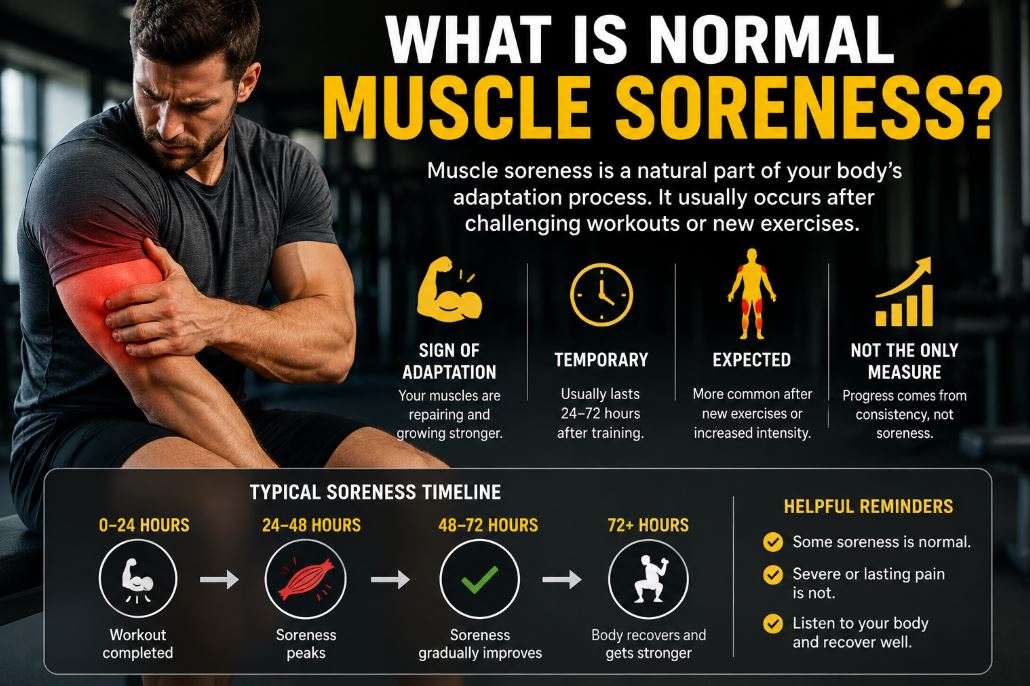
DOMS is especially common after:
- Starting a new training program
- Performing unfamiliar exercises
- Increasing training volume
- Increasing training intensity
- Emphasizing the eccentric (lowering) portion of an exercise
Although soreness can feel uncomfortable, it is generally considered a normal response to training stress.
The problem arises when soreness becomes excessive, lasts unusually long, or occurs after nearly every workout, regardless of what you’re doing.
Many people mistakenly believe that the more sore they are, the better their workout must have been. In reality, soreness is not a direct measure of muscle growth, strength gains, or training quality.
As a coach working with lifters and athletes, I’ve seen people achieve excellent results with very little soreness, while others remain constantly sore without making significant progress. This is because muscle growth depends on progressive overload, recovery, nutrition, and consistency—not simply how much discomfort you feel the next day.
It’s also important to distinguish normal soreness from pain.
Muscle soreness typically feels like generalized stiffness, tenderness, or discomfort within the muscle itself. Sharp pain, swelling, bruising, joint pain, or symptoms that worsen over time may indicate something more serious and should not be ignored.
Understanding this distinction helps put soreness into perspective.
Some soreness is normal.
Constant soreness is not always normal.
And in many cases, persistent soreness is your body’s way of telling you that recovery, training, or lifestyle factors need attention.
Now let’s look at the most common reasons it keeps happening.
10 Reasons It Keeps Happening
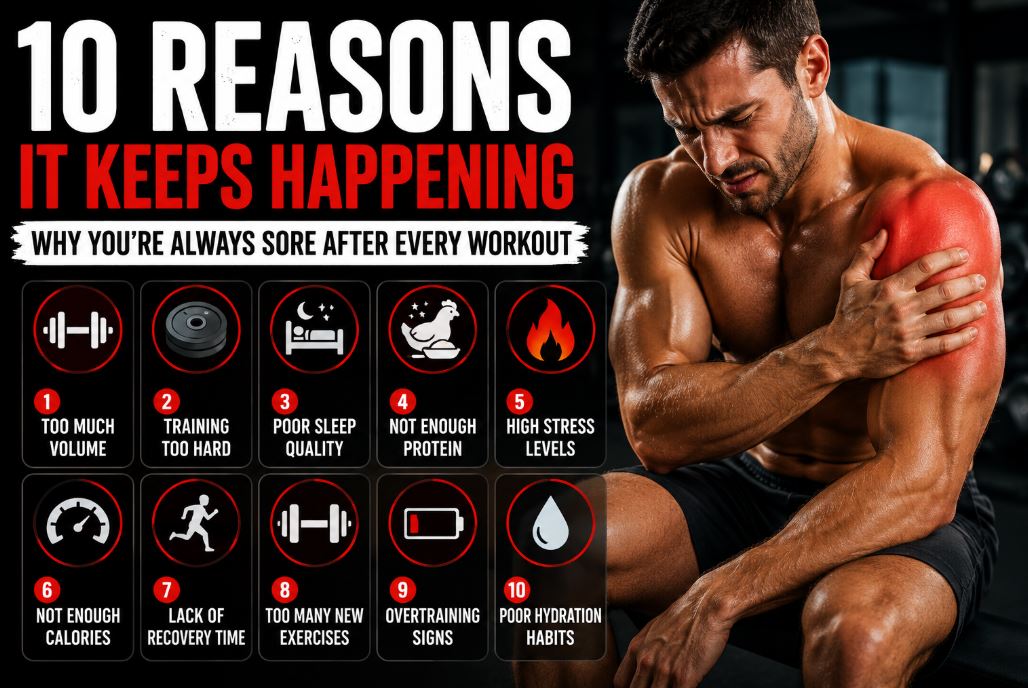
Reason #1: You’re Constantly Increasing Training Volume
More training is not always better training.
One of the most common reasons people remain sore after nearly every workout is that they continually increase their training volume without giving their bodies enough time to adapt.
Training volume refers to the total amount of work you perform, including the number of exercises, sets, repetitions, and overall workload completed during a session. While increasing volume can be an effective way to stimulate muscle growth, problems often arise when it increases faster than the body’s capacity to recover.
Many motivated lifters fall into this trap.
They add another exercise.
Then another set.
Then an extra training day.
Then a few more intensity techniques.
Individually, these changes may seem insignificant. Collectively, however, they can create a workload that exceeds the body’s ability to recover between sessions.
When recovery cannot keep pace with training stress, muscle soreness often becomes more frequent and more severe.
As a coach working with lifters and athletes, I’ve frequently seen people interpret persistent soreness as a sign that they’re training hard enough. In reality, it can sometimes indicate that they’re accumulating fatigue faster than they’re recovering from it.
The goal is not to maximize soreness.
The goal is to provide sufficient training stimulus to drive adaptation while still allowing recovery.
This is where many lifters struggle. They continue adding more work long after they’ve reached the point of diminishing returns.
How To Fix It
If you’re constantly sore after workouts, take a closer look at your overall training volume.
- Avoid increasing sets, exercises, and training frequency all at once.
- Make gradual changes instead of large jumps in workload.
- Monitor how your body responds to volume increases.
- Include recovery weeks or deload periods when needed.
- Focus on quality training rather than simply doing more work.
Remember, muscle growth occurs when training and recovery are balanced. More volume can be beneficial, but only if your body has the resources to recover from it.
Reason #2: You’re Not Recovering Properly
Training creates the stimulus for progress, but recovery is where that progress actually happens.
This is one of the most important concepts in fitness, yet it’s often overlooked. Many people focus intensely on their workouts while paying far less attention to the habits that support recovery between sessions.
As a result, they spend hours trying to improve their training while ignoring the factors that determine how well their bodies adapt to it.
Muscle soreness is a perfect example.
Every workout creates a certain amount of stress on the muscles. Recovery allows the body to repair tissue, restore energy stores, and prepare for future training sessions. When recovery is inadequate, this process becomes less efficient, making soreness more likely to persist.
The challenge is that recovery involves more than simply taking a day off from the gym.
Nutrition, hydration, sleep quality, stress levels, training frequency, and overall lifestyle habits all influence how quickly your body recovers.
If several of these factors are working against you at the same time, muscle soreness can become a regular part of your life—even if your training program is otherwise well designed.
As a coach working with lifters and athletes, I’ve found that many people try to solve chronic soreness by changing exercises or adjusting their program. Sometimes the real issue has nothing to do with the workout itself. Instead, it’s a recovery problem disguised as a training problem.
The good news is that recovery habits are often easier to improve than people think.
Small changes can have a surprisingly large impact on how your body feels between workouts.
How To Fix It
If you’re constantly sore, take an honest look at your recovery habits.
- Prioritize consistent, high-quality sleep.
- Consume enough calories and protein to support recovery.
- Stay properly hydrated throughout the day.
- Manage stress whenever possible.
- Allow adequate recovery time between hard training sessions.
- Avoid treating every workout as a maximum-effort event.
Remember, training breaks the body down. Recovery is what allows it to come back stronger. If recovery isn’t keeping pace with training, persistent soreness often results.
Reason #3: You’re Not Sleeping Enough
If there is one recovery habit that consistently separates people who recover well from those who stay sore all the time, it’s sleep.
Unfortunately, sleep is also one of the first things people sacrifice when life becomes busy.
Many lifters focus heavily on training and nutrition while treating sleep as an afterthought. They assume that a few hours less each night won’t make much difference. In reality, sleep plays a critical role in nearly every aspect of recovery.
During sleep, the body performs many of the processes that help repair and restore muscle tissue. Hormonal activity, protein synthesis, immune function, and nervous system recovery are all influenced by sleep quality and duration.
When sleep is consistently inadequate, recovery becomes less efficient.
As a result, muscle soreness may last longer, training performance can decline, and workouts that normally feel manageable may suddenly feel far more demanding.
Sleep deprivation can also increase inflammation and alter how the brain perceives discomfort. This means you may not only recover more slowly—you may actually feel sorer even if your training hasn’t changed.
As a coach working with lifters and athletes, I’ve seen people spend considerable time adjusting their training programs when the real issue was chronic sleep deprivation. Once sleep improved, soreness often decreased significantly without any changes to exercises.
This is one reason why sleep is frequently called the most powerful recovery tool available.
Unlike supplements, recovery gadgets, or advanced techniques, it’s completely free—and incredibly effective.
How To Fix It
If you’re constantly sore after workouts, evaluate your sleep habits.
- Aim for 7–9 hours of sleep per night whenever possible.
- Maintain a consistent sleep schedule.
- Create a cool, dark, and quiet sleeping environment.
- Limit screen exposure before bedtime.
- Avoid excessive caffeine late in the day.
- Treat sleep as part of your training program rather than something separate from it.
Better sleep won’t eliminate all muscle soreness, but it can dramatically improve recovery and reduce the likelihood of feeling sore after every workout.
Reason #4: Your Protein Intake Is Too Low
When people think about protein, they usually think about muscle growth.
While protein is certainly essential for building muscle, its role in recovery is just as important.
Every workout places stress on your muscles. To recover from that stress, the body needs adequate protein to repair damaged tissue, support muscle remodeling, and prepare muscles for future training sessions.
If protein intake is consistently too low, recovery can become less efficient.
As a result, soreness may last longer than expected, and muscles may feel less prepared for subsequent workouts.
This doesn’t mean that consuming more protein will completely eliminate soreness. However, inadequate protein intake can make recovery more difficult and increase the likelihood of remaining sore from one workout to the next.
The problem is that many active individuals underestimate how much protein they’re actually consuming. They may believe they’re eating enough because they occasionally consume protein-rich foods, but their total daily intake falls short of what their training demands require.
This is particularly common among people who are dieting, skipping meals, or prioritizing convenience foods that contain relatively little protein.
As a coach working with lifters and athletes, I’ve seen recovery improve significantly once protein intake becomes more consistent. In many cases, people focus heavily on supplements and recovery methods while overlooking the most basic nutritional requirement for muscle repair.
The goal isn’t to chase an unrealistic amount of protein.
The goal is to consistently provide your muscles with the building blocks they need to recover.
How To Fix It
If you suspect your protein intake may be too low:
- Include a quality protein source in most meals.
- Distribute protein intake throughout the day.
- Prioritize protein intake after training sessions.
- Track your intake for a few days to identify potential gaps.
- Ensure your overall diet supports your training goals.
Remember, training creates the stimulus for adaptation, but protein provides many of the raw materials required for recovery. Without enough of it, soreness may persist longer than necessary.
Reason #5: You’re Training to Failure Too Often
Training to failure can be an effective tool for building muscle and improving performance.
However, like many effective training methods, it can become a problem when overused.
Muscular failure occurs when you’re unable to complete another repetition with proper technique. While pushing close to failure can provide a strong training stimulus, doing so on every set, every exercise, and every workout often creates far more fatigue than many people realize.
This additional fatigue doesn’t just affect performance during the workout—it also affects recovery afterward.
The closer you train to failure, the greater the stress placed on the muscles, nervous system, and recovery processes. While some fatigue is necessary for adaptation, excessive fatigue can make muscle soreness more severe and prolong recovery between training sessions.
Many lifters mistakenly believe that if training to failure is effective, then training to failure more often must be even better.
Unfortunately, that isn’t always true.
As a coach working with lifters and athletes, I’ve frequently seen people chase soreness and exhaustion as proof of a productive workout. They leave the gym feeling destroyed after every session and assume they’re maximizing results. In reality, they’re often accumulating more fatigue than they can effectively recover from.
This is especially common among highly motivated individuals who pride themselves on training hard.
The goal is not to avoid challenging sets altogether.
The goal is to use failure strategically rather than making it the foundation of every workout.
How To Fix It
If you’re constantly sore and frequently train to failure:
- Reserve true muscular failure for selected sets rather than every set.
- Stop most working sets 1–3 repetitions short of failure.
- Focus on consistent progression rather than complete exhaustion.
- Monitor how your recovery changes when failure training is reduced.
- Remember that effective training and maximum fatigue are not the same thing.
Training hard is important, but recovery matters too. In many cases, reducing how often you train to failure can significantly decrease soreness while maintaining—or even improving—long-term progress.
Reason #6: You’re Doing Too Many New Exercises
If you’ve ever followed a new training program and felt unusually sore for days afterward, you’re not alone.
One of the most common causes of excessive muscle soreness is simply exposing your body to unfamiliar movements.
Many people assume soreness is directly related to how hard they trained. While training intensity certainly plays a role, exercise novelty can be just as important.
When you perform a new exercise, your muscles, connective tissues, and nervous system encounter a movement pattern they haven’t fully adapted to yet. As a result, the body often experiences greater muscle damage and soreness compared to exercises it performs regularly.
This is why someone can complete a relatively moderate workout and still feel extremely sore the next day if several unfamiliar exercises were included.
The effect is particularly noticeable when introducing new movement patterns, new equipment, or exercises that emphasize the eccentric (lowering) portion of a lift.
For example, switching from machine exercises to free weights, adding Bulgarian split squats, or trying Nordic hamstring curls for the first time can produce significant soreness even in experienced lifters.
As a coach working with lifters and athletes, I’ve seen people mistake this soreness for proof that a new program is superior. In reality, the body often responds to novelty rather than to a dramatically better training stimulus.
The good news is that this effect usually decreases quickly.
As the body becomes familiar with the exercise, soreness typically decreases even when training intensity remains high.
How To Fix It
If new exercises are leaving you sore after every workout:
- Introduce new exercises gradually rather than changing your entire program at once.
- Allow your body time to adapt to unfamiliar movements.
- Expect some temporary soreness when learning new exercises.
- Avoid judging a workout’s effectiveness solely by how sore it makes you.
- Stay consistent with exercises long enough to benefit from adaptation.
Remember, muscle soreness is often greatest when an exercise is new. Once your body adapts, you can continue making progress without feeling excessively sore after every workout.
Reason #7: You’re Returning After a Long Break
If you’ve recently returned to training after several weeks, months, or even years away from the gym, persistent soreness is often completely expected.
This is one of the most common reasons people feel sore after nearly every workout.
Many individuals assume that because they were previously fit, strong, or experienced, their bodies should immediately be able to handle the same training loads they used before. Unfortunately, the body doesn’t always adapt that quickly.
During a training break, muscles gradually lose some of their conditioning, work capacity, and resistance to training stress. The nervous system also becomes less efficient at coordinating movement patterns that were once familiar.
As a result, exercises that previously felt routine can suddenly create significant soreness.
This doesn’t necessarily mean you’re out of shape or doing something wrong.
It simply means your body is readjusting to the demands of regular training.
The challenge is that many returning lifters become overly enthusiastic. They attempt to train with the same volume, intensity, and frequency they used before the break. While motivation may be high, the body’s recovery capacity often hasn’t caught up yet.
This mismatch between ambition and readiness can create excessive soreness that persists from workout to workout.
As a coach working with lifters and athletes, I’ve seen this happen countless times. Someone returns to training feeling motivated, pushes hard during the first few weeks, and then becomes concerned because they’re constantly sore. In most cases, the soreness isn’t a sign of a problem—it’s simply part of the reconditioning process.
The encouraging news is that this phase is usually temporary.
As your body rebuilds strength, endurance, and exercise tolerance, soreness typically becomes much less severe.
How To Fix It
If you’ve recently returned to training:
- Start with less volume than you think you need.
- Increase training demands gradually over several weeks.
- Focus on consistency rather than intensity.
- Resist the urge to “make up for lost time.”
- Allow your body time to rebuild its tolerance to training stress.
Remember, your muscles may remember how to perform the exercises, but they still need time to regain the conditioning required to recover from them efficiently.
Reason #8: You’re Not Eating Enough Calories
Many people immediately think about protein when discussing recovery, but total calorie intake matters too.
In fact, even if your protein intake is adequate, consistently eating too few calories can make recovery significantly more difficult and increase the likelihood of feeling sore after every workout.
Your body requires energy to repair muscle tissue, restore glycogen stores, support hormonal function, and adapt to training stress. When calorie intake is too low, the body has fewer resources available to perform these recovery processes efficiently.
This is one reason why soreness often becomes more noticeable during aggressive fat-loss phases.
Many lifters reduce their calorie intake, maintain a demanding training schedule, and then wonder why their muscles feel sore for longer than usual. The answer is often simple: the body is trying to recover while operating with limited energy.
The problem becomes even more pronounced when a large calorie deficit is combined with high training volume, inadequate sleep, or elevated stress levels.
In these situations, recovery can quickly fall behind training demands.
As a coach working with lifters and athletes, I’ve frequently seen people blame their workout program for persistent soreness when the real issue was inadequate energy intake. Once calories were increased to more appropriate levels, recovery often improved dramatically without changing the training plan itself.
This doesn’t mean fat loss and recovery are incompatible.
Many people successfully build strength and preserve muscle while dieting. However, the larger the calorie deficit becomes, the more difficult recovery tends to be.
How To Fix It
If you’re constantly sore and currently dieting:
- Evaluate whether your calorie deficit is too aggressive.
- Ensure you’re consuming enough food to support your training volume.
- Prioritize nutrient-dense meals that support recovery.
- Avoid combining extremely low calories with excessive training volume.
- Monitor how soreness changes as calorie intake changes.
Remember, your body needs energy to recover. If you’re consistently asking it to train hard while providing too little fuel, you may experience persistent soreness.
Reason #9: Stress Is Slowing Recovery
When people think about recovery, they usually focus on training, nutrition, and sleep.
While these factors are certainly important, many overlook another major influence on recovery: stress.
The human body doesn’t make a sharp distinction between training stress and life stress. Whether the source is a difficult workout, a demanding job, financial concerns, relationship problems, or chronic anxiety, the body must still devote resources to managing that stress.
When stress levels remain elevated for extended periods, recovery can become less efficient.
This doesn’t mean that stress directly causes muscle soreness. Rather, it can reduce the body’s ability to recover from the training stress that normally produces soreness in the first place.
People experiencing high levels of stress often report poorer sleep, lower energy levels, reduced motivation, and slower recovery between workouts. Over time, these factors can accumulate and contribute to persistent soreness.
The challenge is that many lifters fail to connect these dots.
They look only at their training program, ignoring the fact that the rest of their lives may be increasing their overall recovery demands.
As a coach working with lifters and athletes, I’ve often seen recovery improve without changing a single workout. Instead, improvements came from better sleep habits, reduced stress, improved time management, or simply taking steps to improve overall lifestyle balance.
This doesn’t mean you need a completely stress-free life to recover effectively.
It simply means that recovery is influenced by more than what happens inside the gym.
How To Fix It
If stress may be contributing to your soreness:
- Prioritize consistent sleep and recovery habits.
- Schedule rest days when needed.
- Incorporate stress-management techniques that work for you.
- Avoid adding unnecessary training volume during particularly stressful periods.
- Recognize that recovery capacity can fluctuate based on life circumstances.
Remember, training is only one source of stress your body must manage. If life stress is already high, your recovery capacity may be lower than usual—even if your workout program hasn’t changed.
Reason #10: You’re Mistaking Normal Soreness for a Problem
Sometimes the reason you’re concerned about being sore after every workout is not that something is wrong—it’s that your expectations about soreness are unrealistic.
In today’s fitness culture, people often receive conflicting messages. Some are told that soreness is proof of an effective workout, while others are led to believe that any soreness indicates poor recovery or overtraining.
The truth is that neither extreme is entirely accurate.
Some degree of muscle soreness is a normal part of resistance training, especially when you’re challenging your body, increasing training demands, or performing exercises that place significant stress on the muscles.
The problem arises when people begin to view all soreness as negative.
For example, if your muscles feel mildly sore for a day or two after a challenging workout but your performance remains good, your energy levels are normal, and the soreness gradually improves, there may be no problem at all.
In many cases, this is simply the body’s normal response to training.
As a coach working with lifters and athletes, I’ve seen many people become overly concerned about soreness that was completely expected. They start questioning their program, unnecessarily changing exercises, or searching for recovery solutions when the body is simply adapting to training.
At the same time, it’s important not to ignore genuine recovery issues.
The key is learning to distinguish between normal post-workout soreness and soreness that is excessive, prolonged, or accompanied by declining performance and persistent fatigue.
Understanding this difference can eliminate a great deal of unnecessary worry.
Not every sore muscle is a problem that needs fixing.
Sometimes it’s simply evidence that your body is adapting to the training stimulus you’ve provided.
How To Fix It
If you’re worried about being sore after workouts:
- Learn what normal DOMS feels like.
- Focus on overall recovery and performance rather than soreness alone.
- Avoid using soreness as your primary measure of workout quality.
- Monitor long-term progress instead of day-to-day discomfort.
- Remember that some soreness is a normal part of the adaptation process.
The goal isn’t to eliminate all soreness forever. The goal is to recover well enough that soreness doesn’t interfere with your ability to train consistently and make progress over time.
How to Reduce Muscle Soreness and Recover Faster
Although we’ve already discussed solutions for each reason you’re sore after every workout, it’s helpful to review the most important recovery principles in one place. Persistent soreness rarely comes from a single problem—it is usually the result of several recovery factors working against you at the same time.
If you’re constantly sore, the solution is rarely a special supplement, massage tool, or recovery hack.
In most cases, reducing soreness comes down to improving the fundamentals that allow your body to recover effectively from training stress. The good news is that once those fundamentals are in place, recovery often improves dramatically.
As a coach working with lifters and athletes, I’ve found that the people who recover best are not necessarily the ones with the most advanced recovery methods. They’re usually the ones who consistently take care of the basics.
Here are the most important steps.

1. Manage Training Volume Wisely
More isn’t always better.
If you’re constantly adding sets, exercises, and training days, your body may never fully recover before the next workout.
Focus on performing enough work to stimulate progress while still allowing adequate recovery between sessions.
2. Prioritize Recovery as Much as Training
Training creates the stimulus for improvement, but recovery is where adaptation occurs.
Make recovery a deliberate part of your fitness plan rather than something you hope will happen automatically.
3. Get More High-Quality Sleep
Sleep is one of the most powerful recovery tools available.
Consistently getting 7–9 hours of quality sleep can improve muscle recovery, reduce fatigue, and help minimize excessive soreness.
4. Consume Enough Protein
Your muscles need protein to repair and rebuild after training.
Aim to include a quality protein source with most meals throughout the day and ensure your intake matches your training demands.
5. Avoid Training to Failure All the Time
Training to failure can be effective, but excessive training to failure often creates unnecessary fatigue.
Most workouts should challenge you without completely exhausting your recovery capacity.
6. Introduce New Exercises Gradually
New exercises frequently cause more soreness than familiar movements.
Rather than completely changing your program overnight, introduce new exercises progressively and allow your body time to adapt.
7. Fuel Your Workouts Properly
Calories provide the energy needed for recovery.
If you’re training hard while eating too little, soreness often lasts longer, and recovery becomes more difficult.
8. Manage Life Stress
Stress doesn’t just affect your mind—it affects your recovery too.
High stress levels can reduce recovery capacity, increase fatigue, and make post-workout soreness feel worse than it otherwise would.
9. Stay Consistent Instead of Extreme
One of the biggest mistakes people make is alternating between periods of very hard training and periods of inactivity.
Moderate, consistent training usually produces better long-term recovery than constantly pushing your body to extremes.
10: You’re Not Using Recovery Methods Strategically
Sleep, nutrition, and sensible training volume do most of the work in recovery, but many lifters also use additional methods. One of the most popular is cold water immersion, often called cold plunging. Research suggests it can modestly reduce perceived muscle soreness in the days after hard training, which can be helpful during particularly demanding training phases.
The key is timing. Using cold water immersion right after every strength workout may blunt long-term gains in muscle size and strength, so use it strategically, for example after unusually hard sessions or during busy competition periods, rather than after every workout. If you plan to use it regularly at home, a cold plunge chiller keeps the water at a consistent, controlled temperature without the need for bags of ice.
11. Stop Chasing Soreness
This may be the most important lesson of all.
Soreness is not the goal.
Muscle growth, strength gains, improved fitness, and long-term progress are the goals.
Many successful lifters rarely experience severe soreness yet continue to make excellent progress year after year.
Focus on recovery, performance, and consistency rather than using soreness as your primary measure of success.
When these principles are applied consistently, most people notice that soreness becomes less severe, recovery becomes faster, and training becomes far more productive.
Coach’s Note — Soreness Is Not the Same as Progress
As a coach working with lifters and athletes, one of the biggest misconceptions I encounter is the belief that muscle soreness automatically means a workout was successful. While soreness can occur after productive training sessions, it is not a direct measure of muscle growth, strength gains, or fitness improvements.
In fact, some of the strongest and most experienced athletes experience very little soreness during periods of excellent progress. Their bodies have simply become efficient at recovering from training stress.
Instead of asking, “How sore am I?”, a better question is, “Am I getting stronger, performing better, and recovering well enough to train consistently?” Those factors are usually far more important indicators of progress than soreness alone.
Final Thoughts
Feeling sore after a workout is a normal part of the training process.
In fact, most people will experience some degree of muscle soreness from time to time—especially when increasing training volume, introducing new exercises, or returning after a break. A certain amount of soreness simply reflects your body adapting to a training stimulus.
However, being sore after nearly every workout is a different story.
Persistent soreness is often a sign that your recovery isn’t fully keeping pace with the demands of your training. Factors such as excessive training volume, inadequate sleep, poor nutrition, insufficient calories, high stress levels, and overly aggressive programming can all contribute to a cycle of constant soreness.
The good news is that this problem is usually fixable.
In most cases, you don’t need a completely new workout program, expensive recovery devices, or complicated recovery hacks. Instead, the solution often involves improving the fundamentals: training intelligently, sleeping more, eating adequately, managing stress, and giving your body enough time to adapt.
As a coach working with lifters and athletes, I’ve found that the people who make the best long-term progress are rarely the ones who feel destroyed after every workout. They’re the ones who recover well enough to train consistently week after week, month after month, and year after year.
Remember, the goal of training is not to maximize soreness.
The goal is to maximize results.
If you’re getting stronger, building muscle, improving performance, and recovering well enough to continue training productively, you’re moving in the right direction—even if you’re not sore all the time.
Focus on progress, prioritize recovery, and trust the process. Over time, your body will become more resilient, your recovery will improve, and those constantly sore muscles will become a thing of the past.
Cheung K, Hume P, Maxwell L.
Barnett A.
Schoenfeld BJ, Contreras B.
Cintineo HP, Arent MA, Antonio J, Arent SM.
Macnaughton LS et al.
Dáttilo M, Antunes HKM, Galbes NMN, Mônico-Neto M, DE Sá Souza H, Dos Santos Quaresma MVL, Lee KS, Ugrinowitsch C, Tufik S, DE Mello MT.
Santanielo N, Nóbrega SR, Scarpelli MC, Alvarez IF, Otoboni GB, Pintanel L, Libardi CA.
Mahmoo A.
Stults-Kolehmainen MA, Bartholomew JB, Sinha R.
