


Tendon pain creates a frustrating paradox for lifters: the tendon hurts when you load it, yet appropriate loading is often key to restoring its capacity. The solution is usually neither “push through everything” nor “stop using the tendon completely.” Understanding what tendinopathy actually is — and isn’t — is the first step toward navigating that paradox sensibly.
Tendinopathy is not simply a “damaged tendon” waiting patiently to heal on its own. It’s a more complex condition involving pain, reduced function, and sometimes structural change, all interacting with how the tendon is being loaded. This guide builds on the anatomy and biomechanics covered in our Tendons and Ligaments guide, applying them specifically to what happens when a tendon starts to hurt—and what that means for how you train.
Quick Answer
Tendinopathy is a clinical condition characterized primarily by tendon pain and reduced function, usually associated with mechanical loading. It commonly affects tendons such as the Achilles, patellar, rotator cuff, gluteal, and elbow tendons. Tendinopathy is not simply synonymous with inflammation or a torn tendon. Changes in tendon structure can occur, but imaging abnormalities and pain do not always correspond closely. Management commonly centers on modifying aggravating loads and progressively rebuilding the tendon’s capacity through appropriately dosed exercise.
1. What Happens to a Tendon in Tendinopathy?
A healthy tendon is built from an organized collagen matrix maintained by tenocytes (tendon cells) embedded within it — the structural picture covered in detail in our Tendons and Ligaments guide. In tendinopathy, this organization can change in several ways at once: alterations in collagen organization, shifts in proteoglycan content, changes in cellular activity, modifications to the tendon’s vascular and neural environment, and changes to the tendon’s mechanical properties (Scott, Backman & Speed, 2015).
It’s worth being precise about what this does and doesn’t mean. Tendinopathy isn’t simply a tendon “wearing out” as a mechanical part degrades with use. It’s a more active, biologically complex process — one involving genuine tissue change, but not a simple linear decline toward failure.
2. Tendinopathy vs Tendinitis vs Tendinosis

This distinction matters enough to address directly and early, because inconsistent terminology genuinely confuses people trying to understand their own tendon pain.
| Term | What It Generally Means |
|---|---|
| Tendinopathy | The broad clinical term for tendon pain and impaired function, without specifying the underlying pathology |
| Tendinitis | Historically implies an inflammatory tendon pathology |
| Tendinosis | Traditionally describes degenerative structural changes with little to no inflammation |
| Tendon tear | Partial or complete structural disruption of the tendon |
These terms are related, but not interchangeable—and even clinical usage hasn’t been fully consistent. Historically, “tendinitis” was the dominant term, based on an assumption that inflammation was the primary driver of tendon pain. Later research found that histological samples from chronically painful tendons often showed limited evidence of classic inflammatory cells, which pushed “tendinopathy” into use as a broader, pathology-agnostic umbrella term — one that doesn’t presuppose a specific underlying mechanism (Scott, Backman & Speed, 2015). In practice, terminology still varies between clinicians and sources, and symptoms alone cannot reliably classify tendon pain — a theme that resurfaces throughout this guide.
3. The Tendinopathy Continuum
One influential framework for understanding tendinopathy is the continuum model, originally proposed by Cook and Purdam, describing three overlapping presentations of load-induced tendon pathology: reactive tendinopathy (an acute, non-inflammatory response to sudden increased load), tendon disrepair (an attempt at matrix healing that doesn’t fully succeed), and degenerative tendinopathy (more established structural change, often in longer-standing presentations) (Cook & Purdam, 2009).
This model has been genuinely useful for organizing clinical thinking about tendinopathy — but it’s worth being careful about how it’s presented. Even the original authors, revisiting the model years later, examined its clinical utility rather than treating it as settled fact (Cook, Rio, Purdam & Docking, 2016). This guide treats the continuum the same way: a useful conceptual model for organizing how tendinopathy can present, not a proven, universal biological sequence that every tendon passes through in a fixed order. Real presentations are messier than any three-stage diagram can fully capture.
4. What Causes Tendinopathy?

The word “overuse” gets thrown around constantly here, and it’s worth retiring in favor of something more precise: load exceeds current tendon capacity.
Several contributors can create that mismatch, individually or in combination: a sudden increase in training volume, a jump in intensity, introducing new exercises the tendon isn’t accustomed to, repetitive high-load exposure without adequate variation, insufficient recovery between sessions, a period of detraining followed by an abrupt return to previous loading levels, age-related changes in tendon properties, broader metabolic or systemic factors, and individual biomechanics or training context.
Tendinopathy is often less about “too much exercise” in absolute terms and more about a mismatch between tendon capacity and the load being applied. The same training volume that one tendon handles without issue can exceed what a different tendon — or the same tendon at a different point in time — is currently prepared to tolerate. That framing matters in practice, because it points toward managing the mismatch (adjusting load, building capacity, or both) rather than treating “doing less” as the only lever available.
5. Common Tendinopathies in Lifters
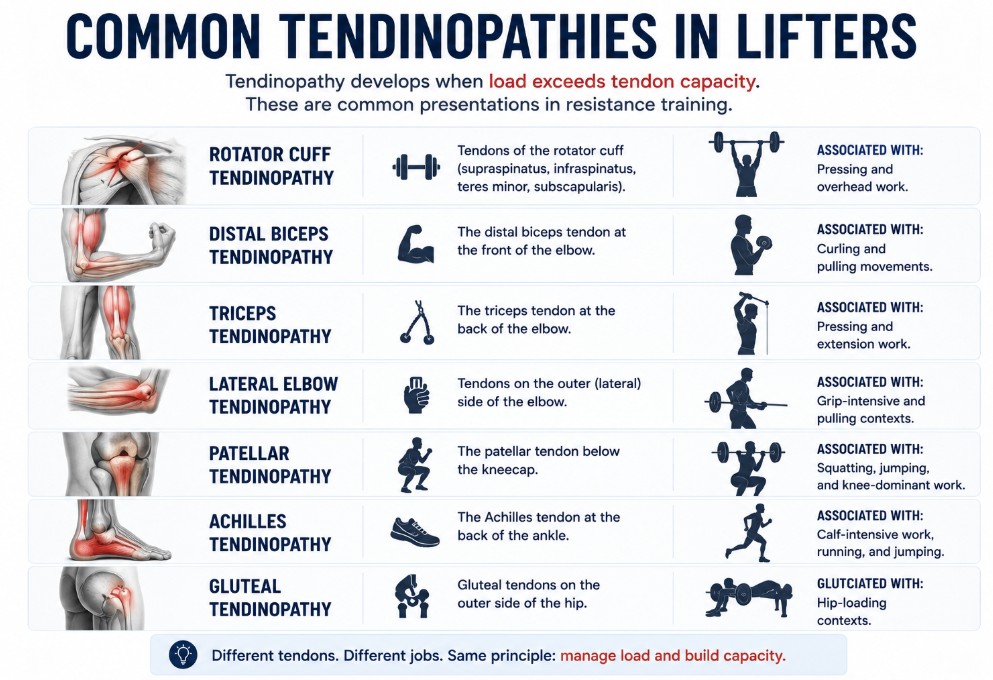
Certain tendons show up in resistance training contexts more than others, given the specific demands lifting places on them. This isn’t a claim that any specific exercise “causes” tendinopathy at a given tendon — as section 4 established, it’s about load exceeding capacity, and any of these presentations can develop through many different paths.
- Rotator cuff tendinopathy — associated with pressing and overhead work, covered in more anatomical depth in our shoulder joint anatomy guide.
- Distal biceps tendinopathy — associated with curling and pulling movements.
- Triceps tendinopathy — associated with pressing and extension work.
- Lateral elbow tendinopathy — associated with grip-intensive and pulling contexts.
- Patellar tendinopathy — associated with squatting, jumping, and knee-dominant work, covered further in our knee joint anatomy guide.
- Achilles tendinopathy — associated with calf-intensive work, running, and jumping.
- Gluteal tendinopathy — associated with hip-loading contexts, covered in our hip joint anatomy guide.
6. What Does Tendinopathy Feel Like?
General patterns tend to include localized pain in the tendon region, pain that relates specifically to loading (worse with certain movements, often better at rest), stiffness, reduced capacity for the activities that load that tendon, sometimes morning stiffness that eases with movement, and pain that changes with activity level rather than remaining perfectly constant.
Symptoms alone cannot confirm which tendon pathology is present. The pattern above is a general description, not a diagnostic checklist — the same symptom picture can arise from tendinopathy, from other tendon or joint pathology entirely, or from structures near the tendon rather than the tendon itself, such as a nearby bursa sharing the same general region (the subacromial bursa near the rotator cuff tendons, for instance).
7. Does Tendon Pain Mean the Tendon Is Damaged?
Not necessarily — and this is one of the most important things a lifter dealing with tendon pain can understand.
Pain severity and structural abnormality are not tightly linked. Research examining Achilles tendon imaging in people with no symptoms at all has found a meaningful prevalence of structural abnormalities on imaging in genuinely asymptomatic individuals (Docking, Hart, Cook & Culvenor, 2021) — meaning plenty of people are walking around with imaging findings that would sound alarming on a report, and no pain whatsoever. The reverse also happens: someone can experience significant tendon pain without a correspondingly dramatic imaging finding.
This matters enormously for lifters who get an ultrasound or MRI and see language like “abnormality” or “degenerative changes” and conclude their tendon is fundamentally “destroyed.” An imaging report is one piece of information, not a direct readout of pain or function — and treating it as a complete verdict on tendon health overstates what imaging alone can actually tell you.
8. Does Tendinopathy Heal?
A nuanced answer is more honest than either extreme here.
This guide won’t promise that a tendon returns to some “pristine,” pre-symptom structural state, imaging included — that’s not a realistic framing given everything covered in the previous section about structure-symptom discordance. But symptoms, function, and load capacity can improve substantially, often very substantially, even in cases where imaging findings don’t fully normalize. The practical goal isn’t a perfect follow-up scan—it’s restored pain levels, restored function, and restored capacity to tolerate the loads you actually want to apply. Chasing a “clean” image as the marker of success sets up a goal that doesn’t reliably track with what actually matters for training.
9. Should You Rest a Tendinopathy?
Complete, prolonged rest is often not ideal, and it’s worth explaining why rather than just asserting it.
Reduced loading reduces tendon capacity over time — the same basic principle covered throughout our Tendons and Ligaments guide, where tendons require ongoing mechanical stimulus to maintain and build their properties. Stop loading a tendon entirely for an extended period, and you’re not protecting it in some neutral, risk-free way — you’re allowing its capacity to decline, which can make the eventual return to training demands harder, not easier. At the same time, “train through anything regardless of symptoms” clearly isn’t the answer either.
The concept that resolves this tension is relative load modification: reducing or adjusting the specific provocative load while maintaining as much tolerated activity as possible, rather than eliminating loading altogether. Current clinical practice guidelines for Achilles tendinopathy explicitly reflect this approach, emphasizing progressive tendon-loading exercise tailored to the individual, rather than prolonged rest, as a central component of management (Chimenti et al., 2024). “Rest” in this context doesn’t mean complete inactivity — it means intelligently managing which loads the tendon is exposed to while that capacity rebuilds.
10. Can You Train With Tendinopathy?
Often, yes — but training frequently needs modification rather than complete cessation, and figuring out what that modification looks like is the central practical question most lifters actually have.
Several variables can be adjusted independently: exercise selection (choosing movements that load the tendon differently), range of motion, absolute load, training volume, session frequency, tempo (how quickly or slowly a repetition is performed), and proximity to failure. This guide won’t hand out a specific personal rehabilitation prescription here — that requires individual assessment this article can’t provide. But the general framing is worth internalizing: the question is usually not simply whether you can train, but what dose and type of loading the tendon can currently tolerate. “Can I train?” is often the wrong question compared to “what training does this tendon currently have capacity for?”
11. Why Progressive Loading Matters
This is the mechanistic heart of why exercise-based approaches dominate tendinopathy management rather than passive treatment alone.
Tendon tissue senses mechanical load at the cellular level and responds through matrix remodeling — the mechanotransduction process covered in depth in our Tendons and Ligaments guide, where mechanical loading gets translated into a biological signal for adaptation (Kjaer, 2004). Progressive loading gives a tendon a structured opportunity to adapt toward the demands being placed on it, gradually increasing the load it’s exposed to as capacity builds.
It’s worth being honest about what this does and doesn’t promise: progressive loading is not a guaranteed, simple, linear “healing” story where week-by-week improvement is inevitable and predictable. It’s a structured way of working with the tendon’s actual biology, applied consistently over time — not a formula that produces identical results for every tendon, every person, and every timeline.
12. Isometric Exercise for Tendinopathy
Isometric contractions — holding a position under tension without joint movement — can be a genuinely useful way to load a symptomatic tendon, particularly in situations where dynamic loading isn’t well tolerated yet.
It’s worth correcting an overstated claim that circulated widely for a period: that isometrics reliably produce immediate pain relief in everyone with tendinopathy. The evidence doesn’t support that as a universal effect. A systematic review and meta-analysis examining isometric exercise across multiple tendinopathies found it was not superior to isotonic (dynamic) exercise for chronic tendinopathy, based on the available evidence (Clifford et al., 2020), and other controlled research has directly found no significant immediate analgesic benefit from isometric exercise in some tendinopathy presentations. Isometrics can help load a symptomatic tendon, but their pain-relieving effect varies by individual and condition—not a guaranteed, universal quick fix.
13. Eccentric Exercise: Is It Still the Gold Standard?
For years, tendinopathy management in popular fitness and even some clinical discussion was practically synonymous with eccentric exercise. That picture has become considerably more nuanced.
Eccentric training does have real supporting evidence, particularly for Achilles and patellar tendinopathy specifically. But it’s not clearly, universally superior to every other loading approach. A systematic review comparing loading programs for Achilles and patellar tendinopathy found only limited evidence (for Achilles) and conflicting evidence (for patellar tendinopathy) that clinical outcomes are actually superior with eccentric loading compared to other loading programs — directly questioning the entrenched assumption that eccentric training is the single best approach (Malliaras, Barton, Reeves & Langberg, 2013).
Eccentric loading is useful; eccentric loading is not magic. It’s one legitimate, evidence-supported loading option among several, not an automatically superior default that every tendinopathy protocol must be built around.
14. Heavy Slow Resistance (HSR)
This approach deserves particular attention for a bodybuilding-focused audience, since it maps naturally onto training most lifters already understand.
Heavy slow resistance involves a relatively heavy load combined with slow, controlled concentric and eccentric contractions— a genuinely practical, familiar way to progressively load a tendon within a structure many lifters already understand. It’s worth resisting the temptation to declare it definitively “the best” approach, though. Systematic review evidence examining isometric, eccentric, and HSR loading for patellar tendinopathy specifically has found that all three approaches show some evidence of benefit, with the specific advantages of each varying depending on context and outcome measured, rather than one method demonstrating clear, consistent superiority across the board (Lim & Wong, 2018).
15. Should Tendon Exercises Hurt?
This is a genuinely practical, heavily searched question, and it deserves a careful answer rather than a rigid rule.
Some loading protocols allow a degree of symptoms during exercise—complete pain avoidance isn’t always the target, and that’s a meaningful departure from how most people intuitively approach an area that hurts. But more pain during exercise does not equal more adaptation. The research literature has discussed symptom tolerance during loading protocols as something that can be permitted within a moderate range in some approaches, but specific protocols and pain-monitoring approaches vary considerably between studies and practitioners. This guide won’t provide a specific numerical pain threshold—something like a fixed “3 out of 10 pain rule”—as a universal prescription. That kind of specific numeric guidance depends on individual assessment and context this article isn’t positioned to provide, and treating it as a one-size-fits-all rule oversimplifies what the underlying research actually supports.
16. How Long Does Tendinopathy Take to Improve?
Think in terms of weeks to months, not days — and resist the appeal of a single, clean timeline number, because there genuinely isn’t one that applies universally.
Recovery duration depends on which tendon is involved, how long symptoms have been present before management begins, the severity and irritability of the presentation, the training demands the person is working back toward, age, general health, how consistently load is actually managed, and adherence to whatever loading approach is being followed. Clinical guidance for conditions like Achilles tendinopathy generally frames management as a structured, often multi-month process rather than a quick fix (Chimenti et al., 2024). This guide won’t promise a specific number of weeks as a guaranteed endpoint — that would overstate the certainty any general article can offer about an individual case.
17. Common Tendinopathy Mistakes Lifters Make
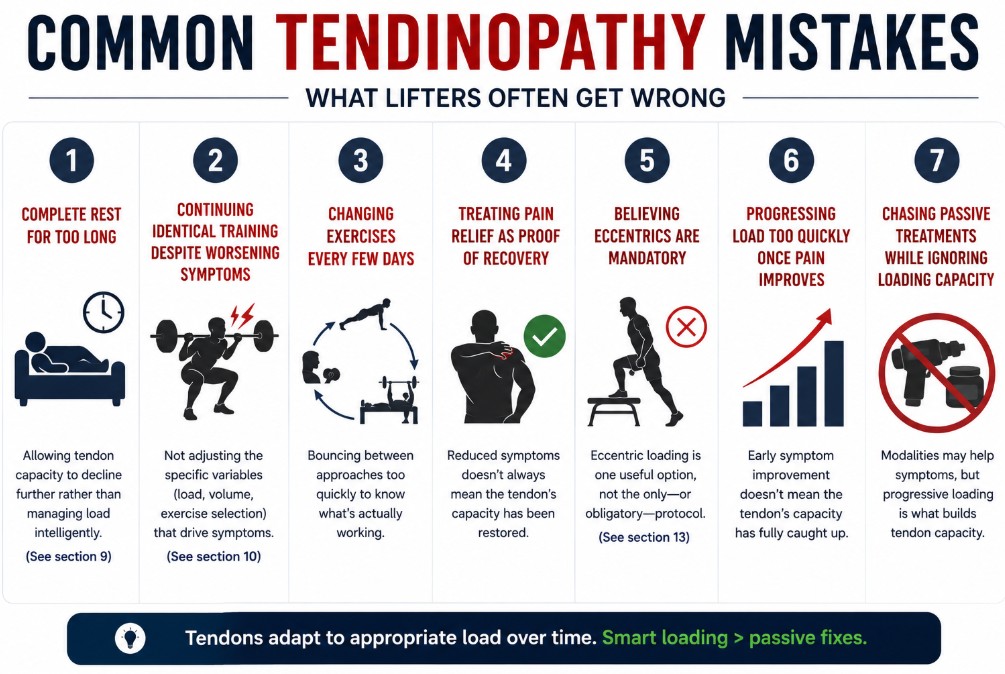
Several recurring patterns show up often enough to name directly.
- Complete rest for too long — allowing tendon capacity to decline further rather than managing load intelligently, as covered in section 9.
- Continuing identical training despite worsening symptoms — not adjusting the specific variables (load, volume, exercise selection) that section 10 covered.
- Changing exercises every few days — bouncing between approaches too quickly to let any single strategy demonstrate whether it’s working.
- Treating pain relief as proof the tendon is fully recovered — conflating reduced symptoms with restored capacity, when the two don’t always move together.
- Believing eccentrics are mandatory — as section 13 covered, eccentric loading is one useful option, not an obligatory protocol.
- Progressing load too quickly once pain improves — early symptom improvement doesn’t mean the tendon’s capacity has fully caught up.
- Chasing passive treatments while ignoring loading capacity — investing heavily in modalities that may offer symptomatic relief while neglecting the progressive loading that actually builds capacity.
18. What About Massage, Foam Rolling, Stretching & Supplements?
A brief, honest overview, since these come up constantly in tendon pain discussions.
Massage and foam rolling can influence symptoms and short-term movement tolerance, but they don’t replace the progressive tendon loading covered throughout this guide — the same distinction our fascia guide covers in more depth regarding what these tools can and can’t actually do mechanically.
Stretching isn’t a universal fix for tendon pain, and depending on the specific tendon and presentation, certain stretching positions can actually be provocative rather than helpful — not something to apply reflexively to every case.
Collagen and gelatin supplementation is a genuinely active area of nutrition research related to connective tissue physiology, covered more broadly in our connective tissue guide — but this article won’t claim that any supplement treats or resolves tendinopathy on its own. Nutrition can support the broader physiological environment; it isn’t a substitute for appropriate mechanical loading.
19. When Tendon Pain Needs Professional Assessment
This guide has stayed at the level of general education throughout, and it’s worth closing with a clear, direct boundary rather than leaving it implicit.
Certain presentations warrant proper professional assessment rather than self-management: sudden, severe pain; a pop or snap sensation at the time of injury; major weakness or loss of function; obvious swelling or bruising; suspected tendon rupture; symptoms that are progressively worsening rather than stabilizing or improving; and persistent symptoms that don’t respond to sensible load modification over a reasonable period. This guide isn’t the place for diagnosis, and none of the general information above should be treated as a substitute for individual assessment when any of these apply.
20. Training Implications for Lifters
Everything in this guide comes down to a short set of practical principles.
- Tendons need load. Categorically avoiding loading doesn’t protect a tendon — it leaves it undertrained for the demands it will eventually face again.
- Capacity matters more than fear of movement. The goal is to build what the tendon can tolerate, not to avoid everything that might provoke symptoms.
- Modify rather than automatically stop training. As section 10 covered, you can adjust multiple training variables before “stop entirely” becomes the only option.
- Progressive loading beats random rehab exercises. A structured, consistent approach to increasing tendon capacity outperforms an unfocused collection of exercises picked without a clear loading rationale.
- Pain and structural damage are not synonymous, as section 7 established — don’t let an imaging report alone dictate how you interpret your symptoms.
- Build back toward the actual demands of your training — the end goal of tendinopathy management for a lifter isn’t just “pain-free”; it’s tolerating the specific loads your training requires.
Coach’s Note: The goal isn’t to make a painful tendon experience zero load forever. It’s to find the amount of load it can currently tolerate, build from there, and progressively restore the capacity required for the lifting you actually want to do.
Key Takeaways
- ✓Tendinopathy is not simply tendon inflammation — it’s a broader term for tendon pain and impaired function without specifying the underlying pathology.
- ✓Tendon pain does not perfectly reflect structural damage — imaging abnormalities occur in asymptomatic people, and significant pain can occur with limited imaging findings.
- ✓Sudden changes in load are often more relevant to tendinopathy than the exercise itself — the core issue is load exceeding current capacity.
- ✓Complete, prolonged rest can reduce tendon capacity rather than protect it — relative load modification is generally preferred.
- ✓Progressive loading is central to rebuilding tendon capacity, working through the tendon’s own mechanotransduction biology.
- ✓Eccentric exercise is a useful loading option but not uniquely superior to isometric or heavy slow resistance approaches.
- ✓Isometric and heavy slow resistance loading both have legitimate roles, with evidence for each varying by context.
- ✓Some symptoms during loading do not automatically mean further damage — but more pain during exercise isn’t evidence of more adaptation either.
- ✓Recovery typically takes weeks to months, with no single universal timeline that applies to every case.
- ✓Returning to lifting means rebuilding capacity for the actual training demands you want to return to, not just chasing pain-free status.
Frequently Asked Questions
What is tendinopathy? +
Tendinopathy is a clinical condition characterized primarily by tendon pain and reduced function, usually associated with mechanical loading. It’s a broad umbrella term that doesn’t specify a single underlying pathology, and it’s not simply synonymous with inflammation or a torn tendon.
What is the difference between tendinopathy and tendonitis? +
Tendinopathy is the broader clinical term for tendon pain and impaired function generally. Tendinitis historically implies an inflammatory pathology specifically. The terms are related but not interchangeable, and even clinical usage of them hasn’t been fully consistent over time.
What causes tendinopathy? +
Tendinopathy generally develops when load exceeds a tendon’s current capacity — often driven by sudden increases in training volume or intensity, new exercises, insufficient recovery, detraining followed by abrupt reloading, or individual factors like age and biomechanics, rather than “overuse” in a simple absolute sense.
Does tendinopathy heal? +
Symptoms, function, and load capacity can improve substantially, even when imaging findings don’t fully normalize. The realistic goal is restored pain levels, function, and load tolerance rather than a “perfect” follow-up scan, since structure and symptoms don’t always track closely together.
Can you train with tendinopathy? +
Often yes, though training frequently needs modification rather than complete cessation. Exercise selection, range of motion, load, volume, frequency, and tempo can all be adjusted based on what the tendon currently tolerates, rather than training being an all-or-nothing decision.
Should you rest a painful tendon? +
Complete, prolonged rest is often not ideal, since reduced loading can reduce tendon capacity over time. Current clinical guidance generally favors relative load modification — adjusting the specific provocative load while maintaining as much tolerated activity as possible — over eliminating loading entirely.
What exercises are best for tendinopathy? +
There’s no single universally best exercise. Isometric, eccentric, and heavy slow resistance loading all have supporting evidence, with the most appropriate approach depending on the specific tendon, presentation, and individual context rather than one method being categorically superior.
Are eccentric exercises best for tendinopathy? +
Not uniquely. Eccentric training has real supporting evidence for certain tendinopathies, but systematic reviews have found only limited or conflicting evidence that it produces superior outcomes compared to other loading approaches like heavy slow resistance or isometric training.
How long does tendinopathy take to heal? +
Typically weeks to months rather than days, though there’s no single universal timeline. Duration depends on the specific tendon, symptom duration and severity before management begins, training demands, age, general health, and consistency of load management.
Does tendon pain mean the tendon is damaged? +
Not necessarily. Pain severity and structural abnormality on imaging aren’t tightly linked — imaging abnormalities are common even in people with no symptoms at all, and significant pain can occur without a dramatic corresponding imaging finding. An imaging report is one piece of information, not a complete verdict on tendon health.
References
- Scott, A., Backman, L. J., & Speed, C. (2015). Tendinopathy: Update on Pathophysiology. Journal of Orthopaedic & Sports Physical Therapy, 45(11), 833–841. https://doi.org/10.2519/jospt.2015.5884
- Cook, J. L., & Purdam, C. R. (2009). Is tendon pathology a continuum? A pathology model to explain the clinical presentation of load-induced tendinopathy. British Journal of Sports Medicine, 43(6), 409–416. https://doi.org/10.1136/bjsm.2008.051193
- Cook, J. L., Rio, E., Purdam, C. R., & Docking, S. I. (2016). Revisiting the continuum model of tendon pathology: what is its merit in clinical practice and research? British Journal of Sports Medicine, 50(19), 1187–1191. https://doi.org/10.1136/bjsports-2015-095422
- Docking, S. I., Hart, H. F., Cook, J. L., & Culvenor, A. G. (2021). Age, Body Mass Index, and Physical Activity Partly Explain Variability in the Prevalence of Achilles Tendon Abnormalities: A Systematic Review With Meta-analysis of Imaging Studies in Asymptomatic Individuals. Journal of Orthopaedic & Sports Physical Therapy, 51(5), 232–252. https://doi.org/10.2519/jospt.2021.9970
- Chimenti, R. L., Neville, C., Houck, J., Cuddeford, T., Carreira, D., & Martin, R. L. (2024). Achilles Pain, Stiffness, and Muscle Power Deficits: Midportion Achilles Tendinopathy Revision – 2024. Journal of Orthopaedic & Sports Physical Therapy, 54(12), CPG1–CPG32. https://doi.org/10.2519/jospt.2024.0302
- Kjaer, M. (2004). Role of extracellular matrix in adaptation of tendon and skeletal muscle to mechanical loading. Physiological Reviews, 84(2), 649–698. https://doi.org/10.1152/physrev.00031.2003
- Clifford, C., Challoumas, D., Paul, L., Syme, G., & Millar, N. L. (2020). Effectiveness of isometric exercise in the management of tendinopathy: a systematic review and meta-analysis of randomised trials. BMJ Open Sport & Exercise Medicine, 6(1), e000760. https://doi.org/10.1136/bmjsem-2020-000760
- Malliaras, P., Barton, C. J., Reeves, N. D., & Langberg, H. (2013). Achilles and patellar tendinopathy loading programmes: A systematic review comparing clinical outcomes and identifying potential mechanisms for effectiveness. Sports Medicine, 43(4), 267–286. https://doi.org/10.1007/s40279-013-0019-z
- Lim, H. Y., & Wong, S. H. (2018). Effects of isometric, eccentric, or heavy slow resistance exercises on pain and function in individuals with patellar tendinopathy: A systematic review. Physiotherapy Research International, 23(4), e1721. https://doi.org/10.1002/pri.1721
