



Fascia has become one of the most talked-about — and misunderstood — tissues in fitness. People often describe it as something that becomes “tight,” needs to be “released,” or can be broken up with a foam roller. The real anatomy is considerably more interesting, and considerably more precise, than most of what circulates in gym conversation.
Fascia is a connective tissue system connected to muscles, organs, nerves, blood vessels, and other structures throughout the body, with structural, mechanical, and sensory functions. Understanding what it actually is — and isn’t — separates useful training decisions from a lot of gym mythology.
Quick Answer
Fascia is connective tissue that forms sheets, layers, and interconnected networks throughout the body. It surrounds, separates, and connects muscles and other structures while providing mechanical support and allowing tissues to move and glide relative to one another. Depending on the definition used, the fascial system may also encompass a broader continuum of collagen-containing connective tissues. Fascia is therefore not simply “wrapping” around muscles, but part of an integrated connective-tissue network involved in structure, movement, force transmission, and sensory function.
1. What Exactly Counts as Fascia?
Here’s something worth knowing upfront: even the anatomy and fascia research communities haven’t fully agreed on a single definition — and that’s genuinely useful context, not a gap in this guide’s research.

The Fascia Research Society’s Fascia Nomenclature Committee, through a structured expert consensus process, settled on two related but distinct terms. “A fascia” refers to a sheath, sheet, or other dissectible aggregation of connective tissue that forms beneath the skin to attach, enclose, and separate muscles and other internal organs — a narrower, anatomically dissectible structure. “The fascial system” refers to something broader: the three-dimensional continuum of soft, collagen-containing, loose and dense fibrous connective tissues that permeate the body (Adstrum, Hedley, Schleip, Stecco & Yucesoy, 2017).
Why does this matter? Because a lot of the confusion around fascia in fitness content comes from switching between these two meanings without saying so — sometimes fascia means a dissectible sheet you could point to in a cadaver, and sometimes it means a body-wide functional network. Both are legitimate concepts. They’re just not the same thing, and conflating them is where a lot of overreach starts. This distinction connects directly to the broader picture covered in our connective tissue guide — fascia is one member of a much larger connective tissue family, not a separate biological system operating by its own rules.
2. What Is Fascia Made Of?
Fascia is built from the same basic ingredients as most connective tissue: collagen, elastin, water, proteoglycans and glycosaminoglycans, and a resident cell population dominated by fibroblasts, all organized within an extracellular matrix.

A simple mental model captures how these work together: collagen provides much of the tensile strength, elastic fibers contribute to recoil, and the hydrated extracellular matrix helps fascial layers interact and glide against one another. A key component of that gliding function is hyaluronan, secreted by a specialized cell population within the fascia’s loose connective tissue layers, which lubricates the interface between adjacent fascial and muscular layers and allows them to slide against one another with minimal friction (Stecco et al., 2018). Local mechanical forces can influence how that matrix is organized and composed over time — fascia isn’t a fixed, inert material, but a tissue that responds to the mechanical environment it experiences, a theme this guide returns to later.
3. The Main Types of Fascia
There’s real terminological variability here between sources — worth acknowledging directly rather than presenting one classification as the only correct one. Different anatomy sources classify fascia somewhat differently, with some using a simple superficial/deep split and others using a more detailed four-category system.
A commonly used, practical classification recognizes four categories (StatPearls, 2023):
- Superficial fascia — found directly beneath the skin, generally a looser layer of interwoven collagen and elastic fibers, often incorporating adipose tissue.
- Deep fascia — surrounds bones, muscles, nerves, and blood vessels. This layer matters most for musculoskeletal movement and is the primary focus of the rest of this guide.
- Visceral fascia — surrounds and supports organs within body cavities, such as the pleura around the lungs or the pericardium around the heart.
- Parietal fascia — lines the walls of body cavities, a general term for tissue found, for example, in the pelvis.
For a lifter, deep fascia is where nearly all of the training-relevant content in this guide lives — it’s what surrounds the muscles you’re actually training.
4. Muscle Fascia: How Fascia Surrounds Skeletal Muscle
This is where fascia anatomy becomes directly relevant to resistance training.
Skeletal muscle has a nested connective tissue architecture: the epimysium surrounds the entire muscle, the perimysium wraps bundles of muscle fibers called fascicles, and the endomysium surrounds individual muscle fibers themselves. It’s worth being precise about terminology here rather than treating terms as interchangeable: these intramuscular connective tissue layers and “deep fascia” are related but not strictly synonymous across every source — some classification systems treat the epimysium as continuous with the surrounding deep fascia, while others draw a clearer structural boundary between them. This architecture applies across the body — see our guides to the major upper body muscles and major lower body muscles for how it plays out in specific muscle groups.
5. What Does Fascia Do?

Five functions, working together across the body:
- Supports and organizes tissues — providing structural context that keeps muscles, organs, and other structures properly positioned.
- Separates anatomical compartments — creating distinct spaces that keep different tissue groups functionally organized.
- Allows tissues to glide — permitting relative movement between adjacent structures during motion.
- Contributes to mechanical force transmission — a topic significant enough to deserve its own section next.
- Contributes sensory information — fascia is genuinely innervated tissue, a point this guide returns to later when discussing pain and sensation.
The broader fascial-system framework explicitly includes force transmission and sensory roles among fascia’s core functions, alongside its structural contributions — this is where the anatomy starts connecting directly to how you actually train.
6. Fascia and Force Transmission
This is one of the most important sections in this guide, because it’s where popular fitness understanding and rigorous anatomy genuinely diverge.
The standard mental model most lifters carry is simple: muscle pulls tendon, tendon pulls bone. That’s useful and largely accurate — but it’s also incomplete. Force can also transmit through connective tissue connections between muscle fibers, surrounding tissues, and fascial structures, not exclusively through the classic muscle-to-tendon-to-bone pathway. Experimental and anatomical research shows that mechanical force can also be transmitted through connective-tissue pathways beyond that single route, linking muscles to neighboring structures in measurable, real ways (Wilke, Schleip, Yucesoy & Banzer, 2018).
It’s worth drawing a clear line here, though, because this genuine finding gets stretched into claims the evidence doesn’t support. This does not mean that evidence for local or regional myofascial force transmission automatically validates broad claims about whole-body fascial chains or “meridians.” The measured, documented phenomenon is real and interesting. Sweeping versions built on top of it in some fitness and bodywork circles outrun what current evidence establishes.
7. Fascia and Movement: Why Tissues Need to Glide
During movement, muscles change shape as they contract and lengthen, and the structures around them — other muscles, nerves, blood vessels — need to move relative to those changing shapes without getting caught or restricted. Fascial interfaces contribute to this relative sliding and help adjacent structures move with less mechanical interference.
This sliding function shows up in essentially every resistance training movement you perform — the squat, the overhead press, a biceps curl, a row — all require the connective tissue surrounding your working muscles to permit relative gliding as those muscles change length and shape through the movement.
8. Does Fascia Adapt to Resistance Training?
Fascia is not an inert, plastic-like wrapping that simply sits in place indefinitely. Like other connective tissue, it’s mechanically responsive — the mechanical environment fascia experiences can influence connective-tissue remodeling and how its extracellular matrix is organized over time, following the same basic mechanotransduction logic covered in our Tendons and Ligaments guide: mechanical loading is sensed at the cellular level and translated into signals that influence matrix synthesis and remodeling (Kjaer, 2004).
That said, it would overreach the evidence to claim that lifting directly “thickens and strengthens” all fascia in some straightforward, uniform way. Fascial tissues are biologically responsive to mechanical stimuli, but the extent and training-specific significance of fascial adaptation in humans are less clearly established than adaptation of muscle, tendon, and bone — not a special, separate process requiring dedicated “fascia training,” but also not a well-mapped area of the adaptation literature the way muscle hypertrophy or tendon stiffness adaptation are.
9. What Does “Tight Fascia” Actually Mean?
This is where the guide shifts from anatomy to the specific claims people actually search for—and “tight fascia” is one of the most common, least precisely defined phrases in gym vocabulary.
“My fascia is tight” is not a precise anatomical diagnosis. The sensation people describe as tightness can involve several distinct, overlapping factors: muscle tone, nervous system perception and protective responses, genuine tissue stiffness, pain, and simple movement tolerance in an unfamiliar range. Fascia itself may contribute to some of that sensation in some cases — but attributing every tight feeling specifically to fascia, as opposed to any of these other contributing factors, overstates what can actually be determined from a subjective sensation alone.
10. Can You Stretch Fascia?
Fascial tissues genuinely do experience mechanical strain during stretching — that part is straightforward. What’s less straightforward is the popular claim that stretching simply “lengthens” fascia in a durable, structural sense.
It’s worth separating acute range-of-motion change from long-term tissue remodeling, because they’re driven by different mechanisms. A 2025 systematic review and meta-analysis of 65 studies involving 1,542 adults found that both acute and chronic static stretching reduced overall muscle-tendon unit stiffness, while chronic stretching also increased stretch tolerance (how much passive tension a person can tolerate before feeling resistance). The review found no significant overall increase in muscle fascicle length (Ingram et al., 2025). Importantly, these findings do not directly show whether fascia itself structurally lengthens with stretching — fascicle length is a specific measure of muscle architecture, not a direct measurement of fascial tissue length. The review does show that range-of-motion improvements can occur through changes in mechanical stiffness and stretch tolerance without measurable increases in muscle fascicle length.
11. Does Foam Rolling “Release” Fascia?
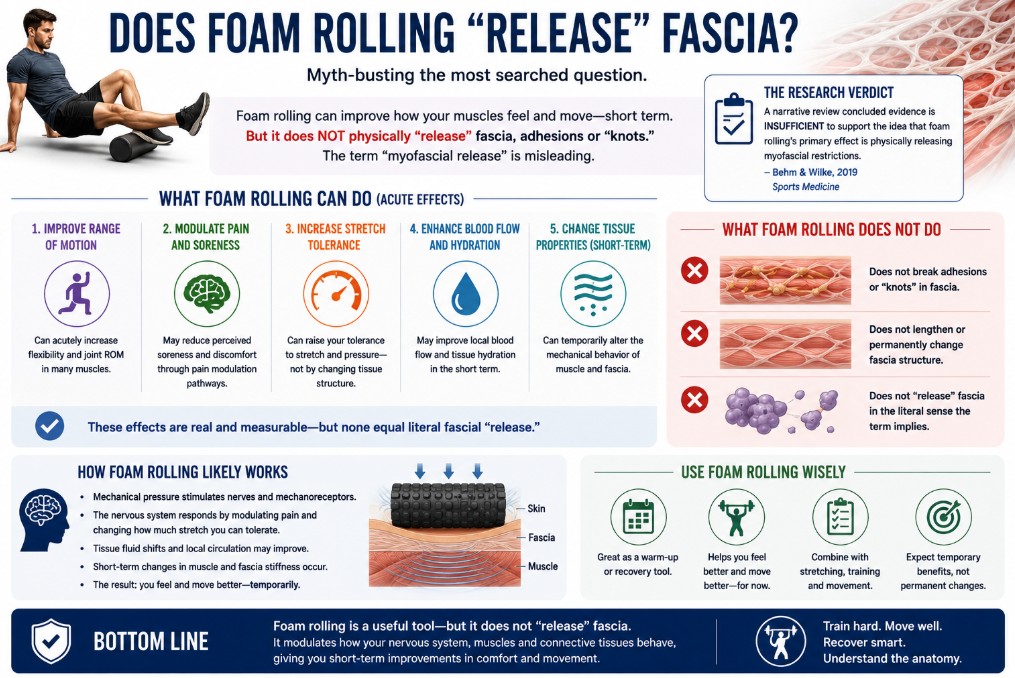
This might be the single most search-relevant question in this entire guide, and it deserves a genuine myth-busting answer rather than a hedge.
Foam rolling can produce real, measurable acute improvements in range of motion and may influence perceived soreness and discomfort. That much is reasonably well supported. But the term commonly used to describe this — “myofascial release” — implies a specific mechanism (physically releasing restrictions, adhesions, or “knots” in fascia) that current evidence does not support. A narrative review examining the mechanisms behind foam rolling and similar devices concluded that evidence is insufficient to support the idea that their primary effect comes from physically releasing myofascial restrictions, making the term “self-myofascial release” genuinely misleading as a description of what’s actually happening (Behm & Wilke, 2019).
Proposed mechanisms include neural modulation (including pain modulation pathways), changes in stretch tolerance, local blood flow and hydration, and short-term changes in tissue mechanical properties—their relative contributions remain uncertain, but none amount to literal fascial “release” in the sense the popular term implies.
12. Can Massage Break Up Fascia?
A related, equally popular claim deserves the same level of scrutiny, though it warrants less space here since the underlying logic mirrors the foam rolling discussion above.
Manual pressure from massage can influence sensation, movement tolerance, and local tissue behavior in the short term. But evidence does not justify interpreting these short-term effects as proof that normal, healthy fascia has been physically “broken apart” the way you might break up a physical clump — that specific mechanistic claim isn’t well supported by what’s currently known about fascial tissue mechanics, for largely the same reasons covered in the foam rolling section above.
13. Fascia, Pain and Sensation
Fascia is genuinely innervated tissue, and it can be involved in nociception (the nervous system’s detection of potentially harmful stimuli) and broader sensory function — proprioception and interoception among them, consistent with the fascial-system framework’s inclusion of sensory roles alongside structural and mechanical ones. A systematic review of fascial innervation confirmed sensory nerve endings, including nociceptive fibers, across multiple fascial structures in both human and animal studies, though the review also noted that overall research quality in this area remains mixed and calls for more rigorous investigation (Suarez-Rodriguez et al., 2022).
But this genuine biological fact doesn’t support a much stronger claim that sometimes gets attached to it: pain in a particular region is not automatic proof that fascia specifically is the source of that pain. Nerves, muscles, joint structures, and other tissues in the same region can all contribute to a given pain experience, and identifying fascia specifically as the cause requires more than pain alone.
14. Fascia vs Tendon vs Ligament
A quick comparison helps place fascia within the broader connective tissue family covered throughout this site.
| Tissue | Main Role | Typical Structure |
|---|---|---|
| Fascia | Encloses, connects, and separates structures; contributes to force distribution | Variable connective tissue sheets and networks |
| Tendon | Transmits force from muscle to bone | Dense regular connective tissue |
| Ligament | Connects bone to bone, restrains joint motion | Dense collagenous connective tissue |
For the full anatomical and biomechanical picture of tendons and ligaments specifically, see our Tendons and Ligaments guide, and for a direct comparison between those two tissues, our tendon vs ligament guide.
15. Training Implications for Lifters
Five principles, drawn from everything covered above.
- You don’t need a special “fascia workout.” Normal resistance training already mechanically loads the connective tissue throughout your body, fascia included.
- Train through useful ranges of motion — not specifically to “stretch fascia,” but because movement capacity and appropriate training stimulus are worthwhile goals in their own right.
- Foam rolling is optional, not mandatory. If it helps your range of motion or serves as a useful warm-up component, use it — not because your fascia supposedly needs to be “released.”
- Don’t interpret every tight sensation as fascial restriction. As section 9 covered, “tightness” has multiple possible contributors, and fascia specifically is rarely the only, or even the primary, one.
- Progressive loading matters more than fascia-specific hacks. Progressive loading should remain the foundation of resistance training; fascia-specific techniques have not been shown to replace the adaptations produced by well-structured training.
Coach’s Note: You do not need to “unlock,” “melt,” or “break up” your fascia before you can train effectively. Build strength through usable ranges of motion, progress loading gradually, and use tools such as stretching or foam rolling when they serve a specific purpose — not because your fascia supposedly needs to be released.
Key Takeaways
- ✓Fascia is connective tissue, not a mysterious separate body system — and there is no single universally accepted definition, even among researchers.
- ✓Fascia surrounds, separates, and connects tissues, with deep fascia being especially relevant to musculoskeletal movement.
- ✓Fascial tissues can participate in genuine force transmission beyond the classic muscle-tendon-bone pathway — though “everything is connected” fascial-chain claims overstate this real finding.
- ✓Fascia is innervated and has genuine sensory functions, but pain in a region is not automatic proof that fascia is the source.
- ✓“Tight fascia” is not a precise diagnosis — the sensation of tightness has multiple possible contributors.
- ✓Stretching can improve flexibility through increased stretch tolerance and reduced muscle-tendon unit stiffness; current evidence does not require measurable increases in muscle fascicle length to explain those gains.
- ✓Foam rolling produces real acute benefits, but current evidence does not support that it works by physically “releasing” fascia.
- ✓Normal resistance training already provides mechanical loading to connective tissue — no special “fascia workout” is required.
Frequently Asked Questions
What is fascia? +
Fascia is connective tissue that forms sheets, layers, and interconnected networks throughout the body. It surrounds, separates, and connects muscles and other structures, providing mechanical support and allowing tissues to glide relative to one another. There is no single universally agreed-upon definition, and experts distinguish between “a fascia” (a specific dissectible structure) and “the fascial system” (a broader functional continuum).
What does fascia do? +
Fascia supports and organizes tissues, separates anatomical compartments, allows tissues to glide relative to one another, contributes to mechanical force transmission, and provides sensory information through its innervation.
Where is fascia located in the body? +
Fascia is found throughout the body — directly beneath the skin (superficial fascia), surrounding muscles, nerves, and blood vessels (deep fascia), around internal organs (visceral fascia), and lining body cavity walls (parietal fascia).
What are the main types of fascia? +
A commonly used classification recognizes four types: superficial fascia (beneath the skin), deep fascia (surrounding muscles and neurovascular structures), visceral fascia (around organs), and parietal fascia (lining body cavity walls). Different anatomy sources classify fascia somewhat differently, with some using simpler two-category systems.
What causes tight fascia? +
“Tight fascia” is not a precise diagnosis. The sensation of tightness can involve muscle tone, nervous system perception, genuine tissue stiffness, pain, and movement tolerance in unfamiliar ranges — not necessarily fascia specifically.
Can fascia become tight? +
Fascia may contribute to a sensation of tightness in some cases, but attributing every tight feeling specifically to fascia overstates what can be determined from subjective sensation alone. Multiple tissue and nervous system factors typically contribute together.
Can you stretch fascia? +
Fascial tissues experience mechanical strain during stretching, but it is difficult to isolate how much of a flexibility change comes specifically from fascia. Current evidence shows that static stretching can reduce overall muscle-tendon unit stiffness and increase stretch tolerance without consistently increasing muscle fascicle length. Therefore, improved flexibility should not automatically be interpreted as evidence that fascia has been physically “lengthened.”
Does foam rolling release fascia? +
Foam rolling produces real, measurable acute improvements in range of motion and can reduce perceived discomfort, but current evidence does not support that it works by physically “releasing” fascial restrictions or adhesions. The effects are more likely explained by neural mechanisms and changes in tissue viscoelastic properties.
Can massage break up fascia? +
Massage can influence sensation, movement tolerance, and local tissue behavior in the short term, but the idea that manual pressure physically “breaks apart” normal, healthy fascia is not well supported by current understanding of fascial tissue mechanics.
Does resistance training strengthen fascia? +
Fascia is mechanically responsive and participates in connective-tissue remodeling in response to training, following similar principles to other connective tissue. However, the evidence does not support that lifting simply and uniformly “thickens and strengthens” fascia — the response is more complex than that simplified framing suggests.
References
- Adstrum, S., Hedley, G., Schleip, R., Stecco, C., & Yucesoy, C. A. (2017). Defining the fascial system. Journal of Bodywork and Movement Therapies, 21(1), 173–177. https://doi.org/10.1016/j.jbmt.2016.11.003
- Anatomy, Fascia Layers. (2023). StatPearls. StatPearls Publishing. ncbi.nlm.nih.gov/books/NBK526038
- Wilke, J., Schleip, R., Yucesoy, C. A., & Banzer, W. (2018). Not merely a protective packing organ? A review of fascia and its force transmission capacity. Journal of Applied Physiology, 124(1), 234–244. https://doi.org/10.1152/japplphysiol.00565.2017
- Kjaer, M. (2004). Role of extracellular matrix in adaptation of tendon and skeletal muscle to mechanical loading. Physiological Reviews, 84(2), 649–698. https://doi.org/10.1152/physrev.00031.2003
- Ingram, L. A., Tomkinson, G. R., d’Unienville, N. M. A., Gower, B., Gleadhill, S., Boyle, T., & Bennett, H. (2025). Mechanisms Underlying Range of Motion Improvements Following Acute and Chronic Static Stretching: A Systematic Review, Meta-analysis and Multivariate Meta-regression. Sports Medicine, 55(6), 1449–1466. https://doi.org/10.1007/s40279-025-02204-7
- Behm, D. G., & Wilke, J. (2019). Do Self-Myofascial Release Devices Release Myofascia? Rolling Mechanisms: A Narrative Review. Sports Medicine, 49(8), 1173–1181. https://doi.org/10.1007/s40279-019-01149-y
- Suarez-Rodriguez, V., Fede, C., Pirri, C., Petrelli, L., Loro-Ferrer, J. F., Rodriguez-Ruiz, D., De Caro, R., & Stecco, C. (2022). Fascial Innervation: A Systematic Review of the Literature. International Journal of Molecular Sciences, 23(10), 5674. https://doi.org/10.3390/ijms23105674
- Stecco, C., Fede, C., Macchi, V., Porzionato, A., Petrelli, L., Biz, C., Stern, R., & De Caro, R. (2018). The fasciacytes: A new cell devoted to fascial gliding regulation. Clinical Anatomy, 31(5), 667–676. https://doi.org/10.1002/ca.23072
