

Close Menu
Bodybuilding Wizard

    Subscribe to Updates

    Join our mailing list to receive the latest updates from our team.

    Facebook X (Twitter) Instagram
    Trending
    • Decline Machine Press (Hammer Strength Decline Press): How To, Muscles Worked, Benefits & Alternatives
    • Ring Dips: How To, Muscles Worked, Benefits & Alternatives
    • Reverse-Grip Incline Dumbbell Press: How To, Muscles Worked, Benefits & Alternatives
    • Landmine Chest Press: How To, Muscles Worked, Benefits & Alternatives
    • Reverse-Grip Bench Press: How-To, Muscles Worked, Benefits & Alternatives
    • Dumbbell Squeeze Press (Hex Press): How To, Muscles Worked, Benefits & Alternatives
    • Muscle-Tendon Unit: How Muscles Transfer Force to Bones
    • Anatomical Position and Directional Terms: A Guide for Lifters
    RSS Facebook X (Twitter) LinkedIn YouTube Pinterest Instagram
    Bodybuilding Wizard
    Subscribe Login
    • Home
    • Tools
      • Interactive Muscle Anatomy
      • Interactive Human Skeleton
      • Bodybuilding & Fitness Calculators
      • Dietary & Nutrition Calculators
      • Body Measurement Calculators
      • Fitness Tests
      • Bodybuilding Glossary
      • DIY Projects
    • Training
      • Weight training basics
      • Advanced bodybuilding
      • Strength training for women
      • Workout programs
      • Home weight training programs
      • Cardio workout
      • Exercise equipment
      • Weight training accessories
      • Weight lifting injuries
      • Weight training for sports
    • Exercises
      • Chest exercises
        • Middle chest exercises
        • Upper chest exercises
        • Lower chest exercises
      • Back exercises
        • Middle back (latissimus dorsi)
        • Upper back (trapezius)
        • Lower back (erector spinae)
      • Arm exercises
        • Bicep exercises
        • Tricep exercises
        • Forearm exercises
        • Grip-strengthening exercises
      • Shoulder exercises
        • Front deltoid
        • Side deltoid
        • Rear deltoid
        • Rotator Cuff
        • Scapular & Shoulder Stability
        • Neck strengthening exercises
      • Leg and glute exercises
        • Quadricep exercises
        • Hamstring exercises
        • Calf exercises
        • Glute & Hip exercises
        • Shin exercises
      • Abdominal exercises
        • Upper abdominal exercises
        • Lower abdominal exercise
        • Oblique exercises
      • Core exercises
      • Kettlebell exercises
      • Foam rolling & Stretching
      • Explosive (dynamic) lifts
    • Motivation
      • Greatest physiques
      • Motivation techniques & tips
      • Events and competitions
      • Latest fitness news
      • Videos
        • Funny gym reels
        • Motivational videos
        • Funny workout videos
      • Pictures
      • Quotes
      • Funny Fitness
      • Transformations
    • Diet
      • Nutrition Fundamentals
      • Diet Types & Strategies
      • Foods & Superfoods for Athletes
      • Muscle Building & Performance Nutrition
      • Weight Loss & Fat Management
      • Food Psychology & Myths
      • Recipes & Meal Ideas
    • Supplements
      • Supplements Review
      • Muscle Building Supplements
      • Anabolic Steroids
      • Fat Burners & Weight Loss
      • Pre-Workout & Energy Boosters
      • Recovery & Sleep Aids
      • Cognitive & Nootropic Support
      • General Supplement Advice
      • Health Supplements
        • Joint & Bone Support
        • Gut Health & Digestion
        • Vitamins & Minerals
        • Superfoods & Greens
      • Steroid Alternatives
    • Anatomy
      • Upper-Body Muscles
      • Lower-Body Muscles
      • Bones & Skeletal Anatomy
      • Muscle Growth & Genetics
      • Joints, Tendons & Connective Tissue
      • Hormones & Endocrine System
      • Physiology & Body Systems
      • Body Composition & Fat
      • General Anatomy & Basics
    • Health
    Bodybuilding Wizard
    You are at:Home»Anatomy»Bones & Skeletal Anatomy»Wolff’s Law Explained: Why Strength Training Builds Stronger Bones
    Bones & Skeletal Anatomy

    Wolff’s Law Explained: Why Strength Training Builds Stronger Bones

    No Comments14 Mins ReadkrunoslavBy krunoslavJuly 28, 2026Updated:August 9, 2026
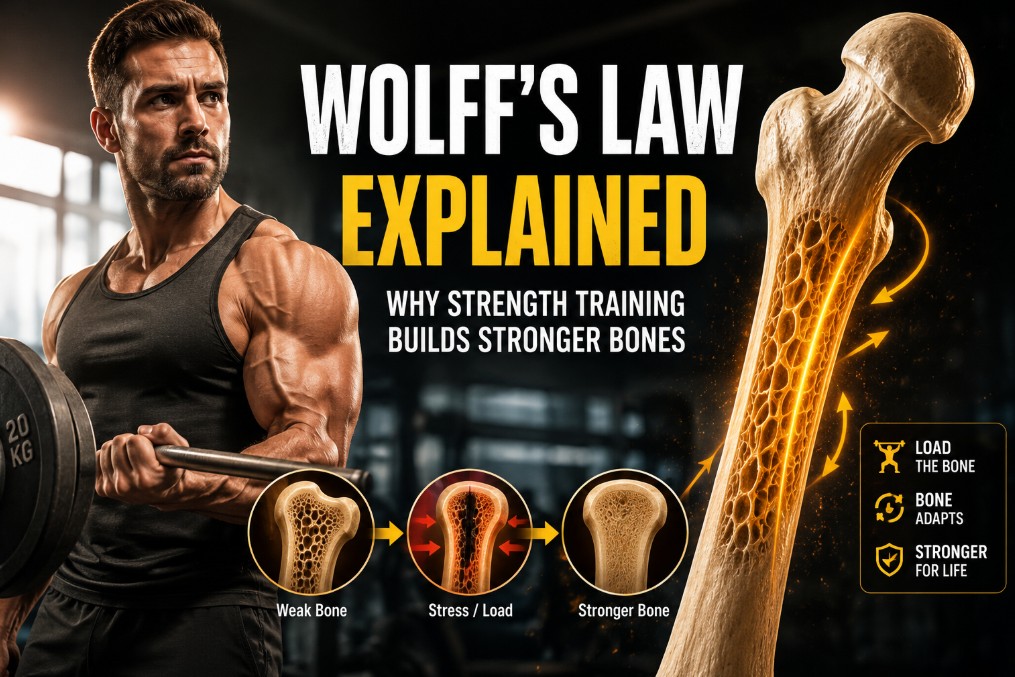
    Wolff's Law illustrated by strength training increasing bone strength through mechanical loading
    Share
    Facebook Twitter Pinterest LinkedIn Email Tumblr WhatsApp Telegram
    Table of Contents
    • Introduction
    • What Is Wolff's Law?
    • The Core Principle: Form Follows Load
    • Scientific Evidence Supporting Wolff's Law
    • The Mechanostat: How Frost Refined Wolff's Law
    • Why Weightlifting Is Such a Strong Stimulus
    • Is Wolff's Law Always True?
    • How Wolff's Law and Bone Remodeling Work Together
    • Practical Takeaways for Lifters
    • Interesting Facts About Wolff's Law
    • Conclusion

    Introduction

    Lift heavy enough, consistently enough, and your bones respond the same way your muscles do: they get stronger. This isn’t a training myth or a motivational exaggeration — it’s a well-documented biological principle called Wolff’s Law, and it’s one of the clearest scientific reasons resistance training belongs in everyone’s routine, not just bodybuilders chasing muscle.

    Wolff’s Law is simple to state but easy to misunderstand. Most explanations either oversimplify it into “lifting makes bones stronger” without saying why, or bury it in dense biomechanics language that never connects back to your actual training. This guide does neither. It covers what Wolff’s Law actually says, who discovered it, the real evidence behind it, how modern science has refined it, and exactly what it means for how you train. For the cellular mechanics of this process, see our companion guide to bone remodeling, or start with our overview of the human skeletal system.

    âš¡ Quick Facts
    Definition
    Bone adapts to the mechanical loads placed upon it.
    Proposed By
    Julius Wolff (1836–1902)
    First Described
    Late 19th century (1892)
    Core Principle
    Bone becomes stronger where it experiences regular loading.
    Applies Throughout Life
    Yes, although bone adapts more slowly with age.
    Best Stimulus
    Progressive resistance and impact training.
    Biological Mechanism
    Bone remodeling.
    Why It Matters for Lifters
    It explains why strength training builds stronger bones over time.

    What Is Wolff’s Law?

    Wolff’s Law states that bone adapts to the mechanical loads placed on it. Increase the load on a bone consistently, and it will remodel itself to become stronger and denser. Reduce the load, and the bone will lose density and strength over time.

    The law is named after Julius Wolff (1836–1902), a German anatomist and surgeon who observed in the late 19th century that the internal trabecular structure of bone — the honeycomb-like lattice within the ends of long bones — consistently aligned itself along the lines of mechanical stress the bone experienced. Wolff proposed that this alignment wasn’t random. It was the bone’s structural response to the forces it habitually carried.

    Wolff originally framed his observation in strict mathematical terms, describing bone architecture as if it precisely mirrored an engineering stress diagram. Modern research has shown that his mathematical formulation was oversimplified — but the core biological insight underneath it has held up remarkably well: bone is not a fixed structure. It’s a living tissue that continuously reshapes itself in response to the demands placed on it.

    The Core Principle: Form Follows Load

    Strip away the history and the biomechanics, and Wolff’s Law comes down to one idea: bone builds itself around the loads it regularly experiences, and loses what it doesn’t need.

    This is the same logic behind why a tennis player’s serving arm develops noticeably denser, thicker bone than their non-dominant arm, why a weightlifter’s spine and hips become measurably stronger over years of squatting and deadlifting, and why an astronaut’s skeleton weakens within weeks of leaving Earth’s gravity. In every case, the bone is responding to the mechanical signal it’s actually receiving — nothing more, nothing less. Bone doesn’t get stronger just because you intend to lift heavy weights. It gets stronger because it’s physically forced to carry more load than it’s used to.

    Scientific Evidence Supporting Wolff’s Law

    Wolff’s Law isn’t just a 19th-century observation that’s been repeated ever since — it’s been tested repeatedly with modern imaging and research methods, and the core finding holds up consistently:

    • Tennis players. One of the clearest real-world demonstrations of Wolff’s Law comes from studies comparing tennis players to inactive controls. One study of professional male tennis players found the dominant, racket-holding arm carried roughly 20% more bone mineral content than the non-dominant arm, along with 10–15% greater bone mineral density at the hip and 15% greater density at the lumbar spine compared to inactive controls — a striking illustration of how localized, repetitive mechanical loading reshapes bone specifically at the sites under the greatest stress.
    • Weightlifters. Resistance training is associated with measurable increases in bone mineral density, particularly at skeletal sites that bear the training load, consistent with Wolff’s Law, which predicts that bone adapts to where mechanical stress is applied rather than uniformly across the entire skeleton.
    • Astronauts (the reverse case). Wolff’s Law also predicts what happens when load is removed, and astronauts provide a dramatic real-world test of exactly that. In microgravity, weight-bearing bones no longer need to support body weight, and astronauts lose roughly 1–1.5% of bone density per month during long-duration missions — some of the fastest bone loss ever documented in otherwise healthy adults.

    Taken together, these findings point in the same direction from three completely different angles: add load, and bone strengthens at that site; remove load, and bone weakens at that site. That consistency, across very different populations and methods, is what gives Wolff’s Law its staying power as a working model of how bone actually behaves.

    The Mechanostat: How Frost Refined Wolff’s Law

    Wolff’s original formulation described what happens to bone, but it didn’t fully explain how much loading is needed to trigger a response, or what happens with too little or too much. In the 1960s, orthopedic surgeon Harold Frost proposed a refinement known as the mechanostat — a model that describes bone as operating within distinct loading zones, each producing a different response:

    • Disuse window — mechanical strain below the level bone is accustomed to. Bone in this zone loses mass and strength over time, which is exactly what happens during prolonged bed rest, immobilization, or spaceflight.
    • Adapted (lazy) zone — the strain range bone is already used to handling. Loading within this zone maintains existing bone but doesn’t stimulate meaningful new growth, which is why lifting the same weight for the same reps indefinitely eventually stops improving bone density, much like it stops improving strength.
    • Mild overload zone — strain that exceeds the bone’s current baseline without approaching failure. This is the zone where new bone formation is actively stimulated and is the target for training-related bone adaptation.
    • Pathologic overload zone — strain that exceeds what bone can safely accommodate, even with adaptation. Loading in this zone risks the accumulation of microdamage and stress fractures rather than productive adaptation.

    The mechanostat model explains something Wolff’s original law didn’t: why both too little training and too much training fail to build bone, while progressively increasing load within a reasonable range succeeds. It’s the same “sweet spot” logic that governs progressive overload for muscle, applied to skeletal tissue instead.

    Wolff's Law infographic showing how strength training increases bone density through mechanical loading and bone remodeling

    Why Weightlifting Is Such a Strong Stimulus

    Not every form of movement triggers Wolff’s Law equally, and resistance training happens to sit near the top of the list for a few specific reasons:

    • High force relative to bodyweight. A heavy squat or deadlift can apply several times bodyweight in force through the hips and spine — a load magnitude that low-impact activities like walking or swimming simply don’t approach.
    • Novel and progressive loading. Because progressive overload is central to effective strength training, the load on bone rarely stays in the “adapted zone” for long — it’s continually pushed into the mild overload zone where new bone formation is triggered.
    • Rapid loading rate. Bone tends to respond more strongly to loads applied quickly, such as during the concentric phase of a heavy lift or a jump, compared to slow, sustained loads of the same magnitude.
    • Site-specific, whole-body coverage. A well-rounded resistance training program loads the spine, hips, and upper body directly, unlike many cardio-based activities that concentrate stress on just the lower limbs.
    💡 Coach’s Note

    Many people assume that lifting weights is harmful to the joints and bones. In reality, when resistance training is introduced gradually, performed with sound technique, and supported by adequate recovery, the opposite is usually true.

    Your skeleton needs regular mechanical loading to remain strong. Squats, deadlifts, presses, carries, and other weight-bearing exercises give bones a reason to maintain and improve their strength.

    The greater long-term risk is often not resistance training itself, but avoiding it altogether. Without sufficient loading, bones gradually lose the stimulus they need to preserve density and structural strength.

    Is Wolff’s Law Always True?

    In the interest of giving you the full picture rather than just the flattering version: Wolff’s Law, as originally stated, isn’t perfectly accurate, and modern bone biology treats it as a useful simplification rather than a precise mathematical rule.

    Wolff’s original claim was that bone architecture mirrors mechanical stress with something close to mathematical precision. That specific formulation hasn’t held up under closer scrutiny. Bone’s actual response to loading is more complex, involves multiple overlapping biological processes, and doesn’t always follow the clean, predictable pattern the original law implies — mechanical adaptation can, in some cases, even produce trade-offs elsewhere in a joint rather than a purely beneficial outcome.

    None of this undermines the practical takeaway that matters for training. The general principle that bone adapts to mechanical loading and loses density without it remains well supported by decades of experimental and observational evidence, even if the precise mechanism is more complex than Wolff himself described in 1892. For a lifter, the nuance is academic. The practical conclusion, that consistent mechanical loading builds stronger bone, stands.

    How Wolff’s Law and Bone Remodeling Work Together

    Wolff’s Law and bone remodeling are closely related, but they aren’t the same thing. Think of Wolff’s Law as the principle and bone remodeling as the biological process that makes that principle possible.

    Wolff’s Law explains what happens: bone adapts to the mechanical loads placed upon it. When you consistently expose your skeleton to greater forces through activities like resistance training, your bones gradually become stronger. When loading decreases—as during prolonged bed rest, immobilization, or spaceflight—bone strength and density decline over time.

    Bone remodeling explains how this adaptation actually occurs. Specialized bone cells continuously remove small amounts of old or damaged bone and replace them with new bone tissue. Mechanical loading detected by osteocytes triggers signaling pathways that coordinate the activity of osteoclasts and osteoblasts, gradually reshaping bone to better withstand future loads.

    In other words, Wolff’s Law describes the outcome, while bone remodeling provides the cellular mechanism that produces it. One is the overarching biological principle; the other is the continuous physiological process that allows your skeleton to respond to training throughout life.

    If you’d like to explore the cellular biology in more detail, read our complete guide to bone remodeling, where we explain each stage of the remodeling cycle and how exercise influences it.

    Practical Takeaways for Lifters

    Wolff’s Law translates into a short list of practical principles, without needing to repeat the full exercise breakdown already covered in our bone remodeling guide:

    • Progressive overload isn’t just for muscle. The same principle that drives hypertrophy is what drives bone adaptation — load needs to progressively exceed what bone has already adapted to.
    • Bone adaptation is site-specific. Training your legs won’t meaningfully strengthen the bones in your arms, and vice versa. A well-rounded program matters for skeletal health, not just for balanced muscle development.
    • More isn’t always better. Per the mechanostat model, loading that pushes into the pathologic overload zone doesn’t build stronger bone; it risks injury. Progression should be gradual.
    • Consistency beats intensity spikes. Because bone remodels over months, not weeks, sustained training over years is what produces meaningful density changes, not a single aggressive training block.

    Interesting Facts About Wolff’s Law

    • Professional tennis players develop noticeably stronger bones in their dominant arm. Years of repetitive serving and swinging increase bone mass in the humerus and forearm. In some studies, the dominant arm has shown more than 30% greater bone strength than the non-dominant arm.
    • Gymnasts have some of the highest bone mineral density of any athletes. High-impact landings and bodyweight strength exercises provide powerful mechanical loading. This stimulates substantial bone adaptation throughout the skeleton.
    • Astronauts can lose around 1–1.5% of their bone density each month in space. Without gravity, bones receive very little mechanical loading. This makes spaceflight one of the clearest real-world demonstrations of Wolff’s Law.
    • Bone adapts only where it’s loaded. Heavy squats strengthen the hips and spine, while exercises like pull-ups and overhead presses primarily target the bones of the upper body. Bone adaptation is highly site-specific.
    • Bones adapt much more slowly than muscles. Strength gains can appear within weeks, but measurable improvements in bone density usually take several months. Long-term consistency is essential.
    • Bones never stop adapting. Although bone adaptation slows with age, healthy bone continues to respond to mechanical loading throughout life. It’s never too late to benefit from resistance training.

    Conclusion

    Wolff’s Law explains one of the most important principles of human physiology: bone adapts to the loads placed upon it. Challenge your skeleton with regular mechanical loading, and it responds by becoming stronger. Remove that challenge, and bone gradually loses strength and density.

    Resistance training provides one of the most effective ways to stimulate this adaptation. Exercises like squats, deadlifts, presses, and carries place controlled stress on the skeleton and encourage long-term bone growth. The key is to train consistently, increase loads gradually, and allow enough time for recovery.

    Building stronger bones takes longer than building stronger muscles, but the benefits can last a lifetime. By understanding Wolff’s Law, you can train not only for better performance today but also for a healthier, more resilient skeleton in the years ahead.

    ✔ Key Takeaways
    Bone responds to mechanical loading.
    Regular resistance training stimulates bones to become stronger and denser over time.
    Wolff’s Law explains the principle.
    Bone remodeling is the biological process that makes this adaptation possible.
    Progressive overload matters.
    Bones adapt only when training provides a greater challenge than they have already adapted to.
    Consistency beats intensity.
    Bone adaptation takes months, so long-term training produces the greatest benefits.
    Frequently Asked Questions
    What is Wolff’s Law?
    Wolff’s Law states that bone adapts to the mechanical loads placed on it. Regular loading encourages bone to become stronger. Reduced loading can lead to bone loss over time.
    Who discovered Wolff’s Law?
    German surgeon and anatomist Julius Wolff developed the concept in the 19th century. He studied how bone structure changes in response to mechanical stress.
    How does Wolff’s Law work?
    Mechanical loading creates strain within bone tissue. Osteocytes detect that strain and send cellular signals. These signals influence bone remodeling and help the skeleton adapt to future loads.
    Does strength training increase bone density?
    Strength training can improve or preserve bone mineral density. It works best when the exercises load the skeleton and gradually become more challenging. The response also depends on age, training history, nutrition, and hormones.
    What exercises are best for strengthening bones?
    Resistance and weight-bearing exercises provide the strongest stimulus. Good examples include squats, deadlifts, lunges, presses, loaded carries, jumping, and stair climbing. A balanced program should load both the upper and lower body.
    Is walking enough to increase bone density?
    Walking supports general health and helps maintain regular weight-bearing activity. However, it may not provide enough overload to produce large increases in bone density. Resistance training and higher-impact exercise usually create a stronger bone-building stimulus.
    How long does it take for bones to adapt to exercise?
    Bone adapts more slowly than muscle. Meaningful changes usually require several months of consistent training. Larger improvements may require a year or longer.
    Does Wolff’s Law apply to older adults?
    Yes. Bones can still respond to mechanical loading later in life. Adaptation may occur more slowly, but resistance training can help preserve bone strength, muscle function, and balance.
    Can exercise reverse osteoporosis?
    Exercise cannot guarantee a complete reversal of osteoporosis. However, a suitable training program can help slow bone loss, preserve bone strength, improve balance, and reduce fall risk. Anyone with osteoporosis should discuss high-impact or heavy exercise with a qualified healthcare professional.
    What is the difference between Wolff’s Law and bone remodeling?
    Wolff’s Law describes the general principle that bone adapts to mechanical loading. Bone remodeling describes the cellular process behind that adaptation. Osteoclasts remove old bone, while osteoblasts form new bone.
    📚 References
    1. Frost HM. Wolff’s Law and bone’s structural adaptations to mechanical usage: an overview for clinicians. The Angle Orthodontist. 1994;64(3):175–188.
    2. Oppenheimer AJ, Tong L, Buchman SR. Craniofacial Bone Grafting: Wolff’s Law Revisited. Craniomaxillofacial Trauma & Reconstruction. PMC
    3. Calbet JAL, Moysi JS, Dorado C, Rodriguez LP. Bone mineral content and density in professional tennis players. Calcified Tissue International. 1998;62(6):491–496. PubMed
    4. Kohrt WM, Bloomfield SA, Little KD, Nelson ME, Yingling VR. American College of Sports Medicine Position Stand: Physical activity and bone health. Medicine & Science in Sports & Exercise. 2004;36(11):1985–1996. PubMed
    5. NASA. Risk of Spaceflight-Induced Bone Changes. NASA
    6. Farr JN, et al. Wolff’s Law in Action: A Mechanism for Early Knee Osteoarthritis. Arthritis Research & Therapy. PMC
    7. Kenkre JS, Bassett JHD. Physiology, Bone Remodeling. StatPearls [Internet]. Treasure Island (FL): StatPearls Publishing. NCBI Bookshelf
    Share. Facebook Twitter Pinterest LinkedIn Tumblr Email WhatsApp
    krunoslav
    • X (Twitter)

    Hey! My name is Kruno, and I'm the owner and author of Bodybuilding Wizard. I am a licensed fitness trainer with a Ph.D. in kinesiology. Throughout my career, I have dedicated myself to helping individuals achieve their health and fitness goals through personalized training programs. In addition to my academic qualifications, I have completed various specialized courses, including certifications in nutrition and strength training, which have further enhanced my ability to provide comprehensive fitness guidance. I started this website back in late 2014, and it has been my pet project ever since. My goal is to help you learn proper weight training and nutrition principles so that you can get strong and build the physique of your dreams!

    Related Posts

    Bone vs Muscle: What’s the Difference and How Do They Adapt to Training?

    Bone Adaptation to Resistance Training: How Lifting Weights Builds Stronger Bones

    Bone Bruise: Symptoms, Recovery Time, Treatment & When to Return to Exercise

    Leave A Reply Cancel Reply

    You must be logged in to post a comment.

    WE ARE SOCIAL
    • Facebook 3.6K
    • Twitter
    • YouTube 134
    • Instagram
    RECENT POSTS
    October 10, 2026

    Decline Machine Press (Hammer Strength Decline Press): How To, Muscles Worked, Benefits & Alternatives

    October 10, 2026

    Ring Dips: How To, Muscles Worked, Benefits & Alternatives

    October 6, 2026

    Reverse-Grip Incline Dumbbell Press: How To, Muscles Worked, Benefits & Alternatives

    October 4, 2026

    Landmine Chest Press: How To, Muscles Worked, Benefits & Alternatives

    October 3, 2026

    Reverse-Grip Bench Press: How-To, Muscles Worked, Benefits & Alternatives

    RECENT COMMENTS
    • Justin Dew on Designing your own home gym
    • krunoslav on How Skeletal Muscles Are Named: A Simple Guide to Muscle Names
    • Christina on How Skeletal Muscles Are Named: A Simple Guide to Muscle Names
    • igtropin on Stiff-Leg Deadlift: Proper Form, Muscles Worked & Hamstring Growth Guide
    • teragon labs on Barbell Back Squat: Proper Form, Benefits, Muscles Worked & Expert Tips
    LATEST GALLERIES

    Subscribe to Updates

    Join our mailing list to receive the latest updates from our team.

    ABOUT
    ABOUT

    We are a group of bodybuilding enthusiasts and this is our effort to have all the details about bodybuilding on a single website. We strive to educate and inform our visitors so that they can make the correct training, nutrition, and supplement decisions on their own. Bodybuilding Wizard will make your dream body your reality and take you to a whole new level!

    POPULAR POSTS
    April 2, 2014

    Lying Leg Curl: Complete Guide to Hamstring Isolation, Strength & Muscle Growth

    February 18, 2019

    How Skeletal Muscles Are Named: A Simple Guide to Muscle Names

    March 28, 2014

    Free weights: The main tool for building muscles

    BODYBUILDING WIZARD
    Bodybuilding Wizard Footer Logo
    Facebook X (Twitter) Instagram Pinterest YouTube
    • About
    • Authors
    • Editorial Policy
    • Write for us
    • Privacy
    • Contact
    • Terms of Use
    • Advertising
    • FAQ
    Copyright © 2014-2026 BodybuildingWizard. All rights reserved. Powered by WordPress. Made with love and lots of caffeine.

    Type above and press Enter to search. Press Esc to cancel.

    Sign In or Register

    Welcome Back!

    Login to your account below.

    Lost password?