
Introduction
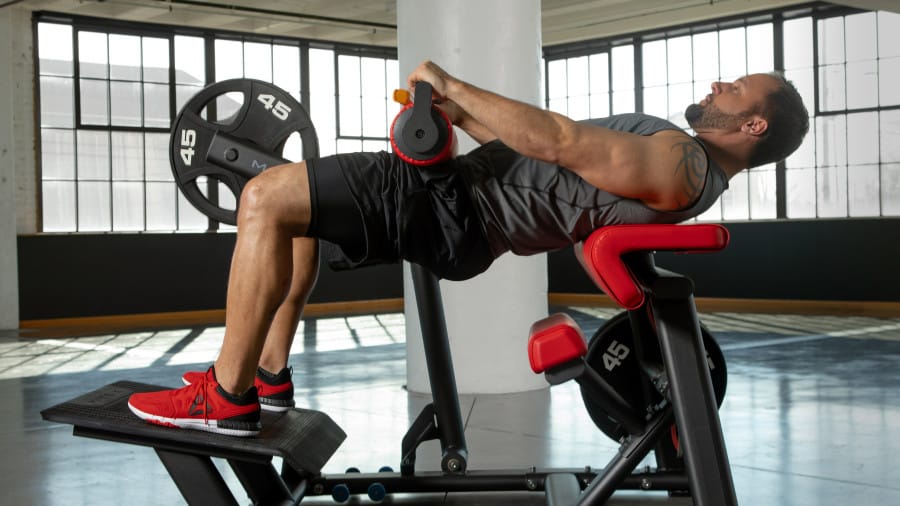
The machine hip thrust is one of the best exercises for building stronger, more powerful glutes through controlled hip extension. Compared to squats or lunges, it places significantly greater emphasis on the glutes while reducing balance demands and lower-back stress.
One of the biggest advantages of the machine hip thrust is convenience. The setup is usually faster, more stable, and more comfortable than barbell hip thrusts thanks to the built-in pads and machine support.
This exercise is especially effective for:
- Glute hypertrophy
- Hip-extension strength
- Athletic power development
- Lower-body stability
- Glute-focused training programs
In my experience as a coach, the machine hip thrust works especially well for lifters who struggle with the setup or discomfort of traditional barbell hip thrusts. The key is maintaining controlled hip extension, stable pelvic positioning, and strong peak glute contraction throughout every repetition.
Other Names for the Machine Hip Thrust
The machine hip thrust may appear under several different names depending on the gym brand, manufacturer, or coaching style being used. While the terminology varies slightly, all versions refer to the same glute-focused hip-extension movement performed using a dedicated machine.
- Machine hip thrust
- Hip thrust machine
- Glute thrust machine
- Glute drive machine
- Hip thrust trainer
- Machine glute thrust
- Plate-loaded hip thrust machine
Some commercial gyms may also label the machine based on the manufacturer’s name, such as:
- Matrix Glute Trainer
- Nautilus Glute Drive
- Booty Builder Machine
Required Equipment for the Machine Hip Thrust
The machine hip thrust is performed on a specialized machine designed for loaded hip extension training.
Essential Equipment
- Hip thrust machine/glute drive machine
Optional Resistance Equipment
- Weight plates (for plate-loaded machines)
- Resistance bands
- Hip pads or extra padding for comfort
The machine hip thrust is one of the easiest ways to train the glutes hard without dealing with the awkward setup of a heavy barbell hip thrust. It works especially well for maximizing glute hypertrophy and improving strong, explosive hip extension.
How to Perform the Machine Hip Thrust with Proper Form
Step 1 — Load the Machine
Load the desired resistance onto the hip thrust machine according to the machine design. Start with a manageable weight that allows controlled movement and strong glute contraction.
Step 2 — Position Your Feet
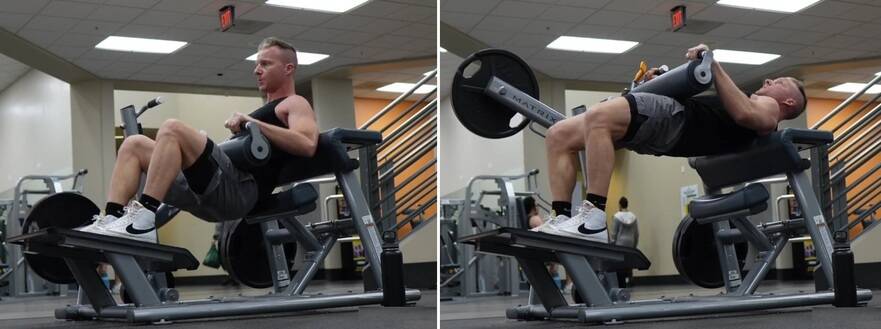
Sit on the machine and place your feet firmly on the foot platform about shoulder-width apart. Your knees should eventually form roughly a 90-degree angle at the top position.
Step 3 — Secure the Hip Pad
Lower the machine’s hip pad or restraint system securely across your hips or midsection. Make sure the pad feels stable and comfortable before starting the exercise.
Step 4 — Set Your Upper-Back Position
Slide your body into position so your upper back is firmly supported against the back pad. Keep your chest stable and your neck in a neutral position throughout the movement.
Step 5 — Brace and Prepare
Brace your core gently, keep your ribs down, and engage the glutes before initiating the lift. If your machine has a safety mechanism, disengage it carefully according to the machine instructions.
Step 6 — Drive Through the Feet
Press through your feet into the platform and thrust your hips upward by contracting the glutes. Focus on controlled hip extension instead of using momentum.
Step 7 — Reach Full Hip Extension
Lift the hips until your body forms a straight line from shoulders to knees. Stop once neutral spinal alignment is reached and avoid excessively arching the lower back.
Step 8 — Squeeze the Glutes at the Top
Pause briefly at lockout and squeeze the glutes strongly. Keep the pelvis stable and maintain full-body tension.
Step 9 — Lower Under Control
Slowly lower the hips back toward the starting position while maintaining muscular tension. Avoid dropping quickly or relaxing completely between repetitions.
Step 10 — Re-Rack the Machine Safely
Once you complete the set, carefully return the machine to its starting position and re-engage the safety mechanism before exiting the machine.
One of the biggest advantages of the machine hip thrust is that it allows you to focus almost entirely on glute-driven hip extension without wasting energy on balancing or awkward setup. This often leads to better glute activation and more consistent progressive overload.
Video Demonstration
Watching a proper demonstration is especially useful for the machine hip thrust because many lifters either rush the movement or overextend the lower back near lockout. Pay attention to the controlled hip drive, stable rib positioning, and strong glute contraction at the top position.
The machine hip thrust is often easier for beginners to learn than the barbell version because the setup is more stable and comfortable. That extra stability allows many lifters to focus more effectively on pure glute contraction and controlled hip extension mechanics.
Muscles Worked in the Machine Hip Thrust
Primary Muscles
The primary muscles responsible for the movement are the gluteus maximus, hamstrings, and adductor magnus, which work together to extend the hips powerfully throughout the exercise.
Secondary Muscles
Several surrounding muscles assist the movement and contribute to lower-body stability during hip extension. These include the gluteus medius, gluteus minimus, quadriceps, erector spinae, and deep core musculature.
Stabilizing Muscles
Stabilizing muscles help maintain pelvic positioning, spinal alignment, and force transfer throughout the movement. These include the abdominal stabilizers, obliques, lower-back stabilizers, and supporting hip musculature.
Antagonist Muscles
The muscles opposing hip extension are primarily the hip flexors. These include the iliopsoas, rectus femoris, tensor fasciae latae, and sartorius.
How the Machine Hip Thrust Works: Biomechanics & Mechanics
The machine hip thrust is a horizontal hip-extension exercise designed to maximize glute involvement through controlled loaded hip extension. Unlike traditional lower-body exercises such as squats or lunges, the machine setup minimizes balance demands and allows the glutes to become the primary force-producing muscles.
Key Joint Action
The primary joint action is hip extension, in which the hips drive upward through powerful gluteal contraction until the body reaches a straight line from shoulders to knees.
Horizontal Hip-Extension Mechanics
The machine hip thrust uses horizontal force production rather than vertical loading. This creates:
- Strong glute contraction
- High hip-extension demand
- Reduced spinal compression
- Greater glute-focused tension
This is one reason hip thrust variations are so effective for glute hypertrophy and explosive athletic performance.
Peak Glute Contraction
One of the biggest advantages of the machine hip thrust is the extremely high glute tension near lockout. The exercise heavily loads the glutes in the shortened position, which can create powerful peak contraction and a significant hypertrophic stimulus.
Stability Advantage
Compared to free-weight hip thrusts, the machine version provides:
- Greater external stability
- Easier body positioning
- Reduced balance demands
- Simpler setup mechanics
This allows many lifters to focus more effectively on glute contraction and controlled hip extension mechanics rather than on stabilization.
Pelvic Stability Importance
Maintaining stable pelvic positioning is essential throughout the movement. Excessive lumbar arching near the top often reduces glute activation and shifts tension toward the lower back.
Continuous Tension Advantage
Because the resistance remains constant throughout the movement, the machine hip thrust maintains continuous muscular tension throughout the set. This is highly beneficial for:
- Glute hypertrophy
- Time under tension
- Peak contraction work
- High-volume lower-body training
Common Mechanical Errors
Common mistakes include excessively arching the lower back, pushing through the toes rather than the heels, bouncing through repetitions, relaxing at the bottom position, and relying on momentum rather than controlled hip extension.
The most important factor is maintaining controlled glute-driven hip extension and stable pelvic mechanics rather than simply moving the weight explosively.
Technique Optimization Tips
The machine hip thrust becomes significantly more effective when movement quality, pelvic stability, and controlled glute contraction remain the priority. Small adjustments in foot placement and execution can noticeably improve glute recruitment and overall exercise effectiveness.
- Drive through the heels during every repetition.
- Keep the ribs down and avoid lumbar overextension.
- Maintain neutral head and neck positioning.
- Pause briefly at peak contraction.
- Squeeze the glutes forcefully at lockout.
- Lower the hips slowly under control.
- Maintain continuous muscular tension throughout the set.
- Use controlled tempo instead of explosive bouncing.
The machine hip thrust usually becomes far more effective when you focus on controlled hip extension, stable pelvic positioning, and strong peak glute contraction instead of simply trying to move the weight explosively.
Poor unilateral stability and weak glute medius function often reduce overall glute recruitment during exercises like this. Explore the most common glute-training problems in Why Your Glutes Aren’t Growing.
Technical Emphasis & Targeting Adjustments
Although the machine hip thrust is mechanically simpler than many free-weight lower-body exercises, small adjustments in foot placement, tempo, and loading style can significantly influence muscular recruitment and the overall emphasis of movement. In practical training situations, these modifications are often useful for maximizing glute activation and improving lower-body force production.
- Position the feet slightly farther away to increase hamstring involvement.
- Position the feet slightly closer to increase the quadriceps contribution.
- Drive through the heels to maximize glute recruitment.
- Use a resistance band around the knees for greater glute medius activation.
- Pause longer at the lockout for a stronger peak glute contraction.
- Slow down the eccentric phase to increase muscular tension.
- Maintain neutral pelvic positioning throughout the movement.
- Use controlled repetitions instead of explosive bouncing.
The main takeaway is that controlled glute-driven hip extension and stable pelvic mechanics usually matter far more than simply using heavier machine resistance.
Machine Hip Thrust Benefits and Drawbacks
The machine hip thrust is one of the most effective exercises for glute hypertrophy, hip-extension strength, and explosive lower-body power while minimizing unnecessary balance demands. However, like any exercise, it also has limitations.
Benefits
- Extremely high glute activation and peak contraction.
- Easier setup than barbell hip thrusts.
- Greater stability and comfort during heavy loading.
- Reduced lower-back stress compared to many compound lifts.
- Excellent for progressive overload and glute hypertrophy.
- Beginner-friendly machine mechanics.
- Strong carryover to sprinting, jumping, and athletic hip extension.
Drawbacks
- Machine availability varies between gyms.
- Less stabilization demand compared to free-weight variations.
- Poor technique may still lead to lumbar overextension.
- Some machines may not fit all body sizes comfortably.
- Advanced lifters may still benefit from combining machine and free-weight hip thrust variations.
The machine hip thrust usually works best when you prioritize controlled glute contraction, stable pelvic positioning, and continuous muscular tension instead of simply trying to move the heaviest possible weight.
Machine Hip Thrust Variations & Replacement Exercises
There are many ways to perform hip thrusts depending on your available equipment, training goals, and experience level. All of the following variations can help improve glute strength, hip-extension power, and lower-body hypertrophy.
Barbell Hip Thrust
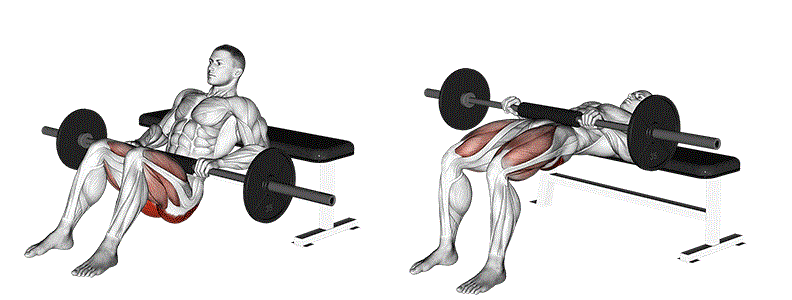
The barbell hip thrust is one of the most popular glute-building exercises in strength training and bodybuilding. It allows significant progressive overload and extremely high glute activation through loaded horizontal hip extension.
Compared to the machine version, the barbell hip thrust usually requires:
- More setup time
- Greater stabilization demands
- Better coordination and positioning
Smith Machine Hip Thrust
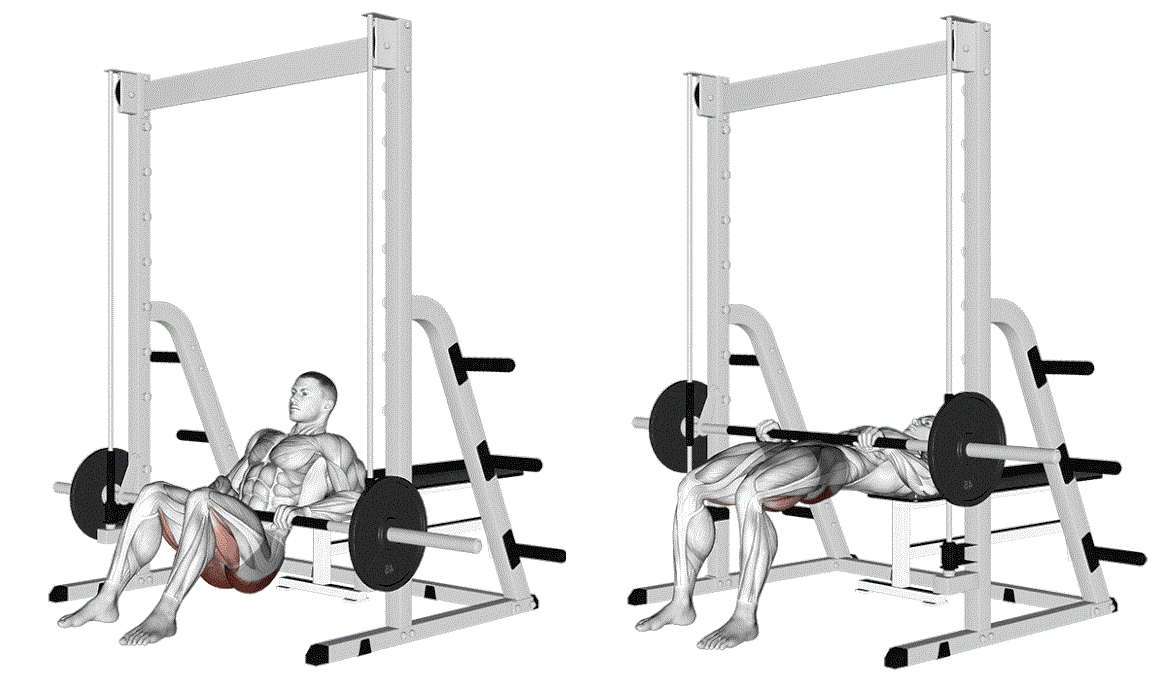
The Smith machine hip thrust uses a fixed bar path, which increases stability and often makes setup easier than the traditional barbell version.
This variation is commonly used for:
- Glute hypertrophy training
- Beginner-to-intermediate lifters
- Controlled tempo work
- High-volume glute sessions
Single-Leg Hip Thrust (Using Body Weight)
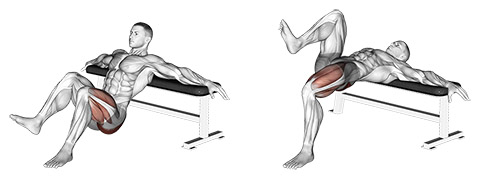
This unilateral variation dramatically increases the demands on stabilization and pelvic control by working one side at a time.
Although bodyweight-only, many people are surprised by how challenging this variation feels due to:
- Increased unilateral loading
- Greater glute activation
- Stronger core involvement
- Increased balance requirements
2 Up, 1 Down Hip Thrusts
This variation is useful for lifters who find full single-leg hip thrusts too difficult. Both legs assist during the lifting phase, while only one leg controls the lowering phase.
This creates:
- Greater eccentric overload
- Improved unilateral strength development
- Better glute control and stability
Dumbbell Hip Thrust
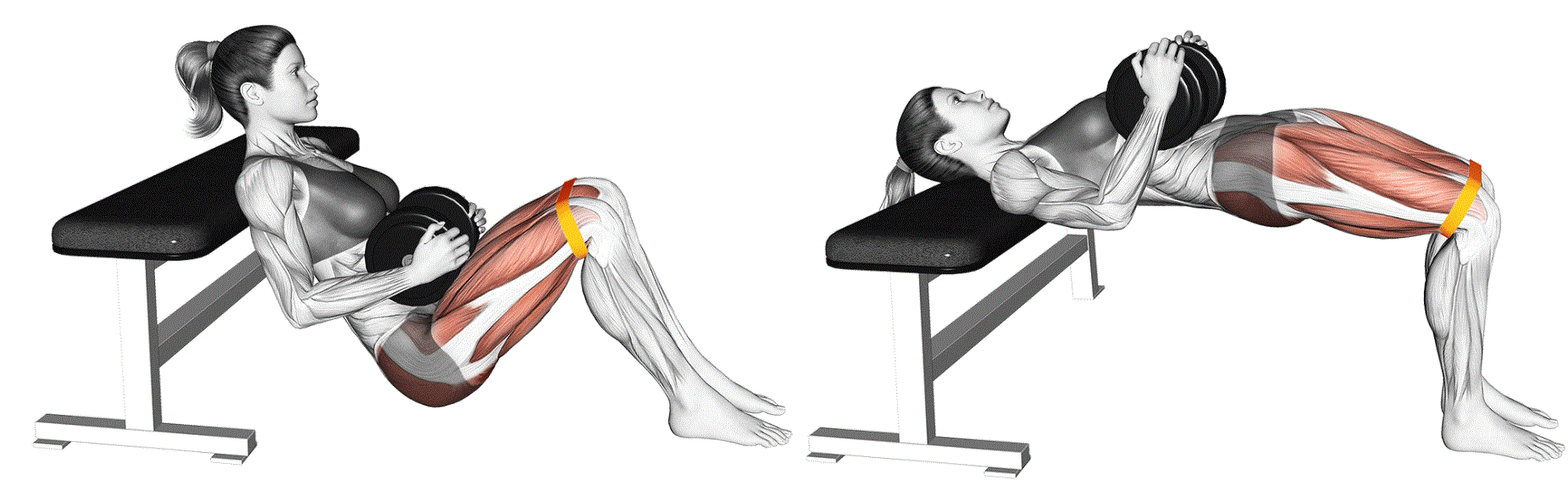
The dumbbell hip thrust is a simple alternative for home workouts or gyms without heavy barbells. A dumbbell is placed across the hips to create additional resistance.
This variation works especially well for:
- Beginners
- Home training
- Moderate hypertrophy work
- Learning hip-thrust mechanics
Resistance Band Hip Thrust (Banded Thrusts)
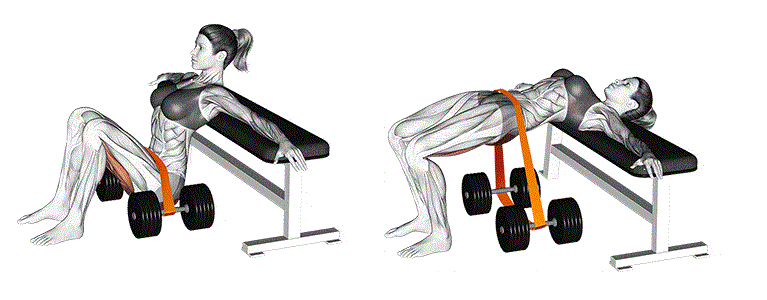
This variation uses resistance bands to create accommodating resistance throughout the movement. Band tension increases near lockout, where glute contraction is strongest.
Resistance-band hip thrusts are especially useful for:
- Home workouts
- Glute activation circuits
- High-repetition glute training
- Lower-load hypertrophy work
Combine Band Resistance with the Barbell

This advanced variation combines barbell loading with additional resistance-band tension.
The combination creates:
- Extremely high peak glute tension
- Greater lockout resistance
- Increased glute medius involvement
- Advanced hypertrophy stimulus
This variation is commonly used in:
- Powerlifting accessory training
- Athletic performance programs
- Advanced glute-focused hypertrophy routines
Replacement Exercises for the Machine Hip Thrust
If the machine hip thrust is unavailable or you want additional variety in your glute and hip-extension training, several other exercises can effectively target the glutes, hamstrings, and surrounding hip stabilizers using similar movement mechanics.
- Barbell Hip Thrust
- Glute Bridge Exercise
- Cable Pull-Through Exercise
- Butt Blaster (Donkey Kick Machine)
- Reverse Hyperextension
- Romanian Deadlift
- Smith Machine Hip Thrust
- Walking Lunge
- Reverse Lunge
- High Box Step-Ups with Knee Raise
- Mini Band Lateral Walk
- Standing Hip Extension
- Cable Hip Abduction
- Cable Hip Adduction
- Clamshell Exercise
For a complete overview of all recommended movements and variations, explore our full glute & hip exercise database, where you can find the best exercises for glute hypertrophy, hip-extension strength, athletic power, and lower-body stability.
Who Should Use This Exercise?
The machine hip thrust can be useful for a wide range of trainees because it combines high glute activation, strong loading potential, and relatively stable movement mechanics. In practical training situations, it works especially well for building glute strength and improving explosive hip-extension power.
- Lifters focused on glute hypertrophy
- Athletes improving their sprinting and jumping power
- Bodybuilders adding glute-focused accessory volume
- Beginners learning hip-thrust mechanics
- People wanting a more stable alternative to barbell hip thrusts
- Individuals seeking lower-back-friendly glute training
- Women focused on glute development and shaping
Who Should Avoid or Modify It?
Although the machine hip thrust is generally beginner-friendly, some individuals may still need to modify the movement due to mobility limitations, pelvic control, or lower back sensitivity.
- People excessively arching their lower back during the lockout
- Individuals unable to maintain stable pelvic positioning
- Lifters using momentum instead of controlled hip extension
- People experiencing hip discomfort during loaded hip extension
- Anyone pushing through the toes instead of the heels
- Trainees selecting resistance that compromises movement quality
Where This Exercise Fits in a Workout
The machine hip thrust is best used as a primary glute-strengthening or glute-hypertrophy exercise within lower-body, athletic-performance, or bodybuilding-oriented training programs. In most practical situations, it works especially well early in the workout when the glutes are fresh and capable of producing maximal force.
- Early in glute-focused lower-body workouts
- As a primary glute hypertrophy movement
- During athletic power-development sessions
- As a lower-back-friendly hip-extension exercise
- Within bodybuilding accessory training
- During sprint and jump performance programs
The main takeaway is that the machine hip thrust is best used as a controlled, glute-dominant hip-extension exercise designed to improve glute hypertrophy, explosive hip power, and lower-body force production.
Sets and Reps Recommendations
The machine hip thrust generally responds best to controlled repetitions with strong peak contraction and stable pelvic mechanics. In my experience as a coach, the best results usually come from maximizing glute tension and movement quality rather than simply using excessive machine resistance.
- Sets: 3–5 per workout
- Reps: 6–15 reps
- Tempo: Controlled eccentric phase with a brief pause at lockout
- Rest time: 60–120 seconds between sets
Additional Programming Tips
- Drive through the heels during every repetition
- Keep the ribs down at lockout
- Squeeze the glutes forcefully at the top position
- Maintain continuous tension throughout the set
- Avoid excessively arching the lower back
- Pair the exercise with squats, lunges, or Romanian deadlifts for balanced lower-body development
What usually produces the best results is controlled glute-driven hip extension and stable pelvic positioning rather than aggressively bouncing the weight upward.
Machine Hip Thrust vs. Barbell Hip Thrust
The machine hip thrust and barbell hip thrust are both excellent exercises for glute hypertrophy and hip extension strength, but they differ in their stability demands, setup complexity, and overall training feel.
| Training Factor | Machine Hip Thrust | Barbell Hip Thrust |
|---|---|---|
| Stability Demand | Moderate | Higher |
| Setup Complexity | Simple | Moderate–High |
| Comfort | High | Moderate |
| Progressive Overload | Excellent | Excellent |
| Glute Activation | Extremely high | Extremely high |
| Beginner Accessibility | Excellent | Good |
| Balance Requirement | Lower | Higher |
| Best Use | Controlled glute training | Maximal free-weight loading |
Conclusion: Both exercises are extremely effective for glute development, but the machine hip thrust usually provides greater comfort and an easier setup, while the barbell version offers slightly greater stabilization and demands greater free-weight control.
For many lifters, combining both variations can produce excellent long-term glute hypertrophy and hip-extension strength development.
Closing Thoughts
The machine hip thrust is one of the most effective exercises for building stronger, more powerful glutes through controlled loaded hip extension. Its stable setup, strong glute emphasis, and lower-back-friendly mechanics make it valuable for beginners, athletes, and advanced lifters alike.
In my experience, the biggest improvements usually come from controlled hip extension mechanics, stable pelvic positioning, strong peak gluteal contraction, and sustained muscular tension, rather than simply trying to move the heaviest possible weight.
This exercise can be especially useful for lifters who struggle with the awkward setup or discomfort of traditional barbell hip thrusts, while still seeking serious glute hypertrophy and hip-extension strength gains.
Ultimately, the goal is simple: use the machine hip thrust to improve glute strength, glute hypertrophy, athletic hip-extension power, and lower-body performance through controlled, high-quality repetitions over the long term.
Frequently Asked Questions
Is the machine hip thrust better than the barbell hip thrust?
In my coaching experience, the machine hip thrust is often better for beginners and high-volume glute training because the setup is easier and more stable. The barbell hip thrust is still excellent, but it usually requires more setup skill and comfort with free weights.
Why do I feel machine hip thrusts in my lower back?
When clients feel this exercise in the lower back, I usually check for excessive arching at the top. Keep your ribs down, brace your core, and finish the rep by squeezing the glutes instead of leaning backward.
Should I go heavy on the machine hip thrust?
I like heavy hip thrusts, but only when form stays clean. If the weight forces you to bounce, lose pelvic control, or shorten the range of motion, it is too heavy for productive glute training.
Where should my feet be on the hip thrust machine?
As a general rule, I start most lifters with feet about shoulder-width apart and shins close to vertical at lockout. From there, I adjust foot position based on whether they feel the movement more in the glutes, hamstrings, or quads.
Is the machine hip thrust good for women’s glute training?
Yes. I consider it one of the best machine exercises for women who want stronger, rounder glutes because it allows focused glute loading without the awkward setup of a heavy barbell.
How often should I train machine hip thrusts?
For most lifters, one to three times per week works well depending on total glute volume, recovery, and training experience. I would not train it hard every day because the glutes still need recovery to grow.
Should I pause at the top of each machine hip thrust?
Yes. I strongly prefer a short pause at lockout because it improves glute contraction, reduces momentum, and helps prevent the lower back from taking over.
Can machine hip thrusts replace squats?
No. In my view, machine hip thrusts are excellent for glutes, but they should not fully replace squats or other compound leg exercises. Squats train more total lower-body musculature, while hip thrusts specialize in glute-focused hip extension.
