
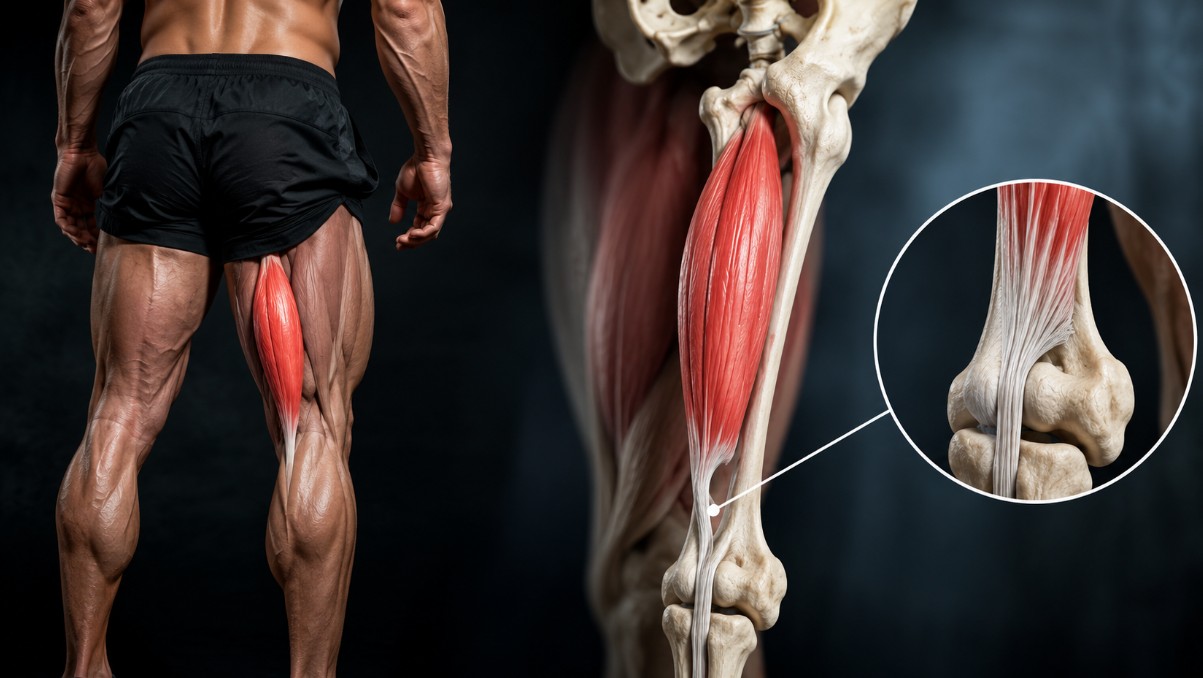
The semitendinosus is named for what it literally is — a muscle that’s roughly half tendon by length — and that unusually long, cord-like tendon happens to be one of the most surgically useful pieces of tissue in the human leg. It’s also one of the few tendons in the body known to regrow after being surgically removed.
Key Facts
The semitendinosus is one of the three hamstring muscles, running along the inner-posterior thigh and named for its unusually long tendon of insertion. It extends the hip, flexes the knee, and — unlike the biceps femoris — internally rotates the tibia when the knee is bent. Its tendon is one of the most commonly harvested grafts for ACL reconstruction surgery.
| Muscle type | One of three hamstring muscles |
|---|---|
| Primary functions | Hip extension, knee flexion, internal rotation of the tibia (when the knee is flexed) |
| Unique feature | Roughly half tendon by length; commonly harvested for ACL reconstruction and capable of regenerating afterward |
| Innervation | Tibial division of the sciatic nerve (L5, S1, S2) |
| Blood supply | Perforating branches of the profunda femoris artery, inferior gluteal artery, and superior muscular branches of the popliteal artery |
| Common exercises | Nordic curl, Romanian deadlift, seated leg curl |
| Main bodybuilding role | Inner hamstring shape, hip-hinge strength, and knee stability |
Semitendinosus Anatomy & Location
The semitendinosus is one of three muscles that make up the hamstring group, alongside:
- Biceps femoris — the most lateral hamstring, with two heads and a unique external-rotation role
- Semimembranosus — the broadest of the three hamstrings at its origin, lying partly beneath the semitendinosus
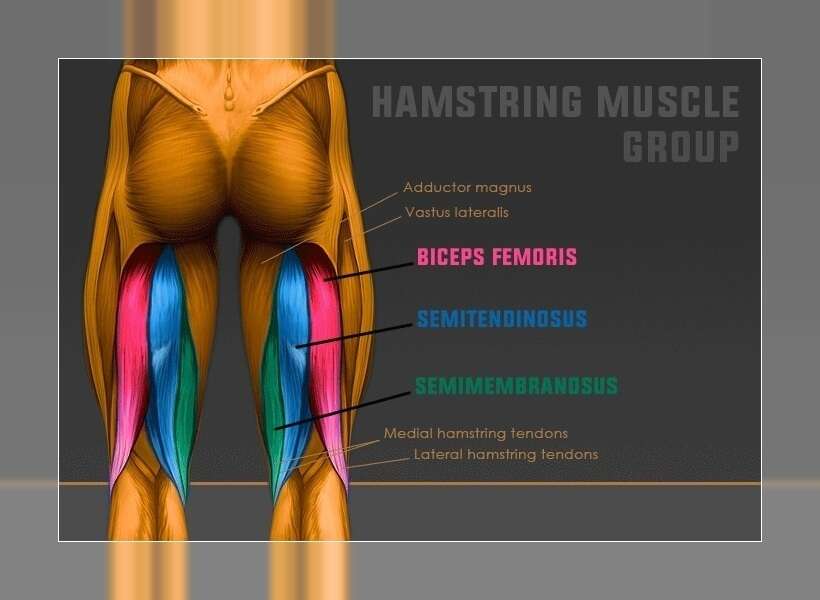
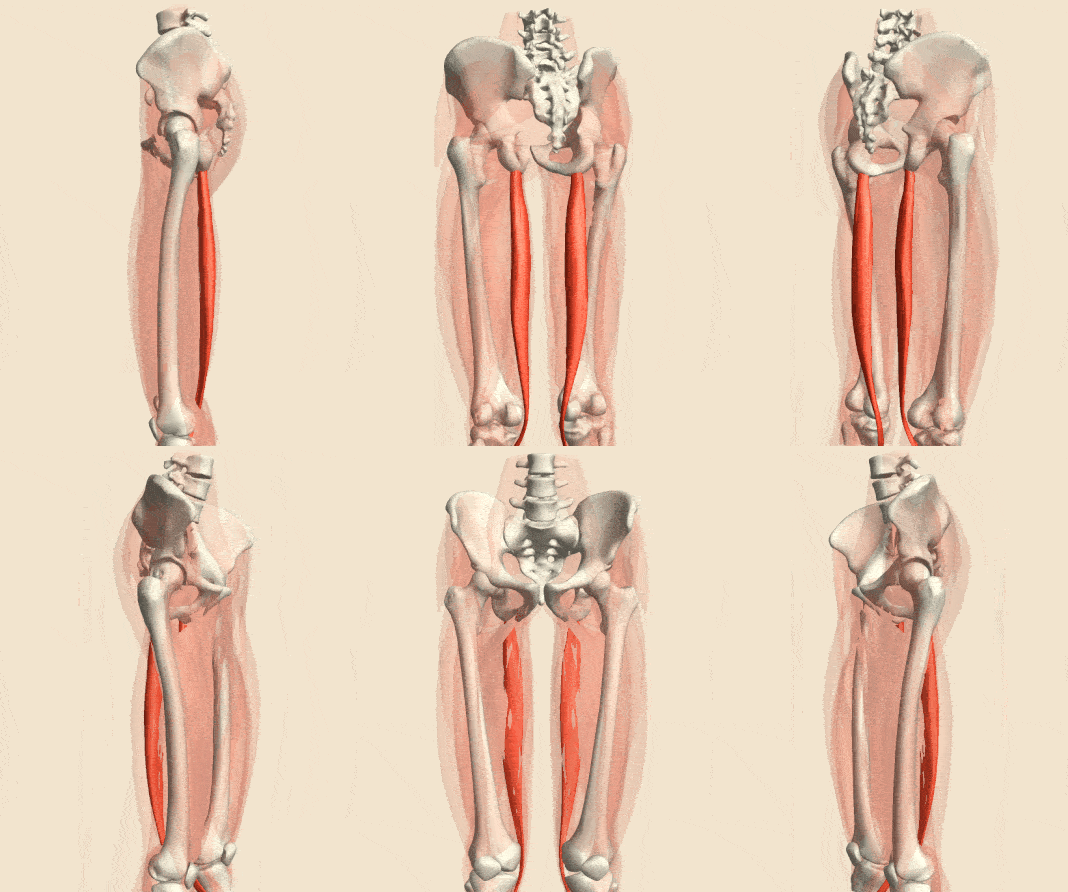
The semitendinosus lies superficial to the semimembranosus on the inner-posterior thigh, just medial to the biceps femoris. According to StatPearls’ anatomical reference on the semitendinosus, roughly around the middle of the thigh, its muscle belly gives way to a long, cord-like tendon that forms the medial border of the popliteal fossa — the diamond-shaped space behind the knee — before curving around the inner knee toward its insertion. To see exactly how it fits within the posterior thigh musculature, our interactive muscle anatomy tool lets you explore it alongside the other two hamstrings. If terms like origin, insertion, and innervation aren’t yet fully familiar, our muscle anatomy basics guide covers what they mean and why they matter for training.
Origin, Insertion, Innervation & Blood Supply
| Origin | Medial border of the ischial tuberosity of the pelvis, sharing a common tendon with the long head of the biceps femoris, plus the medial border of that biceps femoris tendon and the proximal aponeurosis |
|---|---|
| Insertion | Superior anteromedial surface of the tibia, as the most posterior of the three tendons forming the pes anserinus (alongside the sartorius and gracilis) |
| Innervation | Tibial division of the sciatic nerve (L5, S1, S2) |
| Blood supply | Perforating branches of the profunda femoris artery, inferior gluteal artery, and superior muscular branches of the popliteal artery |
Semitendinosus Structure & the Pes Anserinus
The name “semitendinosus” translates roughly to “half tendon,” and that’s an accurate description of its architecture: the muscle belly makes up only part of its total length, with the rest being a long, cord-like tendon of insertion — noticeably longer than what you see in the biceps femoris or semimembranosus.
That tendon terminates at a structure called the pes anserinus (“goose’s foot” in Latin), where it converges with the tendons of the sartorius and gracilis onto the upper medial tibia. What makes the pes anserinus genuinely interesting anatomically is that its three contributing muscles come from three different developmental compartments of the thigh — the sartorius from the anterior compartment, the gracilis from the medial compartment, and the semitendinosus from the posterior (hamstring) compartment — yet all three converge on the same small patch of bone. A fluid-filled sac called the pes anserine bursa sits beneath this conjoined tendon to reduce friction during knee movement.
Perhaps the most surprising anatomical fact about this muscle is what happens after its tendon is surgically removed. Because the semitendinosus tendon is one of the most common grafts used in ACL reconstruction, its post-harvest behavior has been studied extensively — and recent ultrasound research found genuine tendon regeneration at the harvest site in the large majority of patients within about a year, a regenerative capacity that most tendons in the body don’t share.
Functions of the Semitendinosus
As a biarticular hamstring, the semitendinosus extends the hip and flexes the knee, working alongside the other two hamstrings in both roles. Its more distinctive contribution is rotational: when the knee is flexed, the semitendinosus (together with the semimembranosus) internally rotates the tibia — the direct opposite of the external rotation produced by the biceps femoris. This is the same medial-versus-lateral rotational balance that helps stabilize the knee through twisting movements.
Semitendinosus Synergists & Antagonists
Synergists (muscles that work alongside the semitendinosus to help produce the same movement):
For knee flexion: biceps femoris, semimembranosus, and the gastrocnemius (secondary role). For hip extension: gluteus maximus. Finally, for internal tibial rotation specifically: semimembranosus, sartorius, and gracilis — its fellow pes anserinus tendons.
Antagonists (muscles that oppose the semitendinosus’s action, working in the opposite direction):
The quadriceps femoris directly opposes knee flexion by performing knee extension. At the knee’s rotational axis, the biceps femoris acts as a functional antagonist, producing external rather than internal rotation.
Common Semitendinosus Exercises
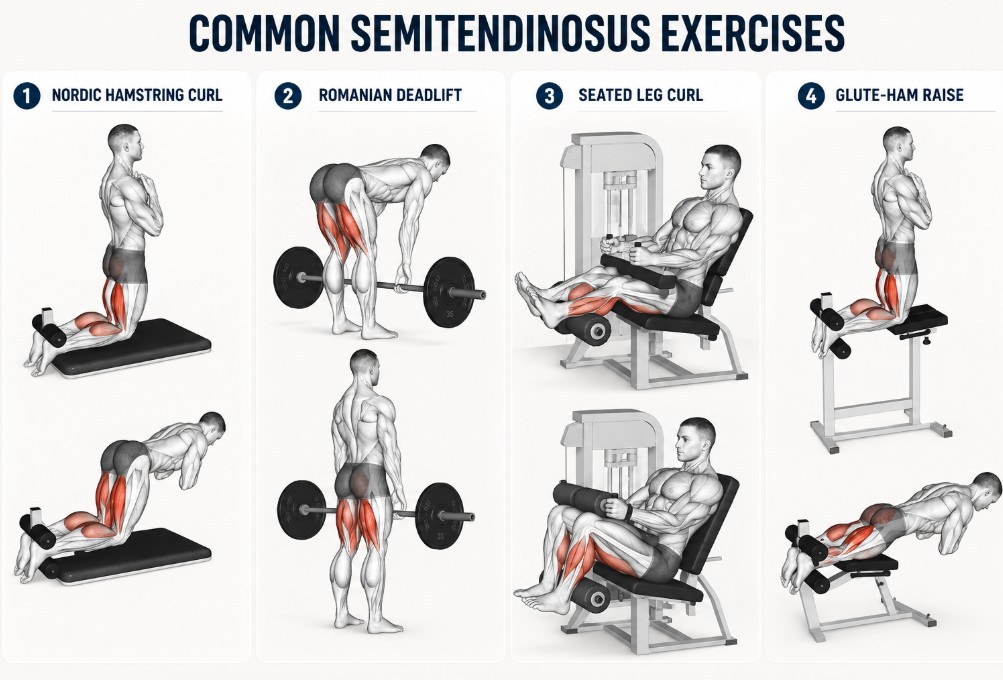
| Exercise | Role of the Semitendinosus |
|---|---|
| Nordic hamstring curl | Prime mover — research comparing hamstring exercises has found Nordic curls tend to bias the semitendinosus more than the biceps femoris |
| Romanian deadlift | Prime mover, hip-dominant bias |
| Seated leg curl | Prime mover, knee-dominant bias |
| Glute-ham raise | Major contributor, combining hip and knee-dominant demand |
For a complete breakdown of hamstring training options, see our full guide: Best Hamstring Exercises.
Stretching & Mobility
For hamstring stretching progressions that address the semitendinosus alongside the rest of the group, see our guide: Top 10 Hamstring Stretching Exercises. For general tightness, foam rolling can also help — see our guide: Foam Roller Hamstring Roll. If you experience cramping specifically during leg curls, see our dedicated guide: Why Hamstrings Cramp During Leg Curls.
Bodybuilder’s Take
“I’ve heard Nordic curls are better for the semitendinosus specifically — is that true?” Yes, and it’s one of the more consistent findings in hamstring EMG research: Nordic curls tend to preferentially bias the semitendinosus, while exercises like the lying leg curl tend to bias the biceps femoris more. If you only ever do one type of hamstring exercise, you’re likely under-training one of the two.
“I had ACL surgery using my semitendinosus tendon — will my hamstring ever be normal again?” In most cases, the tendon partially or fully regenerates within about a year, which is a genuinely unusual biological property. Strength typically returns reasonably well, though studies do show some persistent differences in muscle size and mechanical properties compared to the non-harvested side, so full rehab and patience matter.
“Why do I feel inner-knee pain that seems related to my hamstrings after a lot of running?” This could be related to the pes anserine bursa, a small fluid-filled sac beneath the conjoined tendons of the semitendinosus, gracilis, and sartorius at the inner knee, which can become irritated with repetitive knee flexion — worth having evaluated if the pain persists.
Common Semitendinosus Conditions
This section is educational and should not replace professional medical advice.
Pes anserine bursitis — inflammation of the bursa beneath the conjoined semitendinosus, gracilis, and sartorius tendons at the inner knee, causing pain typically worsened by stair climbing or rising from sitting. Osteoarthritis, obesity, and being female are documented risk factors.
Post-harvest tendon changes — after ACL reconstruction using a semitendinosus graft, the tendon commonly regenerates, though the regenerated tissue and adjacent muscle may show some persistent differences from the original.
Persistent inner-knee pain, swelling, or hamstring weakness that doesn’t improve with rest should be evaluated by a healthcare professional rather than trained through.
Common Semitendinosus Myths
Myth: Harvesting the semitendinosus tendon for ACL surgery permanently removes that tissue. In most patients, the tendon shows genuine regeneration at the harvest site within roughly a year — a regenerative capacity uncommon among tendons.
Myth: Any hamstring exercise trains the semitendinosus and biceps femoris identically. Research shows meaningful exercise-specific differences — Nordic curls tend to bias the semitendinosus, while exercises like lying leg curls tend to bias the biceps femoris, so a complete program benefits from including both movement patterns.
Complete your anatomy knowledge with the muscles of the chest, shoulders, back, arms, core, and neck.
Explore Upper Body MusclesFrequently Asked Questions
Why is it called the semitendinosus?
The name means roughly “half tendon,” describing how a large portion of the muscle’s length is made up of its unusually long, cord-like tendon of insertion rather than muscle belly.
Does the semitendinosus regrow after ACL surgery?
In most patients studied, yes — the tendon shows genuine regeneration at the harvest site within about a year, though the regenerated tissue can show some structural differences from the original.
What is the pes anserinus?
The conjoined tendon insertion of the sartorius, gracilis, and semitendinosus muscles onto the upper medial tibia, named for its resemblance to a goose’s foot.
Which exercise best targets the semitendinosus?
Research suggests Nordic curls tend to bias the semitendinosus more than the biceps femoris, while lying leg curls tend to bias the biceps femoris more, so combining both is more complete than relying on one.
Does the semitendinosus rotate the knee?
Yes — together with the semimembranosus, it internally rotates the tibia when the knee is flexed, the opposite of the external rotation produced by the biceps femoris.
Sources & References
Every claim in this guide is grounded in anatomical references and published research.
- StatPearls / NCBI Bookshelf — Anatomy, Bony Pelvis and Lower Limb, Thigh Semitendinosus Muscle
- StatPearls / NCBI Bookshelf — Pes Anserine Bursitis
- Differences in Activation Amplitude Between Semitendinosus and Biceps Femoris During Hamstring Exercises: A Systematic Review and Meta-Analysis
- Ultrasound Evaluation of the Regenerating Tendon of the Semitendinosus After Harvest for Anterior Cruciate Ligament Reconstruction
