



The vastus lateralis is the muscle you’re actually looking at when you admire a well-developed outer quad sweep — it’s the largest of the four quadriceps muscles, and unlike its biarticular neighbor, the rectus femoris, it responds reliably to almost every kind of knee-extension training you throw at it. It’s also, somewhat surprisingly, the single most-biopsied muscle in exercise science.

Key Facts
The vastus lateralis is the largest and most powerful of the four quadriceps muscles, forming the outer (“lateral”) bulge of the thigh. It originates broadly along the proximal femur and inserts via the quadriceps tendon onto the patella and, through the patellar ligament, the tibial tuberosity. Unlike the rectus femoris, it crosses only the knee joint, making it a reliable responder to almost any knee-extension exercise.
| Muscle type | Largest of the four quadriceps femoris muscles |
|---|---|
| Primary function | Knee extension |
| Secondary function | Lateral patellar stabilization |
| Innervation | Femoral nerve (L2–L4, predominantly L3) |
| Blood supply | Lateral circumflex femoral artery, with contributions from perforating branches of the profunda femoris |
| Common exercises | Leg extension, front squat, hack squat, leg press |
| Main bodybuilding role | Outer quad sweep / thigh width and definition |
Vastus Lateralis Anatomy & Location
The vastus lateralis is one of four muscles that make up the quadriceps femoris group, alongside:
- Rectus femoris — the only quad head that crosses the hip as well as the knee
- Vastus medialis — the innermost head, known for its teardrop shape and role in patellar tracking
- Vastus intermedius — the deepest head, hidden entirely beneath the rectus femoris
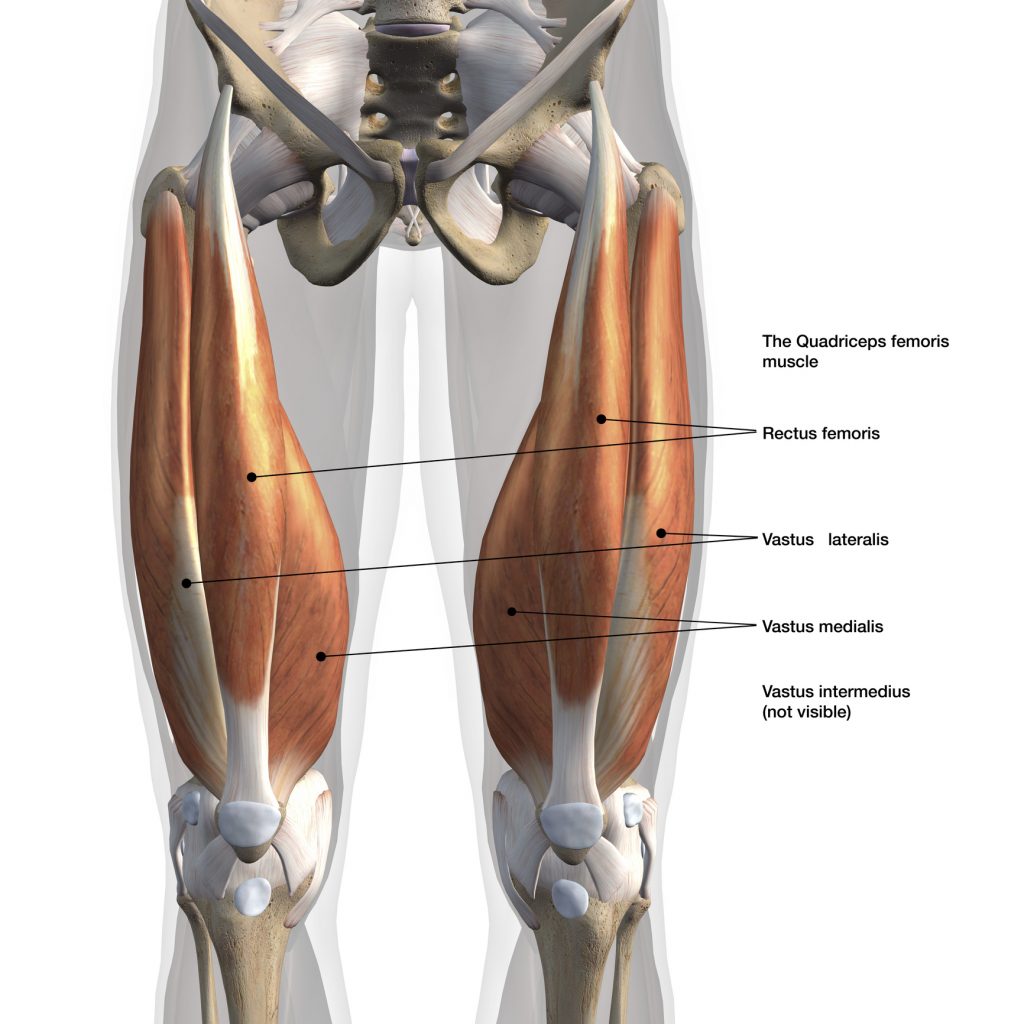
The vastus lateralis sits along the outer thigh, positioned laterally about the femur, and is broader and bulkier than any of the other three heads — it’s simply the largest single component of the quadriceps by cross-sectional area. It runs from the hip region down to just above the knee, superficial enough to be easily visible and palpable as the “outer sweep” when the quad is flexed. To see exactly where it sits relative to the rest of your leg musculature, our interactive muscle anatomy tool lets you explore it alongside the other three heads.
The iliotibial (IT) band runs along the same outer thigh line and is often confused with the vastus lateralis, but the two are anatomically distinct — the IT band is a fibrous tract, not a muscle, running superficial to the vastus lateralis rather than being part of it.

Origin, Insertion, Innervation & Blood Supply
| Origin | Intertrochanteric line, greater trochanter, gluteal tuberosity, lateral lip of the linea aspera, and lateral intermuscular septum of the femur |
|---|---|
| Insertion | Lateral side of the quadriceps tendon, joining the other quad heads to envelop the patella, then continuing via the patellar ligament to the tibial tuberosity |
| Innervation | Femoral nerve (L2–L4), with L3 as the predominant nerve root |
| Blood supply | Lateral circumflex femoral artery, with contributions from perforating branches of the profunda femoris artery |
Not sure what origin, insertion, or innervation actually mean? Our muscle anatomy basics guide explains these foundational concepts in detail.
Vastus Lateralis Structure & Muscle Architecture
The vastus lateralis is a unipennate muscle, meaning its fibers run at an angle to a single central tendon rather than the mixed bipennate/longitudinal arrangement seen in the rectus femoris. This pennation angle allows more muscle fibers to pack into a given cross-sectional area, which is part of why the vastus lateralis can generate such large forces despite not being dramatically longer than the other quad heads.
In roughly 60% of people, the vastus lateralis actually has two separate insertional heads — a long head and an obliquus head — divided by a thin layer of fat or fascia, with the angle of fiber insertion onto the patella varying between the two. This subdivision doesn’t functionally split the muscle in any meaningful training sense, but it explains why some anatomical descriptions treat the vastus lateralis as having an internal structure nearly as complex as that of the vastus medialis, despite far less attention being paid to it in fitness content.
One detail worth knowing purely as an interesting aside: the vastus lateralis is the standard site for skeletal muscle biopsies in exercise physiology research — most of the fiber-type and hypertrophy studies referenced across our anatomy guides (including the quadriceps research cited elsewhere on this site) draw their muscle tissue samples specifically from this muscle, using the Bergström needle technique. It’s also the preferred site for intramuscular injections, especially in infants and children, due to its accessible size and location.
Functions of the Vastus Lateralis
The vastus lateralis has a simpler job description than the rectus femoris: it only crosses the knee joint, so its sole primary action is knee extension, working alongside the other three quad heads. Because it doesn’t have a hip-flexion role competing for its neural drive, it doesn’t suffer from the same “torque-sharing” limitation that blunts rectus femoris involvement in compound lifts — the vastus lateralis responds well to squats, leg presses, and lunges just as reliably as it does to single-joint leg extensions.
Its secondary role is lateral patellar stabilization, working as a counterbalance to the vastus medialis on the inner thigh. The two muscles pull the patella in opposite directions during knee extension, and a strength imbalance between them (typically a relatively weak vastus medialis) is one of the factors clinicians consider in patellar tracking issues.
Vastus Lateralis Synergists & Antagonists
Synergists (muscles that work alongside the vastus lateralis to help produce the same movement):
Rectus femoris, vastus medialis, and vastus intermedius — all three assist knee extension as fellow members of the quadriceps group.
Antagonists (muscles that oppose the vastus lateralis’s action, working in the opposite direction):
The hamstrings oppose knee extension by flexing the knee.
Common Vastus Lateralis Exercises

| Exercise | Role of the Vastus Lateralis |
|---|---|
| Front squat | Prime mover — EMG research has found front squats produce among the highest vastus lateralis activation of common squat variations |
| Hack squat | Prime mover — the fixed bar path and deep knee-flexion range load the vastus lateralis heavily through a long range of motion |
| Leg press | Prime mover, alongside the other quad heads |
| Leg extension | Prime mover — trains the vastus lateralis reliably, same as it does the other three quad heads |
| Bulgarian split squat | Prime mover, under unilateral loading |
For a complete breakdown of quad training options, see our full guide: Best Quadriceps Exercises.
Bodybuilder’s Take
“Does a wider squat stance target my outer quad sweep better?” This is one of the most persistent gym myths, and controlled EMG studies consistently find little to no meaningful difference in vastus lateralis activation between narrow, shoulder-width, and wide squat stances. Stance width changes hip and adductor involvement far more than it changes which quad head gets emphasized.
“Why does the vastus lateralis respond to basically every quad exercise, while I’ve heard rectus femoris is picky about squats?” Because the vastus lateralis only crosses the knee, it doesn’t face the torque-sharing conflict that limits the rectus femoris in compound hip-and-knee movements. Whatever exercise extends your knee under load will train it, which is part of why it’s usually one of the first quad muscles to grow noticeably in beginners.
“I read that most quad research uses this exact muscle for biopsies — does that mean anything for how I should train it?” Not directly for programming, but it does mean a lot of what we know about muscle fiber adaptation, hypertrophy signaling, and fatigue in general comes from vastus lateralis tissue specifically — so in a sense, this muscle has quietly shaped much of modern exercise science.
Common Vastus Lateralis Conditions
This section is educational and should not replace professional medical advice.
Quadriceps contusion (“charley horse”) — because the vastus lateralis sits superficially along the outer thigh, it’s commonly affected by direct blows in contact sports, producing bruising, swelling, and temporary loss of knee-extension strength.
Lateral patellar tracking issues — an imbalance between a relatively strong vastus lateralis and a relatively weak vastus medialis is one of several factors associated with the patella tracking laterally rather than smoothly within its groove.
Persistent lateral knee or thigh pain, or a thigh injury that doesn’t improve with basic rest and ice, should be evaluated by a healthcare professional rather than trained through.
Common Vastus Lateralis Myths
Myth: A wider squat stance builds the outer quad sweep better. EMG research doesn’t support this — stance width has little measurable effect on vastus lateralis activation, though it does change hip and adductor demand.
Myth: The IT band and the vastus lateralis are the same structure. They run along the same general line on the outer thigh, but the IT band is a fibrous connective tissue tract, while the vastus lateralis is a separate, deeper muscle.
Complete your anatomy knowledge with the muscles of the chest, shoulders, back, arms, core, and neck.
Explore Upper Body MusclesKey Takeaways
- The vastus lateralis is the largest of the four quadriceps muscles, forming the outer thigh sweep.
- Unlike the rectus femoris, it crosses only the knee joint, so it responds reliably to both compound and isolation exercises.
- Squat stance width has little proven effect on how much it’s activated — that’s a persistent gym myth.
- It’s the standard site for muscle biopsies in exercise science and a common site for intramuscular injections.
- It’s frequently affected by direct-blow thigh contusions in contact sports due to its superficial position.
Frequently Asked Questions
What is the main function of the vastus lateralis?
Knee extension, working alongside the other three quadriceps muscles, with a secondary role stabilizing the patella laterally.
Does a wider squat stance target the vastus lateralis more?
No. EMG studies consistently find little to no meaningful difference in vastus lateralis activation across narrow, standard, and wide squat stances.
Is the vastus lateralis the same as the IT band?
No. They run along the same outer thigh line, but the IT band is a fibrous connective tissue structure, not a muscle, and sits superficial to the vastus lateralis.
Why is the vastus lateralis used for muscle biopsies?
It’s large, accessible, and superficial, making it a practical, relatively low-risk site for the needle biopsy techniques used in exercise physiology research.
Do squats train the vastus lateralis well?
Yes. Unlike the rectus femoris, the vastus lateralis only crosses the knee joint, so it responds reliably to squats, leg presses, and other compound movements as well as to isolation exercises.
Sources & References
Every claim in this guide is grounded in anatomical references and published research.
- StatPearls / NCBI Bookshelf — Anatomy, Bony Pelvis and Lower Limb, Vastus Lateralis Muscle
- StatPearls / NCBI Bookshelf — Anatomy, Bony Pelvis and Lower Limb: Thigh Quadriceps Muscle
- Anderson et al. — EMG Analysis of the Vastus Medialis/Vastus Lateralis Muscles Utilizing the Unloaded Narrow- and Wide-Stance Squats
