


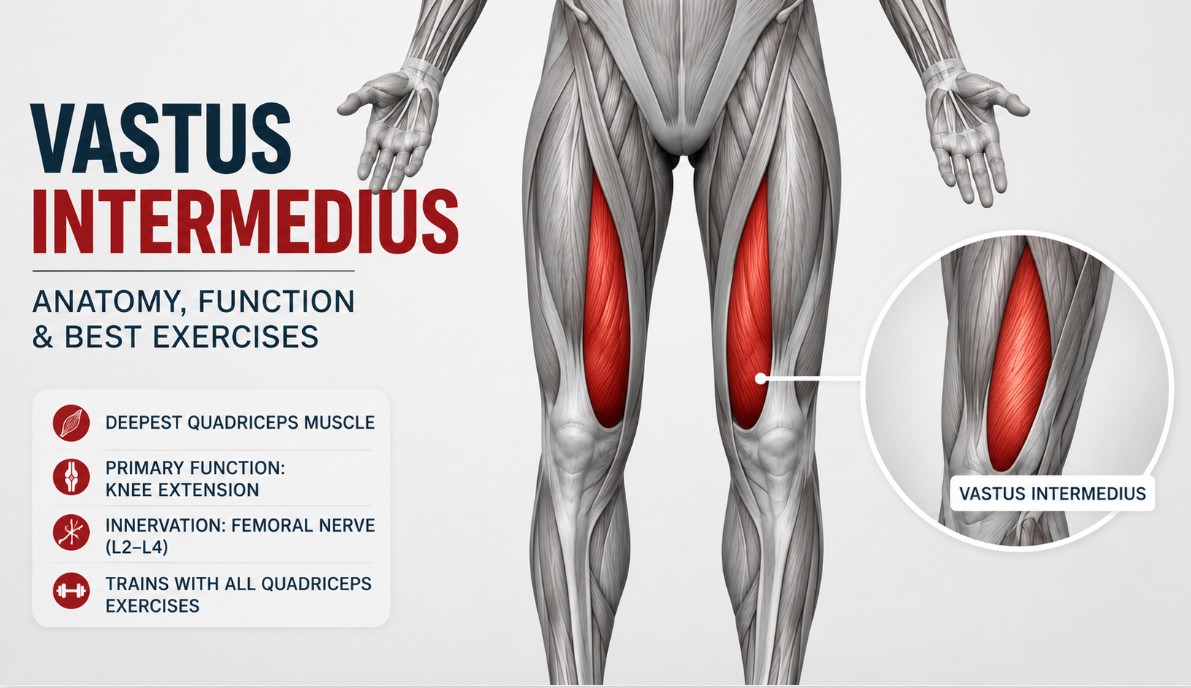
You will never see, feel, palpate, or selectively train the vastus intermedius — it’s buried directly beneath the rectus femoris and shares the same tendon as the other three quad heads, so no exercise on earth isolates it. But recent anatomical research has found that the region around it is more complex than any textbook diagram shows, including a small “hidden” muscle discovered only in 2016.

Key Facts
The vastus intermedius is the deepest of the four quadriceps muscles, sitting directly beneath the rectus femoris in the center of the thigh. It shares the same tendon and knee-extension role as the other three quad heads, but because it’s buried under the rectus femoris with no independent tendon or surface landmark, it can’t be visually assessed, palpated, or trained in isolation from the rest of the quadriceps.
| Muscle type | One of four quadriceps femoris muscles; the deepest of the four |
|---|---|
| Primary function | Knee extension |
| Unique feature | Cannot be visually assessed, palpated, or trained in isolation — always works with the other three quad heads |
| Innervation | Femoral nerve (L2–L4) |
| Blood supply | Femoral artery, via muscular branches |
| Common exercises | Leg extension, squats, leg press — any knee-extension exercise trains it |
| Main bodybuilding role | Overall quad thickness and knee-extension strength, though not visually distinguishable |
Vastus Intermedius Anatomy & Location
The vastus intermedius is one of four muscles that make up the quadriceps femoris group, alongside:
- Rectus femoris — the only quad head that crosses the hip as well as the knee, sitting directly over the vastus intermedius
- Vastus lateralis — the largest and strongest of the four heads, forming the outer sweep
- Vastus medialis — the innermost head, known for its teardrop shape and role in patellar tracking
The vastus intermedius sits centrally in the anterior thigh, directly beneath the rectus femoris and flanked by the vastus lateralis and vastus medialis on either side. Because it’s completely covered by the rectus femoris, it has no surface presence at all — you can’t see it, feel it separately from its neighbors, or stretch it independently the way you can bias the rectus femoris (via hip extension) or the vasti (via a sideways stretching angle). It’s often described as the hardest of the four quad muscles to work with directly for exactly this reason. To see how it fits within the layered thigh musculature, our interactive muscle anatomy tool lets you explore the quadriceps group layer by layer.

Origin, Insertion, Innervation & Blood Supply
| Origin | Anterior and lateral surfaces of the proximal two-thirds to three-quarters of the femoral shaft, and the lateral intermuscular septum |
|---|---|
| Insertion | Deep layer of the quadriceps tendon, joining the base of the patella, then continuing via the patellar ligament to the tibial tuberosity |
| Innervation | Femoral nerve (L2–L4) |
| Blood supply | Muscular branches of the femoral artery |
New to terms like origin, insertion, and innervation? Our guide to muscle anatomy basics breaks down exactly what these terms mean and why they matter for training.
Vastus Intermedius Structure & Related Structures
The vastus intermedius isn’t quite as simple as “one deep slab of muscle” — anatomical research over the past decade has identified two closely related structures that most textbooks, and virtually every fitness website, leave out entirely.
The first is the articularis genus, a small, flat muscle arising from the deepest fibers of the vastus intermedius just above the knee. Rather than contributing to knee-extension force, its job is to retract the suprapatellar bursa (a fluid-filled sac above the kneecap) and the joint capsule during knee extension, preventing them from being pinched between the femur and patella. Detailed cadaveric dissection has found it functionally intertwined with the vastus intermedius and vastus medialis, sharing nerve branches with both, rather than acting as a fully independent muscle.
The second, more striking discovery is the tensor of the vastus intermedius (TVI) — a distinct muscle belly found between the vastus lateralis and vastus intermedius that wasn’t formally described in the anatomical literature until 2016. In the cadaveric study that first identified it, the TVI was present in all 26 dissected limbs, with its own independent nerve and blood supply, and was found to fuse into a separate layer of the quadriceps tendon rather than simply being a variant of either neighboring muscle. A subsequent 2021 systematic review confirmed it as a consistent anatomical feature rather than a rare variation, effectively making the quadriceps femoris a five-component structure rather than the traditional four.
None of this changes how you train — the TVI and articularis genus move with the rest of the quadriceps during any knee-extension exercise — but it’s a good example of how “settled” anatomy still gets revised, and why a genuinely thorough guide to this muscle can’t stop at the textbook description.
Functions of the Vastus Intermedius
The vastus intermedius has the simplest job description of any quad muscle: knee extension, and nothing else. It crosses only the knee joint, has no independent tendon, and inserts into the same shared quadriceps tendon as the other three heads. Because of this, every exercise that trains the quadriceps as a group trains the vastus intermedius as well — there’s no torque-sharing conflict like the rectus femoris faces, and no separate fiber orientation issue like the vastus medialis obliquus has for patellar tracking. It simply contracts whenever the knee extends against resistance.
Vastus Intermedius Synergists & Antagonists
Synergists (muscles that work alongside the vastus intermedius to help produce the same movement):
Rectus femoris, vastus lateralis, and vastus medialis — all three assist knee extension as fellow members of the quadriceps group, and in practice always contract together with the vastus intermedius since they share the same tendon.
Antagonists (muscles that oppose the vastus intermedius’s action, working in the opposite direction):
The hamstrings oppose knee extension by flexing the knee.
Common Vastus Intermedius Exercises

| Exercise | Role of the Vastus Intermedius |
|---|---|
| Leg extension | Prime mover, alongside the other three quad heads |
| Squats (any variation) | Prime mover, alongside the other three quad heads |
| Leg press | Prime mover, alongside the other three quad heads |
| Bulgarian split squat | Prime mover, under unilateral loading |
Unlike the other three quad heads, there’s no exercise variation, foot position, or stance width that meaningfully biases the vastus intermedius over its neighbors — it simply responds to total knee-extension training volume. For a complete breakdown of quad training options, see our full guide: Best Quadriceps Exercises.
Bodybuilder’s Take
“Is there really no way to specifically target the vastus intermedius?” Correct — and this isn’t a training gap you can fix with a clever exercise variation. It shares the same tendon and the same knee-extension role as the other three heads, so it gets exactly the stimulus your overall quad training volume provides. If your quads are growing from consistent knee-extension work, the vastus intermedius is growing too, whether you can feel it individually or not.
“My quads look a bit flat or narrow from the front even though I train hard — could this be a vastus intermedius issue?” Unlikely to be the main cause, since it can’t be selectively under-trained the way a neglected muscle group elsewhere in the body can. Front-on quad thickness is driven more by overall quad development (especially the more superficial rectus femoris and vasti) and body fat than by any single deep muscle.
“Why does this muscle even get its own article if I can’t train it differently?” Partly for completeness, since it’s genuinely a quarter of your quadriceps muscle mass — and partly because the anatomy around it (the articularis genus and the recently discovered tensor of the vastus intermedius) is more interesting and more clinically relevant than most lifters realize, even if none of it changes your programming.
Common Vastus Intermedius Conditions
This section is educational and should not replace professional medical advice.
Quadriceps atrophy after knee injury or surgery — following ACL reconstruction and other knee surgeries, measurable quadriceps muscle loss is common and well-documented, affecting the deeper heads, including the vastus intermedius, along with the more visible ones, contributing to the overall thigh atrophy seen during recovery.
Suprapatellar bursitis — inflammation of the bursa that the articularis genus fibers help retract during knee extension; while not a vastus intermedius condition itself, it’s anatomically linked closely enough to be worth knowing about.
Persistent knee swelling, visible thigh muscle wasting, or ongoing weakness after a knee injury should be evaluated by a healthcare professional rather than trained through.
Common Vastus Intermedius Myths
Myth: With the right exercise, you can train the vastus intermedius separately from the rest of the quad. This isn’t possible — it shares the same tendon and the same simple knee-extension role as the other three heads, unlike the rectus femoris or vastus medialis, which have genuine reasons certain exercises affect them differently.
Myth: Because it’s hidden, the vastus intermedius doesn’t matter much for size or strength. It’s a substantial contributor to overall quadriceps cross-sectional area and knee-extension strength — it’s simply not a muscle you can visually assess or isolate, which is different from it not mattering.
Complete your anatomy knowledge with the muscles of the chest, shoulders, back, arms, core, and neck.
Explore Upper Body MusclesKey Takeaways
- The vastus intermedius is the deepest quadriceps muscle, hidden entirely beneath the rectus femoris with no surface presence.
- It shares the same tendon and knee-extension role as the other three quad heads, so no exercise trains it selectively.
- The articularis genus, a small muscle arising from its deep fibers, retracts the suprapatellar bursa during knee extension.
- A previously undescribed fifth quadriceps component, the tensor of the vastus intermedius, was only formally identified in 2016.
- Every knee-extension exercise — squats, leg press, leg extension — trains the vastus intermedius equally as part of the whole quadriceps group.
Frequently Asked Questions
Can you feel or see the vastus intermedius?
No. It sits directly beneath the rectus femoris with no surface presence, so it can’t be visually assessed or palpated separately from the other quad muscles.
Is there a best exercise for the vastus intermedius?
No single exercise biases it over the other quad heads — it responds to any knee-extension exercise, since it shares the same tendon and role as the rest of the quadriceps.
What is the tensor of the vastus intermedius?
A distinct muscle belly located between the vastus lateralis and vastus intermedius, first formally described in 2016 and confirmed as a consistent anatomical feature by later research, effectively adding a fifth component to the traditional four-part quadriceps.
What does the articularis genus do?
It’s a small muscle arising from the deep fibers of the vastus intermedius that retracts the suprapatellar bursa and joint capsule during knee extension, preventing them from being pinched between the femur and patella.
Why can’t you stretch the vastus intermedius the way you stretch the other quad heads?
Because it has no independent surface position, there’s no angle or joint position that biases a stretch toward it specifically, unlike the rectus femoris (via hip extension) or the vasti (via a sideways stretching angle).
Sources & References
Every claim in this guide is grounded in anatomical references and published research.
- StatPearls / NCBI Bookshelf — Anatomy, Bony Pelvis and Lower Limb: Thigh Quadriceps Muscle
- Grob et al. — A Newly Discovered Muscle: The Tensor of the Vastus Intermedius
- Sahinis & Kellis — Anatomy, Morphology and Function of the Tensor of Vastus Intermedius: A Systematic Review
- Grob et al. — The Anatomy of the Articularis Genus Muscle and Its Relation to the Extensor Apparatus of the Knee
