


Introduction
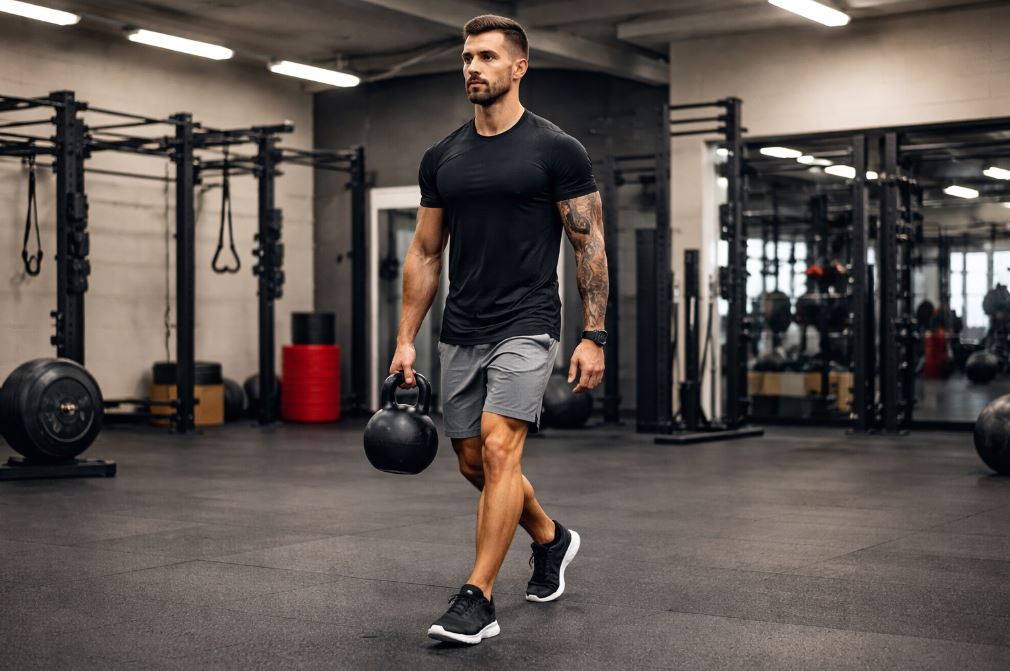
The suitcase carry is a unilateral loaded carry that challenges the body to resist side bending while walking under load. By holding weight in only one hand, the exercise forces the core, hips, and shoulder stabilizers to work together to maintain upright posture and efficient movement.
Despite its simplicity, the suitcase carry is one of the most effective tools for building real-world core stability, correcting left-right imbalances, and improving posture under asymmetrical load. Unlike most ab exercises that train the core through deliberate movement — flexion, rotation, extension — the suitcase carry trains the core’s capacity to resist movement while the rest of the body is actively walking, which is a genuinely different and arguably more functionally relevant demand.
In coaching practice, suitcase carries are one of the simplest ways to build real core strength without doing endless crunches or chasing burn. The unilateral load forces the torso and pelvis to stay level while walking, which is exactly the type of stability most athletes and lifters actually need.
Exercise Snapshot
Muscles Worked in the Suitcase Carry
The suitcase carry exercise emphasizes unilateral stabilization across the kinetic chain.
Primary muscles
- Obliques — the primary anti-lateral flexors, working continuously to prevent the torso from collapsing toward the loaded side
- Transversus abdominis — braces the spine and maintains intra-abdominal pressure throughout the walk
- Quadratus lumborum — works alongside the obliques to resist lateral spinal flexion, one of the few common exercises that directly and significantly challenge this often-neglected muscle
Secondary muscles
- Gluteus medius — stabilizes the pelvis on the unloaded side with every step, preventing the hip from dropping
- Shoulder stabilizers on the loaded side — work to maintain the weight’s position without shrugging or excessive shoulder elevation
- Grip and forearm muscles — sustain the hold on the weight throughout the entire walk
Antagonists
The obliques and quadratus lumborum on the unloaded side lengthen under control as the torso resists leaning toward the weight, while remaining ready to assist with returning the torso to neutral if any lean begins.
The asymmetry built into this exercise is what makes it valuable. Bilateral carries and lifts allow the body to share the load evenly and hide imbalances between the two sides. The suitcase carry removes that option entirely — one side bears the entire load, and the core has nowhere to transfer the anti-lateral-flexion demand. That exposure is precisely what makes this exercise so effective at both revealing and correcting left-right strength asymmetries.
How to Do a Suitcase Carry: Step-by-Step Form Guide
Starting position
- Hold the weight — dumbbell, kettlebell, or weight plate — in one hand at your side, similar to carrying a suitcase
- Stand tall with feet hip-width apart
- Keep your shoulders level and avoid shrugging on the loaded side
- Brace the core as if preparing for a plank
- Stack the rib cage over the pelvis before initiating movement
At this point, the body should feel balanced despite the asymmetrical load.
Execution
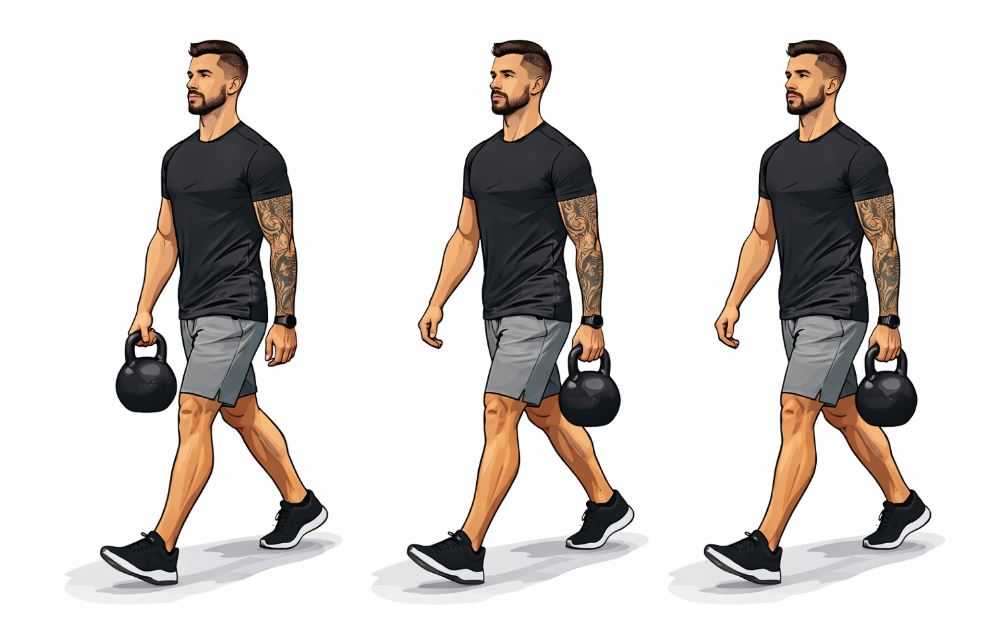
- Start walking forward with slow, controlled steps
- Keep the torso upright and resist leaning toward the weight
- Maintain even stride length and steady breathing
- Focus on keeping the pelvis level throughout the walk
- End the set if posture or alignment breaks down
- Switch hands after completing the set
The key coaching cue: The goal is not to fight the weight aggressively, but to calmly control it. Walk tall, keep the ribs stacked over the pelvis, and don’t let the loaded shoulder shrug up. If your torso starts to lean, the set is over — reduce the load, slow the tempo, and earn perfect reps rather than pushing through with compensated form.
5 Common Suitcase Carry Mistakes (And How to Fix Them)
1. Leaning toward or away from the weight
This is the central failure mode of the exercise. Leaning toward the weight lets the obliques and quadratus lumborum off the hook; leaning away overcompensates and can create its own postural issues. The torso should stay genuinely vertical throughout — if either kind of leaning starts, the set is effectively over regardless of how many steps remain.
2. Shrugging the loaded shoulder
Elevating the shoulder on the loaded side is a common compensation that reduces the core’s anti-lateral-flexion workload by allowing the shoulder and upper trapezius to absorb some of the asymmetrical load. Keep the shoulders level and avoid shrugging on the loaded side throughout the entire walk.
3. Taking rushed or uneven steps
Hurrying through the walk or taking uneven strides undermines the controlled, deliberate quality that makes this exercise effective. Maintain even stride length and a steady, unhurried pace throughout.
4. Using a load that compromises posture
Selecting a weight heavy enough to break the upright posture defeats the purpose of the exercise entirely. The suitcase carry should prioritize posture and control over load — choose a weight that keeps the torso genuinely vertical for the entire prescribed distance or duration.
5. Forgetting to switch sides evenly
Neglecting to perform equal work on both sides perpetuates the very left-right imbalance this exercise is designed to correct. Always switch hands after completing the set and ensure both sides receive equal training volume over time.
Benefits of the Suitcase Carry Exercise
Builds anti-lateral flexion strength
The core learns to resist lateral bending forces, which are common in daily life and sports, such as carrying a heavy bag, holding a child on one hip, or absorbing an off-center impact in contact sports.
Improves left-right balance
Unilateral loading exposes and corrects asymmetries that bilateral exercises often hide, since there is no opportunity for the stronger side to compensate for the weaker one.
Enhances postural control
Maintaining an upright torso under uneven loads improves awareness of spinal alignment, which translates directly to everyday posture and movement quality.
Transfers to athletic movement
The suitcase carry is useful for sports involving cutting, sprinting, contact, and unilateral force production, where the body must maintain control despite asymmetrical forces.
Low complexity, high return
Simple to perform yet extremely effective when executed correctly, the suitcase carry delivers a disproportionate training benefit relative to its technical demands.
Coach’s Note — Why Does Suitcase Carrie Work So Well
I’ve found suitcase carries especially useful for athletes in sports that involve sprinting, cutting, contact, or rapid direction changes, because they strengthen the body’s ability to resist side-bending and maintain clean mechanics under fatigue. For the general population, suitcase carries are just as valuable: they improve posture, gait stability, and the ability to carry uneven loads in everyday life without compensating through the lower back.
Who Should Use This Exercise
- Athletes in sprinting, cutting, or contact sports who need to maintain clean mechanics under asymmetrical and fatigued conditions
- Anyone with a known or suspected left-right strength imbalance — the suitcase carry exposes and directly trains the weaker side
- General population trainees seeking better posture, gait stability, and the practical capacity to carry uneven loads in daily life
- Lifters looking for a low-complexity, high-return accessory exercise that requires minimal setup
Who Should Be Cautious
- People with active lower back pain — anyone with existing back issues should get clearance from a physiotherapist before adding loaded asymmetrical carries
- People with shoulder instability on the loaded side — the sustained grip and shoulder stabilization demand may aggravate certain shoulder conditions
- Anyone tempted to load up heavily too soon — posture must come before load; a heavy suitcase carry performed with a compromised lean trains the wrong pattern entirely
How to Make It Easier or Harder
Easier
- Lighter load — reducing the weight is the most direct way to make the anti-lateral flexion demand more manageable, while posture is established
- Shorter distance or duration — reducing the total walking distance or time keeps the exercise manageable while the core builds the necessary endurance
Harder
- Heavier load — increase the weight only once the current load is consistently carried with a fully upright torso and no shoulder shrug
- Longer distance — extending the carry distance increases the total time under the anti-lateral flexion demand
- Trap bar single-handle carry — an advanced variation using a trap bar’s single handle, offering a different grip and loading experience for experienced trainees
Suitcase Carry vs. Farmer’s Carry
Although both exercises involve carrying weight at the sides, their training effects differ substantially.
The farmer’s carry uses bilateral loading, allowing for heavier weights and emphasizing grip strength, traps, and general work capacity. Because the load is symmetrical, the body does not need to strongly resist lateral bending.
The suitcase carry exercise, by contrast, introduces intentional asymmetry. This forces the core — especially the obliques and quadratus lumborum — to prevent the torso from collapsing toward the loaded side. As a result, suitcase carries are far superior for unilateral core stability and correcting side-to-side weaknesses.
In practice, farmer carries build overall strength and conditioning, while suitcase carries refine control, balance, and asymmetry management.
| Feature | Farmer’s Carry | Suitcase Carry |
|---|---|---|
| Load distribution | Bilateral (both hands) | Unilateral (one hand) |
| Core demand | General trunk stabilization | Anti-lateral flexion focus |
| Grip emphasis | Very high | High |
| Postural challenge | Moderate | High |
| Load potential | Higher | Lower |
| Primary use | Strength, conditioning | Core balance, asymmetry correction |
Suitcase Carry vs. Overhead Carry
While both exercises challenge core stability, the direction of stress and primary adaptations differ.
The overhead carry places the load above the center of mass, dramatically increasing demands on shoulder stability, scapular control, and anti-extension core strength. It prioritizes vertical alignment and overhead integrity.
The suitcase carry exercise keeps the load low but off-center, emphasizing lateral stability rather than overhead control. It is typically easier on the shoulders but more demanding for the obliques and pelvis.
In practice: Overhead carries are ideal for shoulder health and overhead athletes, whereas suitcase carries are unmatched for lateral core strength and gait stability.
Exercise Variations
Trap Bar Single-Handle Carry
An advanced variation using a trap bar’s single handle to perform the carry. The trap bar’s grip geometry and loading angle differ from those of a standard dumbbell or kettlebell, offering a distinct feel for experienced trainees already comfortable with the suitcase carry.
Kettlebell Suitcase Carry
Using a kettlebell rather than a dumbbell slightly changes the weight distribution, with the kettlebell’s center of mass typically lower than a dumbbell’s, which can feel different in the grip and shoulders.
Weight Plate Suitcase Carry
Holding a weight plate by its edge rather than a dumbbell or kettlebell handle adds a grip-specific challenge, since plates are typically less ergonomic to hold than a dedicated handle.
Programming Guidelines (Sets, Distance, Tempo)
Suitcase carries should prioritize posture and control over load.
Recommended Sets
2–4 sets per side
Distance
15–40 meters
Alternative
20–45 seconds per side if training for time rather than distance
Tempo
Slow, controlled walking — never rushed
Rest Periods
60–90 seconds between sets
Weekly Frequency
1–3 times per week
Replacement Exercises (Alternatives)
If suitcase carry is not suitable, consider:
- Side Plank
- Offset Goblet Squat
- Cable Pallof Press
- Farmer’s Walk
- Lateral Sled Drag
Conclusion
The suitcase carry is one of the most effective unilateral exercises for developing real-world core stability and postural control. Forcing the body to resist lateral forces during movement builds strength that transfers directly to sports, lifting, and everyday tasks.
When combined with farmer’s carries and overhead carries, the suitcase carry completes a comprehensive loaded-carry system that addresses strength, stability, and movement quality from multiple angles.
Looking for more unilateral and core stability exercises? Check out our complete core exercises library. Check out our guides to upper ab, lower ab, and oblique exercises as well.
What is the main purpose of the suitcase carry exercise?
The suitcase carry is designed to improve unilateral core stability by training the body to resist lateral bending under asymmetrical load.
Which muscles benefit the most from suitcase carries?
The obliques, quadratus lumborum, deep core stabilizers, and gluteus medius are the primary muscles challenged during the suitcase carry.
Is the suitcase carry better than the farmer’s carry for core training?
For anti-lateral flexion and correcting side-to-side imbalances, the suitcase carry is more effective than the farmer’s carry.
How heavy should the weight be for suitcase carries?
The load should be heavy enough to challenge posture but light enough to maintain a perfectly upright torso throughout the walk.
Should I switch hands during suitcase carries?
Yes. Performing equal volume on both sides helps prevent the development of new imbalances.
Can beginners perform suitcase carries safely?
Yes, beginners can start with light weights and short distances while focusing on posture and control.
How long should a suitcase carry set last?
Most sets range from 20–45 seconds or 15–40 meters per side, depending on training goals.
Is suitcase carry useful for lower back health?
When performed correctly, suitcase carries can improve trunk stability and reduce compensatory lower back movement.
Can suitcase carries improve posture?
Yes. The exercise reinforces upright posture and teaches the body to maintain alignment under uneven load.
How often should suitcase carries be included in a training program?
Suitcase carries can be programmed 1–3 times per week as part of core, stability, or conditioning work.
