


Introduction
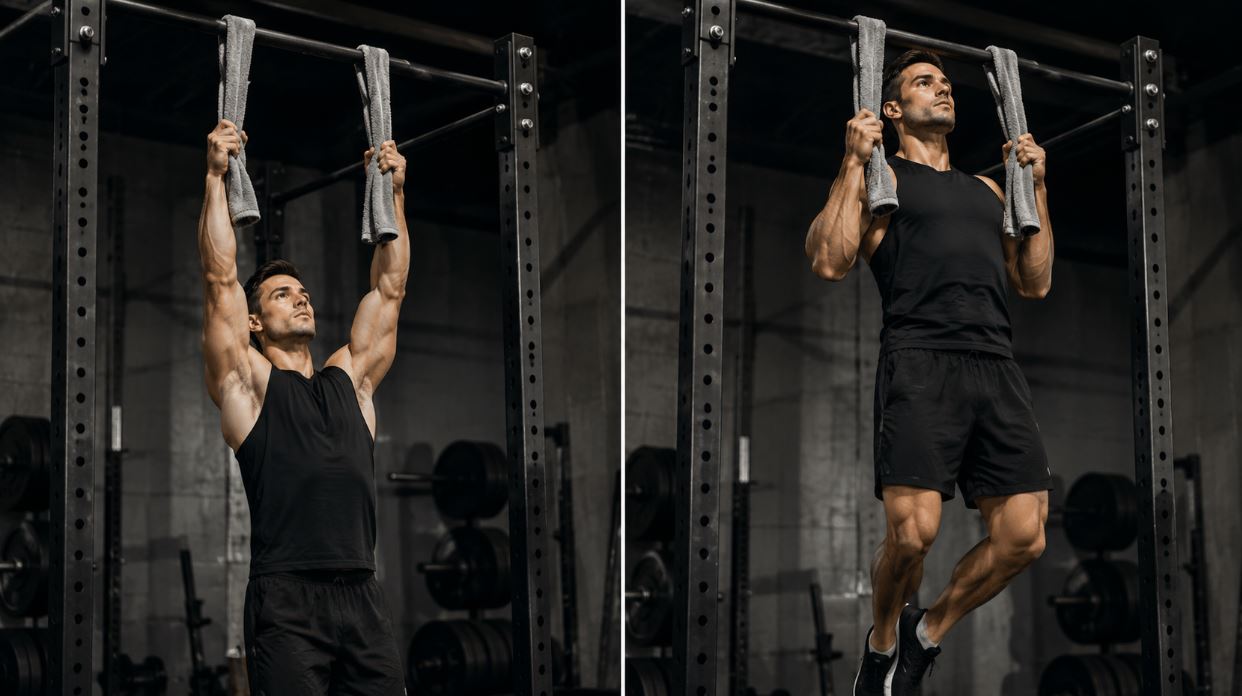
The Towel Pull-Up takes a standard pull-up and removes the bar from your hands entirely — you drape a towel over the bar and grip the two hanging ends instead, then pull up as you normally would. It looks like a small change, but the towel turns a straightforward back exercise into a serious grip and pulling-strength hybrid, because now your hands have to fight to keep a soft, shifting, non-fixed surface from sliding out of them on every single rep.
This is one of my favorite ways to expose a weak grip under dynamic load, not just a static one. The Barbell Hold and Plate Pinch Hold both train grip while your body stays still — the Towel Pull-Up trains it while your whole bodyweight is moving, which is a meaningfully different and often more humbling challenge.
Muscles Worked in the Towel Pull-Up
Primary muscles
- Forearm flexors — work overtime here, gripping and re-gripping the shifting towel fabric throughout every rep
- Latissimus dorsi — drives the actual pulling motion, just as in a standard pull-up
Secondary muscles
- Biceps brachii and brachioradialis — assist in flexing the elbow through the pulling motion, covered in our guide to the biceps brachii and surrounding arm musculature
- Trapezius — stabilizes the shoulder blades throughout the pull, just as it does in any vertical pulling movement
The reason this is so much harder than it looks: a towel doesn’t behave like a rigid bar. It twists, it bunches unevenly in your fist, and it gives slightly under tension — none of which happens when you’re gripping a fixed steel bar. Your forearms end up working continuously through the whole rep just to keep the fabric from rotating out of your hand, not just at the top or bottom.
Step-by-Step Form Guide
Starting position
- Drape a sturdy towel over a pull-up bar so both ends hang down evenly
- Grip one end of the towel in each hand, as close to the bar as your reach comfortably allows
- Hang with arms fully extended, shoulders engaged, feet off the floor

Execution
- Pull yourself upward by driving your elbows down and back, the same motion as a standard pull-up
- Pull until your chin reaches or passes the level of your hands, or as high as your grip and pulling strength allow without losing shoulder control — towel length varies, so hand position relative to the bar will too
- Lower yourself back down under control, resisting the urge to drop quickly just because your grip is fatiguing
- Reset your grip on the towel between reps if it has shifted or loosened
Coaching cue I give every client: Grip the towel like you’re trying to wring water out of it, not just hold it. A passive grip lets the fabric slowly rotate and bunch in your palm, which is exactly what causes people to lose their hold mid-rep. Active, continuous squeezing is what keeps the towel locked in your hand from the first pull to the last.
Common Mistakes
1. Using a thin or slippery towel
A thin gym towel or one with a slick, satiny finish gives your hands almost nothing to grip onto, which makes the exercise far harder than intended for the wrong reasons. A thicker, more textured towel — the kind with real terry-cloth grip — is what actually trains the exercise as designed.
2. Relying on wrist wraps or hooks instead of a grip
I occasionally see people loop the towel around a wrist wrap or use a hook-assist device to remove the grip demand from the exercise entirely. That defeats the purpose. If the goal is to combine grip and pull strength, the hands need to be doing the actual holding — save the assistive gear for exercises where grip isn’t the point.
3. Letting the towel slide instead of resetting your grip
If the towel starts to rotate or slip through your hands mid-set, fighting it just produces a sloppy rep with poor shoulder positioning. It’s better to pause, reset your grip on the towel between reps, and start the next rep clean than to force a rep while your hand is actively losing the fabric.
4. Kipping or swinging to overcome grip fatigue
Once the grip starts to fail, the instinct for a lot of people is to start swinging the body to generate momentum and muscle the rep up anyway. That turns a controlled pulling-and-gripping exercise into a compensation pattern, adding real risk to the shoulder and elbow in the process. If the grip is genuinely failing, that’s the set — not a cue to start kipping.
Benefits of the Towel Pull-Up
Combines pulling strength with dynamic grip demand
Most grip exercises are static holds. This one asks your grip to keep functioning while your whole bodyweight moves through a range of motion, which is a meaningfully different — and often weaker — quality for most lifters than a simple static hold.
Builds a grip that transfers to real, unstable objects
Tree branches, ropes, and other irregular or shifting objects don’t behave like a fixed barbell. Training your grip on a towel teaches your hands to adapt to a surface that moves and bunches under tension, which carries over far better to those situations than gripping steel ever will.
Improves grip endurance under bodyweight load
Because each rep demands continuous re-gripping rather than a single static squeeze, this builds the kind of grip stamina that shows up throughout an entire set of pull-ups or rows, not just in the first few seconds of a hold.
Stronger carryover to rope climbs
A towel is one of the closest things to a rope you can grip in a standard gym, which makes this one of the most useful accessible substitutes for building rope-climb grip strength when an actual climbing rope isn’t available.
Who Should Use This Exercise
- Lifters whose grip fails during pull-ups or rows before their back and arms are actually fatigued
- Climbers and grip-sport athletes who need a grip that holds up on unstable, shifting surfaces, not just fixed bars
- Anyone who has mastered the standard pull-up and is looking for a way to add real difficulty without changing the core movement pattern
Who Should Be Cautious
- Complete beginners who cannot yet perform a standard bodyweight pull-up — master the base movement first; adding a grip challenge on top of an unbuilt pulling base is the wrong order of progression
- Anyone with existing elbow issues, such as golfer’s or tennis elbow, the repeated dynamic gripping can aggravate tendon irritation at the elbow
- People with shoulder instability, since the added grip demand can encourage compensatory movement elsewhere in the kinetic chain if the shoulder isn’t stable to begin with
How to Make It Easier or Harder
Easier
- Use a thicker, more absorbent towel — more material gives your hands a better surface to grip, making the hold noticeably more secure than a thin one
- Use a resistance band for assistance, the same way you would with a standard band-assisted pull-up, to reduce the bodyweight load while still training the towel grip
- Perform negative-only reps — jump or step up to the top position and focus only on a slow, controlled lowering phase
Harder
- Use a single towel for both hands, gripping it close together near the center rather than using two separate towels — this removes the slight stability advantage of having each hand independently anchored
- Add a weighted vest once bodyweight reps are no longer challenging
- Slow the tempo, particularly the lowering phase, to extend time under tension for both the lats and the grip
Exercise Variations
Towel Dead Hang
A natural regression for anyone who isn’t yet ready for full towel pull-up reps: hang from the towel with arms fully extended, then hold the position without pulling up at all. This trains the same towel-specific grip demand in isolation, making it an ideal starting point for building grip confidence on the towel before adding the pulling component.
Towel Pull-Up vs. Fat Grip Pull-Up
Both exercises load the grip during a pulling movement, but the source of the difficulty is different — one comes from instability, the other from raw diameter.
| Towel Pull-Up | Fat Grip Pull-Up | |
|---|---|---|
| Source of difficulty | Unstable, shifting fabric | Fixed, oversized diameter |
| Grip type | Crush grip with constant re-gripping | Crush grip, static diameter challenge |
| Equipment | Any towel and a pull-up bar | Fat Gripz or similar attachment |
| Best for | Grip adaptability on irregular objects | Maximum crush-grip overload |
The practical takeaway: I rotate both into a program rather than picking one permanently. The towel teaches the hand to adapt to a moving, irregular grip surface, while the fat grip handle is the better tool for pure crush-grip overload at a fixed, repeatable difficulty. If your goal is general grip resilience, both belong in the rotation.
Replacement Exercises (Alternatives)
If the Towel Pull-Up doesn’t fit your setup or goals, these target a similar grip demand:
- Fat Grip Pull-Up (crush-grip alternative with fixed diameter)
- Dead Hang
- Barbell Hold
- Plate Pinch Hold
How to Incorporate the Towel Pull-Up Into Your Workouts
- As a back-day finisher or grip-focused pulling variation — I typically program this after standard pull-ups or rows, such as the bent-over barbell row, once the grip is already warmed up but not yet fully fatigued
- Reps: 5–8 reps per set, prioritizing grip security over total rep count
- Sets: 3 sets
- Frequency: 1–2 times per week is enough — this is a demanding combination of pulling and grip work, and recovery matters more here than people expect
Looking to round out your grip training? Check out our guides to the Barbell Hold, Plate Pinch Hold, and Dead Hang, or learn more about why grip strength matters across your entire training program.
Conclusion
The Towel Pull-Up takes an exercise most lifters already know and turns it into one of the best dynamic grip tests available with almost no extra equipment. It exposes exactly the kind of grip weakness that a fixed bar never will, because the towel simply won’t let your hands get away with a passive hold. Add it in once your standard pull-up is solid, grip the towel like you mean it, and you’ll feel the carryover the next time you’re hanging onto anything that isn’t a smooth steel bar.
If this exposed just how much your grip has been lagging behind your back strength, you’re not alone — it’s one of the most common gaps I see. Our complete grip strengthening guide covers the other exercises that round it out, and this article digs into the most common reasons grip stays weak in the first place.
Frequently Asked Questions
What kind of towel works best for Towel Pull-Ups?
A thick, textured gym or bath towel works best — the kind with real terry-cloth grip rather than a thin, satiny finish. A towel that’s too thin or slippery makes the exercise harder for the wrong reason, testing how poorly your hands grip slick fabric rather than building genuine pulling and grip strength.
Do I need to be able to do a regular pull-up before trying Towel Pull-Ups?
Yes. The Towel Pull-Up adds a significant grip challenge on top of the standard pulling movement, so it should come after a solid bodyweight pull-up is already established, not before. Trying to learn the pull-up pattern itself while also fighting an unstable towel grip is the wrong order of progression.
Can I use one towel or do I need two?
Either works, and it changes the difficulty. Two separate towels, one per hand, is the more accessible starting point since each hand has its own independent grip surface. A single towel gripped by both hands close together is a harder progression, since the hands now have to share and stabilize one piece of shifting fabric together.
Why does my grip fail on Towel Pull-Ups before my back gets tired?
That’s the expected outcome for most lifters, since the constant re-gripping demand of an unstable towel surface fatigues the forearms faster than a fixed bar would. It’s a sign your back strength on a standard pull-up has likely outpaced your dynamic grip endurance, which is exactly the imbalance this exercise is designed to expose and improve.
