


Introduction
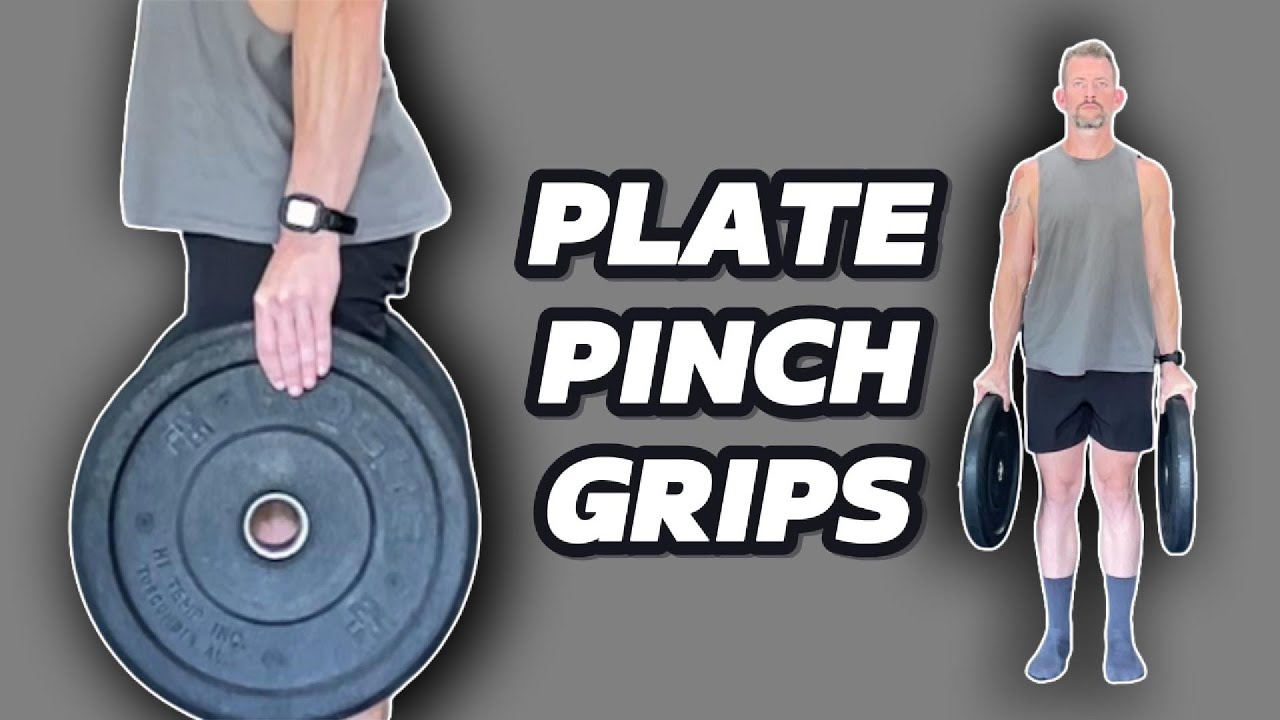
The Plate Pinch Hold is exactly what it sounds like: gripping a weight plate (or two stacked together) between your fingers and thumb and holding it for time. It looks almost too simple to matter — until you try it with a 20kg plate and feel your thumb give out in under ten seconds. In my years coaching lifters, this is one of the exercises I come back to constantly, because pinch grip is the weak link that almost nobody trains directly, even though it’s the first thing that fails when you’re carrying odd-shaped loads or stacking plates onto a bar.
Unlike a crush grip (squeezing a handle or gripper closed) or a support grip (holding a loaded bar), the pinch grip relies almost entirely on your thumb against your fingers, which is exactly why it deserves its own dedicated training, something we cover in more depth in our guide to hand grip types and widths.
Muscles Worked in the Plate Pinch Hold
Primary muscles
- Adductor pollicis and thumb flexors (flexor pollicis longus/brevis) — these small but critical muscles are doing almost all the work here, pressing the thumb against the fingers to keep the plate from sliding out of your hand
- First dorsal interosseous — stabilizes the index finger against the thumb’s pressure, and becomes especially noticeable when pinching a thin, single plate where the thumb has less surface to work with
Secondary muscles
- Forearm flexors — assist in maintaining finger flexion against the plate’s edge, though they play a smaller role than in a crush-grip exercise
In my experience, this exercise exposes the gap between “I have a strong grip” and “I have a strong thumb.” I’ve had powerlifters who could crush a hand gripper shut with ease but couldn’t hold a 15kg plate pinched for more than a few seconds — the thumb simply isn’t trained by most other lifts, including deadlifts and rows.
Step-by-Step Form Guide
Starting position
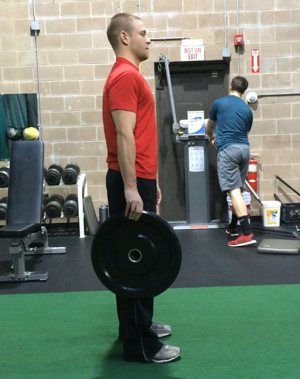
- Stand tall with a weight plate (or two plates pressed smooth-side-out, back to back) resting on the floor in front of you
- Bend at the hips and knees, keeping your back flat, and grip the top edge of the plate between your fingers (in front) and thumb (behind)
- Position your hand so the plate hangs naturally, not twisted to one side
Execution
- Stand up by extending your hips and knees, lifting the plate off the floor while keeping your arm straight at your side
- Hold the plate steady at arm’s length, resisting the urge to let it rotate or swing
- Keep your shoulder back and down rather than hiking it up toward your ear
- Hold for the prescribed duration, then lower the plate back to the floor under control — don’t drop it
Coaching cue I give every client: Squeeze through the pad of your thumb, not just your fingertips. Most people instinctively try to “claw” the plate with their fingers, but the thumb is the side that actually determines how long you last. Once you feel your thumb start to roll or slide, the set is essentially over — there’s no recovering grip once that happens.
Common Mistakes
1. Using plates with a lip or raised rim
Many plates have a small raised edge near the center hole that the fingers can hook onto, which makes the hold artificially easier and gives a false sense of progress. For genuine pinch-strength training, use flat, smooth-edged plates — the kind with nothing for your fingers to hook into.
2. Letting the wrist do the work instead of the thumb
I see this constantly with newer clients: they try to cock the wrist back to “lever” the plate up rather than relying on thumb pressure. This turns the exercise into a wrist-flexion drill instead of a pinch-grip drill, and it’s also a fast way to aggravate the wrist. Keep the wrist neutral and let the thumb-to-finger pinch do the holding.
3. Gripping too close to the center
Many people instinctively grab the plate closer to the middle, where it feels more stable. That instinct works against you here — gripping only the outer edge is what actually trains the pinch grip, since it forces the thumb and fingers to hold the plate purely through pressure rather than letting a wider grip share the load. If your hand naturally creeps toward the center hole, that’s a sign the weight is too heavy for a true edge grip.
Benefits of the Plate Pinch Hold
Direct transfer to real-world pinch tasks
Carrying awkward, edge-gripped loads — stacking plates, lifting boxes by their sides, strongman-style plate carries — relies on exactly this grip pattern. A few other gym exercises train it directly.
Progressively loads an undertrained structure
Because the thumb is rarely loaded directly in standard lifting, dedicating time to pinch work helps progressively load the thumb muscles and connective tissues — a structure that often becomes a limiting factor once grip demands increase elsewhere in a program.
Who Should Use This Exercise
- Lifters whose grip fails before the target muscle group on deadlifts, rows, or shrugs — a weak grip is a common bottleneck in weight training long before the prime movers are maxed out
- Strongman and grip-sport competitors, since pinch-style implements (plates, blocks) are a standard event format
- Climbers and athletes who need durable thumb and finger strength for pinch-style holds
Who Should Be Cautious
- Anyone with existing thumb or CMC joint issues (the joint at the base of the thumb) — pinch holds place direct stress exactly there, and pre-existing irritation will flare under load
- Anyone with a recent thumb sprain or strain — even a fully loaded, controlled pinch is enough to re-aggravate a joint or ligament that hasn’t finished healing
- People with tendinitis in the forearm or wrist — the isometric pinch demand can aggravate inflamed tendons; this is one to delay until that resolves, not push through
How to Make It Easier or Harder
Easier
- Use two plates pressed together instead of one — the increased width gives the thumb a better mechanical angle and is noticeably easier to hold than a single thin plate
- Shorter hold duration — start with 10–15 second holds and build from there
Harder
- Use a single plate rather than two stacked together — thinner plates are harder to pinch than two pressed back-to-back, despite often weighing less
- Extend the hold duration before adding weight — build toward 45–60 seconds with a single plate before increasing load further
Exercise Variations
Single Plate Pinch
Instead of pressing two smooth-side-out plates together (the easier, beginner version), pinch a single plate by its edge. The reduced width forces the thumb into a less favorable angle, making this noticeably harder, even with a lighter total load — a good way to progress without simply adding weight.
Plate Pinch Carry
Once the static hold is solid, take the pinch grip on the move: pinch a plate in each hand and walk a set distance or time, just as you would with a farmer’s walk. This adds a stability and grip-endurance challenge on top of the raw isometric hold, and it’s a closer match to how pinch grip actually gets used outside the gym — carrying a plate by its edge across a gym floor, for example, rather than just standing still and holding it.
Replacement Exercises (Alternatives)
If the Plate Pinch Hold doesn’t fit your setup or goals, these targets a similar grip demand:
- Captains of Crush Gripper (crush-grip alternative)
- Barbell Hold (support-grip alternative)
- Towel Pull-Up (combines pull strength with grip endurance)
- Plate Pinch Carry (see Variations above)
- Farmer’s Walks
- Dead Hang
- Fingertip Push-Up
How to Incorporate the Plate Pinch Hold Into Your Workouts
- As a grip-specific finisher — I usually have clients do this at the end of a pulling session, after the main lifts, since pre-fatiguing the grip earlier in a workout will compromise deadlifts and rows
- Duration: 15–30 second holds to start; build toward 45–60 seconds per side before adding weight rather than extending time further
- Sets: 3 sets per hand
- Frequency: 2–3 times per week is plenty — thumb and finger tendons recover more slowly than larger muscle groups, so daily training here tends to backfire
- Beginners should start with one hand at a time rather than attempting bilateral holds — it’s easier to monitor thumb position and catch a slipping grip on one side before trying to manage both at once
Looking to round out your grip training? Check out our guides to the Farmer’s Walk, Dead Hang, and Suitcase Carry, or learn more about why grip strength matters across your entire training program.
Conclusion
The Plate Pinch Hold trains a piece of grip strength that almost nothing else in a standard program touches — the thumb. It’s a simple exercise on paper, but the first time you try it with a plain, flat plate, you’ll likely find out exactly how undertrained your pinch grip really is. Add it in as a finisher, be patient with the progression, and you’ll notice the carryover the next time you’re stacking plates or carrying something awkward by its edge.
Pinch grip is just one piece of the puzzle, though — a genuinely strong grip also needs crush and support training to back it up. See how it all fits together in our complete guide to grip strengthening exercises, and if your grip keeps failing on other lifts too, here’s why that happens and how to fix it.
Frequently Asked Questions
Why does my thumb hurt more than my fingers during the Plate Pinch Hold?
That’s expected — the thumb (specifically the adductor pollicis and the joint at its base) bears the majority of the load in a pinch grip, while the fingers mostly just provide an opposing surface. Mild muscular fatigue in the thumb is normal; sharp joint pain at the base of the thumb is not, and is a sign to stop and scale back.
How much weight should I start with on a Plate Pinch Hold?
Start lighter than you’d expect — a 5–10kg plate is plenty for most beginners to feel real fatigue within 15–20 seconds. The pinch grip is far weaker than your crush or support grip, so don’t judge the starting weight by what you can deadlift or carry.
Should I train Plate Pinch Hold with both hands at once or one at a time?
Either works, but training one hand at a time lets you focus fully on thumb position and lets you compare strength side to side, which often reveals an imbalance worth addressing. Two-handed pinching (one plate per hand, done simultaneously) is a reasonable time-saver once technique is solid.
Can the Plate Pinch Hold help with deadlift grip?
Indirectly, yes. The deadlift relies on a support/crush grip rather than a pinch grip, so this exercise won’t directly replicate that demand — but it strengthens the same forearm and thumb structures that tend to be the first to fatigue when grip becomes the limiting factor on heavy pulls.
