


Introduction
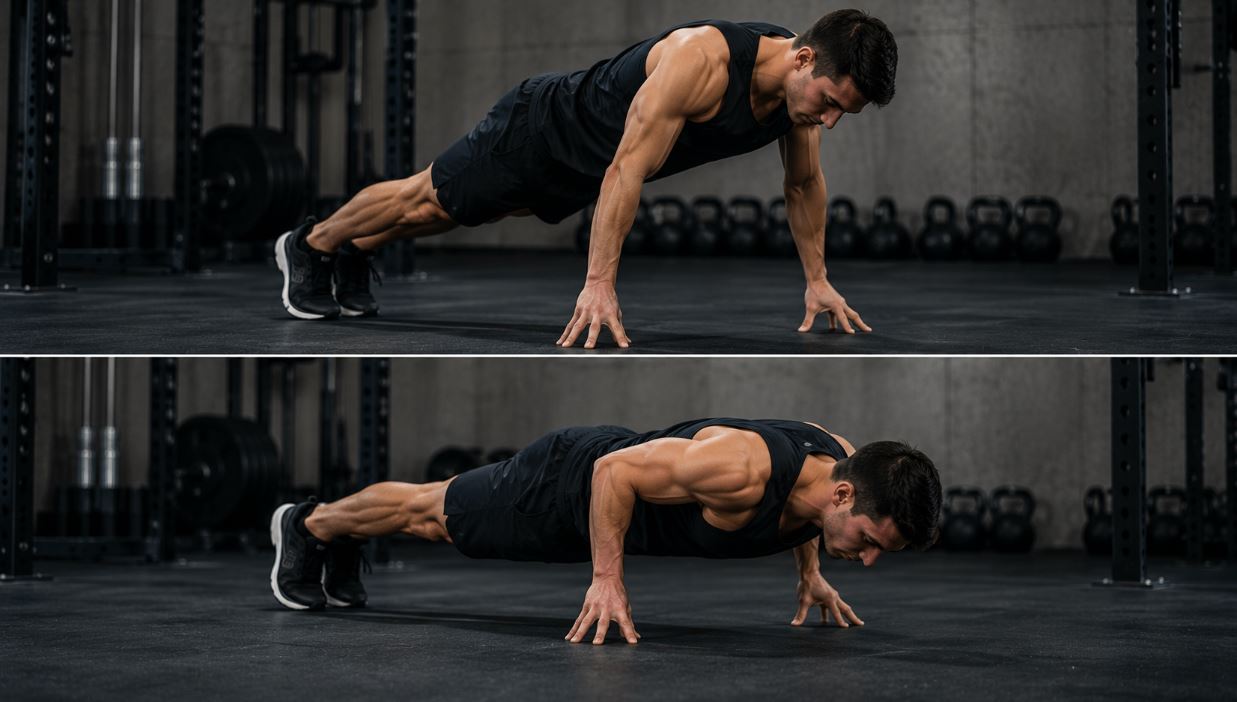
The Fingertip Push-Up is exactly what it sounds like: a standard push-up performed balanced on the tips of your fingers instead of your flat palms. It rounds out this category in a way none of the other exercises here do — everything else we’ve covered trains a crush, pinch, or support grip, but this one trains the fingers under compression and extension load instead, which is a completely different demand on the joints and tendons.
This is the one I bring up with anyone training for combat sports or grappling, since a strong, resilient fingertip is something those sports demand in ways a standard grip exercise simply doesn’t address. It’s also one of the more humbling exercises on this list — most people who can do dozens of regular push-ups find their fingers giving out far sooner than their chest or triceps the first time they try this version.
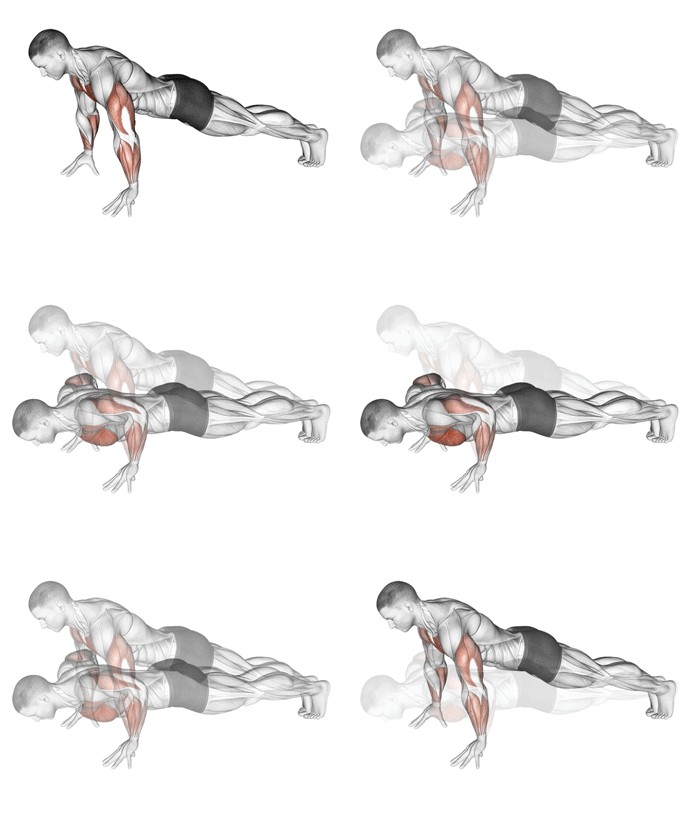
Muscles Worked in the Fingertip Push-Up
Primary stabilizers
- Finger flexors, intrinsic hand muscles, and finger joint stabilizers — work together isometrically to hold the fingers against collapse under bodyweight load, with the small intrinsic muscles and the connective tissue around each joint doing much of the real stabilizing work, not just the larger flexor muscles
Secondary stabilizers
- Finger extensors and wrist stabilizers — assist in keeping the fingers in a stable, slightly extended position, but act more as stabilizers here than as the primary drivers of the hold
- Triceps brachii — extends the elbow through the pushing motion, the same as in any standard push-up, covered in more detail in our triceps brachii anatomy guide
- Anterior deltoid and chest — drive the pressing movement, the same prime movers as in a standard push-up
- Core muscles — brace isometrically to maintain a straight body line throughout the movement, the same anti-extension demand seen in any plank-style position
The key difference from the rest of this category is that in a crush or pinch grip exercise, the fingers are actively closing around something. Here, the finger flexors and intrinsic hand muscles are working isometrically to resist collapse under load, while the joints and surrounding connective tissue bear direct compressive force in an extended position — a combination almost nothing else in a standard program trains directly.
Step-by-Step Form Guide
Starting position
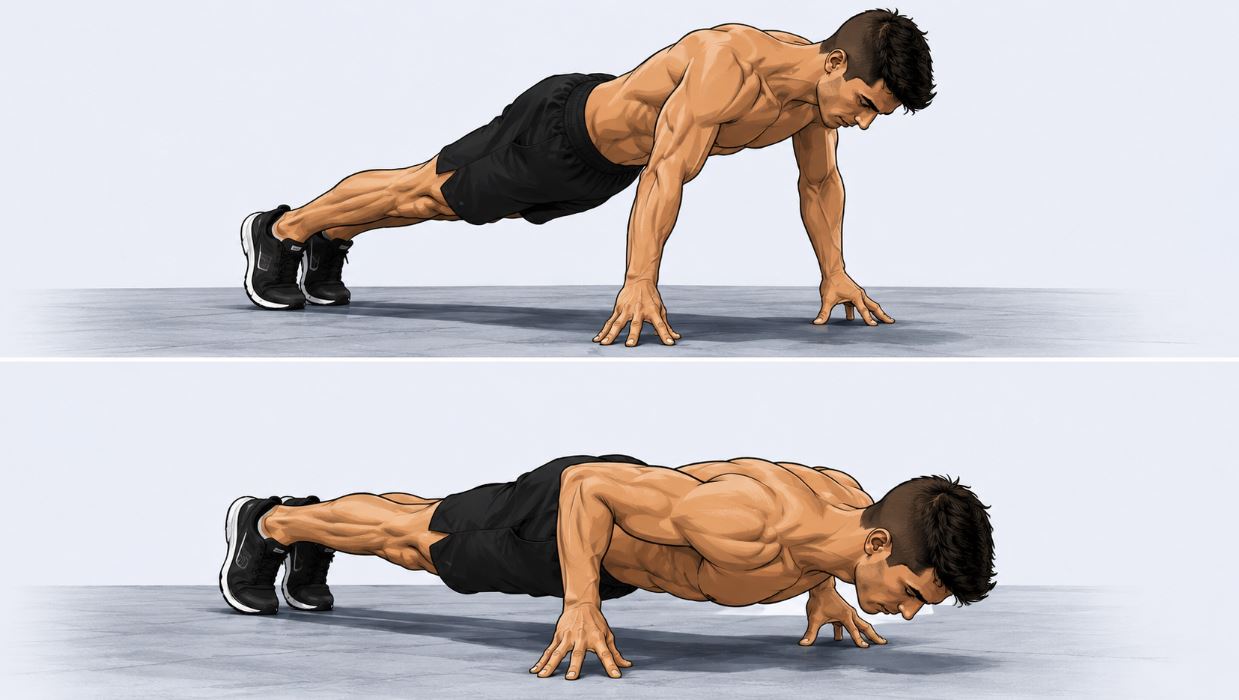
- Set up in a standard push-up position, but balance on your fingertips instead of flat palms
- Spread your fingers and distribute weight across all of them, not just the thumb and first two fingers
- Keep your body in a straight line from head to heels, the same as a standard push-up
Execution
- Lower your body under control by bending the elbows, keeping the fingertip position stable throughout the descent
- Lower until your chest is close to the floor, or as far as your fingers and shoulders can comfortably control
- Press back up to the starting position, maintaining even pressure across all fingertips
- Reset your hand position between reps if your fingers have shifted
Coaching cue I give every client: Spread the load across all ten fingertips, not just your strongest two or three. The instinct under fatigue is to lean onto the thumb, index, and middle fingers because they’re naturally stronger, but that just overloads three joints instead of distributing the work evenly across the whole hand.
Common Mistakes
1. Loading only the strongest two or three fingers
This happens almost automatically as fatigue sets in — the ring and pinky fingers tend to lift slightly while the thumb, index, and middle fingers take over. That concentrates a disproportionate amount of force on fewer joints and undermines the balanced finger strength this exercise is meant to build. Actively press through all fingertips, even as it gets harder to do.
2. Hyperextending the finger joints
Some people let their fingers bend backward slightly at the knuckle under load, rather than keeping them in a stable, slightly arched position. That’s a joint position you want to avoid loading repeatedly, since it places stress on the ligaments rather than the muscles that are supposed to be doing the work. Keep a slight, stable curve in the fingers rather than letting them collapse backward.
3. Progressing too fast
This is the mistake I see most often, and it’s the one that actually causes injuries here. People who can already do strong standard push-ups assume their fingers are ready for the same volume and load, but finger joints and tendons adapt far more slowly than the chest and triceps do. Build up gradually — fewer reps, easier variations, more weeks of patience — than the rest of your pushing strength would suggest you need.
Benefits of the Fingertip Push-Up
Builds finger and tendon resilience for impact
Unlike crush or pinch training, this exercise conditions the fingers to bear direct compressive load, which has a much closer carryover to absorbing impact in combat sports, falls, or any situation where the fingers need to handle force without folding.
Trains fingertip support and finger-joint stability in an extended position
This isn’t classic extensor training, the way a rubber-band finger-extension exercise would be. What it trains is the fingers’ ability to support a real load while held in a stable, extended position — a joint-stability demand that most grip work, which emphasizes active flexion, doesn’t address at all.
Strong carryover to grappling and striking sports
Athletes in BJJ, boxing, and MMA regularly need finger and hand structures that can withstand compressive forces without breaking down, whether that’s gripping a gi, absorbing an impact, or simply bearing awkward weight during a scramble.
Who Should Use This Exercise
- Combat sports athletes (BJJ, boxing, MMA) who need fingers and hand joints that hold up under impact and compression
- Climbers and calisthenics athletes looking to round out crush and pinch grip work with a finger-extension-focused exercise
- Anyone who has mastered the standard push-up and wants a genuinely new challenge rather than just adding more reps or weight
Who Should Be Cautious
- Anyone with existing finger joint issues, including arthritis or a history of joint injury, should avoid the concentrated load through individual finger joints is precisely the wrong stimulus for an already irritated joint
- Complete beginners who haven’t yet mastered the standard push-up — build the base pushing pattern with a standard push-up first, since adding a significant new finger-loading demand on top of unbuilt pushing strength is the wrong order of progression
A specific safety note: Do not attempt fingertip push-ups if you have finger pain, joint hypermobility, a recent sprain, or push-up mechanics that aren’t yet solid. Start with the incline or kneeling versions below, and progress to full-floor reps only once those are genuinely comfortable.
How to Make It Easier or Harder
Easier
- Perform from the knees rather than the full plank position, reducing the load on the fingers while still practicing the fingertip position
- Use an incline, such as a bench or box, which reduces the percentage of bodyweight the fingers have to support
- Start with the Fingertip Plank Hold (see Variations below) before attempting full repetitions — building tolerance in a static position first is safer than going straight into moving reps
Harder
- Elevate the feet to shift more bodyweight onto the hands and fingers
- Perform single-arm fingertip push-ups once the standard two-hand version is well controlled
- Add a brief pause at the bottom position to increase time under tension on the fingertips, specifically
Exercise Variations
Fingertip Plank Hold
The best regression before attempting full push-up reps: hold a plank position balanced on your fingertips instead of performing the pushing motion at all. This builds the same finger and joint stability demand in isolation, without the added complexity of moving through a full range of motion, making it the logical first step for anyone new to fingertip loading.
Knuckle Push-Up
Performed the same way, but balanced on the first knuckles of a closed fist rather than the fingertips. This is a useful alternative for anyone whose finger joints aren’t ready for direct fingertip loading, since the knuckles distribute load differently and tend to be more tolerant of repeated compression for most people. It trains a similar pushing and joint-conditioning pattern without the same direct demand on individual finger joints.
Fingertip Push-Up vs. Knuckle Push-Up
Both are push-up variations that shift the load off the flat palm, but they place it on different structures with different risk profiles.
| Fingertip Push-Up | Knuckle Push-Up | |
|---|---|---|
| Load bears through | Finger joints and tendons | Knuckles, wrist stays neutral |
| Primary training effect | Finger and hand stability | Knuckle conditioning, neutral wrist position |
| Relative risk | Higher — direct finger joint loading | Lower — better tolerated by most people |
| Best for | Combat sports, climbing, and advanced finger conditioning | A safer regression or alternative for sensitive finger joints |
The practical takeaway: I treat the knuckle push-up as the safer entry point, not a lesser exercise. If fingertip loading feels risky, uncomfortable, or simply unavailable to you because of joint sensitivity, the knuckle version delivers a similar pushing and conditioning benefit with meaningfully less direct stress on the finger joints themselves.
Replacement Exercises (Alternatives)
If the Fingertip Push-Up doesn’t fit your setup or goals, these target a similar demand:
- Standard Push-Up (regression for those not yet ready for finger-loaded variations)
- Knuckle Push-Up (see Variations above)
- Captains of Crush Gripper (for crush-grip strength alongside finger conditioning)
- Plate Pinch Hold
How to Incorporate the Fingertip Push-Up Into Your Workouts
- As an accessory finger-conditioning exercise, not a primary chest builder — I program this for athletes who specifically need finger and joint resilience, rather than as a replacement for standard pressing work
- Reps: 5–10 reps per set, prioritizing even finger distribution and joint position over total rep count
- Sets: 2–3 sets
- Frequency: 2–3 times per week, with gradual progression — finger joints and tendons adapt more slowly than larger muscle groups, so patience here matters more than it does almost anywhere else in this category
Looking to round out your grip training? Check out our guides to the Captains of Crush Gripper, Plate Pinch Hold, and Barbell Hold, or learn more about why grip strength matters across your entire training program.
Conclusion
The Fingertip Push-Up is the odd one out in this category, and that’s exactly its value — it trains a kind of finger resilience that crush, pinch, and support grip work simply don’t touch. Build up to it gradually, spread the load evenly across all your fingertips, and you’ll develop a hand that can handle direct impact and compression, not just hold onto things tightly.
This rounds out the joint and tendon side of grip training, but it’s just one part of a complete program. For the other nine exercises that build crush, pinch, and support grip, see our full grip strengthening guide — and if you’re not sure why your grip has lagged behind the rest of your training, start here.
Frequently Asked Questions
How many regular push-ups should I be able to do before trying fingertip push-ups?
There’s no strict number, but you should be comfortably performing a full set of standard push-ups with good form before adding the extra finger-loading demand. Trying to build pushing strength and finger joint tolerance at the same time is a harder, less efficient way to progress than mastering the base movement first.
Are fingertip push-ups bad for your finger joints?
When introduced gradually with good technique, they’re generally a reasonable way to build finger and joint resilience over time. The risk comes from progressing too quickly or maintaining poor finger position, such as hyperextension or uneven loading, rather than from the exercise itself.
Should I use a knuckle push-up instead if my fingers hurt?
Yes — the knuckle push-up is a reasonable substitute for anyone whose finger joints aren’t ready for direct fingertip loading, since it distributes load through the knuckles rather than the individual finger joints. If fingertip loading causes sharp or persistent joint pain rather than normal training fatigue, switching to knuckles or a standard push-up is the more appropriate choice.
Why do my ring and pinky fingers feel weaker during this exercise?
This is extremely common, since the thumb, index, and middle fingers are naturally stronger and tend to take over under fatigue, leaving the ring and pinky doing comparatively little work. Deliberately focusing on pressing evenly through all fingertips, especially the outer two, helps correct this imbalance over time.
