



Introduction
The Captains of Crush gripper, usually just called a CoC, is a hand gripper built around one simple idea: close the handles all the way together against a known, standardized spring resistance. Unlike most of the exercises in this category, there’s no pulling, no carrying, no bodyweight involved — just your hand closing a fixed resistance, which makes it the cleanest, most isolated test of pure crush-grip strength you’ll find.
I keep a set of these in my gym bag specifically because they strip away every other variable. The Towel Pull-Up and Fat Grip Pull-Up both train crush grip, but they do so while your whole body weight is also being managed. A CoC removes that completely — it’s just the hand, against the spring, with nothing else to think about.
Muscles Worked in the Captains of Crush Gripper
Primary muscles
- Finger and forearm flexors — these do all the work essentially, contracting to overcome the gripper’s spring tension and close the handles together
Secondary muscles
- Brachioradialis — provides minor stabilization through the wrist and forearm during the closing effort, covered in more detail in our guide to the biceps brachii and surrounding arm musculature
The reason the last centimeter or two of the close is so much harder than the first is simple spring mechanics: a coiled gripper spring resists more as it compresses further, so the closer the handles get to touching, the more force your hand has to produce to finish the job. This is exactly why people can often get a gripper most of the way closed but stall just short of a full close — that’s not a lack of effort, it’s the spring fighting back hardest exactly where you need the most strength.
Step-by-Step Form Guide
Starting position
- Place the gripper in your hand with the coil resting in your palm, fingers wrapped around one handle, and your thumb pressing against the other
- Position your hand so the gripper sits in the crease where your fingers meet your palm, not out near the fingertips
- Set your wrist in a neutral position rather than cocked back or forward
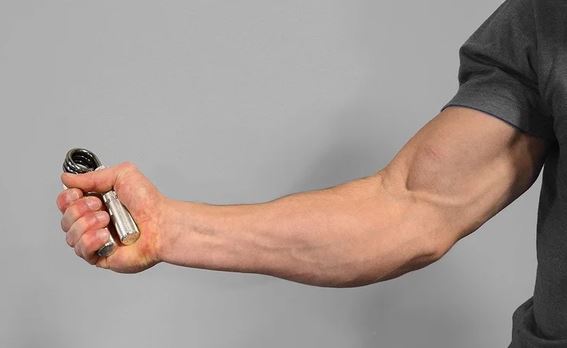
Execution
- Squeeze the handles together smoothly and continuously until they touch, or until you reach your maximum effort for that rep
- Hold the closed position briefly if performing for time, or release immediately if performing for reps
- Open the gripper under control rather than letting the spring snap it open
- Reset your hand position between reps if the gripper has shifted
Coaching cue I give every client: Set the gripper deep in your hand before you start squeezing, not after. Trying to close a gripper that’s sitting too far out toward your fingertips wastes strength on a worse leverage position before the real effort even begins. Get the setup right first, then squeeze.
Common Mistakes
1. Using momentum to “throw” the close
Some people swing their arm or jerk the gripper to build momentum into the close, especially when they’re right at the edge of their max resistance. That might close the gripper, but it’s not training the muscle to produce the force on its own — it’s borrowing momentum to fake a close that the grip alone couldn’t achieve. A controlled, continuous squeeze is what actually builds strength.
2. Setting the gripper too shallow in the hand
Gripping the handles too close to the fingertips rather than deep in the palm puts your hand at a significant leverage disadvantage before you’ve even started squeezing. This is one of the most common reasons people stall on a gripper they should be able to close — the problem isn’t strength, it’s setup.
Benefits of the Captains of Crush Gripper
Standardized, trackable progress
Because CoC grippers come in known, consistent resistance levels, you can track strength gains with real precision over time — closing the same numbered gripper that gave you trouble six months ago is about as clean a strength benchmark as grip training offers.
Isolates crush grip without fatiguing anything else
There’s no bodyweight, no balance, and no other muscle group involved. This makes it ideal for genuinely isolated crush-grip work, and it’s also why it’s so easy to fit in literally anywhere — at a desk, in a car, watching TV.
Extremely portable and accessible
A gripper fits in a pocket or gym bag and requires no setup, no rack, and no bar. For anyone who travels or trains outside a typical gym, it’s one of the few serious grip tools that goes wherever you go.
Who Should Use This Exercise
- Anyone who wants a precise, standardized way to measure crush-grip progress over weeks and months
- Grip-sport competitors and enthusiasts, since closing specific CoC numbers is itself a recognized benchmark within that community
- Lifters who want extra crush-grip volume without adding fatigue to the back, arms, or legs, the way a loaded carry or pull-up variation would
Who Should Be Cautious
- Anyone with existing finger or hand joint issues, including arthritis or tendinitis in the fingers — the concentrated, repeated closing motion, as it places direct stress on those same joints
- Anyone with a recent hand or wrist injury — even a low-resistance gripper still demands a forceful closing motion that can aggravate a joint or tendon that hasn’t finished healing
How to Make It Easier or Harder
Easier
- Use a lower resistance gripper — most lines, including the CoC series, start with a Guide or trainer-level gripper well below the numbered resistances, which is the appropriate starting point for most beginners
- Train negatives only — use your other hand to help close the gripper, then focus on resisting the spring as it opens back up under control
Harder
- Progress to the next numbered resistance once the current one closes consistently and with good form
- Add hold time at full closure once the gripper closes easily, rather than just releasing immediately after the close
Captains of Crush Gripper vs. Plate Pinch Hold
Both are isolated, equipment-based grip tools that strip away everything except the hand itself, but they train opposite ends of the grip spectrum.
| Captains of Crush Gripper | Plate Pinch Hold | |
|---|---|---|
| Grip type | Crush grip | Pinch grip |
| Primary driver | Finger flexors closing against a spring | Thumb pressing against the fingers |
| Measurement | Standardized resistance levels | Plate weight and thickness |
| Best for | Tracking crush-grip strength precisely | Building thumb and pinch-specific strength |
The practical takeaway: These aren’t competing tools — they’re testing two different grip patterns that rarely get trained anywhere else. I have clients use both because a strong crush grip doesn’t automatically mean a strong pinch grip, and vice versa. If you only train one, you’re leaving half the grip spectrum undeveloped.
Replacement Exercises (Alternatives)
If the Captains of Crush Gripper doesn’t fit your setup or goals, these targets have a similar grip demand:
- Plate Pinch Hold (pinch-grip alternative)
- Barbell Hold (support-grip alternative)
- Towel Pull-Up or Fat Grip Pull-Up (crush grip under bodyweight load)
- Fingertip Push-Up
How to Incorporate the Captains of Crush Gripper Into Your Workouts
- As standalone grip work, separate from your main lifting sessions — since it doesn’t fatigue anything else, it doesn’t need to be tied to a specific training day the way a barbell-based grip exercise does
- Reps: 5–8 controlled closes per set if training for strength; hold-based work if training the closed position for time
- Sets: 2–3 sets per hand
- Frequency: 2–3 times per week, with at least a day of rest between sessions if you’re working close to your current max resistance
- A practical note on resistance levels: most people, including reasonably strong lifters, find the Guide and #0.5 a realistic starting point, with #1 representing a solid, genuinely strong grip for most recreational trainees. The higher numbers (#2 and beyond) are where things get serious, and very few people ever need to go past that for general training purposes — chasing the highest numbers is really only relevant for dedicated grip-sport competition.
Looking to round out your grip training? Check out our guides to the Plate Pinch Hold, Barbell Hold, and Towel Pull-Up, or learn more about why grip strength matters across your entire training program.
Conclusion
The Captains of Crush gripper strips grip training down to its simplest form: your hand against a known resistance, with nothing else involved. That simplicity is exactly what makes it useful — it’s portable, it’s precisely trackable, and it isolates crush-grip strength better than almost anything else you can do. Get your setup right, squeeze with control rather than momentum, and let the numbered resistance levels tell you exactly how your grip is progressing.
A strong crush grip is a great start, but it won’t fix a weak pinch or support grip on its own. Our complete guide to grip strengthening exercises covers all three patterns together, and if you’re still wondering why your overall grip feels behind, this article walks through the most common causes.
Frequently Asked Questions
What’s a good Captains of Crush number for a beginner?
The Guide or #0.5 gripper is a realistic starting point for most people new to grip training. Closing a #1 represents a genuinely strong grip for most recreational trainees, so there’s no need to feel discouraged if the higher numbers feel completely out of reach at first — progress on these is typically slow and measured in months, not weeks.
How often should I train with a hand gripper?
Two to three times per week works well for most people, with at least a day of rest between sessions when working close to your current maximum resistance. Because grippers don’t fatigue the rest of the body, it’s tempting to overdo the frequency, but the finger and forearm tendons still need adequate recovery time.
Why can I almost close a gripper but never get it all the way?
This is extremely common and comes down to spring mechanics — a gripper’s resistance increases as the handles get closer together, so the final centimeter is mechanically the hardest part of the entire movement. Getting most of the way closed but stalling near the end isn’t a sign of weak effort; it’s the point where the spring is fighting back the hardest.
Can hand grippers cause injury?
Used with reasonable resistance and controlled technique, grippers are generally low-risk, but jumping to a resistance that’s too far beyond your current strength, or using momentum to force a close, can strain the finger tendons or joints. Anyone with existing hand, finger, or wrist issues should approach gripper training cautiously and progress resistance levels gradually.
