


Introduction
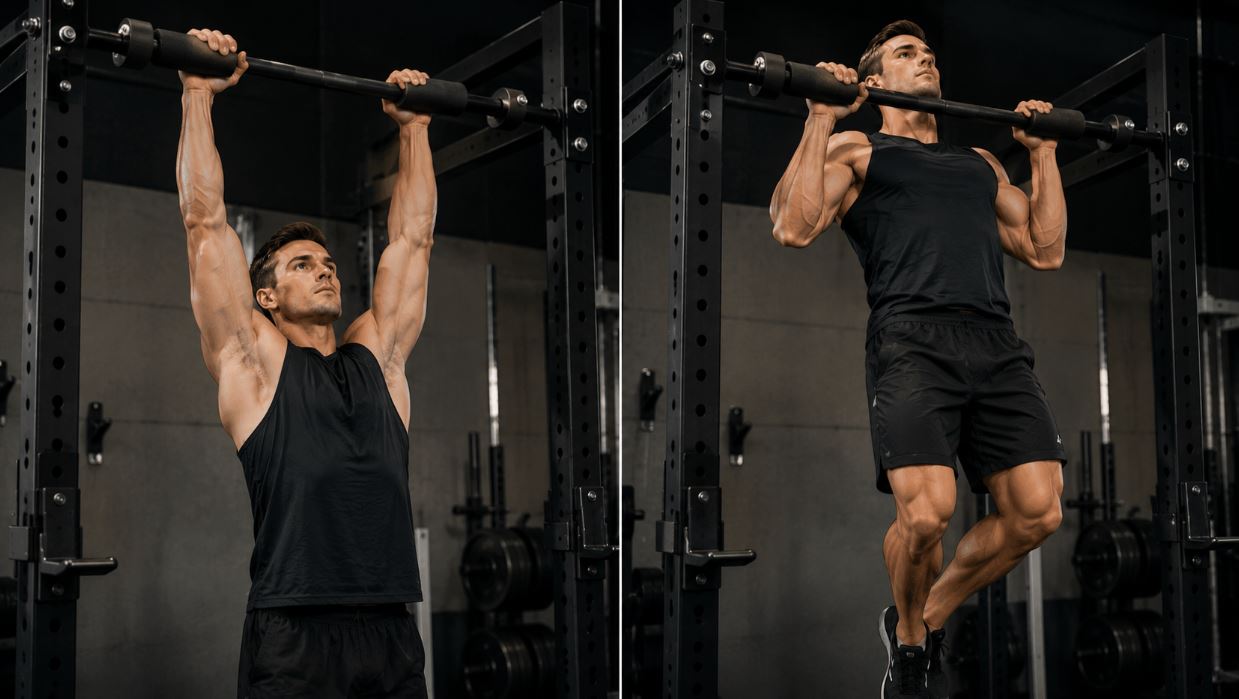
The Fat Grip Pull-Up takes a standard pull-up and increases the diameter of the bar you’re gripping — either with slip-on Fat Gripz attachments or with a thicker bar — and then has you perform the pull-up exactly as you normally would. The bigger diameter forces your hand into a much weaker mechanical position, turning a familiar back exercise into a support grip with a significantly increased crush-grip demand.
This sits naturally alongside the Towel Pull-Up in my coaching — both combine pulling strength with a serious grip challenge, but where the towel’s difficulty comes from an unstable, shifting surface, the fat grip’s difficulty comes from a fixed, oversized diameter that doesn’t move or twist at all.
Muscles Worked in the Fat Grip Pull-Up
Primary muscles
- Forearm flexors — work much harder than on a standard bar, since the increased diameter forces the fingers into a more open, less mechanically efficient position
- Latissimus dorsi — drives the pulling motion, just as in any standard pull-up
Secondary muscles
- Biceps brachii and brachioradialis — assist in flexing the elbow through the pull, covered in our guide to the biceps brachii and surrounding arm musculature
- Trapezius — stabilizes the shoulder blades throughout the pull, the same role it plays in any vertical pulling movement
The mechanical reason this is so much harder comes down to the angle your fingers have to work at. On a standard bar, your fingers can close most of the way around it and generate force efficiently. On a fat grip, the fingers can’t close nearly as far — they’re forced into a more extended position, which is a mechanically weaker angle for generating crushing force. That’s why even a modest increase in diameter results in such a disproportionate jump in demand for grip.
Step-by-Step Form Guide
Starting position
- Attach Fat Gripz (or another diameter-increasing sleeve) to a pull-up bar, or use a dedicated thick bar if available
- Take your normal pull-up grip width, gripping fully around the increased diameter
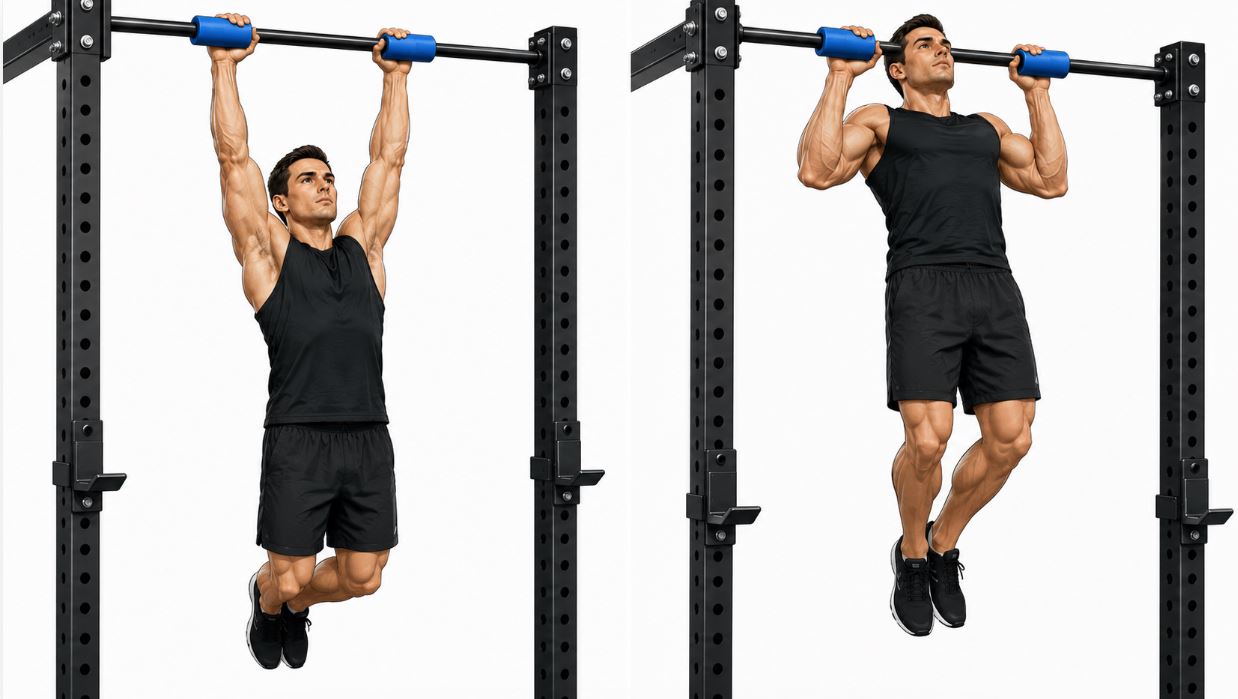
- Hang with arms fully extended, shoulders engaged, feet off the floor
Execution
- Pull yourself upward by driving your elbows down and back, exactly as you would on a standard pull-up
- Continue pulling until your chin clears the level of your hands
- Lower yourself back down under control
- Reset your hand position between reps if your grip has shifted on the larger diameter
Coaching cue I give every client: Wrap your fingers as far around the diameter as you actually can, rather than just resting your fingertips against it. A lot of people unconsciously open their hands slightly because the bar feels awkward, which only weakens the grip. Actively closing the hand as much as the diameter allows is what makes the rep possible.
Common Mistakes
1. Using a fat grip attachment that spins freely on the bar
Some cheaper sleeves rotate too easily around the underlying bar, which adds an unintended element of instability on top of the diameter challenge. That’s not necessarily a bad training stimulus, but it changes what you’re actually testing — a quality attachment that grips the bar securely keeps the challenge isolated to diameter, which is what this exercise is meant to train.
2. Letting the hand open up under fatigue
As the forearms fatigue, the instinct is to let the fingers drift open slightly to find a more comfortable position. That’s exactly the wrong response — an open hand on a fat grip has almost no holding power left. Keep actively closing the hand around the diameter throughout the entire rep, even as it gets harder.
Benefits of the Fat Grip Pull-Up
Maximum, measurable crush-grip overload
Of the grip-focused pull-up variations, this is the most direct way to overload a pure crush grip, and because the diameter remains constant from session to session, it’s easy to track progress — a 2.0-inch hold today, a 2.5-inch hold in a few months.
Transfers directly to thick-bar and axle work
Strongman implements, and odd-diameter equipment in general, don’t match a standard barbell’s dimensions. Training on a fat grip prepares the hand for that exact mechanical disadvantage before you ever touch an axle bar or thick-handled implement.
A consistent, controllable variable compared to the towel
Unlike the towel, which can shift unpredictably from rep to rep, a fat grip attachment presents the same fixed challenge every time. That consistency makes it easier to track strength gains over time and to compare sessions apples-to-apples.
Who Should Use This Exercise
- Lifters who want a measurable way to track crush-grip progress, since diameter is a fixed, repeatable variable in a way the towel isn’t
- Strongman and grip-sport competitors preparing for thick-bar or axle-based events
- Anyone who found the Towel Pull-Up effective but wants a more consistent, controllable version of the same general challenge
Who Should Be Cautious
- Anyone with existing wrist or elbow issues — the altered hand position on a larger diameter changes the load distribution through the wrist and forearm tendons, which can aggravate existing irritation
- Complete beginners who cannot yet perform a standard bodyweight pull-up — build the base pulling pattern first before adding a significant grip challenge on top of it
How to Make It Easier or Harder
Easier
- Start with the smaller diameter attachment available rather than jumping straight to the largest size — most fat grip sets offer more than one diameter, and the smaller option is the appropriate starting point
- Use a resistance band for assistance, the same way you would with a standard band-assisted pull-up, to reduce the bodyweight load while still training the grip
- Perform negative-only reps — step or jump to the top position and focus only on a slow, controlled lowering phase
Harder
- Progress to a larger diameter attachment once the current size becomes manageable for full sets
- Add a weighted vest once bodyweight reps on a given diameter are no longer challenging
- Slow the tempo, particularly the lowering phase, to extend time under tension for both the lats and the grip
Exercise Variations
Fat Grip Dead Hang
The same regression logic as the Towel Dead Hang: hang from the fat grip attachment with arms fully extended and hold the position without pulling up at all. This isolates the diameter-specific grip challenge, making it a useful entry point for anyone who isn’t yet ready for full-fat grip pull-up reps.
Fat Grip Chin-Up
The same exercise is performed with an underhand (supinated) grip instead of the standard overhand grip. The increased diameter still challenges the crush grip the same way, but the underhand position shifts more emphasis onto the biceps during the pull, making this a useful variation for anyone who wants to combine the grip challenge with more direct arm involvement.
Fat Grip Pull-Up vs. Towel Pull-Up
Both exercises combine pulling strength with a serious crush-grip challenge, but the source of the difficulty — and what that means for tracking progress — is different.
| Fat Grip Pull-Up | Towel Pull-Up | |
|---|---|---|
| Source of difficulty | Fixed, oversized diameter | Unstable, shifting fabric |
| Grip type | Crush grip, static diameter challenge | Crush grip with constant re-gripping |
| Equipment | Fat Gripz or similar attachment | Any towel and a pull-up bar |
| Best for | Trackable, maximum crush-grip overload | Grip adaptability on irregular objects |
The practical takeaway: I use these for slightly different goals rather than treating them as interchangeable. The fat grip is a better tool for measurable progress in raw crush strength, since its diameter never changes from session to session. The towel is the better tool when the goal is building a grip that can handle unpredictable, real-world objects. A complete grip program has room for both.
Replacement Exercises (Alternatives)
If the Fat Grip Pull-Up doesn’t fit your setup or goals, these target a similar grip demand:
- Towel Pull-Up (unstable-surface alternative)
- Captains of Crush Gripper (isolated crush-grip alternative)
- Dead Hang (regression for those not yet ready for grip-loaded pull-ups)
- Barbell Hold
- Plate Pinch Hold
How to Incorporate the Fat Grip Pull-Up Into Your Workouts
- As a back-day finisher or grip-focused pulling variation — I typically program this after standard pulling work, once the grip is warmed up but not yet fully fatigued
- Reps: 5–8 reps per set, prioritizing a secure, fully-closed grip over total rep count
- Sets: 3 sets
- Frequency: Once or twice weekly — this combines real pulling volume with a significant grip demand, and the forearms need adequate recovery between sessions
Looking to round out your grip training? Check out our guides to the Towel Pull-Up, Barbell Hold, and Plate Pinch Hold, or learn more about why grip strength matters across your entire training program.
Conclusion
The Fat Grip Pull-Up is the most direct, trackable way to overload a pure crush grip while still getting real pulling work done. The diameter doesn’t move, doesn’t twist, and doesn’t change from rep to rep — which makes it an excellent complement to the Towel Pull-Up rather than a replacement for it. Start with the smaller diameter, close your hand around it as fully as you can, and progress from there.
Diameter is only one variable in grip training — crush, pinch, and support all need their own attention too. For the full picture, see our guide to the 10 best grip strengthening exercises, and if your grip consistently feels like the weak link, this breaks down exactly why.
Frequently Asked Questions
What diameter Fat Gripz should I start with?
Start with the smaller diameter option available in whatever set you’re using. Most fat grip attachments come in more than one size, and jumping straight to the largest diameter before your hand and forearm have adapted to the smaller increase usually just leads to failed reps rather than productive training.
Is the Fat Grip Pull-Up better than the Towel Pull-Up?
Neither is strictly better — they train slightly different qualities. The fat grip offers a fixed, trackable diameter that’s ideal for measuring progress over time, while the towel trains the hand to adapt to an unstable, shifting surface that’s closer to gripping irregular real-world objects. Many lifters benefit from rotating both into their training.
Can I use Fat Gripz on other pulling exercises too?
Yes, and many lifters do. Fat Gripz attachments work on rows, lat pulldowns, deadlifts, and most other pulling movements, not just pull-ups, making them a versatile way to add a grip challenge across an entire training session rather than a single exercise.
Why does my hand cramp during Fat Grip Pull-Ups?
Mild forearm or hand cramping can occur when the muscles are working much harder than they’re accustomed to, which is common the first few times training on an increased diameter. If cramping is severe or persistent, reduce the diameter or volume and allow more recovery time between sessions rather than pushing through it repeatedly.
